

Asylum offers a path to a green card and lets you bring your spouse and children along; withholding of removal does neither. Asylum has a strict one-year filing deadline, while withholding has none, but it demands a much heavier burden of proof. The practical result: asylum builds permanence, withholding only holds off deportation to one specific country.
TL;DR:
- Asylum requires proving a “well-founded fear” of persecution, which roughly translates to a 10% chance, whereas withholding demands showing persecution is “more likely than not” with over 50% certainty.
- Filing asylum within one year of arriving in the U.S. is mandatory, but withholding of removal has no deadline, influencing strategy especially if the deadline is missed.
- Asylum offers a pathway to a green card and family reunification, while withholding does not allow for permanent residence or derivative benefits for relatives.
- Evidence for withholding is more demanding, requiring corroboration like police reports or country reports, beyond personal testimony alone.
- Submitting Form I-589 simultaneously for asylum, withholding, and CAT protections preserves broad relief options and saves additional filings if one claim is denied.
Table of Contents
- Asylum Vs Withholding: The Core Legal Differences
- What Do You Need to Prove for Each Claim?
- How Do You File for Asylum or Withholding?
- What Happens After a Grant or Denial?
- Which Protection Fits Your Situation?
- A Paralegal’s Take on Where Cases Go Wrong
- Get Help Filing Your Asylum or Withholding Claim
- Where to Verify These Rules Yourself
- Sources
- FAQ
Asylum Vs Withholding: The Core Legal Differences
The distinction between asylum and withholding of removal comes down to three things: how hard the case is to prove, who decides it, and what you get if you win. Get these three straight and almost everything else about the asylum application process makes sense.
Asylum uses a “well-founded fear” standard, roughly a 10% chance of future persecution. Withholding of removal demands “more likely than not,” a greater than 50% likelihood, according to guidance from the Executive Office for Immigration Review. That gap isn’t academic. It’s the difference between showing a credible risk and proving, with real evidence, that persecution is probable if you’re sent back.
Who hears your case depends on how you file. USCIS asylum officers decide affirmative asylum applications filed proactively at a local office. Immigration judges within EOIR decide withholding of removal claims, almost always because someone raised the claim defensively while already in removal proceedings.
The benefits gap is where most people feel the real weight of this comparison.
- Green card path: Asylum leads to lawful permanent residence and, eventually, citizenship. Withholding offers no route to a green card at all.
- Family members: Asylum lets you petition for a spouse and unmarried children under 21 as derivatives. Withholding carries no derivative benefit, so your family’s status stands or falls on its own separate case.
- Travel: Asylees can eventually apply for a refugee travel document. Someone with withholding status generally cannot travel abroad without serious risk of being unable to return.
- Filing deadline: Asylum must generally be filed within one year of arrival in the United States, with narrow exceptions. Withholding of removal has no filing deadline whatsoever.
That last point often decides the whole strategy. Miss the one-year window without a strong excuse, and withholding of removal (or CAT) may be the only door left open.
What Do You Need to Prove for Each Claim?
Both asylum and withholding of removal require you to show persecution tied to one of five protected grounds: race, religion, nationality, political opinion, or membership in a particular social group. Immigration law calls this the “nexus” requirement. Your fear can’t just be general danger, gang violence or crime that touches everyone equally rarely qualifies. It has to connect specifically to who you are or what you believe.

Evidence expectations are demanding either way, but withholding pushes you further. Your own testimony can carry a case if it’s detailed, consistent, and credible, but adjudicators want corroboration: medical records documenting injuries, police reports, news coverage, or country-condition reports from organizations tracking human rights abuses in your home country.
Asylum eligibility criteria include several bars that don’t apply the same way to withholding or CAT. A conviction for a “particularly serious crime” bars asylum outright. Firm resettlement in another country before reaching the U.S. bars asylum. Persecuting others yourself, even under duress, bars asylum.
Here’s the wrinkle almost nobody explains clearly: withholding of removal and CAT protection survive some of these bars. A serious criminal bar that kills an asylum claim doesn’t automatically kill a withholding or CAT claim, though a “particularly serious crime” conviction can still block withholding too, depending on severity.
The Convention Against Torture claim skips the nexus requirement entirely. You don’t need to tie the torture to race, religion, or politics. You just need to show it’s more likely than not you’ll be tortured, by the government or with its acquiescence, if returned. That makes CAT a critical fallback when someone’s fear doesn’t fit neatly into one of the five protected categories.
How Do You File for Asylum or Withholding?
Every asylum and withholding claim starts with the same document: Form I-589, Application for Asylum and for Withholding of Removal. Where and how you file it depends on your situation.
- File affirmatively with USCIS if you’re not currently in removal proceedings. An asylum officer interviews you and decides the case administratively.
- File defensively with EOIR if you’re already in removal proceedings. An immigration judge decides asylum, withholding, and CAT claims together in immigration court.
- Meet the one-year deadline for asylum, counted from your last arrival in the United States. Changed circumstances (a coup, a new law targeting your group) or extraordinary circumstances (serious illness, ineffective prior counsel) can excuse a late filing, but you must file within a reasonable time after the excuse arises.
- Track your Employment Authorization Document clock. You generally become eligible for an EAD once your asylum application has been pending 180 days, subject to the 150/30 rule governing when Form I-765 can be submitted. Withholding-only applicants in removal proceedings face separate, often slower, timelines for work authorization.
- Gather documents before you file: identity papers, any evidence of past harm, country-condition reports, witness statements, and a detailed personal declaration.
Pro Tip: File Form I-589 even if you’re not sure asylum will succeed. The same form preserves your withholding and CAT claims, so a judge can grant the broadest relief you actually qualify for without you having to file twice.
What Happens After a Grant or Denial?
Winning asylum and winning withholding of removal look very different a year later. Asylum grants convert into green card eligibility after one year, and eventually citizenship. Withholding of removal leaves the underlying removal order intact; it’s simply “withheld” from being carried out against the specific country where you fear harm.
That distinction has real teeth:
- An asylee can eventually sponsor a spouse and children. Someone with withholding status cannot.
- An asylee can request international travel documents. Someone with withholding status risks being found inadmissible or unable to reenter if they leave.
- If the government identifies a third country willing to accept you, it can remove you there even with an active withholding grant, since the order only bars removal to the country you originally feared.
- Withholding grants can be reopened and revoked if country conditions change enough to undercut the original finding.
If your case is denied at the asylum office, it doesn’t just disappear. Affirmative denials for people without lawful status get referred to immigration court, where you can renew your asylum, withholding, and CAT claims in front of a judge. A denial in immigration court can be appealed to the Board of Immigration Appeals, and from there to a federal circuit court, though deadlines are strict and typically run 30 days from the judge’s decision. Grants of any kind, asylum, withholding, or CAT, remain a small fraction of total filings nationwide, underscoring how fact-intensive these cases really are.
Which Protection Fits Your Situation?
The right choice usually announces itself once you lay out your timeline and your evidence honestly.
- Choose asylum as your primary claim if you’re within the one-year window, have solid documentation, and want a genuine path to a green card and family reunification.
- Lean on withholding of removal if you missed the one-year deadline without a strong excuse, or if a criminal or discretionary bar closes off asylum but doesn’t reach withholding.
- Add a CAT claim whenever your fear involves torture by or with the acquiescence of a government, especially if it doesn’t cleanly tie to race, religion, nationality, political opinion, or social group.
- File everything on one Form I-589 whenever it’s realistic. Immigration judges and asylum officers are required to grant the broadest relief you qualify for, so pairing an asylum claim with backup withholding and CAT claims costs you nothing and protects you if the primary claim falls short.
None of these categories are mutually exclusive on paper. The real constraint is evidence, and how well you can document your specific fear before a deadline or a hearing date arrives.
A Paralegal’s Take on Where Cases Go Wrong
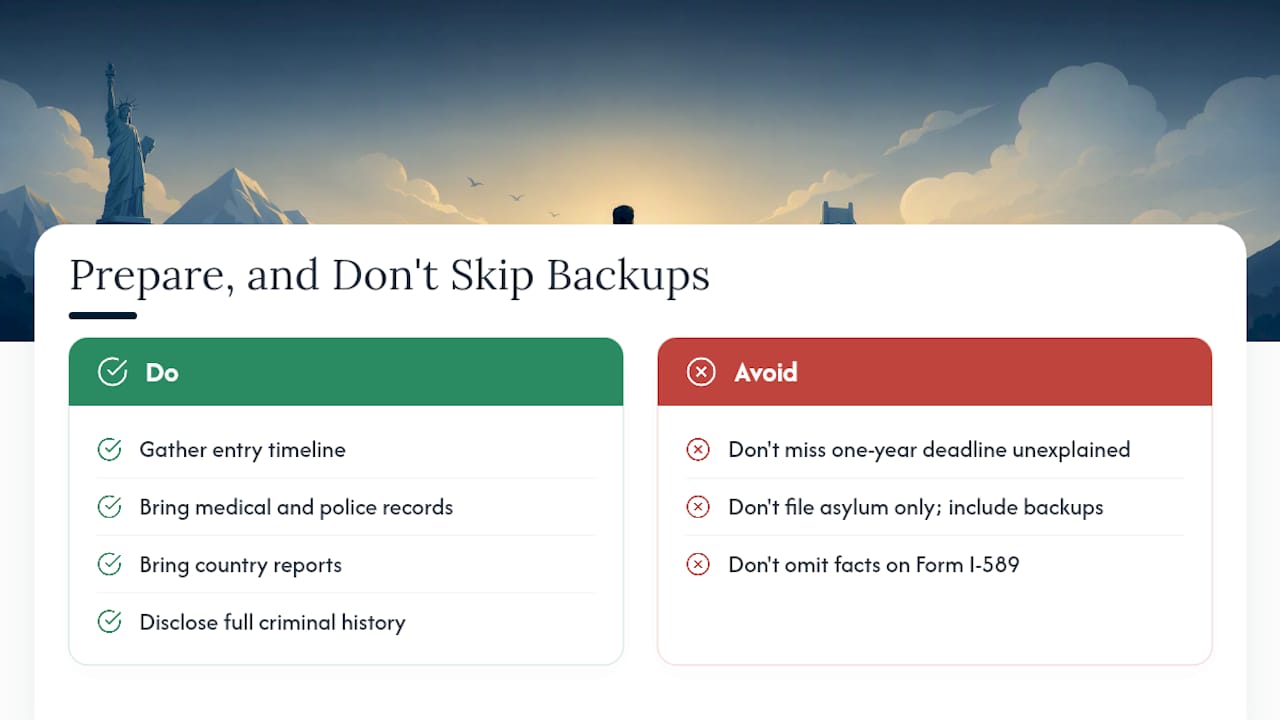
The cases that fall apart rarely fail on the law. They fail on preparation. Applicants miss the one-year deadline and never document why, so a real exception goes unclaimed. Others file only for asylum and skip withholding or CAT as a backup, leaving nothing if the primary claim is denied.
Before meeting with an attorney, gather your timeline of entry, any medical or police records, country reports touching your situation, and a full, honest account of your criminal history, including anything that seems minor. Omissions on Form I-589 create credibility problems that are far harder to fix than the underlying facts themselves.
— Paralegal
Get Help Filing Your Asylum or Withholding Claim
Deciding between asylum, withholding, and CAT isn’t something to sort out alone with a blank I-589 form. Legal professionals with extensive experience build immigration strategies considering each client’s timeline, criminal history, and evidence, crucial factors distinguishing a strong asylum case from one requiring a withholding or CAT backup.

Our team helps clients prepare Form I-589 filings, represents applicants in immigration court, and assists with FOIA requests to pull immigration records that can corroborate a claim. Consultations typically include reviewing entry dates, prior immigration history, and existing evidence such as medical records, police reports, and country documentation to determine applicable forms of relief. Visit our immigration practice page to schedule a consultation, or reach our Salt Lake City immigration team directly if you’re filing in Utah.
Where to Verify These Rules Yourself
- USCIS Asylum overview and Form I-589 instructions
- EOIR substantive law lecture on asylum, withholding, and CAT
- DOJ/EOIR overview of asylum, withholding, and CAT protections
This article is general information, not a substitute for advice from a qualified lawyer. Consult a qualified legal professional about your own circumstances before acting on anything here.
Sources
- Affirmative asylum process — USCIS
- Green card for asylees — USCIS
- Substantive law lecture on Asylum, Withholding, and CAT — EOIR
- I-589, Application for Asylum and for Withholding of Removal — USCIS
FAQ
Is Withholding of Removal the Same as Asylum?
No. Both protect against removal to a country where you’d face persecution, but withholding requires proving persecution is “more likely than not,” a tougher standard than asylum’s well-founded fear test. Withholding also skips the path to a green card that asylum provides.
Can Someone With Withholding of Removal Still Be Deported?
Yes, under specific conditions. Withholding blocks removal only to the country where the person fears harm; if another country agrees to accept them, removal there remains possible. Withholding grants can also be reopened and revoked if country conditions change significantly.
What Are the Disadvantages of Withholding of Removal?
Withholding leaves the original removal order in place instead of erasing it, offers no path to a green card, and provides no derivative benefits for a spouse or children. Recipients also generally can’t travel internationally, since leaving risks being unable to return.
What Are the Two Types of Asylum?
Asylum is generally pursued through two filing routes: affirmative, filed proactively with USCIS using Form I-589, and defensive, raised as a claim in immigration court during removal proceedings. Both use the same form and legal standard, but different adjudicators decide the outcome.
How Do I Know if I Should File for Asylum, Withholding, or Both?
File for asylum if you’re within the one-year deadline and have solid evidence tying your fear to a protected ground. Add withholding and CAT claims on the same Form I-589 as a backup, since adjudicators grant the broadest relief you qualify for, and an attorney at Loayzalaw can help map out which combination fits your history.