

Utah does not automatically recognize common law marriage. Couples who live together, no matter how long, are not legally married unless a court says so under Utah Code §81-2-408. You must petition for judicial recognition, and the filing window is strict: during the relationship or within one year after separation or death. Utah’s legislative update SB110 changes that deadline, making timing especially important now.
TL;DR:
- Couples must petition within one year after separation or death to have a court recognize a common law marriage in Utah.
- Proof of marriage requires demonstrating cohabitation, intent to marry, and consistent reputation, supported by documents and witness testimony.
- Evidence such as joint accounts, property names, tax filings, and affidavits are crucial, especially since no single document proves the marriage.
- Recognition retroactively establishes rights over property, inheritance, and support, but delayed filings risk losing the ability to claim recognition after the new law takes effect in 2026.
- With the upcoming legal changes, it is urgent to preserve evidence and consult a lawyer before the filing window closes.
Table of Contents
- Does Utah Recognize Common Law Marriage?
- How to File a Petition to Recognize a Relationship as a Marriage
- What Counts as Evidence for Common Law Marriage in Utah
- What Happens After a Utah Court Recognizes Your Marriage
- Paternity and Custody When Parents Aren’t Married
- Utah’s 2026 Common Law Marriage Law Change: What SB110 Means
- When to Talk to an Attorney About Common Law Marriage in Utah
- Get Help With Your Utah Marriage Recognition Petition
- Sources
Does Utah Recognize Common Law Marriage?
Utah does not recognize common law marriage the way older statutes in a handful of other states do. There is no automatic status that kicks in after a certain number of years together. Instead, Utah allows a court to judicially recognize an “unsolemnized marriage” if you can prove specific statutory elements. Utah Courts guidance describes this decree as legally equivalent to getting married through a license and ceremony, and it’s typically pursued when a couple needs to backdate the marriage date for property, inheritance, or benefits purposes.
Under §81-2-408, a petitioner must show the couple:
- Was capable of consenting to marriage and of solemnizing it
- Cohabited
- Assumed marital rights, duties, and obligations toward each other
- Held themselves out as, and had a reputation of being, husband and wife
- Both parties consented to the arrangement, whether that consent is shown directly or through circumstantial proof
Courts weigh consent heavily. Joint bank accounts, shared last names, tax filings listing “married,” and consistent testimony from people who knew the couple all serve as circumstantial evidence of that fifth element. A 2025 Utah Court of Appeals case reinforced that an explicit disavowal of intent to marry can defeat a petition even when other evidence looks strong. The official petition form walks through exactly what proof the court expects for each element.
How to File a Petition to Recognize a Relationship as a Marriage
Filing for judicial recognition follows a defined path through Utah’s district courts. Here’s how the process generally unfolds:
- Confirm you’re within the filing window. You can petition while the relationship is ongoing, or within one year after separation or a partner’s death. Miss that year, and the court loses jurisdiction to hear the case, no matter how strong your evidence is.
- Complete the petition form. Use form 1600FA, the Petition to Recognize a Relationship as a Marriage, filed in the district court for the county where either party resides.
- Gather supporting documents. Attach a death certificate if applicable, plus any affidavits or exhibits supporting the statutory elements.
- Pay the filing fee and serve the other party. If the relationship ended through separation rather than death, the other party must be formally served and given time to respond, typically similar to standard civil timelines.
- Attend a hearing or submit by stipulation. Uncontested petitions with clear documentation can resolve in a matter of weeks. Contested cases, especially those involving an estate or a disputing family member, often take several months.
- File for divorce if you’re separating. If the court recognizes the marriage and you intend to end the relationship, you’ll typically need a separate divorce filing to formally dissolve it.
Pro Tip: Build a single chronological exhibit before you file, pairing a timeline of your relationship with the documents that back each entry. Judges move faster through organized petitions, and a clean timeline makes the “holding out” element much easier to prove.
What Counts as Evidence for Common Law Marriage in Utah
Judges lean on a mix of paper trails and personal testimony. No single document proves a marriage on its own, but a pattern across several categories carries real weight.
Documentary evidence typically includes:
- Joint bank or credit accounts opened while cohabiting
- Property deeds or leases listing both names
- Joint tax returns or beneficiary designations naming each other
- Insurance policies or medical forms listing the partner as spouse
Witness affidavits fill the gaps documents can’t. Family members, neighbors, coworkers, and employers who can attest to the couple introducing themselves as married, or being generally known that way in the community, help establish the reputation element courts require. Circumstantial proof, patterns of behavior over time rather than one decisive piece of paper, is often how consent gets proven when a couple never explicitly discussed marital status.
What Happens After a Utah Court Recognizes Your Marriage
A successful petition backdates your marriage to whenever the statutory elements were first met, not the date the judge signs the order. That retroactive date matters for a few practical reasons:
- Property acquired during the recognized period typically gets treated as marital property, subject to the same division rules as a formally licensed marriage
- Spousal inheritance and survivor benefits become available, which is why the one-year post-death filing window matters so much for surviving partners
- Ongoing rights and duties, like spousal support obligations, attach retroactively once recognition is granted
If you’re recognized as married and want to separate, you’ll need to file for divorce like any other married couple, addressing property division, support, and custody through that process. If safety is a concern, a protective order remains available independent of the marital status question.
Paternity and Custody When Parents Aren’t Married
Judicial recognition of a marriage and establishing paternity are two entirely separate legal tracks. Unmarried parents in Utah use one of three routes to establish paternity: a Voluntary Declaration of Paternity (VDP) signed at the hospital or through vital records, an administrative order through the Office of Recovery Services, or a court judgment.
A signed VDP carries a 60-day rescission window, after which it becomes binding for support purposes. Here’s the limit fathers and mothers both need to understand:
- A VDP or ORS order establishes legal paternity and can set child support
- Neither one creates enforceable custody or parent-time orders on its own
- Only a court paternity order can resolve custody and parent-time between unmarried parents
If you’re an unmarried father in Utah seeking parenting time, the ORS process alone won’t get you there. You need a paternity case filed in district court.
Utah’s 2026 Common Law Marriage Law Change: What SB110 Means
Utah’s SB110, effective in 2026, narrows the availability of judicial recognition for unsolemnized marriages going forward and sets a firmer cutoff for pending claims, according to legal industry reporting tracking the bill’s practical impact. The core takeaway for readers: relationships that already meet the statutory elements need to get into court promptly, because the window to petition doesn’t stay open indefinitely, and delay carries real risk under the new framework.
- If you’ve been treating your relationship as a marriage in practice, don’t wait for a triggering event like separation or death to start building your case
- Preserve documents now, joint accounts, leases, tax filings, before memories fade or records get harder to obtain
- Talk to a family law attorney about whether your situation falls inside the current filing window under the revised statute
Pro Tip: If there’s no need to backdate your relationship and you simply want the legal protections of marriage, Utah Courts guidance itself notes it’s often faster and cheaper to get a marriage license than to litigate a recognition petition.
When to Talk to an Attorney About Common Law Marriage in Utah
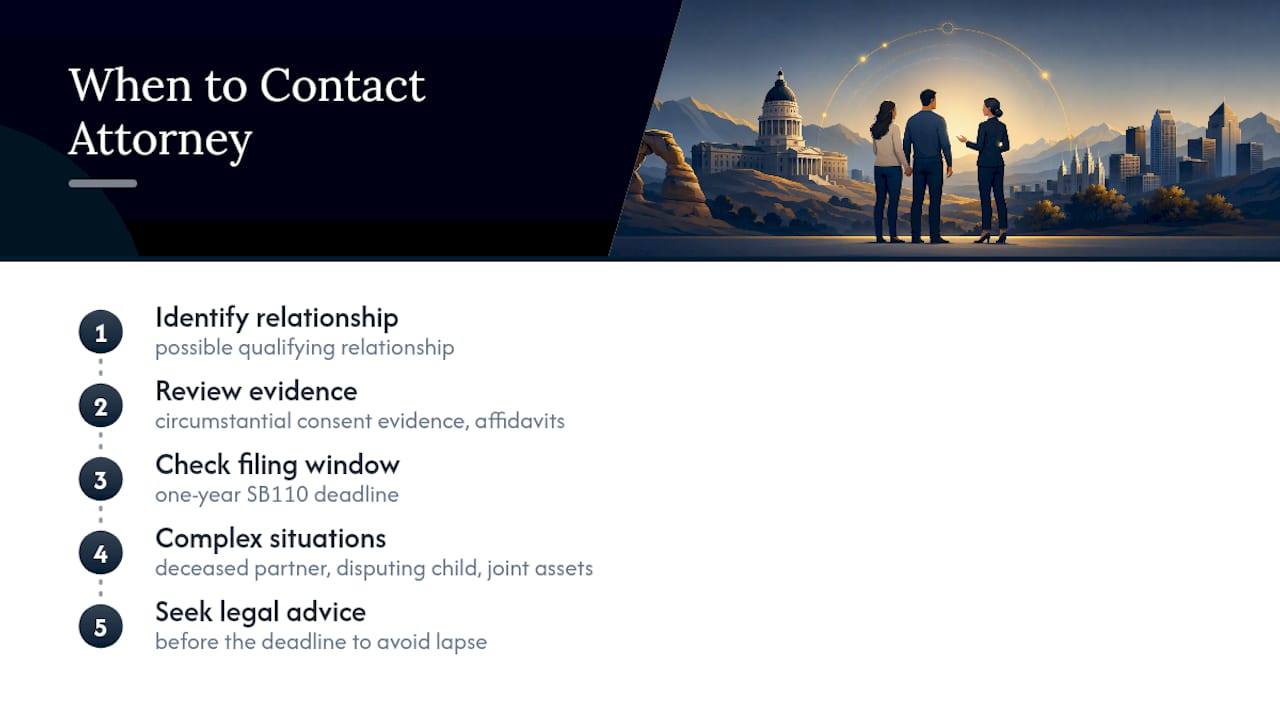
Some petitions are simple. Others involve a deceased partner’s estate, a disputing adult child, joint assets spread across multiple accounts, or a filing deadline that’s closing fast. In those situations, hiring counsel changes outcomes. An attorney knows how to frame circumstantial consent evidence the way judges expect to see it, gather the right affidavits, and calendar the one-year window so a valid claim never lapses on a technicality.
Loayzalaw has built its family law practice around exactly this kind of complex, time-sensitive advocacy for Utah families, drawing on the trust of more than 1,300 clients and over 1,200 resolved cases.
— Paralegal
Get Help With Your Utah Marriage Recognition Petition
If you’ve been living as a married couple without a license, and now face a death, a separation, or a fast-approaching deadline under SB110, waiting costs you options you may not get back. Loayzalaw’s family law team in Salt Lake City handles judicial recognition petitions, contested filings, and the divorce or custody proceedings that often follow, giving you a single point of contact instead of piecing together court forms on your own.

Whether you need help proving the statutory elements, organizing your evidence timeline, or sorting out paternity and custody as an unmarried parent, our family law attorneys can walk you through what the court will actually expect from your petition. Call Loayzalaw today to schedule a consultation and find out whether your filing window under Utah Code §81-2-408 is still open.
This article is general information, not a substitute for advice from a qualified lawyer. Consult a qualified legal professional about your own circumstances before acting on anything here.
Sources
- Utah Code §81-2-408 — Petition to Recognize a Relationship as a Marriage
- Judicial Recognition of a Relationship as a Marriage
- Petition to Recognize a Relationship as a Marriage (form 1600FA)
- Establishing paternity — Office of Recovery Services (ORS)