
A Utah drug court is a court-supervised treatment program that can take the place of jail or prison for people whose crimes are driven by substance use. Getting in is not automatic. A prosecutor, a clinical assessment and a judge all have a say, and in many counties you must enter a plea first. Because that plea can follow you, the decision about whether to apply should be made with a criminal defense attorney, before anything is signed. Our criminal defense practice represents people in Utah facing misdemeanor and felony charges, and this guide explains the program so you can walk into that conversation prepared.
TL;DR
- Utah drug courts are non-adversarial, treatment-focused courts for people at high risk of reoffending with high needs tied to substance use, according to the Utah State Courts Drug Court Summary.
- Eligibility is set by state law and by each county. It generally requires a nonviolent drug or drug-related offense, a risk-and-needs assessment, and agreement to testing, treatment and sanctions.
- Programs last at least twelve months, with frequent testing, weekly treatment contact in the first phase and regular hearings before your judge.
- A 2026 amendment to Utah Code 78A-5-201 says acceptance must be risk-and-needs based and cannot be limited only to specified offenses.
- Because entry usually involves a plea, talk to a defense attorney before you apply, especially if you are not a U.S. citizen.
Table of Contents
- What a Utah drug court is
- Who qualifies
- How you get in
- What the program asks of you
- Drug court, probation or jail
- What the numbers show
- A related option: STEP supervision
- Our perspective
- Talk to us before you apply
- FAQ
- Sources
What a Utah drug court is
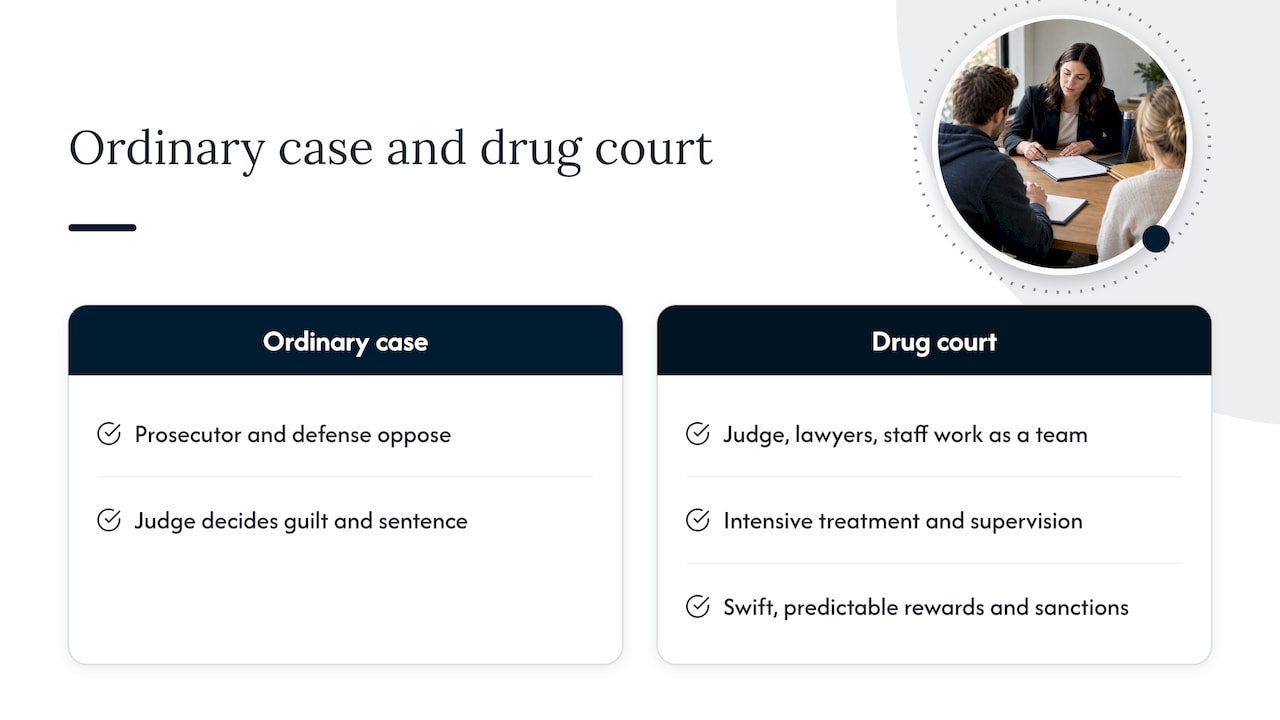
In an ordinary criminal case, the prosecutor and defense lawyer oppose each other and the judge decides guilt and sentence. Drug court changes that structure. The Utah State Courts describe it as non-adversarial and cooperative: judge, prosecutor, defense counsel and treatment staff work as a team, and the participant receives intensive treatment and supervision with swift, predictable rewards and sanctions.
The idea grew out of a pattern judges kept seeing. The Utah courts’ problem-solving courts page explains that the same offenders kept coming back, and that strict probation or imprisonment alone did not fix the underlying addiction. Utah’s first drug court opened in Salt Lake’s Third District Court in 1996, and every program follows the ten key components developed by the U.S. Department of Justice, including early identification of eligible people, frequent drug testing and ongoing judicial interaction.
Drug courts now operate in all eight of Utah’s judicial districts, according to the Utah Foundation. Each county runs its own program within the state’s certification rules, which is why requirements in Salt Lake County differ from those in Davis, Summit or Carbon County.
Who qualifies
There are two layers: legal eligibility and clinical eligibility.
The legal screen
Utah Code 78A-5-201 lists the screening criteria a court may use: a plea to, conviction of, or adjudication for a nonviolent drug or drug-related offense; agreement to frequent alcohol and drug testing; participation in one or more substance abuse treatment programs; and agreement to accept sanctions for noncompliance.
The statute was amended by Chapter 362 of the 2026 General Session. Under the current text, adult criminal drug court acceptance must be risk-and-needs based and aimed at high-risk, high-need individuals. A program cannot limit participation only to specified offenses, and it does not require a felony plea, conviction or adjudication. That matters because most drug possession cases in Utah are now misdemeanors. The Utah Commission on Criminal and Juvenile Justice’s 2024 update notes the shift to Class A and Class B misdemeanors since de-felonization and recommends that drug courts keep widening criteria to include high-risk, high-need people charged with other drug-related crimes, such as property offenses. If you are unsure how your charge is classified, our guides to Utah misdemeanor classes and Utah felony degrees lay out the penalty ranges.
The clinical screen
The Utah Judicial Council’s Adult Drug Court Certification Checklist, adopted December 16, 2019, requires programs to admit only high-risk, high-need participants. Candidates are assessed with a validated risk tool (Utah programs commonly use one called the RANT) and a validated clinical tool that evaluates symptoms of substance dependence or addiction.
The same checklist says people are not automatically excluded for non-drug charges, drug dealing charges or a history of violence, and they cannot be disqualified because of a co-occurring mental health or medical condition when adequate treatment is available. The Utah Foundation reports that 26% of property-crime arrestees in Utah screened as high-need for treatment, compared with 20% of drug-offense arrestees, which is part of why the rules look beyond possession charges.
County rules differ
The county layer is where many people are surprised. Examples from official county documents:
| County | What the published policy says |
|---|---|
| Davis (manual updated 2021) | District court defendants in county residence; high-risk/high-need on the RANT; the prosecutor approves every referral; four successive negative drug tests before admission; the drug court judge makes the final decision |
| Summit (2016 document) | Summit County residence, a clinical diagnosis of drug dependence, high risk/high need, a felony charge, and agreement to follow the treatment provider’s recommendations; exclusions include sex offenses and restitution above $5,000 |
| Salt Lake | Four high-risk Recovery Courts and one medium-risk court; risk and clinical assessments are completed, and the District Attorney’s Office determines eligibility |
County policies are updated over time, so treat these as examples of how rules vary and confirm the current version for your county. The state’s own summary names the biggest limit on participation as a shortage of intensive treatment resources, especially in rural counties.
How you get in
The steps vary by county, but the path usually looks like this:
- Referral. In Davis County, a prosecutor, defense attorney, judge, probation officer or treatment professional can refer a case. Carbon County’s participant handbook describes an application stage.
- Assessment. A validated risk assessment and a clinical assessment decide whether you are high-risk and high-need. In Salt Lake County this is done with Assessment & Referral Services.
- Legal approval. Defense counsel and the prosecutor certify eligibility. The drug court team recommends, and the judge decides.
- Plea or probation status. Depending on the county, you plead guilty, or you may already have a conviction or be on probation. The Drug Court Summary notes that some counties offer charge reduction, a plea in abeyance or dismissal on successful completion.
Each step is a point where the paperwork shapes the outcome. The plea language, what the prosecutor agrees to, and what happens to the charge on completion are all negotiated terms. This is the stage where a defense attorney earns their place: reading the agreement, confirming what you are giving up, and protecting the best result available. If you are not a U.S. citizen, raise your immigration status before any plea, because a drug-related plea can carry consequences separate from the criminal case. Our criminal defense page is the place to start.
What the program asks of you
The certification checklist sets the floor for every certified Utah program:
- Length: a minimum of twelve months, and at least 90 consecutive drug-free days to graduate.
- Treatment: weekly contact with a treatment provider or clinical case manager in the first phase, evidence-based behavioral or cognitive-behavioral treatment, and structured peer support groups with a secular alternative.
- Testing: a regimen that gives you at least a two-in-seven chance of being tested every day.
- Phases: promotion depends on defined behavioral goals, and the final phase focuses on relapse prevention and continuing care.
- Hearings: regular check-ins with the same judge, who rewards progress and responds to setbacks.
County handbooks add detail. Carbon County sets five phases at 30 weeks each, with the possibility of finishing in as little as 15 weeks through incentives. In Salt Lake County, accepted clients are assigned a case manager and a clinical case manager, attend hearings with their judge, and complete treatment, substance testing and court-ordered classes, with the team working toward dismissal or reduction of charges.
A 2025 Judicial Council meeting packet shows the 2019 checklist still being used to review a Third District drug court in August 2025, so these standards are what programs are measured against today.
Drug court, probation or jail
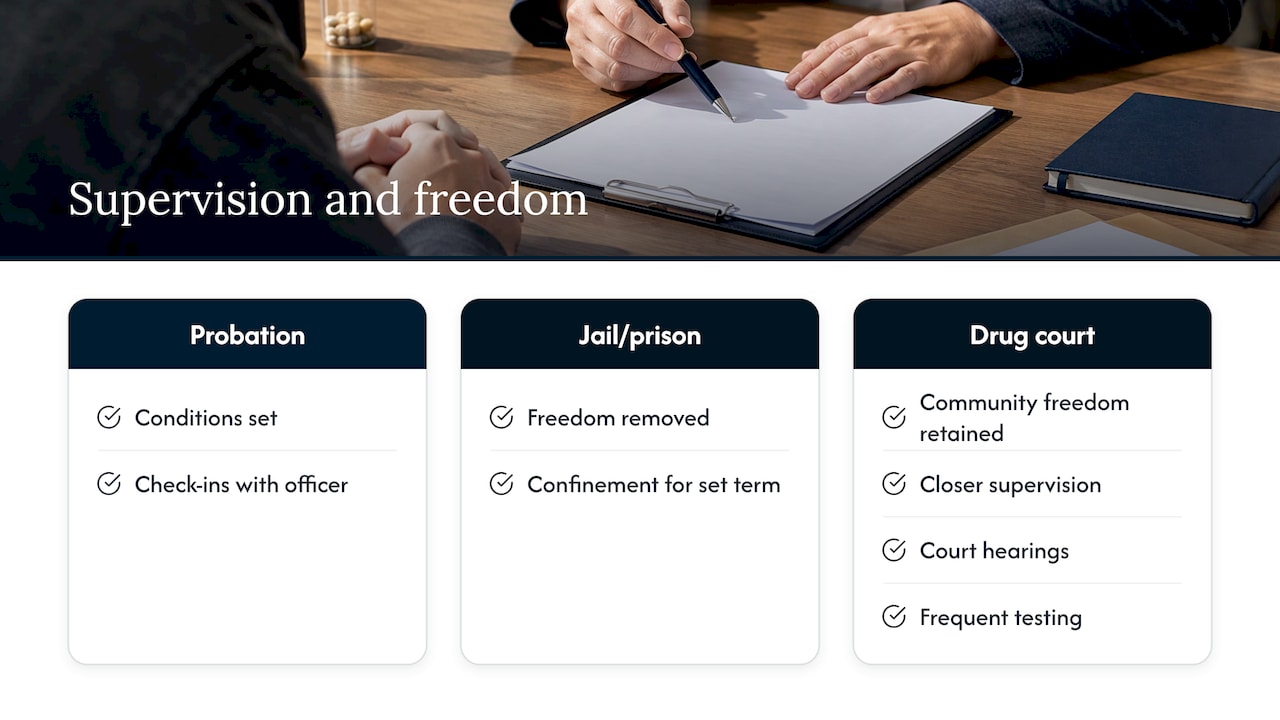
These options are different in what they demand. Standard probation sets conditions and checks in with a supervising officer. Jail or prison removes your freedom for a set term. Drug court sits between them: you stay in the community but under much closer supervision, with court hearings, frequent testing and treatment built into your week. The courts’ own rationale is that this combination addresses addiction rather than only the offense.
The checklist also contains protections that matter for planning. Participants are not terminated for continued substance use if they are otherwise compliant, unless they are not amenable to reasonably available treatment, and people ended from the program because adequate treatment was not available do not receive an augmented sentence. Utah Foundation notes judges’ discretion often shapes how a program runs, which is another reason to have an attorney who knows your court.
If your case is a first offense, another route may fit better. Our guide to diversion versus probation before arraignment explains what first-time defendants can ask for. For the charge itself, see our overview of Utah drug possession penalties and the seven-year lookback.
What the numbers show
The state courts report that national studies found drug courts can reduce recidivism by up to 35 percent and save an average of $6,700 per participant, and that a 2013 study found significant recidivism reductions among Utah participants, particularly for crimes against persons. Utah Foundation reports that a 2016 evaluation of six counties found 58% of 705 participants graduated.
Participation has been shifting. The November 2025 CCJJ update reports 1,312 state-funded drug court clients in FY2025, 41% fewer than the 2,220 in FY2019, with additional county and federal funding supporting other participants. The 2024 update links the decline largely to the lasting effects of the pandemic and a big drop in drug offenses, and encourages courts to look at higher-level property offenders whose crimes are tied to drug use.
A related option: STEP supervision
Utah’s 2026 H.B. 205 lets justice courts in first- or second-class counties set up a Structured Treatment and Enforcement Pathway (STEP) Supervision Program with Judicial Council approval. It calls for graduated sanctions, positive reinforcement, randomized drug and alcohol testing, regular reporting to a supervision officer and court-approved treatment when an assessment indicates it. People with pending violent or sexual offense charges are ineligible. If your case is in a justice court, ask whether your county has set one up.
Our perspective
Most people who call us about drug court are not asking about a program. They are asking whether they can keep their job, their home and their family together while a charge is pending. Drug court can be a real path to that, and we want clients to enter it with their eyes open and their paperwork right.
What we see in the criminal defense work we do is that the best outcomes start before the application. The charge level, the plea terms, the prosecutor’s position and the way the case is framed all affect whether a program is offered and what completion means. Our attorneys represent clients on misdemeanor and felony charges, and we bring that experience to these conversations, with the same responsiveness and respect we try to give every client.
For families and for clients with immigration questions, the stakes extend beyond the courtroom. We take the time to explain what each choice means before a client signs anything.
Paralegal
Talk to us before you apply
If you or someone in your family faces a drug-related charge in Utah, our firm handles criminal defense for misdemeanor and felony cases. We can review your charge, explain how your county’s program works and be with you through the plea and hearings. Start on our Salt Lake City criminal defense page or see all of our practice areas.

FAQ
Do I have to plead guilty to enter Utah drug court?
It depends on the county and your case. The state courts say participants must plead guilty to or have a conviction for a drug-related offense, and some counties offer charge reduction, a plea in abeyance or dismissal on completion. Review the exact terms with your attorney before agreeing.
How long does Utah drug court last?
The state checklist sets a minimum of twelve months and at least 90 consecutive drug-free days to graduate. County programs set their own phase structures, and some allow faster completion through incentives.
Can I be kicked out for a relapse?
The checklist says participants are not terminated for continued use if they are otherwise compliant, unless they are not amenable to reasonably available treatment. Staying engaged with treatment, testing and hearings is what the program measures.
Can I get in with a non-drug charge or a prior violent offense?
Possibly. The state checklist says people are not automatically excluded for non-drug charges, drug dealing or a violence history, though counties set their own limits, and sex offenses are commonly excluded. The 2026 amendment also bars limiting participation only to specified offenses.
Sources
- Utah State Courts Drug Court Summary
- Utah Courts: Problem-Solving Courts
- Utah Code, Title 78A, Chapter 5, Part 2: Drug Court
- Utah Adult Drug Court Certification Checklist
- CCJJ JRI 2024 Annual Update
- CCJJ JRI 2025 Annual Update
- Utah Foundation: Rethinking Rehabilitation
- Davis County Drug Court Policy and Procedure Manual
- Summit County Drug Court
- Salt Lake County Specialty Courts
- Carbon County Adult Drug Court Participant Handbook
- Utah Judicial Council meeting packet, September 2025
- Utah H.B. 205 (2026), enrolled copy