

If USCIS denied your Form I-485, the clock is already running. You generally have 30 days to file a motion if the decision was handed to you, or 33 days if it came by mail. Your work permit and travel document may end sooner than that, and USCIS may later send a Notice to Appear in immigration court. This guide explains how to read the denial, which options are real, and what to do in the first days.
A denial feels final, but it is not always the end of your case. The right next step depends on why USCIS said no, and picking the wrong one can cost you your only filing window.
TL;DR
- A denied I-485 cannot be appealed the way many other USCIS decisions can. Your main remedies are a motion to reopen or a motion to reconsider on Form I-290B, a new I-485, or defending your case before an immigration judge.
- Motion deadline: 30 days from the decision if it was served in person, 33 days if it was mailed. Late filings are normally dismissed.
- Your EAD and advance parole can be cut off quickly after the denial notice. Do not travel on advance parole without speaking to an immigration attorney.
- Read the exact reason for denial first. A missing document, an ineligibility finding and a discretionary denial each call for a different strategy.
- Request your file and talk to an attorney within days, not weeks.
Table of Contents
- What an I-485 denial actually means
- Why USCIS denies adjustment of status
- The first 72 hours after a denial
- Can you appeal a denied I-485?
- Motion to reconsider versus motion to reopen
- How long can you stay after an I-485 denial?
- Work permit, travel and advance parole after a denial
- Can you file a new I-485 after a denial?
- Our perspective
- How we can help
- What to bring to a consultation
- FAQ
- Sources
What an I-485 denial actually means
Form I-485 is the application to adjust status, the step that turns a qualifying immigrant petition into a green card without leaving the country. USCIS must deny an adjustment application when the applicant is ineligible, and may also deny it as a matter of discretion. That distinction matters. An ineligibility denial says you did not meet a legal requirement. A discretionary denial says you were eligible on paper, but the officer weighed the negatives more heavily than the positives.
A denial is also different from a rejection. A rejection happens at intake, for things like a missing signature, wrong fee or outdated form edition, and USCIS returns the package without a decision. A denial comes after review and is a formal decision with consequences for your status.
The denial can arrive after an interview or without one. Being interviewed and then denied does not mean the interview went badly. Sometimes the officer issues a request for evidence first, and the denial follows when the response is incomplete or arrives late.
Why USCIS denies adjustment of status
No single list covers every case, but the same causes appear again and again.
Eligibility problems
- No immediately available visa. For most preference categories, a visa number must be available when you file and when USCIS decides.
- Bars under INA 245©. Unauthorized employment, failure to maintain status or unlawful presence can bar adjustment for people who are not immediate relatives of U.S. citizens.
- Inadmissibility. Certain criminal history, prior immigration violations, health-related grounds or public charge concerns can make you inadmissible unless a waiver applies.
- Not a bona fide relationship. In marriage-based cases, the officer may conclude the marriage is not genuine, or that the petition underneath the I-485 is not approvable.
Evidence and paperwork problems
- Missing or defective Affidavit of Support. One common reason is a missing Form I-864 or joint sponsor when the petitioner’s income is not enough on its own.
- Unanswered request for evidence. USCIS can decide on the record it has if you do not answer by the deadline.
- Missed notices. You must report a change of address to USCIS, and the I-485 instructions give you 10 days to do it. Missing an interview notice because it went to an old address can lead to a denial for abandonment.
Misrepresentation
This one is serious. The same instructions warn that knowingly and willfully falsifying or concealing a material fact, or submitting a false document, results in denial and can lead to criminal prosecution and permanent ineligibility for immigration benefits. If you are worried that something in your file was wrong or incomplete, say so to an attorney before you do anything else, not to USCIS.
Discretion
Even when you meet every requirement, adjustment is a discretionary benefit. Arrests, unpaid taxes, past immigration violations and unreported information can all weigh against you. Strong positive evidence helps: family ties, years of residence, stable work, tax compliance and rehabilitation.
If a DUI or other arrest is part of your story, our page on the immigration consequences of a DUI for noncitizens covers how those cases can affect adjustment.
The first 72 hours after a denial
Do not guess about the denial letter. Treat it as a roadmap and a deadline sheet.
- Write down the date of the decision and how it was served. Delivery in person gives you 30 days for a motion. Mail adds three days, for 33 in total. A denial notice reviewed in a federal court record states this same 30 or 33 day rule for filing a motion on Form I-290B.
- Identify the stated reason. Is it an ineligibility ground, a missing document or a discretionary finding? Highlight every sentence that cites a law or a fact about you.
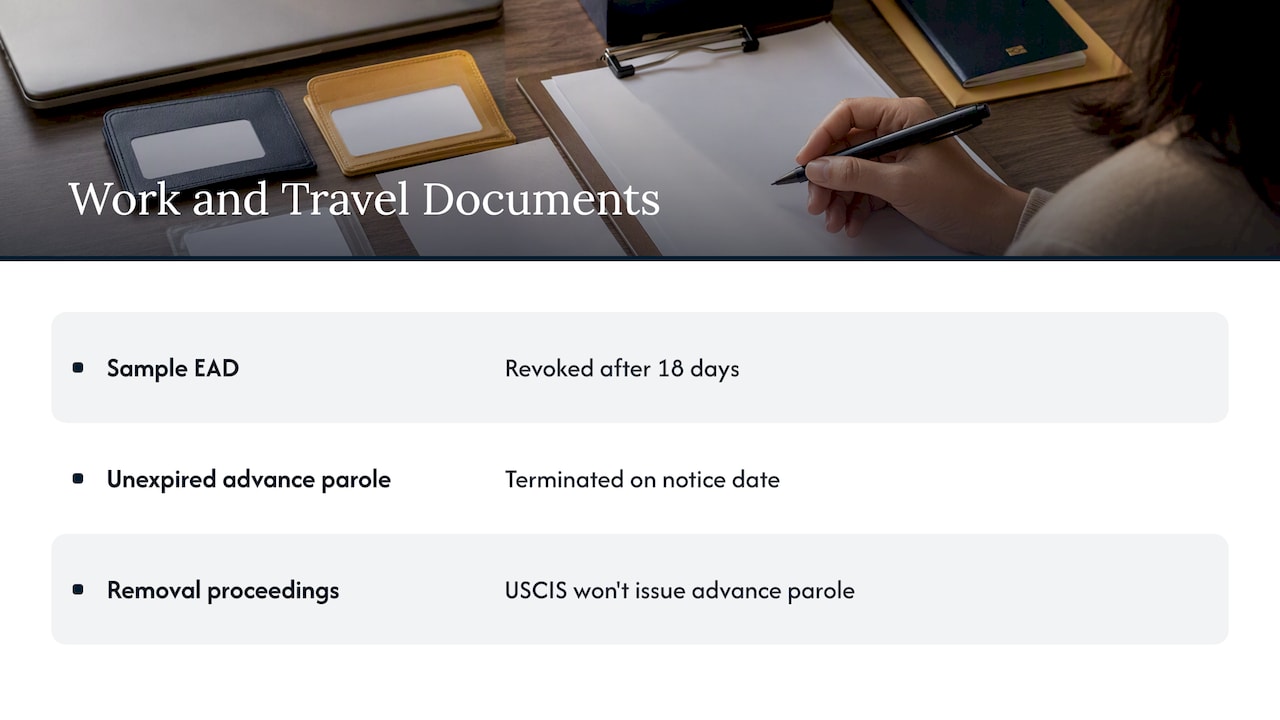
- Check what the notice says about your documents. In that sample notice, an unexpired EAD based on the I-485 was revoked 18 days after the notice unless proof showed the I-485 was still pending, and an unexpired advance parole document was terminated as of the notice date.
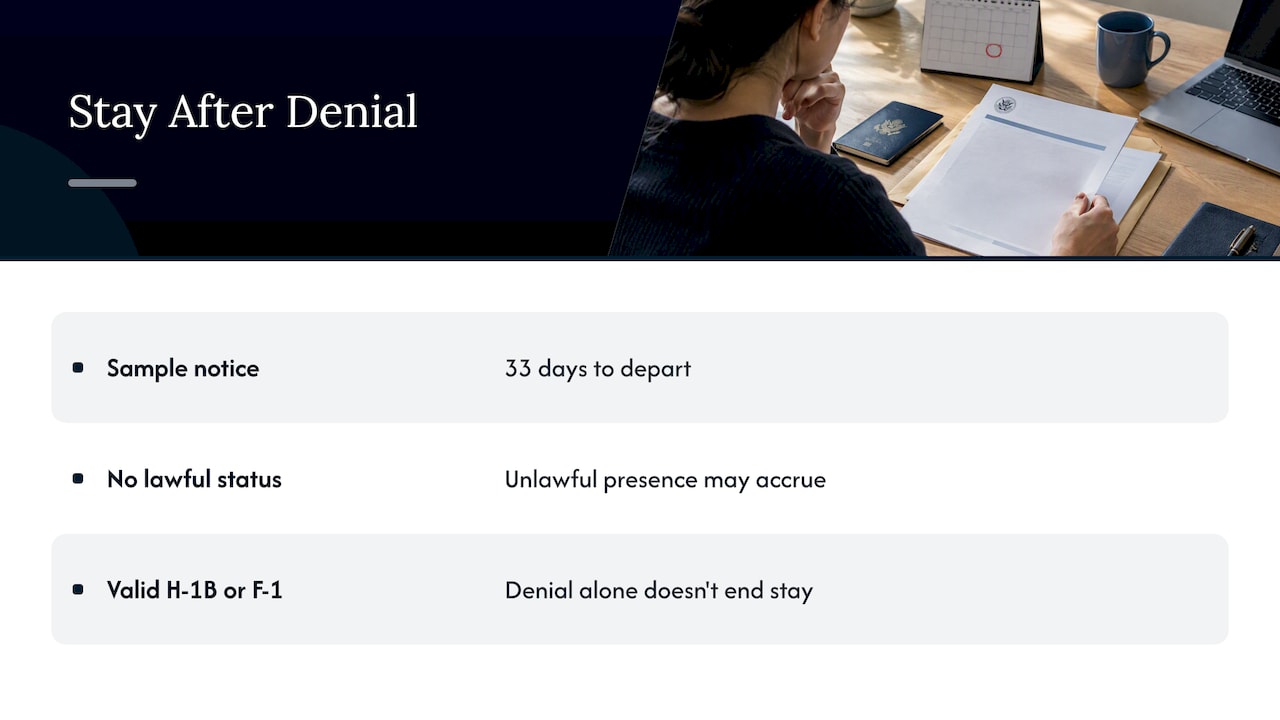
- Find the departure language. The same notice gave the applicant 33 days to depart, and said USCIS may issue a Notice to Appear if the applicant did not. Your own notice may differ, so read yours closely.
- Confirm your address with USCIS. Notices that go to the wrong place are how a bad situation becomes worse.
- Request your records. Your A-file shows what the officer relied on. Our guide to an immigration FOIA request with USCIS, CBP and EOIR explains the steps and whether to do it yourself or hire help.
- Speak to an immigration attorney. The motion window is too short to wait.
Can you appeal a denied I-485?
Not in the usual sense. The denial notice in the research record says the applicant may not appeal, but may file a motion to reopen or reconsider with Form I-290B. The Administrative Appeals Office does not review most adjustment denials, and the Board of Immigration Appeals, according to the EOIR Practice Manual, generally reviews immigration judge decisions rather than direct DHS denials of adjustment. Choosing the correct forum is half of the work.
That leaves four realistic paths.
| Option | Best when | Main risk |
|---|---|---|
| Motion to reconsider | The officer applied the law or policy incorrectly on the record that existed | Cannot add new facts as the core of the argument |
| Motion to reopen | You have new facts or evidence that were not available before | Must show the evidence is new and relevant to the reason for denial |
| New I-485 | You are still eligible and the problem can be fixed | Possible repeat denial, plus new fees and timing issues |
| Immigration court | USCIS has issued an NTA and you are in removal proceedings | Longer process, more exposure, hearings and deadlines |
Motion to reconsider versus motion to reopen
Both are filed on Form I-290B with the same USCIS office that denied your case, and both have the 30 or 33 day deadline. They answer different questions.
A motion to reconsider says the decision was wrong based on the evidence already in the file. You point to the law, the regulation or the policy manual, and show how the officer misapplied it. The governing rule is 8 CFR 103.5. A good motion to reconsider is short, specific and tied to the language of the denial.
A motion to reopen says there are new facts. Examples include a sponsor’s tax transcript that fixes the Affidavit of Support problem, a document that was unavailable earlier, or proof that a status violation did not occur. The new evidence must speak to the reason for denial. Evidence on unrelated topics will not save the motion.
What both have in common:
- A motion does not automatically stop USCIS from acting, and it does not guarantee that your status continues. Ask an attorney how it affects your EAD and your risk of an NTA in your case.
- A late motion is normally dismissed without the officer reading it. Do not count on an exception.
- Filing the wrong type of motion, or the same arguments you already made, rarely works.
If you have the time and facts to support it, you can file one motion, not a series of them, so prepare it carefully.
How long can you stay after an I-485 denial?
There is no universal number of days. What controls is your underlying status, what the denial notice says and whether USCIS issues a Notice to Appear.
In the notice we reviewed, USCIS gave 33 days to depart and warned of a possible NTA after that. If you have no other lawful status, you may begin accruing unlawful presence, which can carry its own bars on returning. If you are still in valid nonimmigrant status, for example an unexpired H-1B or F-1, your situation is different, and the denial does not by itself end your stay.
An NTA starts removal proceedings. At that point an immigration judge has jurisdiction over adjustment applications in most cases, according to a USCIS memo on advance parole, though USCIS keeps jurisdiction in some, such as certain arriving aliens. In court you may be able to renew your adjustment application before the judge, which gives you a second review with a hearing.
If you or a family member is detained, you will want to understand bond. A California bail guide on how to bail out a non-citizen shows how immigration holds and bonds differ from ordinary criminal bail, and an immigration attorney can tell you whether you qualify for a bond hearing.
Work permit, travel and advance parole after a denial
Work authorization. An EAD based on a pending I-485 depends on that pending case. In the sample notice, the EAD was revoked 18 days after the notice unless the applicant proved the I-485 was still pending. If you have another basis for work authorization, such as a different category or an asylum application, keep it current. Our page on renewing a work permit with Form I-765 explains how early you can file to avoid a gap.
Advance parole. The sample notice terminated an unexpired advance parole document as of the notice date. Do not leave the country relying on one without legal advice. Advance parole does not cure inadmissibility for unlawful presence, and the USCIS Policy Manual notes that a departure on advance parole can, in certain circumstances, count as a departure under INA 212(a)(9)(B)(i) if you accrued unlawful presence. A trip abroad could trigger a three or ten year bar.
In removal proceedings. USCIS will not issue advance parole to applicants in removal proceedings, and a request based on compelling circumstances goes to ICE, per the 2010 USCIS memo cited above.
Can you file a new I-485 after a denial?
Sometimes, but a new filing only makes sense when the reason for denial has changed or can be fixed. Ask yourself:
- Was the denial about paperwork? If so, a new filing with a proper I-864, a corrected form or complete evidence may work. Be aware that fees apply again, and your old EAD and advance parole are not revived.
- Was it a legal bar? Refiling the same facts will most likely get the same result. A waiver, a different category or a change in eligibility might be needed, such as a provisional waiver for a U.S. spouse built on a real hardship file.
- Was it discretionary? Plan to show much more positive evidence than before, and address the negative factors directly.
- Does the new filing involve a public charge review? Rules in this area have changed. Our public charge rule explainer covers the version effective September 18, 2026.
- Do your medical results still count? Check the current USCIS policy on Form I-693 validity before refiling.
A second denial can leave you worse off than the first. If the same officer or office sees the same weakness, it will be harder to recover. Take the time to fix the root cause.
For how a clean filing looks from the start, see our 8-step guide to adjustment of status in Utah.
Our perspective
We see the same pattern in many denied adjustment cases. The family waits weeks to talk to a lawyer because they hope the letter will somehow be reversed, then discovers the motion window is almost gone. The first meeting is often about dates, not about arguments.
We start by reading the denial for what it truly says, not what we fear it says. Then we request the file, compare it with what the client remembers, and decide whether the right tool is a motion, a new application or preparation for court. Clients sometimes want us to do all three. That is rarely wise, because each choice affects the others.
Our multicultural perspective helps in immigration cases. Many clients are more comfortable explaining a difficult history in their own language and in their own terms, and the details they share often decide whether a hardship story or a family history is believable. We have worked with more than 1,300 clients, and the lesson is consistent: speak up early, keep every notice and tell your attorney the whole story, including the parts you are afraid of.
— Paralegal
How we can help
If your I-485 was denied, we can review the notice, identify the deadline that applies to you and explain which options fit your facts. Our immigration team assists with motions, refiled applications and defense in immigration court. You can see the Salt Lake City immigration practice or our full list of practice areas and contact us as soon as you have the letter in hand. Bring the denial notice, the envelope it came in, and any receipts or interview notices.
What to bring to a consultation
- The denial notice, front and back, with the envelope or the proof of in-person delivery
- Your I-485 receipt notice, any RFEs and your responses
- Copies of your EAD and advance parole documents
- Your I-94 record and passport pages
- Criminal records, if any, including dismissed cases
- Tax returns and the sponsor’s financial documents if there is an I-864
- Proof of address changes you reported to USCIS
The more complete this folder is, the faster an attorney can tell you whether a motion is realistic. If you are in Utah and received a court notice, also see our page on how the Utah immigration court covers four states and why updating your address matters.
FAQ
Can I file a motion to reopen an I-485 denial?
Yes, on Form I-290B, within 30 days of the decision if it was served in person or 33 days if it was mailed. The motion must rely on new facts or evidence that speak to the reason for denial. If the officer simply misapplied the law, a motion to reconsider is the better fit.
What happens after a green card is denied following an interview?
USCIS mails or delivers a written decision stating the reasons. Your EAD and advance parole may end shortly afterward, and USCIS may issue a Notice to Appear if you have no other lawful status. Read the notice closely and speak to an immigration attorney before the motion deadline passes.
Can I reapply after my I-485 is denied?
Often you can file again, but only if you are still eligible and the problem is fixable. A new filing means new fees and a new decision, and it will not restore a revoked work permit or travel document. Repeating the same application with the same weakness usually gets the same result.
Can I appeal an adjustment of status denial?
A denied I-485 is not appealed to the Administrative Appeals Office or the Board of Immigration Appeals in the usual way. The available remedies are motions to reopen or reconsider with USCIS, a new application, or renewing the application before an immigration judge if you are placed in removal proceedings.
Sources
- USCIS Policy Manual, Volume 7, Part A, Chapter 11: Decision Procedures
- USCIS Form I-485 Instructions
- Sample I-485 denial notice in a federal court record
- USCIS Policy Manual, Volume 7, Part B: 245(a) Adjustment
- USCIS memo on issuance of advance parole
- EOIR Practice Manual
- Guide to bailing out a non-citizen