
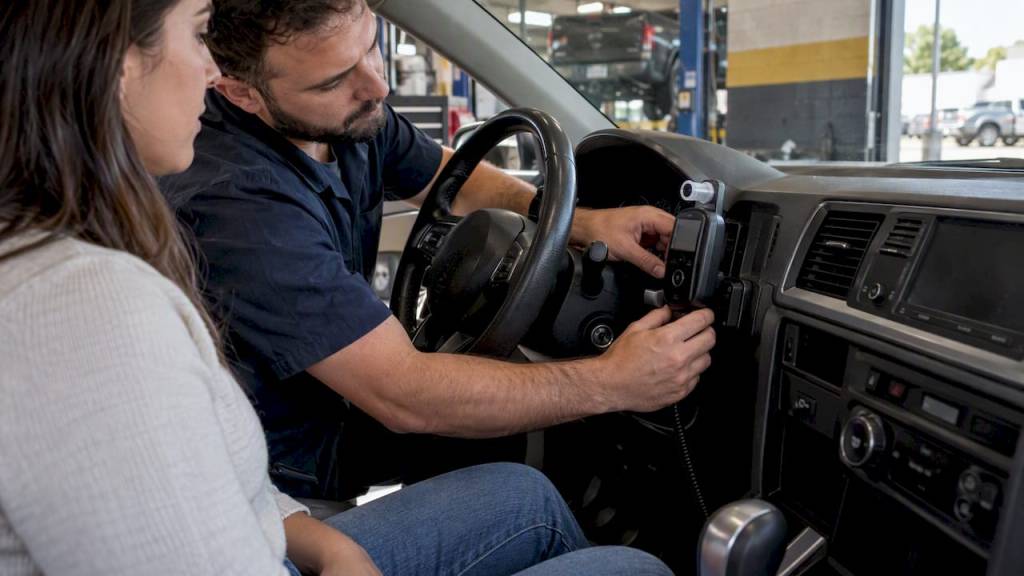
If you were convicted of DUI in Utah, you will almost certainly have to install an ignition interlock device (IID) in every vehicle you drive. For a first conviction the restriction lasts 18 months if you were 21 or older at arrest, and three years if you were under 21, according to the Utah Driver License Division. Every failed test or missed calibration can add 60 days. This guide explains what that means in practice, what it costs, and where a lawyer can change the outcome.
TL;DR
- Length: 18 months for drivers 21 and older, three years for drivers under 21 at the time of arrest. Felony-level and repeat offenses can run 6 to 10 years (Utah DLD).
- Extensions: Since May 3, 2023, each breath violation or failure to calibrate adds 60 days to the restriction.
- Driving without a device: A conviction means a one-year revocation of your driving privilege, and police can see the restriction on your electronic record.
- Cost: You pay for the device. Utah law allows an indigency affidavit to request a waiver or reduction.
- Non-citizens: A DUI conviction can carry immigration consequences far bigger than the interlock itself. Talk to an attorney before you plead.
Table of Contents
- What an ignition interlock device does
- Who has to install one in Utah
- The 60-day extension rule
- Driving without a device
- What an interlock costs in Utah
- Moving out of state with an interlock requirement
- DUI, interlock and immigration status
- Our perspective: what we see in these cases
- When to talk to a defense attorney
- FAQ
- Sources
What an ignition interlock device does
An IID is a breath-testing unit wired into the vehicle’s ignition. The Driver License Division describes it as a constant monitoring device: you blow into it before the car starts, and if your breath alcohol concentration is above the preset limit, the car will not start. Utah’s statute, Utah Code § 41-6a-518, defines the system the same way, as a device that prevents a vehicle from being started or continuously operated without first checking the driver’s breath.
Two details surprise people:
- It is not only a start-up test. The statute describes continuous operation, so the device can ask for retests while you drive.
- It applies to every vehicle. A restricted driver must not drive any vehicle, motorcycles included, without a device installed, per the Driver License Division. Borrowing a friend’s car is not a workaround.
The Division also lists the roles in the program: manufacturers who build the devices, service centers where they are installed, serviced and removed, and installers who do the work (IID provider rules). Only certified equipment counts. A device that is not certified will not satisfy the restriction.
Who has to install one in Utah
The Utah Judicial Branch’s 2025 DUI Statutory Overview summarizes the court’s role: the court shall order an ignition interlock unless it determines and states on the record that one is not necessary for the safety of the community and in the best interest of justice. In other words, the default is yes, and an exception requires a specific finding by the judge.
The length of the restriction depends on age and history:
| Situation | Typical restriction | Source |
|---|---|---|
| DUI conviction, 21 or older at arrest | 18 months | Utah DLD |
| DUI conviction, under 21 at arrest | 3 years | Utah DLD |
| Felony DUI, automobile homicide, some repeat offenses | Up to 6 or 10 years | Utah DLD |
The requirement follows a conviction. It is also separate from the administrative license suspension that follows a DUI arrest. The Division’s early reinstatement page explains that after an arrest the Division may suspend a license for 120 days or two years, and that some drivers can reinstate early. How these tracks interact depends on your arrest date, your record and what happens in court, which is why the details of your own case matter more than any general summary.
The 60-day extension rule
This is the part of the program that catches people off guard. Under a rule effective May 3, 2023, the Division extends your restriction by 60 days for each breath violation or failure to calibrate or monitor the device, as stated on the Utah DLD page. The same extension appears in Utah Code § 53-3-1007 as it relates to the driver license restriction period.
Think of the 18 months as a floor, not a promise. A driver who has three violations adds 180 days, roughly six months, to the end date. The extension comes from any of the following:
- A breath sample over the limit at start-up or during a rolling retest.
- Missing a scheduled calibration or monitoring appointment.
- Failing to report for the service visit the court or the Division requires.
The statute also says a probationer’s system must be monitored every 60 days, or more often if the court orders it. Put the appointment in your phone calendar the day you leave the installer. A missed visit costs two months, and that is entirely avoidable.
Practical habits that prevent violations
- Do not eat, drink or use mouthwash within 15 minutes of blowing. Residual alcohol in mouthwash, energy drinks and some foods can register. Ask your provider for the exact waiting time for your device.
- Tell every passenger and anyone who borrows the car how the rolling retest works, so no one is startled and misses it.
- If a test fails and you were not drinking, write down the date, time and what you had consumed, and tell your provider and attorney promptly.
Driving without a device
If you are convicted of driving, or being in actual physical control of a vehicle, without a required interlock, your driving privilege is revoked for one year from the conviction date (Utah DLD). If the device is removed before the restriction ends, the license is re-suspended until a device is installed again and another reinstatement fee is paid.
Can police tell? Yes. The restriction is added automatically to your electronic driver record, which law enforcement can see. Do not assume a traffic stop will go unnoticed.
A driving-without-interlock charge is its own criminal matter. Misdemeanor classes in Utah carry different penalties, and our overview of Utah misdemeanor classes shows how Class A, B and C offenses differ.
What an interlock costs in Utah
Utah’s statute requires the probationer to pay the cost of the system, so expect to cover installation, a recurring lease and monitoring charge, calibration visits and removal. Prices are set by the vendors, not by the state, and they change. One recent third-party cost guide lists typical Utah ranges of about $70 to $150 for installation and $60 to $95 per month for lease and monitoring. Treat those as a rough benchmark and ask any provider for a written quote that lists every fee, including calibration, late or missed-visit fees and removal.
Because time on the device can grow with each violation, the monthly charge matters more than the install price. Two extra months is two more lease payments.
If you cannot afford it
Utah law does not let a court excuse you from the requirement solely because you cannot pay. It does give you a path for relief: you can file an affidavit of indigency under Section 78A-2-302. If the court finds you indigent, it may waive or reduce the costs, and the statute then requires the interlock provider to absorb the cost of those court-ordered waivers (Utah Code § 41-6a-518). Ask your attorney to raise this at sentencing, before the restriction begins, not months into it.
Moving out of state with an interlock requirement
People often ask whether the requirement transfers. It follows you. Utah’s Driver License Division states that you must fulfill the Utah term even if you relocate, and DUI sanctions are shared among states through the Driver License Compact and the Non-Resident Violator Compact. In practice you need to coordinate three parties: your Utah probation or court, your new state’s motor vehicle agency and a provider that can service your device where you now live.

States write their own interlock rules, with no nationwide standard on duration, approved vendors or violation handling, as one interstate compliance guide points out. If you are on probation, get written permission from the court or probation officer before you move. Failure to maintain the device or report compliance can lead to suspension of your driving privilege wherever you live.
DUI, interlock and immigration status
For a non-citizen, the interlock is the smallest consequence. A DUI conviction can carry serious immigration consequences, up to removal, depending on your status, your history and the specific charge. The Utah courts’ Collateral Consequences Guide catalogs these knock-on effects. Under the Supreme Court’s decision in Padilla v. Kentucky, as the guide describes it, defense attorneys must advise non-citizen clients of deportation risks tied to a guilty plea.
If you hold a visa, a green card or a pending application, do not accept a plea just to end the case quickly and get the device installed. Our guide to the first 48 hours after a DUI for noncitizens walks through what to do and what to avoid saying. If a green card application is part of your plan, see our overview of adjustment of status in Utah.
Our perspective: what we see in these cases
We see the interlock requirement treated as the end of a DUI case, when it is really the long tail. By the time someone reaches an installer, the important decisions about the plea, the charge level and the terms of probation have already been made. A few things we tell people:
- Ask about the interlock before you plead. The length of the restriction depends on age, offense level and history. A charge reduced or a felony avoided can change years of restriction. Our article on Utah felony degrees explains how charge level drives exposure.
- Compliance is the real sentence. The 60-day rule means a perfect record is the only way to finish on the date the court gave you. We encourage clients to keep every appointment receipt.
- Immigration and criminal defense must be handled together. Our firm practices both, and we bring a multicultural perspective to immigration matters. A plea that looks reasonable in criminal court can be damaging for a non-citizen.
- Cost problems should be raised early. If paying for the device would strain your household, the indigency process exists. It works better when it is requested at the start.
These are our observations from client work, not a promise of any result in your case. Every case turns on its own facts.
— Paralegal
When to talk to a defense attorney
You should speak to an attorney if any of these describe you:
- You have been arrested for DUI and have not yet entered a plea.
- You are under 21 and face the three-year restriction.
- You are not a U.S. citizen.
- The device has been flagged for violations and you believe a reading was wrong.
- You have been charged with driving without a required device.
- You need to move out of state while the restriction is active.
Our Utah criminal defense team handles misdemeanor and felony charges. If you are in Salt Lake City, start with our Salt Lake City criminal defense page, or see all our practice areas. Loayza Law has served more than 1,300 clients, and we explain the options, the risks and what comes next in plain language. Bring your citation, any court paperwork and your Driver License Division letters to the first meeting.
FAQ
How much is the daily fee for an interlock device in Utah?
Utah does not set a single daily fee. Vendors charge their own lease and monitoring rates, usually billed monthly, plus installation, calibration and removal. A third-party guide lists about $60 to $95 per month as typical. Ask for a written quote that lists every fee before you sign.
Do police know if I have an interlock restriction?
Yes. The restriction is automatically added to your electronic driver record, which law enforcement can see instantly, according to the Utah Driver License Division. Driving without a required device can lead to a one-year revocation after conviction.
Does an ignition interlock transfer from state to state?
The obligation does. Utah’s requirement follows you if you move, because states share DUI sanctions through interstate compacts. You will need to coordinate with your Utah court or probation officer, your new state’s motor vehicle agency and a provider that can service the device where you live (Utah DLD).
Can the interlock period get longer than 18 months?
Yes. Each breath violation or failure to calibrate or monitor the device adds 60 days to the restriction, per the Utah DLD. Felony-level or repeat offenses can also bring restrictions of 6 to 10 years from the start.
Can I ask the court to waive the cost?
You can file an affidavit of indigency. If the court finds you indigent, it may waive or reduce costs, but it cannot excuse the interlock itself solely because you cannot pay (Utah Code § 41-6a-518).
Sources
- Ignition Interlock Device (IID), Utah Driver License Division
- IID Provider, Utah Driver License Division
- Early Reinstatement, Utah Driver License Division
- Utah Code § 41-6a-518 (2025), Justia
- Utah Code Section 41-6a-518, Utah Legislature
- 2025 DUI Statutory Overview, Utah Courts
- Collateral Consequences Guide, Utah Courts
- Ignition Interlock Device (IID) in Utah, cost overview
- Moving Out of State with an IID: Interstate Compliance Guide