

Yes, you can usually keep your car after filing bankruptcy in Utah if your available exemption covers your equity and you stay current on your loan payments. Utah Code § 78B-5-506(3) sets the motor vehicle exemption at $3,000. Your first move should be calculating your equity, confirming your loan status, and filing the required bankruptcy forms on time.
TL;DR:
- Utah protects up to $3,000 of equity in one vehicle; spouses filing jointly may each claim an exemption if both own vehicles.
- Chapter 7 filers must file a Statement of Intention within 30 days or by the creditors’ meeting, whichever comes first, then act within 45 days.
- Chapter 13 may let borrowers cram down loans more than 910 days old, if secured only by the car, to its current value.
- Reaffirmation preserves the original interest rate and personal liability, so a later default can lead to repossession and a deficiency judgment; surrender discharges the balance.
- Keep payments and required full coverage current, because missed installments can prompt stay relief, while a lender may add costly insurance if coverage lapses.
Table of Contents
- Utah Motor Vehicle Exemption: What It Protects and How to Calculate Car Equity
- Chapter 7 Options: Reaffirmation, Redemption, Surrender, and Key Deadlines
- Chapter 13: Repayment Plans and Cramdowns for Vehicles You Can’t Fully Exempt
- Step-by-Step Checklist: Protecting Your Car Before and After Filing
- Effect of Bankruptcy on Co-Signers or Co-Owners of the Vehicle
- Impact of Bankruptcy on Car Insurance Requirements
- Timeline of the Bankruptcy Process for Car Retention
- Cost Implications of Reaffirming a Car Loan
- How Utah Bankruptcy Law Treats Vehicle Loans Versus Leases
- How Falling Behind on Payments Affects Lender Actions
- Loayza Law’s Perspective on Vehicle Retention Strategy
- Get a Case Evaluation for Your Utah Bankruptcy Filing
- FAQ
- Sources
- Statutes, Official Guidance, and Authoritative Resources
Utah Motor Vehicle Exemption: What It Protects and How to Calculate Car Equity
Utah’s exemption law protects a set amount of equity in one motor vehicle from being sold by a Chapter 7 trustee. Under Utah Code § 78B-5-506(3), you can exempt up to $3,000 in value for one motor vehicle, though certain recreational vehicles don’t qualify unless they serve as your daily transportation. The exemption applies to equity, not the car’s full value, so a financed vehicle with a loan close to its market value often needs little or no exemption at all.
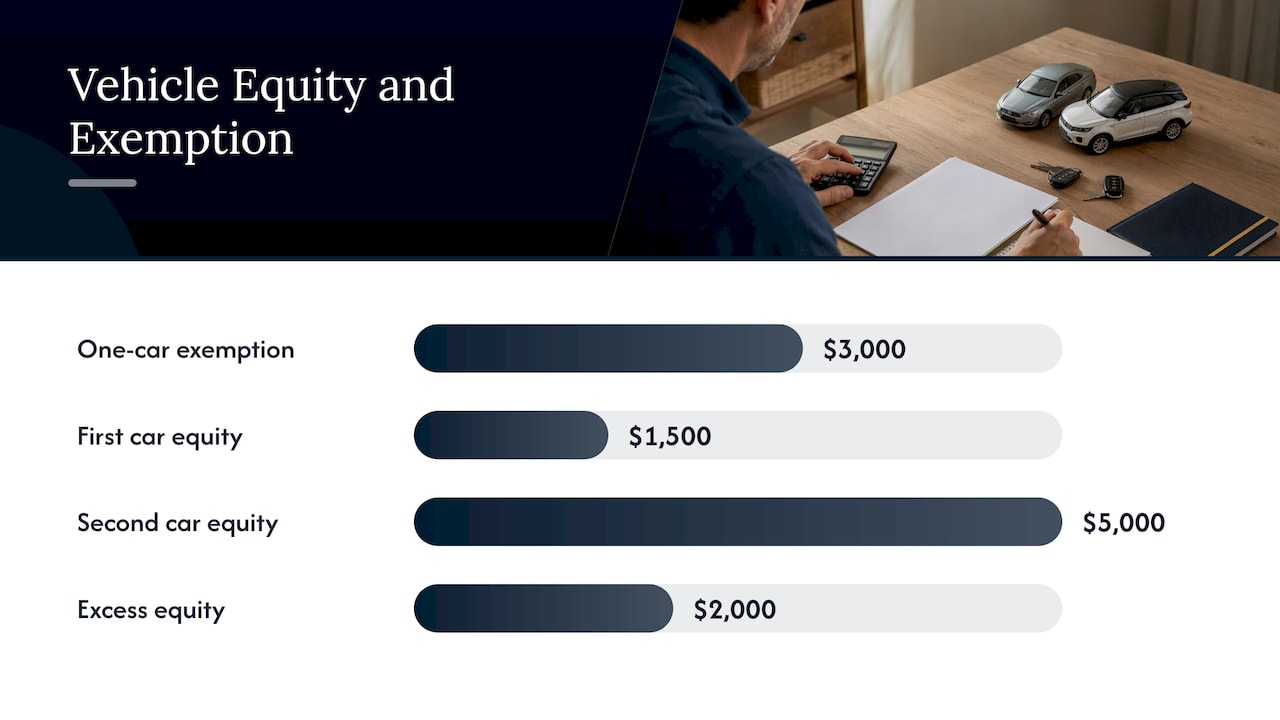
To calculate your equity, subtract your outstanding loan balance from the car’s fair market value. Say your car is worth $12,000 and you owe $10,500: your equity is $1,500, comfortably under the $3,000 exemption. If you owe only $7,000 on that same $12,000 car, your equity jumps to $5,000, which exceeds the exemption by $2,000.
A few additional factors matter here:
- Married couples filing jointly in Utah may each claim a separate motor vehicle exemption, effectively doubling the protected amount when both spouses own vehicles.
- Utah is an opt-out state, meaning filers must use these state exemptions rather than the federal bankruptcy exemption list, according to Nolo’s guide to Utah bankruptcy exemptions.
- When equity exceeds the exemption, a wildcard exemption may cover the remainder depending on what other property you’re protecting.
Many Chapter 7 cases involve vehicles with little or no nonexempt equity, and in those cases trustees typically abandon the car rather than sell it, since a sale after loan payoff and costs would net nothing for the estate, a pattern Nolo’s practical guidance confirms is common. Trustee abandonment means the vehicle reverts fully to you, and the bankruptcy no longer affects what happens to it going forward.
Chapter 7 Options: Reaffirmation, Redemption, Surrender, and Key Deadlines
Filing Chapter 7 doesn’t force a single outcome for your car. You have real choices, and the one you pick shapes whether you keep the vehicle, how much it costs you, and how fast the lender can act if you fall behind.
- Reaffirmation: You sign a new agreement with the lender under 11 U.S.C. § 524 to keep paying the original loan terms, and the debt survives your discharge.
- Redemption: You pay the lender a lump sum equal to the car’s current value under 11 U.S.C. § 722, which can be far less than the loan balance if the car has depreciated.
- Surrender: You give the vehicle back to the lender and the remaining debt is discharged.
- Trustee sale: If equity exceeds your exemption, the trustee may sell the vehicle and pay you the exempt portion in cash.
Timing drives all of this. You must file a Statement of Intention within 30 days of your petition or by your 341 meeting of creditors, whichever comes first, and you generally must perform that stated intention, such as completing reaffirmation or redemption, within 45 days of the meeting. Missing these deadlines can end the automatic stay for that vehicle under § 362(h), opening the door for the lender to repossess.
Staying current on payments before and during your case matters enormously here, since a lender with a current borrower has far less reason to ask the court for relief from the stay.
Pro Tip: If your car has depreciated faster than your loan balance, ask about redemption before assuming reaffirmation is your only path.
A quick example: if your equity is $1,200 and fully exempt, the trustee has no reason to touch the car. If your equity is $6,000 with only $3,000 exempt, the trustee may sell it unless you negotiate another resolution.
Chapter 13: Repayment Plans and Cramdowns for Vehicles You Can’t Fully Exempt
Chapter 13 gives you a different set of tools when your car has more equity than Utah’s exemption covers or when you’re behind on payments and want to catch up over time rather than losing the vehicle outright.
- Instead of surrendering nonexempt equity to a trustee, you pay that amount through your three-to-five-year repayment plan while keeping the car.
- A cramdown can reduce your secured claim to the vehicle’s current fair market value when the loan is older than 910 days and secured solely by the vehicle, lowering your total payoff.
- Mortgage arrears and car loan arrears alike get rolled into the plan, so falling behind before filing doesn’t automatically mean losing the vehicle.
- Chapter 13 often makes more sense than Chapter 7 when you’re several months behind, since Chapter 7’s compressed timeline leaves little room to cure a default.
If you’re weighing Chapter 7 vs Chapter 13 for a vehicle with meaningful equity or a shaky payment history, the plan structure in Chapter 13 is frequently the more forgiving route. A practical checklist for this path includes confirming your vehicle’s value, calculating arrears owed, and proposing a plan payment your budget can sustain for the full plan term, since a default mid-plan can undo the protection you’ve built.
Step-by-Step Checklist: Protecting Your Car Before and After Filing
A little preparation before you file changes the outcome more than almost anything else in this process.
- Calculate your equity. Subtract your loan balance from fair market value. A car worth $9,000 with an $8,200 balance leaves $800 in equity, well under Utah’s $3,000 exemption.
- Get a current payoff statement and payment history from your lender. If you’re behind, try to negotiate a temporary arrangement before filing.
- File your Statement of Intention and schedules on time, then decide among reaffirmation, redemption, or surrender for Chapter 7, or propose your treatment of the vehicle in a Chapter 13 plan.
- Attend your 341 meeting with documentation in hand and respond promptly to any motion for relief from stay.
Bring your title, recent loan statements, proof of insurance, and payment records to your consultation or your 341 meeting. These documents let your attorney or the trustee confirm your numbers quickly, which reduces the chance of delay or dispute.
Pro Tip: Keep every payment confirmation after you file, since lenders occasionally misapply payments during a bankruptcy case, and your own records are the fastest way to correct it.
Effect of Bankruptcy on Co-Signers or Co-Owners of the Vehicle
A co-signer’s obligation doesn’t disappear just because you file. In Chapter 7, your discharge wipes out your personal liability on the loan, but the co-signer remains fully responsible for any remaining balance, and the lender can pursue them directly if you stop paying.
In Chapter 13, a co-debtor stay under the Bankruptcy Code can temporarily protect a co-signer on a consumer debt while your plan is active, as long as you keep making plan payments. That protection isn’t permanent, though, and it generally ends if your case is dismissed or converted. If a relative or friend co-signed your auto loan, keeping payments current protects their credit as much as it protects your vehicle, since a missed payment reported against a co-signed loan affects both names on the account equally.
Impact of Bankruptcy on Car Insurance Requirements
Filing bankruptcy doesn’t change Utah’s minimum auto insurance requirements, and it doesn’t pause your obligation to carry coverage if you’re still driving the vehicle. Lenders holding a security interest in a financed car typically require you to maintain full coverage, not just liability, for as long as the loan is outstanding, whether or not you’ve reaffirmed the debt.
If you let coverage lapse during your case, the lender may add force-placed insurance to your account at a much higher cost than a standard policy, and that expense can complicate a Chapter 13 plan budget or a reaffirmation agreement’s monthly figure. Keeping your existing policy active, and confirming your lender has current proof of insurance on file, avoids an unnecessary cost increase at a time when your finances are already under scrutiny.
Timeline of the Bankruptcy Process for Car Retention
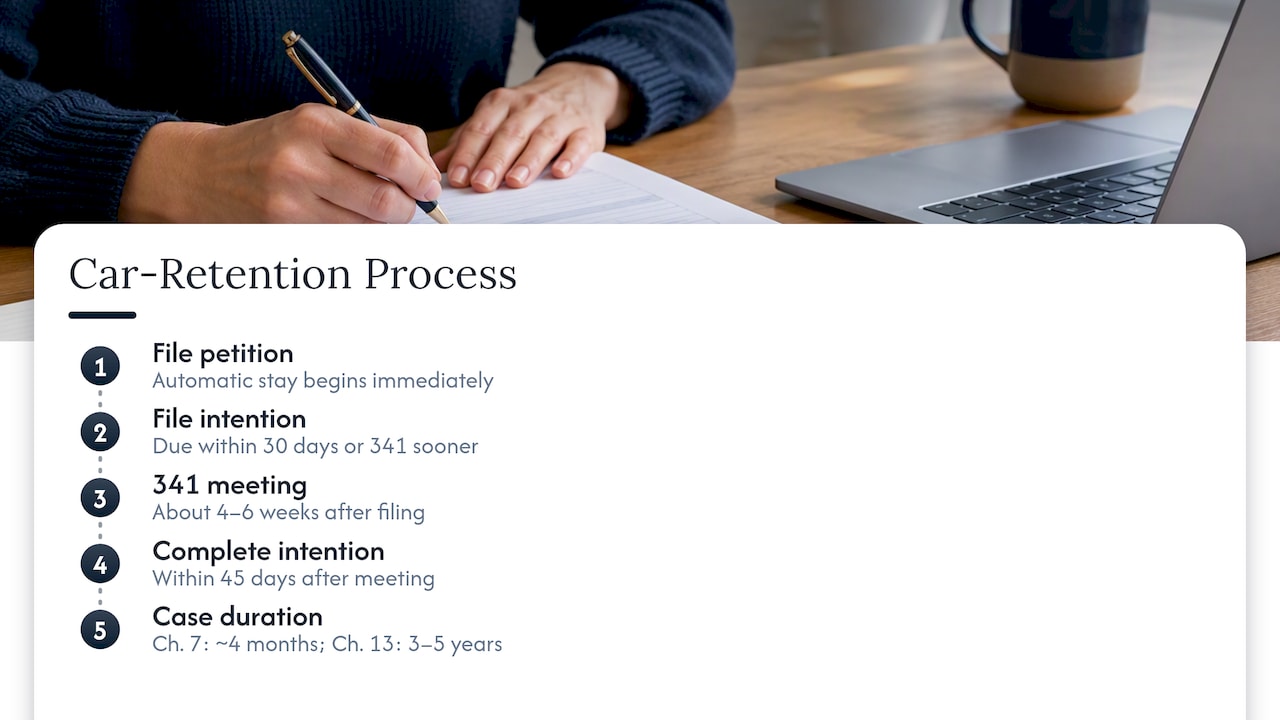
Understanding the sequence of deadlines helps you avoid an accidental loss of stay protection. The process typically unfolds like this: you file your petition, which triggers the automatic stay immediately under 11 U.S.C. § 362 and halts any pending repossession. Within 30 days of filing, or by your 341 meeting if sooner, you must file your Statement of Intention for secured debts like a car loan.
Your 341 meeting of creditors happens roughly four to six weeks after filing, and this is where the trustee reviews your schedules and exemption claims. Within 45 days of that meeting, you need to have performed your stated intention, meaning a reaffirmation agreement is signed and filed, or redemption funds are paid. A Chapter 7 case typically closes within about four months of filing, while a Chapter 13 case runs the length of your confirmed plan, generally three to five years, during which your vehicle payments continue under the plan terms.
Cost Implications of Reaffirming a Car Loan
Reaffirming a car loan means the original contract terms, including the remaining interest rate and any fees built into the loan, carry forward exactly as they were before you filed. If your loan had a high interest rate before bankruptcy, reaffirmation locks that same rate back in, since the agreement typically isn’t renegotiated as part of the process.
Some reaffirmation agreements also require a hearing before a bankruptcy judge, particularly when your budget shows the payment creates a hardship, which can add time and occasionally a filing fee to the process. Because reaffirmation keeps you personally liable for the full debt going forward, a missed payment after reaffirming can result in both repossession and a deficiency judgment for whatever the lender doesn’t recover at resale, a risk that doesn’t exist if you’d surrendered the vehicle instead. Weighing the car’s remaining value against the total cost of the reaffirmed loan, interest included, is worth doing before you sign.
How Utah Bankruptcy Law Treats Vehicle Loans Versus Leases
A financed car and a leased car are treated differently in bankruptcy, and the distinction matters for which tools apply. A vehicle loan creates a secured debt, meaning the lender has a lien on the car itself, which is why reaffirmation, redemption, and the Utah exemption all come into play. A lease, by contrast, is treated as an executory contract rather than a secured debt.
For a leased vehicle, your choice in Chapter 7 is generally to assume the lease, continuing to make payments under the original terms, or reject it and return the car. There’s no redemption option for a lease, since you never held an ownership interest to redeem. In Chapter 13, lease payments can sometimes be addressed within the plan similarly to a secured debt, though the underlying legal treatment as a contract rather than collateral remains. If you’re unsure whether your vehicle is financed or leased, your contract paperwork will say so explicitly, and that distinction should guide which Chapter 7 or Chapter 13 option you pursue.
How Falling Behind on Payments Affects Lender Actions
Being current on your car payment is one of the strongest factors in whether a lender leaves you alone during your bankruptcy case. The automatic stay halts repossession and collection efforts the moment you file, but it isn’t permanent protection regardless of your payment status. A lender who sees missed payments, before or after filing, can file a motion for relief from the automatic stay, asking the court for permission to repossess the vehicle despite your bankruptcy.
CFPB supervisory findings show that some servicers have repossessed vehicles despite an active bankruptcy stay, a practice the regulator treats as a potential unfair act. That finding cuts both ways: it’s a reminder to document your bankruptcy filing clearly with your lender, and it’s useful leverage if a servicer acts improperly despite notice of your case. Chapter 13 gives you more room to cure a default through your plan than Chapter 7 does, which is part of why filers who are behind often lean toward a 13 instead.
Loayza Law’s Perspective on Vehicle Retention Strategy
When working with filers whose vehicles range from fully paid-off commuter cars to loans with years of payments left, the right strategy depends heavily on equity, payment history, and whether a reaffirmed payment fits the post-bankruptcy budget. Deciding between Chapter 7 and Chapter 13 often comes down to one question: does the equity exceed the exemption, or are payments already behind?
- Vehicle equity is calculated against Utah’s exemption early in a consultation, before recommending a chapter.
- Statement of Intention filings and deadlines are handled to help clients avoid losing stay protection through a missed form.
- Chapter 13 plan language is drafted to address arrears and nonexempt equity directly, with negotiation with lenders when a reaffirmation term needs adjusting.
— Paralegal
Get a Case Evaluation for Your Utah Bankruptcy Filing
Protecting a vehicle through bankruptcy involves precise deadlines and calculations, and a missed form or an overlooked exemption can cost you the car. We provide direct, Utah-based bankruptcy representation that walks you through equity calculations, Statement of Intention filings, and the Chapter 7 versus Chapter 13 decision from your first consultation forward.

Bring your vehicle title, recent loan statement, and proof of insurance to your consultation, and we’ll tell you where you stand before you file anything. Visit our bankruptcy practice page to schedule a case evaluation and get a clear answer on your options.
This article is general information, not a substitute for advice from a qualified lawyer. Consult a qualified legal professional about your own circumstances before acting on anything here.
FAQ
What is the law regarding used car returns in Utah?
Utah doesn’t have a general “cooling-off” law that lets buyers return a used car after purchase simply because they changed their mind. Return rights depend entirely on the dealer’s specific written return policy or any separate service contract offered at the time of sale, so reviewing your purchase paperwork is the only reliable way to know your options.
How much money can I have in the bank for Chapter 7?
There’s no fixed cash limit for Chapter 7 eligibility in Utah, since cash and bank account funds are protected only up to whatever wildcard or other applicable exemption amount you have available under Utah’s exemption statutes. Funds beyond your exempt amount can become part of the bankruptcy estate, which is why reviewing your exemptions with an attorney before filing matters.
What is the $3,000 rule for buying cars?
In the context of Utah bankruptcy, the $3,000 figure refers to the state’s motor vehicle exemption under Utah Code § 78B-5-506(3), which protects up to $3,000 of equity in one vehicle from a Chapter 7 trustee sale. It isn’t a car-buying rule; it’s a bankruptcy exemption amount that applies to equity you already hold in a vehicle.
Can I sue a dealership for selling me a lemon used car?
Whether you have a claim against a dealership for a defective used vehicle depends on Utah consumer protection law, any express or implied warranty involved, and the specific facts of the sale, so this falls outside bankruptcy exemption rules entirely. A consultation with an attorney who handles consumer or contract disputes can evaluate whether your situation supports a claim.
Sources
- Utah Code § 78B-5-506 — Justia
- Utah Legislature — Part 5 Utah Exemptions Act
- CFPB — Mitigating harm from repossession of automobiles
- Nolo — Can you keep your car in Chapter 7 bankruptcy?
- Memorandum opinion re motion to redeem vehicle — In re Dean
Statutes, Official Guidance, and Authoritative Resources
- Utah Legislature — Part 5 Utah Exemptions Act
- Utah Code § 78B-5-506 — Justia
- CFPB — Mitigating harm from repossession of automobiles
- Memorandum opinion re motion to redeem vehicle — In re Dean
- Nolo — Can you keep your car in Chapter 7 bankruptcy?
- Nolo — Utah bankruptcy exemptions
- Representing Creditors in Consumer Bankruptcy — Texas Bankruptcy Court guidance