
In Utah, a no-contact order is usually a condition of release in a criminal case: a judge tells the person charged to have no direct or indirect contact with the alleged victim or any witness. A protective order is a different, longer-lasting court order with its own enforcement rules. Which one you are dealing with decides how long it lasts, who can change it and what happens if someone breaks it. Our criminal defense and family law practice areas see both sides of these orders, and this guide explains them in plain terms.
TL;DR
- A no-contact order is typically a release condition in a criminal case. A protective order is a separate order a court issues to protect a person from abuse, stalking or contact.
- Jail no-contact orders are short-term and tied to the first court appearance. Civil protective orders generally last up to three years and can be extended by motion.
- Violating a covered protective order is a class A misdemeanor under Utah law, and a prior history can raise the charge.
- Whether you are the person protected or the person restricted, the order can affect custody, housing, firearms and a pending criminal case, so get the first steps right.
- Do not contact the other person to “clear things up” while any order is in place, even if they contact you first.
Table of Contents
- What a no-contact order means in Utah
- No-contact order vs. protective order
- Who can ask for an order, and what they must show
- How to apply for a civil protective order
- What an order can prohibit
- How long an order lasts and how it is extended
- What happens if someone violates an order
- If you are the person named in an order
- Our perspective
- When to bring in an attorney
- FAQ
- Sources
What a no-contact order means in Utah
The Utah County Attorney’s office describes a no-contact order as a condition of bail or release. A judge orders the defendant to have no direct or indirect contact with any victim or witness in the case. “Indirect” matters: messages through a friend, a relative or a social media post can count as contact.
The same page notes that no-contact orders are not enforceable by police the way protective orders are, although a violation may be charged as Contempt of Court. In practice that is not a loophole. A violation can still bring a new charge, change the terms of release and damage the defense in the underlying case.
The jail no-contact order after a domestic violence arrest
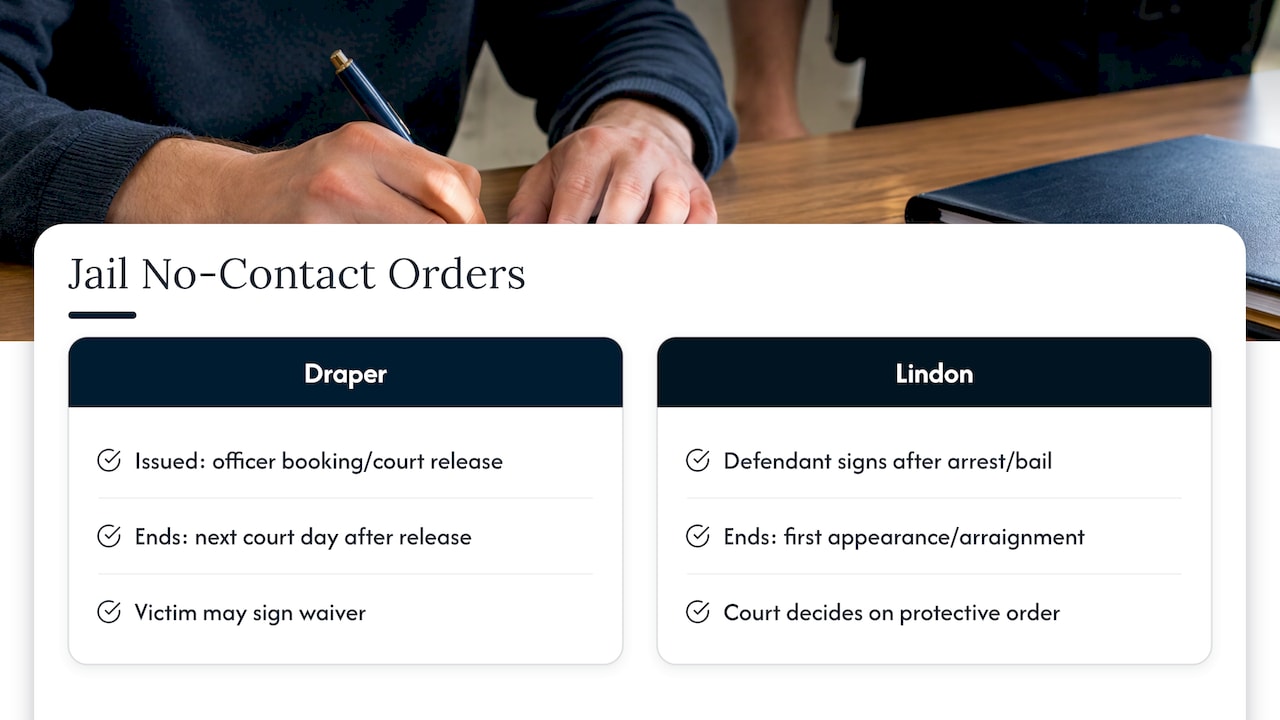
When someone is arrested for a domestic violence offense, a no-contact order often comes first. The City of Draper’s guide explains that the arresting officer issues it at booking, or the court issues it at release. It costs the victim nothing and lasts only until the end of the next court day after release. The victim can waive it by signing a waiver form.
The City of Lindon describes the sequence slightly differently: after arrest and bail, the defendant signs a no-contact jail release agreement that expires at the first appearance or arraignment. At that hearing the court decides whether a criminal protective order is needed. Local practice varies, so read the paperwork you were handed and ask the court clerk or your attorney exactly when yours ends.
One point trips people up. A victim’s willingness to talk does not cancel the order for the person restricted. Only the court, or the formal waiver process the order allows, changes the terms. Until you are told in writing that it has ended, treat it as active.
No-contact order vs. protective order
Utah does not have one protective order. The Utah Courts protective order page lists several, and the criminal side adds more. This table shows how the main ones fit together.
| Order | Who it protects | Who asks for it | Typical length |
|---|---|---|---|
| Jail no-contact order or release agreement | Victim and witnesses in a domestic violence arrest | Set at booking or release | Until the next court day after release, or the first appearance |
| Criminal protective order | Victim in a pending criminal case | Prosecutor, victim advocate or judge | Until the court’s jurisdiction ends, such as end of probation or acquittal |
| Cohabitant protective order | Spouses, former spouses, household members, co-parents and others | The person seeking protection | Up to three years |
| Dating violence protective order | People in a romantic or intimate relationship | The person seeking protection | Set by the court |
| Civil stalking injunction | Anyone being stalked | The person being stalked | Three years |
The criminal-side durations come from the Draper guide. Utah Courts also lists child protective orders, sexual violence protective orders and workplace violence protective orders, the last of which an employer requests when an employee or property was hurt or threatened. We explain the civil side further in our comparison of protective and restraining orders.
The Utah Legislature’s 2019 interim committee report groups the criminal orders into the jail release agreement, the pretrial protective order for a defendant charged with a qualifying offense, the sentencing protective order and the continuous protective order for a person convicted of a qualifying offense. If you are charged, expect a pretrial order to follow the jail release agreement.
Who can ask for an order, and what they must show
The criminal protective order is requested by the prosecuting agency at the first court hearing, so the victim does not have to file anything. A civil order is different: the person seeking protection has to apply.
Under Utah Code Title 78B, Chapter 7, Part 6, any cohabitant who has been subjected to abuse or domestic violence, or faces a substantial likelihood of it, may seek a protective order. That is true whether or not they have left the home and whether or not a divorce is pending.
Utah Courts defines a cohabitant broadly. It includes a current or former spouse, someone who lives or lived with the respondent, someone in a consensual sexual relationship with them, certain relatives, and people who have or are expecting a child together. The petitioner must be 16 or older, and anyone under 18 cannot seek an order against a parent or minor sibling. Dating violence orders require the petitioner to be 18 or older or emancipated.
Stalking is handled differently. Any person who believes they are being stalked can file, and a minor can file alone or through a parent or guardian. The civil stalking injunction page says there is no filing fee. Proof can include police reports, witness statements, audio or video, photos or letters. The Draper guide adds that a civil stalking case generally needs at least two documented incidents, so keep a dated journal of every contact. Our guide to a stalking injunction in Utah walks through filing and responding.
How to apply for a civil protective order
- Choose the right order. Match your relationship to the right category: cohabitant, dating violence, sexual violence, stalking or child. Filing under the wrong category can delay protection.
- Get the forms. Under Utah Code § 78B-7-105, court clerk offices must provide the forms. For people without a lawyer, they must also provide nonlegal help with the forms, filing and service paperwork.
- Write down specific incidents. Dates, places, exact words, screenshots and police report numbers carry more weight than general statements.
- File the petition. A stalking petition can be filed in district court where either party lives, where the petitioner is staying or where the events occurred.
- Wait for the temporary order. Utah Courts says a judge signs a temporary ex parte order, meaning one issued without the other person present, and sets a hearing within 21 days. The order takes effect once the sheriff or constable serves the respondent.
- Attend the hearing. The temporary order usually lasts only until that hearing, where the judge decides whether a longer order is needed.
The step where people go wrong is the hearing. The respondent may bring an attorney, cross-examine and present their own evidence. Going in with organized proof and an understanding of the rules of evidence makes a real difference, especially when custody or a criminal case runs alongside.
What an order can prohibit
Utah Courts explains that a protective order, sometimes called a restraining order, can do much more than stop phone calls. It can:
- prevent the respondent from contacting or communicating with the petitioner and others
- stop threats of violence
- require the respondent to stay away from the petitioner’s home, work, school or place of worship
- bar possession of guns or weapons
- temporarily give the petitioner custody of shared children
If you share children with the person who has an order against you, the order may change your parenting time on its face. That is why these cases so often connect to family court. Our pages on temporary orders in a Utah divorce and on what to include in a parenting plan explain how custody and support are set while an order is active.
How long an order lasts and how it is extended
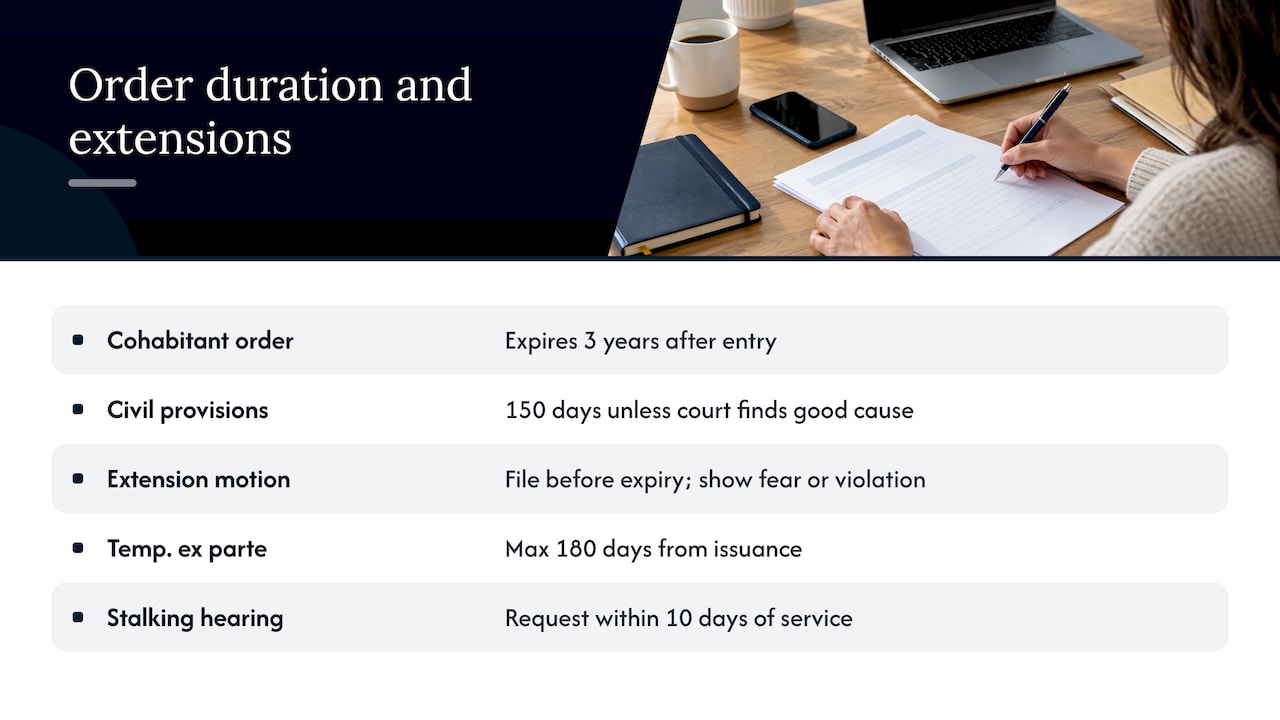
A cohabitant abuse protective order expires automatically three years after entry, according to Part 6 of the Utah Code. Some civil provisions expire 150 days after entry unless the court finds good cause. To extend an order, the petitioner must file a motion before it expires. The motion must show a current reasonable fear of future harm, abuse or domestic violence, or that the respondent violated the order or committed a qualifying offense after it was issued. If the court grants it, it sets a new expiration date. A temporary ex parte order can be extended only for limited reasons and never beyond 180 days from issuance.
Civil stalking injunctions follow their own clock. Per Utah Courts, if the respondent asks for a hearing within 10 days of being served, the petitioner must prove the stalking. The judge can dismiss the order, make it a final injunction for three years or modify it for three years. If no hearing is requested, the temporary injunction automatically becomes final, lasting three years from service. Utah Code § 78B-7-701 adds that the ex parte injunction must be served within 90 days of signing.
The legislature amended Part 6 in the 2024 and 2025 General Sessions, so check the current text of the statute, or ask an attorney, before you rely on a deadline.
What happens if someone violates an order
A respondent who intentionally or knowingly violates a covered protective order, after proper service or after being present when it was issued, commits a class A misdemeanor under Utah Code § 76-5-108. It is also treated as a domestic violence offense with increased penalties. The Draper guide says a violation of a criminal protective order may be enhanced to a felony when there is prior history. For the range of penalties attached to the charge, see our guide to Utah misdemeanor classes, and for a summary of the legal consequences of violating a protection order, including what a bond may involve, that page is a quick overview.
A few real-world patterns lead to violations:
- Replying to a text or call from the protected person. The order binds only the restricted person.
- Asking a friend or family member to “pass along” a message.
- Showing up at a shared workplace, school or place of worship.
- Liking, tagging or commenting on the protected person’s social media.
- Attending a family event where the protected person is present.
If you are protected by an order and the other person breaks it, write down the date, time and what happened, save any messages and call law enforcement. In an emergency, call 911. A confidential statewide 24-hour domestic violence hotline is available at 1-800-897-LINK (5465).
If you are the person named in an order
Being named in a no-contact order or protective order is serious but manageable when you respond carefully.
- Read it line by line. Note the stay-away distances, the places covered and the end date, if one is listed.
- Stop all contact. That includes calls, texts, email, social media and messages through third parties.
- Do not discuss the case. Anything you say to the protected person, a witness or on social media can be used against you.
- Arrange exchanges of belongings and children through the court or an attorney. Do not improvise.
- Ask about the hearing. For a civil order you generally have 10 days after service to request a hearing on a stalking injunction, and a hearing is scheduled on cohabitant petitions within 21 days.
- Talk to an attorney before your first hearing. If criminal charges are pending, what you say at a civil hearing can affect that case.
If a criminal case is open, a criminal defense attorney in Salt Lake City can coordinate your response to the order and the charge so the two do not undermine each other.
Our perspective
Most people come to us after the order is already in place, and the first question is nearly always the same: “What can I still do?” The honest answer starts with identifying which kind of order it is. A jail release agreement, a pretrial criminal protective order and a civil protective order have different end dates, different decision-makers and different ways to be changed.
We approach these matters as one case, not two. A no-contact order touches the criminal charge, parenting time, housing and often immigration status. Our firm handles criminal defense, family law and immigration under one roof, so that a decision in one room is made with the others in mind. For protected parties, we focus on documenting incidents clearly and understanding the process. For people named in an order, we focus on avoiding a violation, which is the mistake that does the most lasting damage.
Clients rarely need more legal vocabulary. They need to know what to do tomorrow morning, and we are glad to help them work that out.
Paralegal
When to bring in an attorney
We represent individuals and families across Utah in criminal defense and family law, and orders like these often sit between the two. If you have been charged and a no-contact order was part of your release, if a protective order is affecting custody, or if a conviction could create immigration consequences, our team can review your paperwork and explain your options. You can see everything we handle on our practice areas page.

We are committed to responsive communication and a strategy built around your specific outcome. Reach out through our site when you are ready to talk through your situation.
FAQ
Can a no-contact order be lifted if the victim wants contact?
Not automatically. For a jail no-contact order, the Draper guide says the victim can sign a waiver form. For other orders, the court must change or end the order, and the restricted person should not rely on the other person’s say-so. Until you have written confirmation, treat the order as active.
How long can a protective order last in Utah?
A cohabitant abuse protective order expires three years after entry, and an extension requires a motion filed before it ends. Civil stalking injunctions last three years. Criminal protective orders last until the court’s jurisdiction ends, such as the end of probation or an acquittal.
Is a no-contact order the same as a restraining order?
No. People often use “restraining order” as another name for a civil protective order. A no-contact order is typically a criminal release condition, and it is tied to a specific case. Our guide to protective vs. restraining orders covers the difference in more detail.
Does it cost anything to get a protective order in Utah?
The Utah Courts civil stalking injunction page lists no filing fee, and the Draper guide says a jail no-contact order costs the victim nothing. Court clerks must also provide forms and nonlegal filing help to people without lawyers. Hiring an attorney is separate and depends on the case.
What if I am served with a temporary order I think is unfair?
Do not contact the petitioner to argue about it. Note the hearing deadline on the paperwork, which is within 10 days for a stalking injunction and within 21 days for a temporary protective order, and speak with an attorney before the hearing.
Sources
- Utah County Attorney: Victim information
- City of Draper: Orders of Protection
- City of Lindon: Domestic Violence
- Utah Courts: Protective Orders
- Utah Courts: Civil Stalking Injunction
- Utah Legislature: Domestic Violence & Protective Orders, 2019 interim report
- Utah Code Title 78B, Chapter 7, Part 6: Cohabitant Abuse Protective Orders
- Utah Code § 78B-7-105: Forms for petitions and protective orders
- Utah Code § 78B-7-701: Ex parte civil stalking injunction
- Utah Code § 76-5-108: Violation of protective orders
- Violation of protection order