

In most U.S. jurisdictions, a protective order and a restraining order serve the same core purpose — preventing contact and protecting safety — but the label, procedures, and enforcement consequences vary significantly by state. Federal law under 18 U.S.C. §2265 treats both as part of the same legal category for interstate enforcement, which means the name on the document matters far less than what the document actually says.
What does matter: whether the order originated in a criminal or civil court, what specific conduct it prohibits, whether it includes firearms restrictions, and whether proper service occurred. Practice guidance from the Battered Women’s Justice Project emphasizes that enforceability depends on legal validity and due process steps, not on the label at the top of the form.
Pro Tip: Read every line of the order’s terms before assuming what it covers. Two orders with different names can have identical protections, and two orders with the same name can differ dramatically in scope.
If you are facing an immediate safety concern, contact your local court clerk or a victim advocate today. For state-specific rules in Utah or elsewhere, an attorney can identify the right petition form and filing court before you take another step.

Table of Contents
- What types of protective orders will you encounter?
- Who can ask for a protective or restraining order?
- How do you actually get an order filed and served?
- What protections can an order include, and how is it enforced?
- How do criminal protective orders differ from civil restraining orders?
- What federal law says about interstate enforcement and firearms
- What to bring to your hearing and how long protection lasts
- What to do if you are served with an order or if your order is violated
- Key Takeaways
- Why the order’s terms matter more than its name
- Loayzalaw is ready to help with your protective order matter
- Useful sources and where to read more
What types of protective orders will you encounter?
Courts and legislatures across the country use a range of names and structures. Knowing the common types helps you recognize what you are dealing with, regardless of what your state calls it.
- Emergency Protective Order (EPO): Issued by law enforcement or a magistrate, often at the scene of a domestic violence incident. EPOs typically last a short time, usually several days — just long enough to get to a courthouse and file for a temporary order.
- Peace Bond / Peace Order: — Used in some jurisdictions (Texas and Maryland, for example) as a lower-threshold order where a petitioner shows a reasonable fear of future harm, even without a prior act of violence.
State-label examples worth knowing:
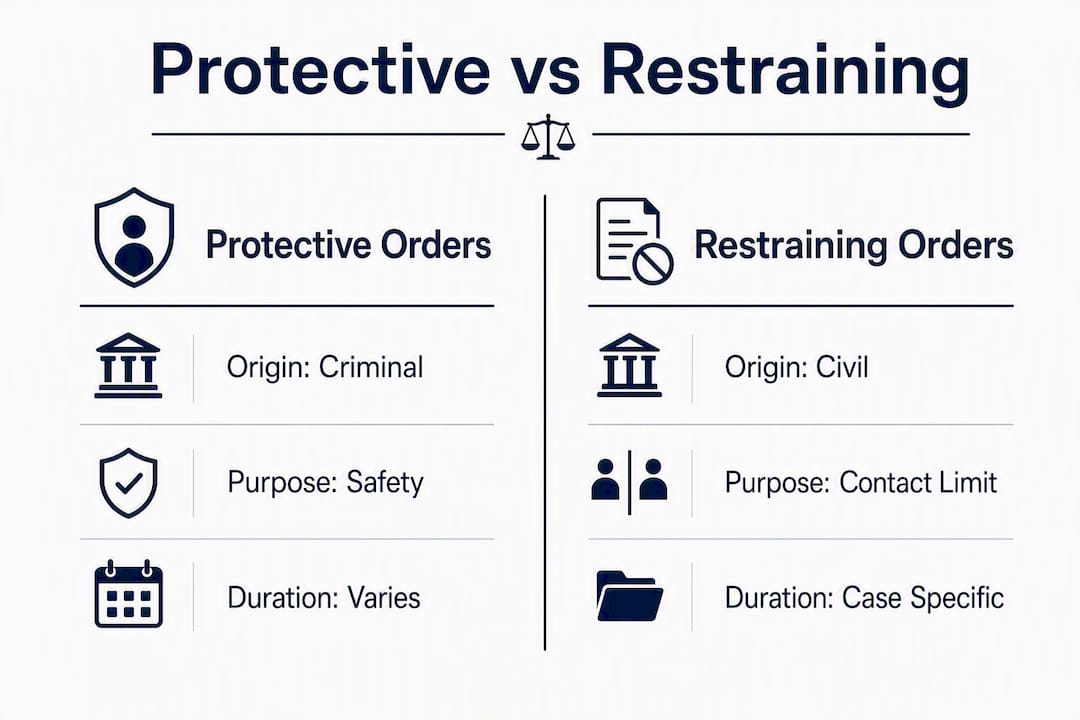
Arizona’s court help resources state plainly that a restraining order and a protective order are the same thing for practical purposes within that state, while still advising readers to check local forms and statutory names. California takes a different approach: form DV-130 is officially titled “Restraining Order After Hearing (Order of Protection),” using both terms on the same document. In Texas, the distinction carries more weight — a family-code Protection Order for domestic violence can be criminally enforceable, while a civil restraining order in a divorce may only be enforceable by contempt.
One procedural detail that catches people off guard: in many states, filing a family law petition (divorce, custody) automatically triggers a standing temporary restraining order that restricts both parties from disposing of assets or removing children from the jurisdiction. These automatic orders are issued by the court without anyone asking for them.

Who can ask for a protective or restraining order?
Eligibility depends on both the type of order and the state’s specific statute. Most states recognize several qualifying grounds and relationship categories.
Common qualifying grounds include:
- Domestic violence or family violence (physical harm, threats, coercive control)
- Stalking or cyberstalking
- Sexual assault
- Harassment (repeated unwanted contact causing fear)
- Elder abuse or dependent adult abuse
- Credible threats of violence, even without physical contact
Relationship categories that commonly qualify:
Spouses and former spouses, cohabitants and former cohabitants, dating partners and former dating partners, parents sharing a child, and close family members are covered in virtually every state’s domestic violence statute. Some states extend protection to roommates without a romantic relationship, and civil harassment statutes in states like California allow anyone to petition against a stranger, neighbor, or acquaintance who has engaged in a pattern of harassment.
Where states diverge is on the edges. A coworker who is being stalked by a colleague may qualify for a civil harassment order in California but face a narrower path in a state that limits certain orders strictly to family or intimate-partner relationships. If you are unsure whether your situation qualifies, a court self-help center or victim advocate can identify the right petition form before you invest time in the wrong filing.
How do you actually get an order filed and served?
The process follows a predictable sequence, though timelines vary by court calendar and jurisdiction.
Step-by-step filing process:
- Identify the correct court. Domestic violence and family-relationship orders are usually filed in family or district court. Civil harassment orders go to civil court. Criminal protective orders are initiated by prosecutors, not petitioners.
- Complete the petition form. Courts require names and addresses of both parties, the nature of your relationship, a detailed description of recent incidents (dates, locations, specific acts), and any prior orders.
- Request ex parte / emergency relief. If you are in immediate danger, ask the clerk for an emergency or ex parte hearing. A judge can issue a TRO the same day based on your sworn statement alone.
- Receive the temporary order. If granted, the court issues a temporary order and schedules a full hearing, typically within 14–21 days depending on the jurisdiction.
- Service on the respondent. The order has no legal effect until the respondent is personally served. Law enforcement or a licensed process server typically handles this. If the respondent cannot be located, ask the court about alternative service options.
- Attend the hearing. Both parties appear before a judge. You present your evidence; the respondent has the right to respond. The judge then decides whether to issue a final order.
- Receive the final order. If granted, the court issues a final protective order with specific terms, duration, and conditions.
Typical timeline at a glance:
| Stage | Typical Duration | Notes |
|---|---|---|
| EPO (law enforcement-issued) | 5–7 days | Bridges the gap to a courthouse filing |
| Ex parte TRO | Up to 14 days in many jurisdictions | Issued without respondent present |
| Hearing scheduled | 14–21 days after TRO in most courts | Varies by court calendar |
| Final order duration | Commonly 1–2 years; lifetime in some cases | Renewable upon petition |
Documents to bring to your hearing:
- Police reports from any incidents
- Photographs of injuries or property damage
- Screenshots of threatening texts, emails, or social media messages
- Medical records if injuries were treated
- Witness names and contact information
- Any existing court orders (custody, divorce, prior protective orders)
- Government-issued ID and certified copies if your order originated in another state
Filing fees vary by court and order type. Many courts waive fees entirely for domestic violence petitioners. Local victim-advocacy organizations and legal aid offices can help you complete forms, accompany you to court, and connect you with free or low-cost legal representation.
What protections can an order include, and how is it enforced?
A protective order is only as useful as its specific terms and the willingness of law enforcement to act on them. Courts have broad authority to tailor provisions to the facts of each case.
Common provisions courts can include:
- Stay-away orders (specific distances from home, workplace, school, or vehicle)
- No-contact provisions (phone, text, email, social media, third-party contact)
- Move-out orders requiring the respondent to vacate a shared residence
- Temporary custody or no-contact with children (where authorized by statute)
- Prohibition on harassing, threatening, or destroying property
- Surrender or turn-in of firearms and ammunition
How enforcement works:
When a respondent violates a protective order, the petitioner should call 911 immediately if in danger. Police can arrest the respondent on probable cause that a violation occurred — in most states, this is a warrantless arrest authority specific to protective order violations. Depending on the state and the nature of the violation, the respondent may face contempt of court, a misdemeanor charge, or a felony charge for repeat or violent violations.
Travis County court materials are direct about one critical limitation: orders are legal tools, not physical barriers. They cannot prevent a determined person from approaching you. That is why practitioners consistently recommend pairing an order with a concrete safety plan: changing locks, notifying your employer and building security, varying your daily routine, and working with a victim-services advocate.
Pro Tip: Keep a certified copy of your order with you at all times, store a digital copy in your phone’s cloud, and give copies to your workplace security, your children’s school, and anyone else who may need to act on it quickly.
Document every violation — date, time, what happened, any witnesses — and report it to police even if you feel uncertain. That documentation builds the record for enforcement and any future criminal charges.
How do criminal protective orders differ from civil restraining orders?
The distinction between criminal and civil orders is one of the most practically significant in this area of law, and it is one that many people do not realize until they are holding two separate documents.
Key differences:
- Origin: Criminal protective orders are issued by a criminal court, typically after an arrest for domestic violence, stalking, or assault. Civil restraining orders arise from civil or family court petitions filed by the protected party.
- Who initiates: In a criminal case, the prosecutor requests the protective order as a condition of the defendant’s release or as part of sentencing. In a civil case, the petitioner files directly with the court.
- Enforcement mechanism: Violating a criminal protective order is itself a criminal offense, triggering arrest authority. Violating a civil restraining order can result in contempt of court proceedings, though many states also criminalize the violation.
- Common contexts: A domestic violence arrest leads to a criminal protective order that the defendant cannot waive or negotiate away. A divorce proceeding may produce a civil restraining order over property, custody, or contact.
When both orders exist at once:
California court guidance confirms that a victim can hold both a criminal protective order and a civil restraining order simultaneously. When provisions conflict — for example, one order allows supervised visitation while another prohibits all contact — the controlling language is found in the documents themselves and the court’s instructions. Practitioners recommend seeking legal counsel immediately when orders conflict, because acting on the wrong one can itself constitute a violation.
A brief example: a woman obtains a TRO in family court during divorce proceedings. Her husband is then arrested for assault, and the criminal court issues its own no-contact order. She now holds two orders. If the family court later schedules a custody hearing requiring both parties to appear, her attorney needs to coordinate with both courts to avoid a conflict.
What federal law says about interstate enforcement and firearms
The federal framework is where the protective vs restraining order distinction truly disappears. Under 18 U.S.C. §2265), every state, territory, and tribal jurisdiction must give full faith and credit to a valid protection order issued elsewhere. The statute covers any injunction or restraining order issued to prevent violent or threatening acts, regardless of what the issuing state called it. You do not need to re-register the order when you move, as long as it meets the federal validity criteria (issued by a court with jurisdiction, with notice to the respondent or an ex parte finding of good cause).
Firearms consequences:
Federal law under 18 U.S.C. §922(g)(8) prohibits a person subject to a qualifying protective order from possessing firearms or ammunition. A qualifying order must: be issued after a hearing with notice to the respondent, restrain the respondent from harassing or threatening an intimate partner or child, and include a finding that the respondent poses a credible threat or explicitly prohibit the use of force. Not every protective order automatically triggers this federal prohibitor — the order’s specific language determines whether it qualifies.
This is a point where the order’s text is decisive. An order that does not include the required findings may not trigger the federal firearms prohibition, even if the parties believe it does. Conversely, a respondent who assumes their order does not affect their gun rights without checking the language is taking a serious legal risk.
Pro Tip: If you are moving to a new state with an existing order, bring certified copies and contact local law enforcement or a family law attorney about enforcement procedures in your new jurisdiction. Some states maintain protection order registries that simplify this process.
Ask the court clerk at filing whether your order includes the language needed to meet federal elements for both interstate enforcement and the firearms prohibitor. If the answer is unclear, that is a question for an attorney before you leave the courthouse.
What to bring to your hearing and how long protection lasts
Preparation for the hearing is where many petitioners lose ground they should not lose. Courts decide based on evidence, and a well-organized presentation makes a measurable difference.
Hearing preparation checklist:
- Police reports and incident numbers from any calls to law enforcement
- Medical records or photos of injuries
- Screenshots of threatening messages (printed and timestamped where possible)
- A written timeline of incidents in chronological order
- Witness names, contact information, and a brief summary of what each can testify to
- Copies of any prior orders, custody agreements, or divorce filings
- Government-issued ID
- Certified copies of any out-of-state orders you want the court to recognize
Costs and fee waivers:
Filing fees for protective orders vary by state and court. Many jurisdictions waive fees entirely for domestic violence victims under state statute. If cost is a barrier, ask the clerk about fee waivers before you file. Local legal aid organizations and domestic violence advocacy programs often provide free assistance with forms and court accompaniment.
Duration and renewal:
| Order Type | Typical Duration | Renewal / Modification |
|---|---|---|
| EPO | 5–7 days | Not renewable; replaced by TRO or final order |
| Temporary / Ex Parte TRO | Up to 14 days in many jurisdictions | Extended at hearing if final order is granted |
| Final Order of Protection | 1–2 years | Petitioner can request renewal before expiration |
| Lifetime / Permanent Order | Issued in extreme or repeat-violence cases | Modification requires court petition and showing of changed circumstances |
To renew or modify an order, either party can file a motion with the court that issued it. The petitioner seeking renewal typically needs to show that the threat or need for protection continues. The respondent seeking modification or termination must demonstrate a substantial change in circumstances. A detailed guide on the modification process can help you understand what courts look for in those proceedings.
What to do if you are served with an order or if your order is violated
The hours immediately after service or after a violation are the most consequential. Acting quickly and correctly protects your rights and your safety.
If you are the respondent served with an order
- Read the order in full. Note every restriction, every distance requirement, every person covered, and the hearing date.
- Comply immediately. Violating the order before the hearing will almost certainly result in arrest and will damage your position at the hearing.
- Note the hearing date and time. Missing the hearing typically results in a final order being issued by default.
- Consult an attorney. A criminal defense attorney can review the order, advise on your rights, and prepare your response for the hearing.
- Gather your evidence. Collect any communications, witnesses, or documentation that contradicts the petition’s allegations.
- Check for firearms in your possession. If the order includes a firearms prohibition, comply immediately and seek legal guidance on surrender procedures.
Practical post-service guidance outlines the procedural steps respondents face in certain jurisdictions and what courts expect at the hearing.
If you are the petitioner and the order is violated
- Call 911 if you are in immediate danger. Do not attempt to handle a violation yourself.
- Document the violation. Write down the date, time, location, what happened, and any witnesses.
- Preserve evidence. Save voicemails, screenshots, or any physical evidence of the contact.
- Notify your attorney or advocate. They can file a motion for contempt or work with prosecutors on criminal charges.
- Ask police to enforce the order. Show officers your certified copy and the documentation of the violation.
Red flags that require immediate legal help:
- You hold two conflicting orders and are unsure which controls
- The order’s language about firearms or custody is ambiguous
- You believe you were served in error or the court lacked jurisdiction
- The respondent claims the order does not apply in your new state
California court guidance confirms that conflicting orders require careful reading of court instructions to determine priority. When in doubt, get legal counsel before acting on either order.
Key Takeaways
The label on a protective or restraining order tells you less than the order’s specific terms, its court of origin, and whether proper service occurred.
| Point | Details |
|---|---|
| Label vs. substance | “Protective order” and “restraining order” are often interchangeable; the order’s terms and civil or criminal origin determine enforcement. |
| Federal interstate enforcement | Under 18 U.S.C. §2265, valid orders must be enforced across all states and territories regardless of what the issuing state called them. |
| Firearms consequences | Federal law under 18 U.S.C. §922(g)(8) can prohibit firearm possession for respondents subject to qualifying orders; check the order’s language. |
| Duration and renewal | EPOs last 5–7 days; final orders commonly run for 1–2 years or, in some cases, for life; renewal requires a court petition before expiration. |
| Loayzalaw for Utah cases | Loayzalaw assists petitioners and respondents in Utah with family law petitions and criminal defense tied to protective order matters. |
Why the order’s terms matter more than its name
The single most consistent mistake we see in protective order matters is treating the label as the substance. A client arrives convinced their order does not cover a particular location or form of contact because the title says “restraining order” rather than “protective order.” In practice, the court wrote the prohibition into the terms, and the label is irrelevant to enforcement.
Terminology in this area of law reflects legislative history more than functional design. States drafted their statutes at different times, borrowed language from different models, and layered amendments over decades. The result is a patchwork where Arizona says the two terms mean the same thing, California prints both on the same form, and Texas draws a genuine legal distinction between them. None of that inconsistency helps someone standing at a courthouse trying to protect themselves or respond to an order they just received.
What practitioners focus on is the document itself: which court issued it, what conduct it prohibits, whether service was properly completed, and whether the language meets federal elements for interstate enforcement and firearms consequences. Those four questions answer almost every practical enforcement issue, regardless of what the order is called.
Local victim-services organizations, court self-help centers, and experienced family law attorneys are the most reliable guides through this process. Loayzalaw works with clients in Utah navigating both civil and criminal protective measures, from initial petitions through hearings, modifications, and defense against alleged violations.
Loayzalaw is ready to help with your protective order matter
Facing a protective order situation — whether you need one or you have been served with one — is one of the most stressful legal experiences a person can go through. Loayzalaw provides dedicated family law representation in Salt Lake City for clients filing petitions, responding to orders, and navigating the intersection of family court and criminal proceedings. The firm’s attorneys handle domestic violence petitions, custody modifications tied to protective orders, and criminal defense for clients facing violation charges.

When you contact Loayzalaw, you will speak with a legal professional who understands Utah’s specific statutes, filing procedures, and court expectations. Bring your existing orders, any police reports, and a timeline of relevant incidents to your initial consultation. The firm has successfully resolved more than 1,200 cases across family law, criminal defense, and related practice areas, and the team is committed to giving you a clear picture of your options from the first conversation.
Call or schedule a consultation through loayzalaw.com to take the next step. This article provides general legal information, not legal advice. Consult a licensed attorney or your local court for guidance specific to your situation.
Useful sources and where to read more
These resources provide statute text, court forms, and procedural guidance for protective and restraining order matters across the United States.
- 18 U.S.C. §2265 (Cornell Law) — Full text of the federal interstate enforcement statute; use this to confirm what federal law requires of states when enforcing out-of-state orders.
- 18 U.S.C. §2265 (U.S. House) — Official U.S. House version of the same statute; useful for citing the primary source in legal documents.
- New Hampshire Courts — Orders of Protection guide — Plain-language guide covering EPO and final order durations; a useful model for understanding how courts explain the process to self-represented parties.
- California Courts self-help — Protective orders — Explains California’s dual-label approach and links to official forms including DV-130; helpful for understanding how one major state handles the terminology overlap.
- Texas State Law Library — Types of protective orders — Side-by-side breakdown of Texas’s distinct order types; essential reading for anyone navigating the Texas family-code vs civil-court distinction.
- Travis County Law Library — Protective order handout — Compares peace bonds, TROs, temporary injunctions, and permanent injunctions; includes the frank reminder that orders are legal tools requiring a safety plan.
- Arizona Court Help — Restraining order vs protective order — Direct answer from an official state court resource on whether the terms are interchangeable in Arizona.
- Battered Women’s Justice Project — Full Faith & Credit guidance — Practitioner-level guidance on interstate enforcement for prosecutors and advocates; explains why validity and service matter more than labels.
- California Courts — Enforcement and tribal protection orders — Covers coexisting orders, conflicting provisions, and tribal jurisdiction; useful for complex multi-order situations.