

A family law attorney in a custody case is defined as a licensed legal advocate who protects parental rights, presents evidence to the court, and argues for custody arrangements that serve the child’s best interests. The standard courts apply is called the “best interests of the child,” and every motion, negotiation, and hearing revolves around that standard. Without a child custody attorney, you face procedural rules, legal deadlines, and opposing counsel alone. The role of family law attorney custody work covers everything from drafting parenting plans to courtroom litigation, and understanding that scope helps you make better decisions from day one.
What legal tasks does a family law attorney handle in custody disputes?
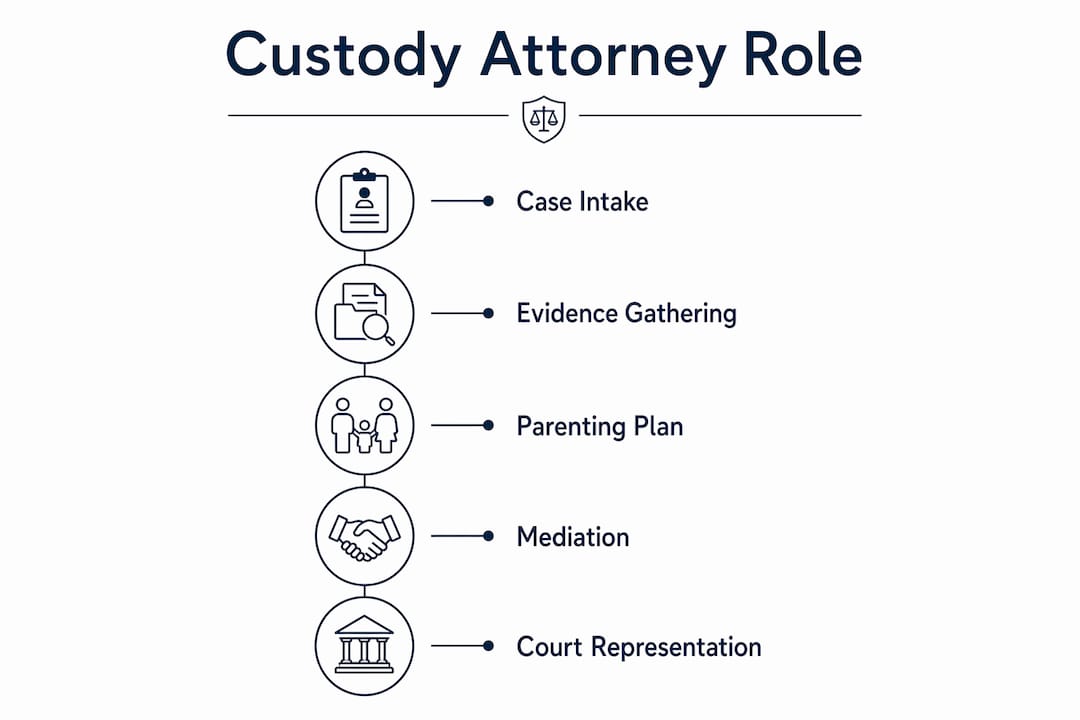
Primary roles of family law attorneys include filing motions, drafting parenting plans, negotiating terms outside court, and providing courtroom advocacy. Each task requires specific legal knowledge that most parents do not have. Missing a filing deadline or submitting the wrong form can delay your case by months or cost you a hearing entirely.
A custody arrangement attorney manages the following core responsibilities:
- Filing legal motions and paperwork. Every custody action starts with formal documents filed in the correct court. Your attorney knows which forms apply under your state’s rules and how to frame the facts legally.
- Drafting and negotiating parenting plans. A parenting plan covers physical custody, legal custody, holiday schedules, and decision-making authority. Attorneys draft these to be specific enough to prevent future disputes.
- Representing you in mediation, hearings, and trials. Most custody cases involve at least one mediation session before trial. Your attorney speaks on your behalf, presents evidence, and cross-examines witnesses.
- Gathering and presenting evidence. School records, medical reports, text messages, and witness statements all require proper handling. Attorneys know what judges find persuasive and how to submit exhibits correctly.
- Advising on custody modifications. Changing circumstances like relocation, employment, or a child’s evolving needs require formal modification requests. Proper legal representation makes those modifications enforceable.
Pro Tip: Keep a dated log of every significant parenting event, communication, or incident from the moment you anticipate a custody dispute. Your attorney can turn that log into admissible evidence.
How do family law attorneys advocate in high-conflict custody cases?

High-conflict custody cases involving parental alienation or narcissistic behavior are among the most complex and emotionally draining legal battles a parent can face. Verbal arguments alone do not win these cases. Courts want documented patterns, not isolated incidents described from memory.
Skilled custody dispute attorneys use specific strategies in difficult cases:
- Document behavioral patterns over time. A single incident rarely changes a judge’s mind. A pattern of documented behavior, recorded consistently over weeks or months, builds a credible picture that courts take seriously.
- Prepare every case as if it will go to trial. Litigation-ready preparation prevents the opposing party from gaining leverage. When the other side knows you are fully prepared, settlement terms often improve.
- Translate emotional concerns into legal arguments. Expert attorneys convert parental concerns into court-relevant arguments focused on child welfare. Judges respond to legal standards, not emotional appeals.
- Apply emotional intelligence to client strategy. Understanding family dynamics helps attorneys advise you on what to say, what not to say, and how to present yourself in court. Behavior in and out of the courtroom affects outcomes.
- Use tactical negotiation to protect your position. Attorneys identify which issues to concede and which to fight. That judgment comes from experience with local judges and similar cases.
Pro Tip: Never send angry texts or emails to the other parent during litigation. Your attorney will tell you the same thing. Those messages become exhibits.
The best outcomes in high-conflict cases come from combining strong evidence with a clear legal narrative. Emotional intelligence and legal preparation work together, not separately.
Why does self-representation put you at a disadvantage in custody battles?
Parents can legally represent themselves in custody cases, but doing so risks unfavorable outcomes because of procedural complexity and the advantages held by opposing attorneys. The risk is not just losing a hearing. It is setting a legal baseline that follows your child for years.
The most serious risk of self-representation is informal agreements. Many parents agree to informal custody arrangements early, and courts often treat those arrangements as the status quo when formal proceedings begin. Changing that baseline later requires proving a substantial change in circumstances, which is a high legal bar.
| Situation | Self-Representation | With a Family Law Attorney |
|---|---|---|
| Filing deadlines | Easy to miss without legal calendar | Managed and tracked by counsel |
| Evidence presentation | Unfamiliar with court standards | Formatted and submitted correctly |
| Opposing counsel | No counter to legal tactics | Matched by experienced advocacy |
| Informal agreements | May become permanent baseline | Reviewed before signing |
| Post-judgment changes | Difficult to modify without legal knowledge | Handled through proper modification filings |
The importance of a family law attorney becomes clearest when the other parent has legal representation and you do not. That imbalance affects every negotiation, every hearing, and every document exchange. An attorney levels that field and ensures your rights are presented with the same force as the opposing party’s claims.
What should you look for when choosing a family lawyer for custody?
Choosing the right custody arrangement attorney starts with local court experience. Judges in family courts have distinct expectations, and attorneys who appear before them regularly understand those preferences. That local knowledge shapes how your case is framed and argued.
Key factors to evaluate when selecting a family lawyer for custody:
- Board certification or specialization in family law. Fewer than 300 attorneys in Florida hold board certification in marital and family law. Specialization signals depth of knowledge that general practitioners cannot match.
- Experience with high-conflict or complex cases. Ask directly whether the attorney has handled cases involving parental alienation, relocation disputes, or mental health considerations. Experience with your specific situation matters more than general years of practice.
- Communication style and responsiveness. You will share sensitive information with this person and rely on their updates during stressful periods. An attorney who explains things clearly and responds promptly reduces your stress and improves your decisions.
- Client reviews and referrals. Verified reviews from past clients in custody cases give you a realistic picture of what working with that attorney looks like day to day.
- Questions to ask at the initial consultation. Ask how many custody cases they handled in the past year, what their approach is to settlement versus litigation, and how they communicate with clients between hearings.
The attorney’s professional background and specialized skills are worth reviewing before your first meeting. Preparation makes that consultation more productive and helps you evaluate fit accurately.
Key Takeaways
A family law attorney in custody cases protects parental rights, builds evidence-based legal arguments, and advocates for custody arrangements that serve the child’s best interests at every stage of the process.
| Point | Details |
|---|---|
| Attorney’s core role | File motions, draft parenting plans, and represent you in mediation and court. |
| High-conflict strategy | Document behavioral patterns over time; prepare every case as if it will go to trial. |
| Self-representation risk | Informal agreements made early often become the court’s permanent baseline. |
| Choosing the right attorney | Prioritize local court experience, specialization, and clear communication. |
| Post-judgment support | Attorneys handle custody modifications triggered by relocation, employment, or a child’s changing needs. |
What I have learned about custody cases after years in family law
The parents who get the best outcomes are rarely the ones who are the most emotional in court. They are the ones who prepared the most thoroughly before they got there. That preparation does not happen by accident. It comes from working with a family lawyer for custody who treats every case as a potential trial, even when settlement seems likely.
One pattern I see repeatedly is parents who wait too long to get legal help. They try to work things out informally, make verbal agreements, and assume good faith will hold. Then the relationship deteriorates, and those informal arrangements become the legal starting point. Reversing that position is expensive and difficult. Getting counsel early costs less than fixing a bad baseline later.
The other thing worth saying plainly: the role of custody lawyer is not just to argue in court. It is to help you think clearly when emotions are running high, to tell you what a judge actually cares about, and to keep your focus on your child’s welfare rather than the conflict with the other parent. The attorneys who do that well are the ones worth hiring.
— Paralegal
Loayzalaw’s family law services for custody cases
Custody disputes require legal representation that combines courtroom experience with genuine care for your family’s outcome. Loayzalaw brings decades of legal experience to family law cases in Utah and Florida, with a track record of more than 1,200 successfully resolved cases across practice areas.

Loayzalaw’s family law team handles parenting plan negotiations, custody modification filings, high-conflict litigation, and post-judgment enforcement. The firm’s approach centers on protecting your parental rights while keeping your child’s welfare at the front of every legal decision. If you are facing a custody dispute and need an attorney who prepares thoroughly and advocates directly, contact Loayzalaw to schedule a consultation and get a clear picture of your legal options.
FAQ
What is the main role of a family law attorney in custody cases?
A family law attorney files legal motions, drafts parenting plans, gathers evidence, and represents you in mediation and court hearings. Their central goal is to protect your parental rights while advocating for custody arrangements that serve your child’s best interests.
Can I handle a custody case without an attorney?
Parents can represent themselves legally, but self-representation carries serious risks, including procedural errors and informal agreements that courts may treat as permanent. When the other parent has legal counsel, the disadvantage is significant.
How do attorneys handle high-conflict custody cases?
Attorneys in high-conflict cases focus on documenting behavioral patterns over time rather than relying on verbal claims. They prepare every case for trial to prevent the opposing party from gaining leverage in negotiations.
What should I ask a custody attorney at the first consultation?
Ask how many custody cases they handled in the past year, how they approach settlement versus litigation, and how they communicate with clients between hearings. Local court experience and specialization in family law are the most important qualifications to confirm.
When should I hire a family law attorney for a custody dispute?
Hire an attorney before making any informal custody agreements with the other parent. Early legal guidance prevents those arrangements from becoming the court’s baseline and protects your position throughout the entire process.