
In Utah, a theft becomes a felony once the property taken is worth $1,500 or more, and certain items, including firearms, operable vehicles, and property taken directly from another person, are felonies no matter the dollar amount. Prior theft convictions and repeat shoplifting can also push a low-value case into felony territory. If you’re facing an allegation, say nothing to police beyond identifying yourself, hold onto every receipt, text, or witness contact you have, and talk to a defense attorney before you talk to anyone else.
TL;DR:
- Theft of property worth $1,500 or more automatically constitutes a third-degree felony, with penalties up to five years in prison and a $5,000 fine.
- Firearms, operable vehicles, and property taken directly from a person are felony-level offenses regardless of value, and repeat theft convictions can elevate charges even for lower-value cases.
- Prior theft convictions within the past 10 years or thefts exploiting vulnerable adults can significantly increase charges, often pushing misdemeanor cases into felony territory.
- Effective defense hinges on preserving evidence quickly, challenging charges based on intent, and identifying procedural issues like improper notice or statute misapplication.
- Restitution and civil penalties can add substantial financial burdens beyond convicted fines, with parties often facing several months to years before case resolution.
Table of Contents
- How Utah Classifies Theft Charges: Value Tiers and Penalties
- Theft By Deception, Retail Theft, and Other Specific Charges
- How Prior Convictions and Repeat Offenses Raise the Charge
- What Happens After You’re Charged: Process and Outcomes
- Common Defenses and Practical Steps to Fight the Charge
- How Loayza Law Handles Theft Cases in Utah
- How Long a Utah Theft Case Typically Takes
- Restitution, Court Costs, and Other Financial Obligations
- A Paralegal’s Perspective: What Actually Matters Right Now
- Talk to Loayza Law About Your Utah Theft Charge
- Useful Statutes and Court Resources
- Sources
- FAQ
How Utah Classifies Theft Charges: Value Tiers and Penalties
The core question in any Utah theft charge is simple: how much was the property worth? Utah Code answers that with four tiers, and the dollar line you land on decides whether you’re facing a misdemeanor citation or a prison sentence.
- Class B misdemeanor: property valued under $500, punishable by up to 6 months in jail and a $1,000 fine.
- Class A misdemeanor: $500 to $1,499, punishable by up to 364 days in jail and a $2,500 fine.
- Third-degree felony: $1,500 to $4,999, punishable by up to 5 years in prison and a $5,000 fine.
- Second-degree felony: $5,000 or more, punishable by up to 15 years in prison and a $10,000 fine.
Those brackets come straight from the theft by deception statute, and the same value ladder applies to general theft charges under Title 76. A firearm or an operable motor vehicle is automatically a second-degree felony no matter what it’s worth, and theft of property taken directly from someone’s person carries its own felony treatment regardless of value. Courts also order restitution on top of any fine, so the financial exposure in a felony case routinely exceeds the statutory maximum fine alone. If you’re staring down a misdemeanor charge and want to understand exactly what a conviction record looks like, Loayzalaw’s breakdown of Utah misdemeanor classes walks through sentencing specifics in more depth.
Theft By Deception, Retail Theft, and Other Specific Charges
Police reports rarely just say “theft.” They cite a specific statute, and each one has its own moving parts.
- Theft by deception requires the prosecution to prove you obtained someone’s property through a false statement or promise made with the purpose of depriving them of it. Under § 76-6-405, ordinary sales exaggeration, what the law calls puffing, doesn’t count. Neither does a false statement with no real financial significance. The statute demands actual pecuniary deception, not just an optimistic sales pitch.
- Retail theft, covered separately under § 76-6-602, targets specific store-related conduct: concealing merchandise, switching or altering price tags, under-ringing items at a register, and removing shopping carts from store property. The same value thresholds from general theft apply, and the statute includes mandatory jail language for certain retail theft convictions, meaning a judge may have less discretion to impose probation alone.
- Receiving stolen property and embezzlement get charged instead of straight theft when the facts fit better. Receiving stolen property applies when someone knowingly holds or sells property they know was stolen by someone else. Embezzlement applies when a person lawfully possessing property, often an employee handling company funds, converts it to their own use.
- Metal theft and catalytic converter theft carry their own add-on provisions in Utah law, reflecting how common these thefts have become and the higher penalties lawmakers attached to them.
How Prior Convictions and Repeat Offenses Raise the Charge
A theft that would otherwise be a low-level misdemeanor can jump to felony status because of what happened before, not just what happened this time.
- Two qualifying theft-related convictions within the past 10 years can elevate a new theft under $1,500 to a third-degree felony, even though the dollar amount alone would only justify a misdemeanor.
- A prior felony theft conviction within 10 years triggers its own enhancement under § 76-6-404.
- Retail theft carries a distinct repeat-offender rule: if a merchant has already given someone written notice after a prior shoplifting incident, a subsequent theft at that store within roughly five years can be charged more severely.
- Exploiting a vulnerable adult during a theft adds separate, harsher penalties on top of the standard value-based tier.
Prosecutors also have real discretion in which statute they charge under, a point Utah courts have upheld directly (State v. Stevens). That means arguing “they charged me under the wrong statute” rarely works.
Pro Tip: Ask your attorney to pull the merchant’s prior written notice records early. If a retail theft enhancement hinges on a notice that was never properly delivered or documented, that’s a real point of leverage in negotiations.
What Happens After You’re Charged: Process and Outcomes
Getting arrested for theft sets off a fairly predictable sequence, and understanding it takes some of the fear out of the unknown.
- Arrest and booking. You’re taken into custody, processed, and either released on your own recognizance, given a citation, or held pending a bail hearing depending on the severity of the charge and your criminal history.
- Arraignment. This is your first real court appearance, where the charges are formally read and you enter an initial plea, almost always “not guilty” at this stage while your attorney reviews the evidence.
- Pretrial resolution. Cases resolve one of several ways: outright dismissal if the evidence is weak, a diversion program that lets first-time offenders avoid a conviction by completing conditions like restitution and classes, a negotiated plea to a reduced charge, or trial.
- Sentencing or dismissal. A conviction, whether by plea or verdict, triggers sentencing, which almost always includes mandatory restitution to the victim on top of any fine or jail time.
Shoplifting cases carry an added wrinkle: Utah’s retail theft statute allows merchants to pursue civil penalties separately from the criminal case, so a single incident can produce both a criminal record and a civil demand letter, unlike in California shoplifting penalties where the law treats shoplifting differently. Beyond the courtroom, a theft conviction can follow you into job applications, professional licensing boards, and, for noncitizens, immigration proceedings, where even a misdemeanor theft conviction can trigger serious consequences.
Common Defenses and Practical Steps to Fight the Charge
Most theft cases turn on one element: intent to deprive the owner of their property. Prosecutors often lean on circumstantial evidence and statutory presumptions, like the presumption that follows from possessing recently stolen property, to fill that gap. That’s exactly where a defense attorney focuses.
- Lack of intent: you didn’t mean to permanently deprive the owner, you intended to return the item, or you believed you had permission.
- Mistake of fact: you reasonably believed the property was yours or that you had a right to take it.
- Consent: the owner actually agreed to the transfer, undermining the theft claim entirely.
- Entrapment: law enforcement induced conduct you wouldn’t otherwise have committed.
- Insufficient evidence: the state can’t prove value, possession, or intent beyond a reasonable doubt.
Attacking the “intent to deprive” element directly, rather than arguing the state picked the wrong statute, tends to be the stronger strategy given how much discretion prosecutors have in charging decisions.
Pro Tip: Get your receipts, texts, and any witness names to your attorney immediately, and ask for surveillance footage requests to go out fast. Store video often gets overwritten within days, and once it’s gone, a key piece of evidence goes with it.
How Loayza Law Handles Theft Cases in Utah
The firm has extensive experience representing clients through Utah’s criminal justice system. That experience shapes how the firm approaches a theft allegation from day one.
- Early evidence preservation: requesting surveillance footage, receipts, and witness statements before they disappear.
- Charging analysis: reviewing exactly which statute and value tier the state charged, and whether the evidence actually supports it.
- Negotiation strategy: pursuing diversion, reduced charges, or dismissal where the facts allow.
- Trial preparation: building a defense around the specific elements the prosecution must prove.
Bring any paperwork you’ve received, a timeline of events, and a list of potential witnesses to your first consultation. Ask direct questions: what charge tier applies to your case, what a realistic outcome looks like, and what evidence needs to be preserved right now.
How Long a Utah Theft Case Typically Takes
There’s no single timeline that fits every theft case, but a rough pattern holds across most misdemeanor and felony charges in Utah’s district and justice courts. Arraignment usually happens within days to a few weeks of arrest or citation, depending on how the case was initiated and whether you were booked into jail or simply issued a summons.
From there, misdemeanor cases, especially Class B and Class A charges, often resolve within two to four months if the parties reach a plea agreement or the case qualifies for diversion. Felony theft cases move slower. Between the preliminary hearing, discovery exchange, and pretrial motions, a third-degree or second-degree felony theft case commonly takes six months to a year to reach resolution, and contested cases that go to trial can stretch well beyond that.

Several factors speed things up or slow them down: whether the prosecution and defense agree on a plea early, whether the defense needs to file motions challenging the evidence, how backed up the specific court’s calendar is, and whether the case involves multiple charges or codefendants. Diversion agreements, when available, sometimes extend the overall timeline because they require completing conditions like classes or restitution payments over several months before the case formally closes.
Because these timelines vary so much by court and county, checking your case status directly against the court record is worth doing regularly rather than relying on secondhand updates. Missing a scheduled hearing, even by accident, can result in a warrant, which turns a straightforward theft case into a much bigger problem.
Restitution, Court Costs, and Other Financial Obligations
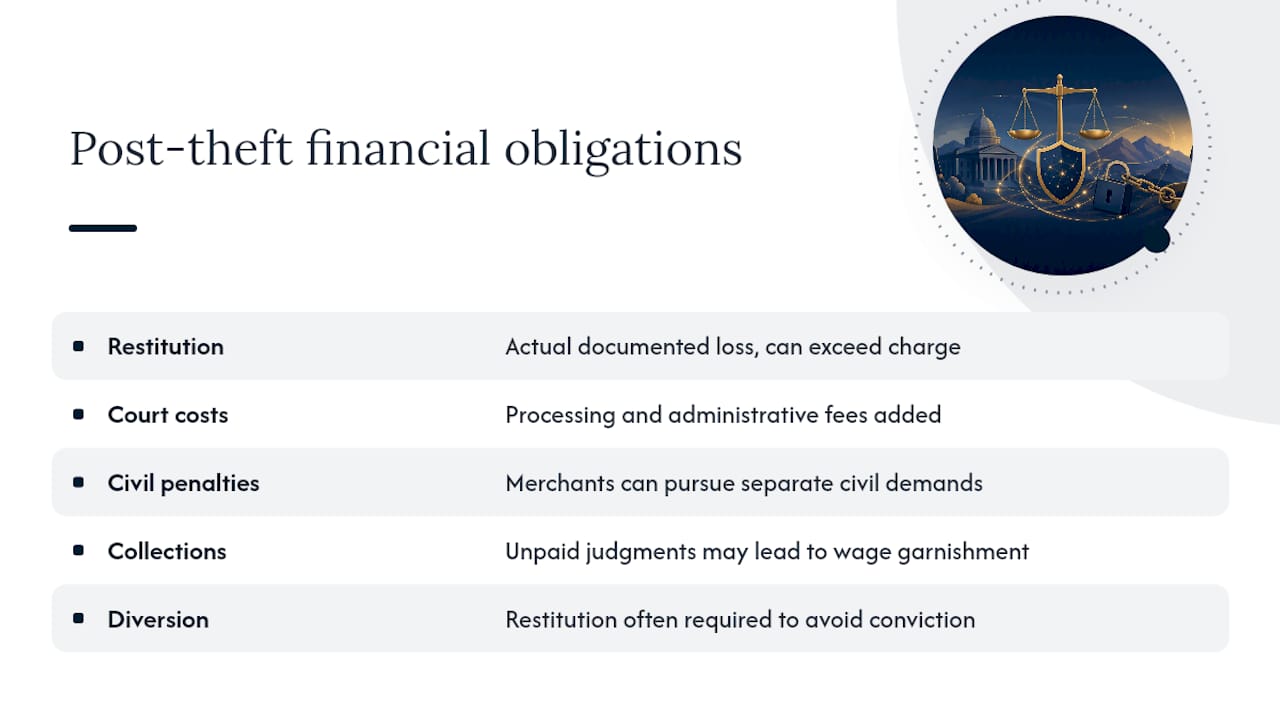
A theft conviction rarely ends with just a fine. Utah law requires courts to order restitution to the victim as a standard part of sentencing, separate from and in addition to any statutory fine.
Restitution covers the actual value of what was taken or damaged, and courts calculate it based on documented loss, not the charge tier alone. If you’re convicted of stealing an item worth $1,200 but the store also documents damage to packaging or lost business costs tied directly to the incident, that full amount can factor into the restitution order. This is why the dollar figure named in a charging document and the amount you ultimately owe don’t always match.
Beyond restitution, defendants typically face court costs and administrative fees that get tacked onto a judgment, separate line items that cover processing and case administration. Retail theft cases add another layer: merchants can pursue civil penalties independent of the criminal case, meaning a shoplifting conviction can generate a civil demand letter on top of criminal restitution. If restitution or a related judgment goes unpaid, it can lead to wage garnishment or other collection actions, similar to the process described in Loayzalaw’s guide on responding to wage garnishment in Utah.
Diversion agreements often bundle restitution into the conditions for avoiding a formal conviction, so paying it promptly and completing any required classes can be the difference between a dismissed case and a permanent record.
A Paralegal’s Perspective: What Actually Matters Right Now
Clients waste critical time trying to explain their side to police before calling an attorney. That rarely helps and often adds statements prosecutors later use against them. The realistic goal in most Utah theft cases isn’t a dramatic acquittal, it’s negotiating a lower tier, securing diversion, or minimizing restitution. Preserve your evidence, stay quiet beyond basic identification, and get counsel involved immediately.
— Paralegal
Talk to Loayza Law About Your Utah Theft Charge
A theft charge in Utah moves fast, and the difference between a felony conviction and a dismissed case often comes down to how quickly evidence gets preserved and how the charging statute gets challenged. The firm brings extensive Utah criminal defense experience, focusing on the specific elements prosecutors have to prove rather than generic courtroom promises.

Whether you’re facing a Class B misdemeanor shoplifting citation or a second-degree felony allegation involving a higher-value item, the firm’s Criminal Defense practice in Salt Lake City handles the full range of Utah theft cases, from early evidence requests through trial. A first consultation typically covers the charge tier you’re facing, what evidence needs to be locked down immediately, and what a realistic resolution looks like given your record and the facts. Call to schedule that consultation before your next court date arrives.
Useful Statutes and Court Resources
- Theft by deception, § 76-6-405
- Theft elements, § 76-6-404
- Retail theft, § 76-6-602
- Utah courts calendar
- Utah Department of Corrections offender search
This article is general information, not a substitute for advice from a qualified lawyer. Consult a qualified legal professional about your own circumstances before acting on anything here.
Sources
- 76-6-405 – Theft by deception. – Utah Statutes
- 76-6-602 Retail theft – Utah Code (FindLaw)
- 76-6-404 – Theft–Elements – Utah Statutes
FAQ
How much do you have to steal in Utah for it to be a felony?
Theft becomes a third-degree felony at $1,500 in value and a second-degree felony at $5,000, under Utah’s theft statutes. Certain items, including firearms, operable vehicles, and property taken from a person, are felonies regardless of value.
What happens if I get charged with theft?
You’ll typically go through arrest or citation, arraignment, and then a pretrial phase where the case resolves through dismissal, diversion, a plea agreement, or trial. A conviction almost always includes mandatory restitution to the victim on top of any fine or jail time.
Can you get a theft charge dropped?
Yes, charges can be dismissed if the evidence doesn’t support the elements the prosecution must prove, particularly intent to deprive, or resolved through a diversion program that avoids a formal conviction. An attorney at a firm like Loayzalaw can evaluate whether the evidence in your case supports a dismissal, reduced charge, or diversion eligibility.
What is the minimum for felony theft?
The minimum value for a felony theft charge in Utah is $1,500, which triggers a third-degree felony. Below that threshold, theft is charged as either a Class A or Class B misdemeanor depending on the exact value involved.