

Utah requires a helmet for every motorcycle rider and passenger under 21. Riders 21 and older are not required by state law to wear one. The rule sits in Utah Code § 41-6a-1505, in the version effective May 6, 2026. The helmet must meet the federal DOT standard, and a violation is an infraction with a capped fine. If you are hurt in a crash, the statute also protects you from having a missing helmet used against you in a civil case about negligence, injuries or damages. That last point is where a Utah personal injury attorney becomes useful, so we cover it in detail below.
TL;DR
- Riders and passengers under 21 must wear DOT-compliant protective headgear on a Utah highway. Riders 21 and older are not required to by state law.
- The standard is the federal one, 49 C.F.R. § 571.218. A real helmet carries a DOT certification label, and novelty helmets do not meet it.
- A violation is an infraction. The court cannot impose a fine above $110 for a motorcycle, or $25 for an e-bike or motor assisted scooter.
- Utah’s statute says not wearing headgear is not contributory or comparative negligence in a civil case. Insurers still argue fault in other ways, so how your crash is documented matters.
- The rule also reaches e-bikes, motor assisted scooters, high power electric devices and autocycles that are not fully enclosed.
Table of Contents
- Who must wear a helmet in Utah
- What counts as a compliant helmet
- Penalties for riding without a required helmet
- Does not wearing a helmet hurt your injury claim?
- After a crash: what protects your claim
- Other changes riders should know
- How we help after a motorcycle crash
- Our perspective
- FAQ
- Sources
Who must wear a helmet in Utah
The law is built around age, not around the type of road or the rider’s experience. Under § 41-6a-1505(1), an individual under 21 years old may not operate or ride on a highway any of the following unless wearing protective headgear that meets the statute’s standards:
- a motorcycle
- an electric assisted bicycle
- a motor assisted scooter
- a high power electric device
- an autocycle that is not fully enclosed
“Ride” matters here. The rule covers passengers as well as the person at the controls. A 19-year-old on the back seat of a 35-year-old’s motorcycle needs a helmet, even though the driver does not.
The Utah Driver License Division says the same thing in its motorcycle handbook: anyone under 21 who rides on a public street or highway must wear headgear that complies with federal DOT standards. Its motorcycle endorsement page names § 41-6a-1505 as the governing statute.
The exceptions
The statute lists two. The rule does not apply to someone riding within an enclosed cab, and it does not apply to someone operating a class 1 electric assisted bicycle or a motor assisted scooter that was rented from a business or corporate entity.
The point on rentals is narrow. It concerns a rented class 1 e-bike or a rented scooter. It does not cover a motorcycle or a scooter you own.
Out-of-state riders
The law applies to the road, not to where your license was issued. If you are under 21 and ride in Utah, you need the helmet even when your home state has no rule or a different one. If you are 21 or older and visiting from a state with an all-rider law, Utah’s age-based rule is the one that applies while you ride here. Check your home state’s rules for the rest of your trip, since the federal government sets no helmet mandate and each state decides for itself.
What counts as a compliant helmet
Utah does not write its own helmet specification. Section 41-6a-1505(4)(a) adopts the federal motorcycle helmet standard, 49 C.F.R. § 571.218, known as FMVSS 218. For bicycles, motor assisted scooters and electric personal assistive mobility devices, subsection (4)(b) adopts a different federal standard, 16 C.F.R. Part 1203, which is the bicycle helmet rule.
In practice, that gives you two different helmets for two different kinds of riding:
| Vehicle | Utah-adopted standard | What to look for |
|---|---|---|
| Motorcycle | 49 C.F.R. § 571.218 (FMVSS 218) | DOT certification label |
| E-bike, motor assisted scooter, electric personal assistive mobility device | 16 C.F.R. Part 1203 | Bicycle helmet standard compliance |
How to read the label
The National Highway Traffic Safety Administration (NHTSA) says a DOT-compliant motorcycle helmet sold in the United States has a back label listing the manufacturer or brand, the model designation, “DOT,” “FMVSS No. 218” and “CERTIFIED.” NHTSA’s helmet guidance also warns that novelty helmets and fake DOT labels exist, and that novelty helmets are unsafe and should not be bought or worn on a motorcycle.
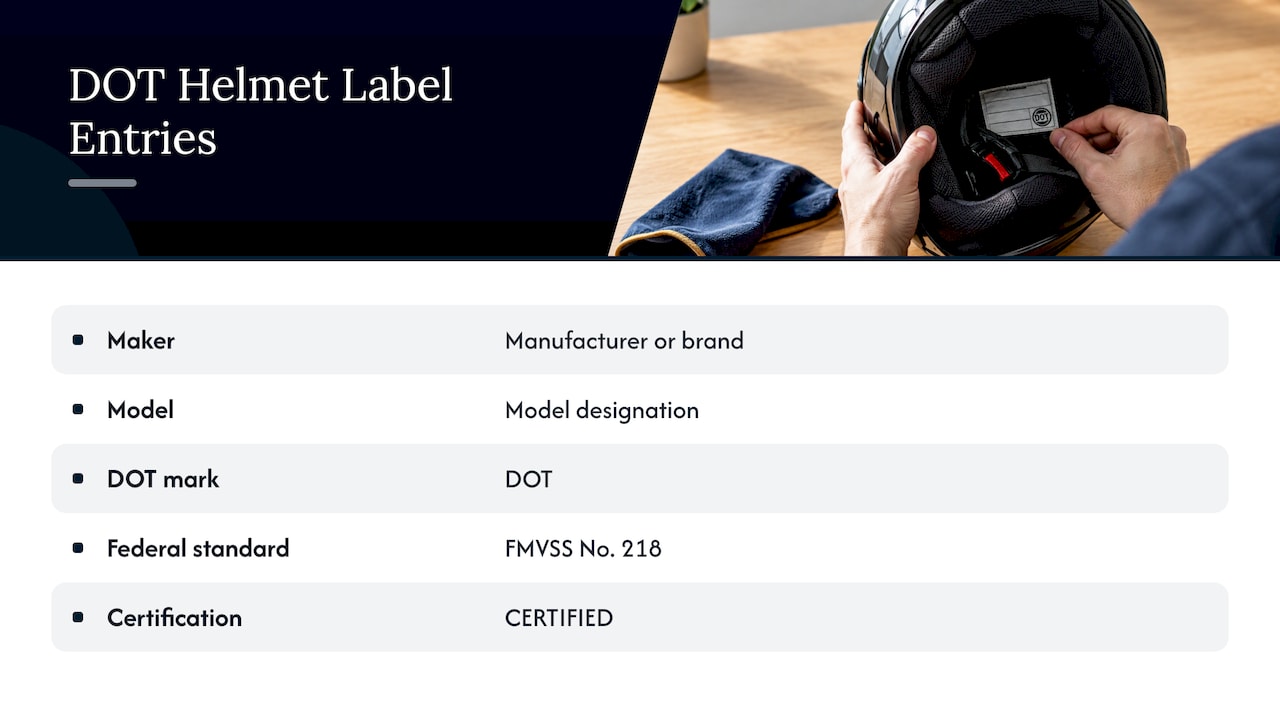
A young rider who wears a novelty helmet is, in legal terms, not wearing compliant headgear. It is the quickest way to turn an ordinary stop into a citation, and the worse risk is a head injury in a crash.
The federal standard itself requires the helmet to be permanently and legibly labeled with specified information, including the DOT certification mark, as NHTSA’s interpretation of Standard 218 explains. A sticker that looks stuck on, has no manufacturer or model line, or lacks “CERTIFIED” is a reason to put the helmet back on the shelf.
Penalties for riding without a required helmet
A helmet violation in Utah is an infraction, not a misdemeanor. The statute sets ceilings on what a court may impose:
- Motorcycle or high power electric device: no more than $110
- Electric assisted bicycle or motor assisted scooter: no more than $25
The 2026 Utah Uniform Fine Schedule, last updated July 1, 2026, lists the same two maximums for § 41-6a-1505. Fine schedules are revised over time, so check the courts’ current schedule if you are looking at a specific ticket.
There is also a small incentive for adults. The Driver License Division handbook explains that a court waives $8 of a fine for a motorcycle operator who was 21 or older at the time and wearing a DOT-compliant helmet. That reduction applies to a moving violation and has no bearing on whether you must wear a helmet.
A ticket is more than the fine
The fine is the small part. A citation can raise questions when it shows up next to other charges from the same stop, or when a young rider’s record matters for school, work or a license. If a helmet citation comes with a DUI, reckless driving or another criminal charge, you want an attorney looking at the whole file. Our criminal defense team in Salt Lake City handles misdemeanor and felony matters. For noncitizens, a stop that grows into something larger can have immigration consequences, which is the reason our page on what happens in the first 48 hours after a DUI exists.
Does not wearing a helmet hurt your injury claim?
This is the question most riders really have, and Utah’s answer favors the rider. Section 41-6a-1505 provides that failure to wear protective headgear does not constitute contributory or comparative negligence, and that it may not be introduced as evidence in a civil action on negligence, injuries or the mitigation of damages. In plain terms, an at-fault driver’s insurer cannot use your bare head to argue that your recovery should shrink.
That protection is specific. It takes one argument off the table. It does not stop an insurer from arguing about everything else in the crash.
Where fault arguments come from instead
Utah uses a comparative fault system. If a jury or adjuster finds you bear a share of the blame, your recovery is reduced by that share, and at the 50% line you can lose it altogether. We explain the line in our guide to the 49% versus 50% comparative negligence rule. The fights in motorcycle cases usually look like this:
- Speed and lane position. The other driver says they never saw you, and that you were going too fast or riding in their blind spot.
- Lane filtering. Utah allows it only under specific conditions, and a rider who filters outside them hands the insurer a fault argument. We lay out the conditions in our article on lane filtering in Utah.
- Evasive action. Insurers argue a rider should have braked or swerved differently.
- Equipment and endorsement. A lapsed endorsement or a defective light gets attention even when it did not cause the crash.
Wearing a helmet remains the best protection against the injury itself. The legal protection above only addresses how fault is argued afterward.
Example: a 24-year-old rider
A 24-year-old on a motorcycle, no helmet, is hit by a driver who turns left across his lane. He is not breaking the helmet law, because he is over 21. The driver’s insurer says he would have avoided the brain injury in a helmet and offers a reduced settlement. Under § 41-6a-1505 that argument does not belong in the negotiation. The real dispute will be who had the right of way and how fast he was going. Evidence on those two points decides the outcome, so photos, witness names and the police report matter more than the helmet.
The same logic applies to a rider under 21. If they were required to wear a helmet and did not, they may face the infraction, but the statute’s civil protection still addresses negligence and damages. The citation and the injury claim run on separate tracks.

After a crash: what protects your claim
A helmet rule is a small part of a motorcycle claim. These steps carry more weight.
- Get medical care right away, and follow the treatment plan. Gaps in treatment are the first thing an adjuster points to.
- Document the scene. Photos of the road, the vehicles, skid marks, traffic signals and your gear. Get the names and numbers of witnesses.
- Keep your damaged helmet and gear. Do not repair, replace or throw out anything until your attorney has seen it.
- Report the crash and get the police report number. Be factual and brief.
- Be careful with recorded statements. An adjuster for the other driver is not working for you, so talk to an attorney before you give one.
- Understand your coverage. Utah’s no-fault system includes personal injury protection (PIP). Our page on what to do when the $3,000 in Utah PIP benefits runs out explains the next step. If the driver who hit you had no insurance, read about protecting an uninsured motorist claim before the four-year limit.
If you also lost wages or were hurt while riding for work, a separate claim may exist. A rider hurt on the job can have a workers’ compensation claim and a claim against a third party at the same time, which we describe in third-party work injury claims in Utah.
Other changes riders should know
The current version of § 41-6a-1505 became effective May 6, 2026, as amended in the 2026 General Session. Its subsection (1) uses the phrase “individual under 21 years old.” Utah’s legislature has also considered other bills touching this section, such as the 2025 Motor Assisted Transportation Devices Amendments, which proposed changes to the helmet requirement for e-bikes and similar devices. The practical lesson for parents is that e-bikes and e-scooters are now handled in the same section as motorcycles, and a teen on an e-bike falls under the same under-21 rule.
Because the section is amended from time to time, confirm the current text on the Utah Legislature’s site if your situation turns on a detail.
How we help after a motorcycle crash
We represent individuals and families across Utah in personal injury, workers’ compensation, criminal defense, family law, immigration, bankruptcy and contract disputes. More than 1,300 clients have trusted us, and we have resolved more than 1,200 cases. When a rider is hurt, our Salt Lake City personal injury team can review how the crash happened, how fault is likely to be argued and what the claim involves. You can read how contingency fees work in personal injury cases before you call, and see everything we handle on our practice areas page.

If a helmet citation arrived with a criminal charge, or an injury has left you with medical bills you cannot manage, tell us which situation you are in when you reach out so we can point you to the right attorney.
Our perspective
Most riders who call us after a crash are surprised by two things. First, they expect the helmet to be the issue, and under Utah law it usually is not. The real questions are who had the right of way, how fast each vehicle was going and whether the evidence was kept.
Second, they expect the process to be simple. A motorcycle claim touches PIP benefits, the other driver’s liability coverage, possible uninsured motorist coverage, and sometimes workers’ compensation if the rider was on the job. Each has its own rules and deadlines.
We believe in client-centered advocacy: you should understand where your case stands and what each decision means. We bring decades of legal experience to personal injury claims, and we answer questions plainly, because a rider recovering from an injury should not also be decoding insurance letters.
If you are a parent, the same applies to a teen who rides. Knowing the under-21 rule, and buying a certified helmet, keeps your family out of both the courtroom and the emergency room.
Paralegal
FAQ
Do I have to wear a helmet on a motorcycle in Utah if I am over 21?
No. Utah’s statute applies to individuals under 21 years old, so an adult rider is not required by state law to wear one. If you are 21 or older and wear a DOT-compliant helmet, a court waives $8 of the fine on a motorcycle moving violation, per the Driver License Division handbook. A helmet remains the best protection against head injury.
What is the fine for riding without a helmet under 21?
It is an infraction. A court may not impose more than $110 for a motorcycle or high power electric device, or more than $25 for an electric assisted bicycle or motor assisted scooter. The Utah Uniform Fine Schedule lists the same maximums, so check the courts’ current schedule for your ticket.
Can not wearing a helmet reduce my settlement after a crash?
Utah’s helmet statute says failure to wear protective headgear is not contributory or comparative negligence and may not be introduced as civil evidence on negligence, injuries or mitigation of damages. Insurers can still argue fault on other grounds, such as speed or lane position. An attorney can review how your crash is being characterized.
Does the helmet law apply to passengers and e-bikes?
Yes. Section 41-6a-1505 covers anyone under 21 who operates or rides, so passengers are included. It also applies to electric assisted bicycles, motor assisted scooters, high power electric devices and autocycles that are not fully enclosed. Rented class 1 e-bikes and rented motor assisted scooters are excepted.
How do I know my helmet is DOT-approved?
Look for the back label. NHTSA says a compliant motorcycle helmet lists the manufacturer or brand, model, DOT, FMVSS No. 218 and “CERTIFIED.” A helmet without that label, or one that carries only a sticker, is a novelty helmet and does not meet Utah’s standard.
Sources
- Utah Code § 41-6a-1505, effective May 6, 2026
- Utah Driver License Division: Motorcycle Section 1
- Utah Driver License Division: Motorcycle Endorsement
- NHTSA: Choose the Right Motorcycle Helmet
- NHTSA interpretation of Standard No. 218
- 2026 Utah Uniform Fine Schedule
- Utah SB 212, Motor Assisted Transportation Devices Amendments (2025)