

An adversary proceeding is a lawsuit that arises in or relates to a bankruptcy case. It begins when someone files a complaint with the bankruptcy court, and it runs separately from the main case. If you have been named as a defendant, the most urgent fact is the clock: you generally have 30 days after the summons is issued to serve an answer. If you are thinking about filing one, the key question is whether your claim falls into one of the categories the federal rules recognize.
This guide explains what these lawsuits are, who brings them, the common types, how filing and service work, what happens after you respond, and how the outcome can affect a discharge. We are a Utah law firm that helps individuals and families with bankruptcy, and we wrote this to help you understand the process before you make decisions.
TL;DR
- An adversary proceeding is a lawsuit within a bankruptcy case, started by a complaint and given its own case number, separate from the main bankruptcy.
- Creditors, trustees and debtors can all be plaintiffs. The most common fights are over whether a debt can be wiped out, whether a discharge should be denied, and whether a payment or transfer should be recovered.
- A defendant must serve an answer within 30 days after the summons is issued, unless the court sets a different time. Ignoring it can lead to a default judgment.
- Individuals may represent themselves, but courts strongly recommend a lawyer, and businesses must have one.
- The result can decide whether a specific debt survives bankruptcy or whether your discharge is at risk.
Table of Contents
- What an adversary proceeding is
- Who files and who is sued
- Common types of adversary proceedings
- The 90-day rule: preferences
- How an adversary proceeding is filed and served
- What happens after the complaint
- What happens if you do not respond
- How the outcome affects your discharge
- Practical steps if you are served
- Our perspective
- Talk to a Utah bankruptcy attorney
- FAQ
- Sources
What an adversary proceeding is
Most of a bankruptcy case is administrative. You file a petition and schedules, attend a meeting of creditors, and the court processes the case. Disputes that need a real lawsuit are handled differently. According to the U.S. Bankruptcy Court glossary, an adversary proceeding is a lawsuit arising in or related to a bankruptcy case, and it starts by filing a complaint.
The important point is that it is not the same thing as your bankruptcy case. The Central District of California explains that an adversary proceeding has its own docket and its own adversary number. You can be in a perfectly ordinary Chapter 7 or Chapter 13 case and still receive a summons in a separate lawsuit tied to it.
That is why people are often confused when the notice arrives. Your bankruptcy may be progressing normally, and then a creditor files a complaint arguing that one particular debt should survive. The two cases are linked, but you must respond to each on its own terms.
Who files and who is sued
Like any lawsuit, there is a plaintiff and a defendant. The Eastern District of New York describes the plaintiff as the individual or business that files the complaint, and the defendant as the individual or business the lawsuit is filed against.
In practice, the roles look like this:
- Creditors sue the debtor, usually to argue that a particular debt should not be discharged, or that the debtor should not receive a discharge at all.
- The bankruptcy trustee sues third parties, such as a creditor who was paid shortly before the filing, to bring money or property back into the bankruptcy estate for distribution.
- The debtor sometimes sues, for example to challenge a lien or to recover property.
In business reorganizations, these suits are frequent. In individual consumer cases, they are less common, but when they happen the stakes are high because they concern a specific debt or the discharge itself.
Common types of adversary proceedings
The categories are not open-ended. Federal Rule of Bankruptcy Procedure 7001 lists the types, and Part VII of the rules governs them. The listed types include proceedings to:
- recover money or property;
- determine the validity, priority or extent of a lien;
- object to or revoke a discharge;
- determine whether a debt is dischargeable;
- revoke an order confirming a plan.
Here is how those categories tend to show up for individuals.
Dischargeability disputes
This is the type consumers most often face. A creditor asks the court to rule that a debt is not dischargeable, meaning it would survive your bankruptcy. Typical arguments involve claims of fraud or willful and malicious injury. Rule 4007 sets a tight window: a complaint to determine dischargeability under the relevant section of the Code is due 60 days after the first date set for the meeting of creditors, and the court can extend that time only on a motion filed before it expires. If you are a creditor, that deadline matters. If you are a debtor, it tells you roughly when this risk window closes.
Objections to discharge
Here the plaintiff, often the trustee or a creditor, argues that you should not receive a discharge at all. This is more serious than a single-debt dispute, because it targets the relief you filed for. These cases tend to turn on whether you were honest and complete in your paperwork and cooperated with the trustee.
Recovery of money or property
Trustees can bring actions to recover transfers made before the filing. One frequent example is a preference claim, discussed next.
Lien disputes
Parties sometimes fight over whether a lien is valid, how it ranks against other claims, or how far it extends. The answer determines who gets paid from the value of an asset.
The 90-day rule: preferences
Readers often ask what the “90-day” rule means in this context. It relates to preferences, one kind of recovery action. Under 11 U.S.C. § 547, a trustee can seek to avoid certain transfers to a creditor made shortly before the bankruptcy filing. The ordinary look-back window is 90 days before the petition. For creditors who are insiders, such as relatives or business affiliates, the window extends to one year.

The statute also presumes that the debtor was insolvent during the 90 days before filing, and it places the burden of proving a transfer is avoidable on the trustee. A creditor defending the claim carries the burden of proving that an exception applies. Those exceptions are in subsection © of the same section and include protections for transfers that were part of a contemporaneous exchange for new value and for payments made in the ordinary course of business. Whether one applies depends on the facts, so a preference demand is a good moment to talk to an attorney rather than guess.
This is separate from the “90-day rule” people sometimes mention for Chapter 7, which is about how recent purchases or cash advances are viewed. If your concern is that, our guide to Chapter 7 versus Chapter 13 is a better place to start.
How an adversary proceeding is filed and served
The mechanics are consistent across districts, though each court has local rules and forms. Check with your court’s clerk or website for current requirements.
- The plaintiff files a complaint. The Eastern District of New York explains that the filing includes the complaint, a cover sheet and any applicable fee. That court lists the current fee for an adversary complaint as $350.00. Fees can change, so confirm the amount with the court where the case is pending.
- The clerk issues a summons. The plaintiff must serve the summons together with the complaint on the defendant.
- The complaint is organized in a set way. The Montana bankruptcy court says a complaint should include sections on jurisdiction, venue, parties, facts, claims for relief and the relief requested.
- The defendant answers. After proper service, the defendant must serve an answer within 30 days after the summons is issued, unless the court prescribes a different time.
Notice that the 30 days run from the date the summons is issued, not from the day you open the envelope. If your paperwork arrives late in that window, you have even less time than you think. Look at the summons itself for the date and any court-set deadline, and act the same day.
Representing yourself or hiring a lawyer
The Northern District of Florida states that individuals may represent themselves, but corporations, partnerships and other business entities must be represented by an attorney. The court also strongly recommends legal counsel, because these cases can involve complex facts and legal questions.
That advice is sound. You are not just filling in a form. You are defending or prosecuting a lawsuit with pleadings, discovery and possibly a trial, and a missed step can cost you a debt or a discharge.
What happens after the complaint
Once the pleadings are filed and served, the case follows a path similar to other civil litigation.
- Pretrial conference. The Eastern District of North Carolina explains that after all pleadings are filed and served, the court sets a preliminary pretrial conference to discuss the issues, discovery and scheduling.
- Discovery. Parties may take depositions, serve interrogatories and request documents, both before and after that conference and before the scheduling-order deadline.
- Resolution. Many cases settle, are decided on motion, or go to trial. The outcome is a judgment in the adversary case that then feeds back into the main bankruptcy.
Discovery is where most defendants feel the weight of the process. You may need to produce bank statements, messages and records about the debt in question. Start gathering them early and do not delete anything.
What happens if you do not respond
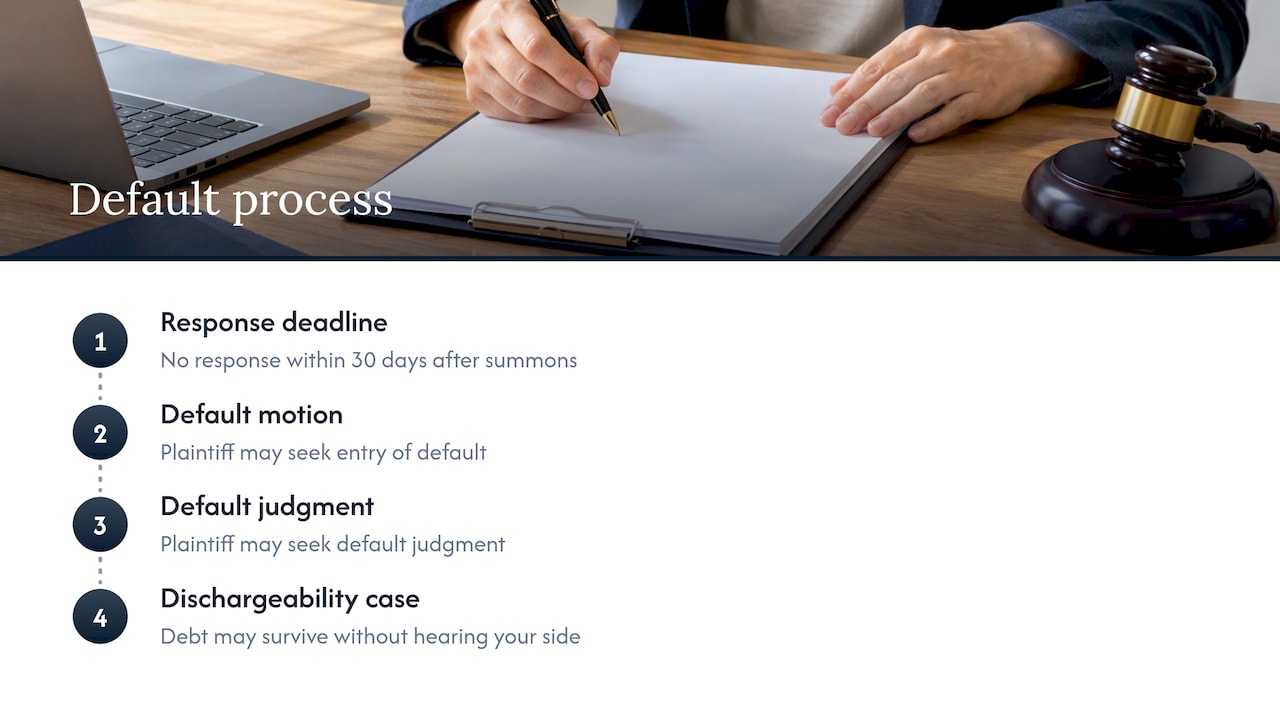
The same North Carolina court notes that if a defendant does not respond within 30 days after the summons is issued, the plaintiff may move for entry of default and then for a default judgment. In a dischargeability case, that can mean a court finding that the debt survives your bankruptcy without ever hearing your side.
If you have already missed a deadline, do not assume it is over. Contact a bankruptcy attorney immediately, because courts sometimes set aside defaults for good reason, and the sooner someone asks, the better the chance. For a general look at how deadlines work after a missed response in other contexts, see our page on what happens when a Chapter 13 case is dismissed and how to respond.
How the outcome affects your discharge
An adversary proceeding can decide whether a debt is dischargeable or whether a discharge should be revoked, both of which are listed in Rule 7001. Here is what that means in plain terms:
| Result | What it means for you |
|---|---|
| Debt found dischargeable | The debt is wiped out with your other eligible debts at discharge |
| Debt found not dischargeable | You still owe that debt after your case ends, though other debts are discharged |
| Discharge denied or revoked | You lose the broader protection you filed for |
| Transfer avoided | The money or property goes back to the estate, and the creditor may have a claim for what it gave up |
| Lien ruling | Determines who has priority in the value of the asset |
Because the stakes differ so much, the first question for any defendant is: what exactly is the plaintiff asking the court to do? Read the “relief requested” section of the complaint first.
Practical steps if you are served
- Write down the deadline. Find the summons date and calculate 30 days, or use the date the court set.
- Read the complaint’s claims and the requested relief. Note which category from Rule 7001 it fits.
- Collect documents tied to the debt or transfer: contracts, statements, emails, receipts.
- Contact your bankruptcy attorney if you have one. If you do not, speak with one before you answer.
- Do not ignore calls or letters from the plaintiff, but avoid making admissions in writing before you understand the claims.
- Be careful with outside offers. A lawsuit can attract companies promising fast fixes. Our readers sometimes find it useful to review the warning signs of debt relief scams, especially upfront fees, before paying anyone.
Our perspective
When clients call us after receiving a summons in an adversary proceeding, the first thing we hear is fear: “I thought my bankruptcy was almost finished.” We understand that reaction. A bankruptcy case is supposed to give people a path forward, and a separate lawsuit can feel like a door slamming.
What we do first is slow the situation down and read the paperwork. Which type of proceeding is this? Who is the plaintiff? What is the deadline? In our experience, most of the harm comes not from the claim itself but from missing the time to respond. That is why we put such emphasis on responsiveness: you should not wait days to hear back when a court clock is running.
We bring personalized legal strategies to each matter, built on decades of legal experience and a commitment to integrity. Our firm has served more than 1,300 clients and resolved more than 1,200 cases, and we approach every bankruptcy-related dispute with the same client-centered advocacy. Our multicultural perspective also helps us communicate clearly with clients from many backgrounds who may be facing the court system for the first time.
If you are in a bankruptcy case in Utah and a creditor or trustee has filed a complaint against you, we would be glad to review it with you and explain your options in plain language.
Paralegal
Talk to a Utah bankruptcy attorney
If you have been served in an adversary proceeding, or you are about to file for bankruptcy and want to understand the risks first, our team can help you plan. We handle Chapter 7, Chapter 13 and Chapter 11 matters, and you can see everything we do on our practice areas page.

For cost questions before you start, read our guide to Utah bankruptcy filing costs, or learn about our Salt Lake City bankruptcy services. Small business owners can also review our page on Subchapter V and small business bankruptcy costs in Utah.
FAQ
What does “adversary proceeding” mean in simple terms?
It is a lawsuit filed inside a bankruptcy case. Someone, such as a creditor, trustee or debtor, files a complaint against someone else, and the dispute is resolved separately from the main case. It has its own docket and case number.
How long do I have to respond to an adversary complaint?
The defendant must generally serve an answer within 30 days after the summons is issued, unless the court sets a different time. Check the summons for the exact date, because the clock does not start when you receive the papers.
Can I handle an adversary proceeding without a lawyer?
Individuals may represent themselves, but courts strongly recommend legal counsel because the facts and legal questions can be complex. Businesses such as corporations and partnerships must have an attorney.
Can a creditor stop a debt from being discharged?
Yes, by filing an adversary complaint asking the court to find the debt not dischargeable. The deadline for most of these complaints is 60 days after the first date set for the meeting of creditors, unless the court extends it on a timely motion. A lawyer can tell you whether the creditor’s claim fits one of the recognized grounds.
Sources
- adversary proceeding | United States Bankruptcy Court
- Bankruptcy Case vs. Adversary Proceeding | Central District of California
- Adversary Proceedings | Eastern District of New York
- Rule 7001. Types of Adversary Proceedings | Federal Rules of Bankruptcy Procedure
- Rule 4007. Determining Whether a Debt Is Dischargeable
- 11 U.S. Code § 547 – Preferences
- Adversary Proceeding Primer | Eastern District of North Carolina
- Filing an Adversary Proceeding Without an Attorney | Northern District of Florida
- What is an adversary proceeding and how do I file a complaint | Montana Bankruptcy Court