

A civil stalking injunction in Utah is a court order that tells another person to stop contacting you and stay away from you. You ask for it by filing a request in district court. If the judge sees a good reason, a temporary order can be issued before the other person has a chance to respond. A final order, issued after a hearing or after the 10-day window passes, lasts three years from the date the temporary order was served. This guide explains who can file, what to prove, what the court does, and what both sides should do next.
We wrote it for two readers: the person who feels unsafe and wants protection, and the person who has just been served and is afraid of what the order means for their life, their job, and their children.
TL;DR
- You can ask for a civil stalking injunction if someone has acted two or more times in a way that would cause a reasonable person fear or emotional distress. Utah Courts explains the standard.
- You file in district court. Utah law says there is no fee to file or to serve a stalking injunction.
- The person who is served has 10 days to request a hearing. At that hearing, the petitioner must prove the stalking by a preponderance of the evidence.
- A final injunction lasts three years from the date the temporary order was served.
- Violating an injunction can lead to criminal charges, so both sides need to understand exactly what the order says.
Table of Contents
- What counts as stalking for a civil injunction in Utah
- How to file a civil stalking injunction in Utah
- The temporary injunction and the 10-day hearing
- What a final injunction can require and how long it lasts
- What happens if someone violates the injunction
- Civil injunction at a glance
- Our perspective
- When an attorney helps
- How we can help
- Frequently asked questions
- Sources
What counts as stalking for a civil injunction in Utah
Utah does not require a dramatic incident. According to the state court system, a person may file when the respondent has acted two or more times in a way that would cause a reasonable person to suffer emotional distress or to fear for their own safety or the safety of someone else. The key phrase is “reasonable person.” The question is not only how you felt, but whether an ordinary person in your position would have felt afraid or seriously distressed.
The law calls this pattern a course of conduct. Utah Courts describes it as two or more acts such as following, monitoring, photographing, threatening, or communicating with someone, directly or indirectly, by any method, device, or means. That wording is broad on purpose. It reaches:
- Showing up repeatedly at your home, school, or workplace
- Tracking your movements, including through a device or an app
- Sending messages through texts, social media, email, or other people
- Taking photographs of you or your property without your consent
- Threats, spoken or written
One text message is not a course of conduct. Ten messages sent over a week after you asked the person to stop, combined with a car parked outside your building, may well be.
Who can file
An individual who believes they are a victim of stalking may petition for a civil stalking injunction under Utah Code Title 78B, Chapter 7. A minor can file alone or through a parent, guardian, or custodian.
Who cannot be named
The same statute says a stalking injunction cannot be obtained against a law enforcement officer, a governmental investigator, or a licensed private investigator.
Stalking injunction versus protective order
People often mix these up. A cohabitant protective order is built for people who live together, are related, or share a household relationship. A stalking injunction fits where the people are not in that kind of relationship: a neighbor, a former coworker, an acquaintance, an ex who never lived with you. If your situation involves a spouse or former spouse, a cohabitant, or a shared child, ask an attorney which order fits best, because the choice affects what the court can order and how the case connects to any divorce or custody matter.
How to file a civil stalking injunction in Utah
The process runs through the district court. The court’s self-help page lays out the steps, and we have put them in the order most people follow.
- Choose the courthouse. You can file in the district court where you live, where the respondent lives, where you are temporarily staying, or where the events took place.
- Complete the forms. Utah Courts lists the Request for Civil Stalking Injunction, the Service Assistance Form, the Temporary Civil Stalking Injunction, the Civil Stalking Injunction, and the Request for Hearing.
- Attach your proof. Police reports, witness statements, recordings, photos, or letters all help.
- Submit the packet. A judge reviews the request and the proof.
- Wait for the temporary decision. If the judge finds a good reason, a temporary order may be issued.
- Service. The respondent must be served with the paperwork. The order is not effective against the respondent until they know about it.
What it costs
Money stops many people from filing, so here is the answer plainly. Utah Code section 78B-7-105(4) provides that there is no fee to file for a stalking injunction or to serve one. Hiring an attorney is a separate choice with its own cost, which we discuss below.
Building evidence that holds up
A judge decides from what is in front of them. These habits make a petition stronger:
- Keep a dated log. Write down each incident the same day: date, time, place, what happened, who saw it.
- Save everything in original form. Screenshots help, but keep the original messages, voicemails, and call records on the device.
- Do not delete or edit. Even an angry reply from you can be used. Stop responding once you have told the person to stop.
- Report to police when you feel unsafe. A police report is among the types of proof the court lists.
- Name witnesses. A neighbor, coworker, or friend who saw the conduct can give a statement.
- Show the pattern. The law looks for two or more acts, so connect the incidents instead of presenting them one at a time.
If you are in immediate danger, call 911 first. The court process is for protection over time, not for emergencies in progress.
The temporary injunction and the 10-day hearing
The first order is usually decided on paper. The judge reviews your request and proof and may grant a temporary civil stalking injunction if there is a good reason. The respondent is not in the room at that stage.
That is why the next step matters so much. According to Utah Courts, the respondent may request a hearing within 10 days after being served, and the court will notify the petitioner of the hearing date.

If you are the petitioner
If a hearing is set, treat it as the main event. The judge listens to both sides and decides whether to dismiss, make, or modify the injunction. You must prove why it is needed, so bring your evidence organized and in copies: the log, the messages, the photos, the police report, and any witness who can attend. Under the Utah Code, the petitioner bears the burden of proving by a preponderance of the evidence that stalking occurred. That means more likely than not. It is a lower standard than the “beyond a reasonable doubt” standard in criminal court, but it is still a burden you carry.
If you were served
Read the order from start to finish the day you receive it. Then:
- Count 10 days from service and request a hearing in that window if you dispute the claims.
- Comply with the order while you wait. A temporary order is enforceable even if you think it is wrong.
- Do not contact the petitioner to argue, apologize, or ask them to withdraw. Contact through a friend can also be treated as contact.
- Gather your own evidence: messages that show the contact was mutual or innocent, records that show you were elsewhere, and witnesses.
- Talk to an attorney before the hearing.
You can still ask for a hearing after the 10 days, but the position changes. The court explains that you must then persuade the judge the injunction is not needed, and the Utah Code says the burden is on you to show good cause for dissolving or changing it. Waiting makes the case harder.
What a final injunction can require and how long it lasts
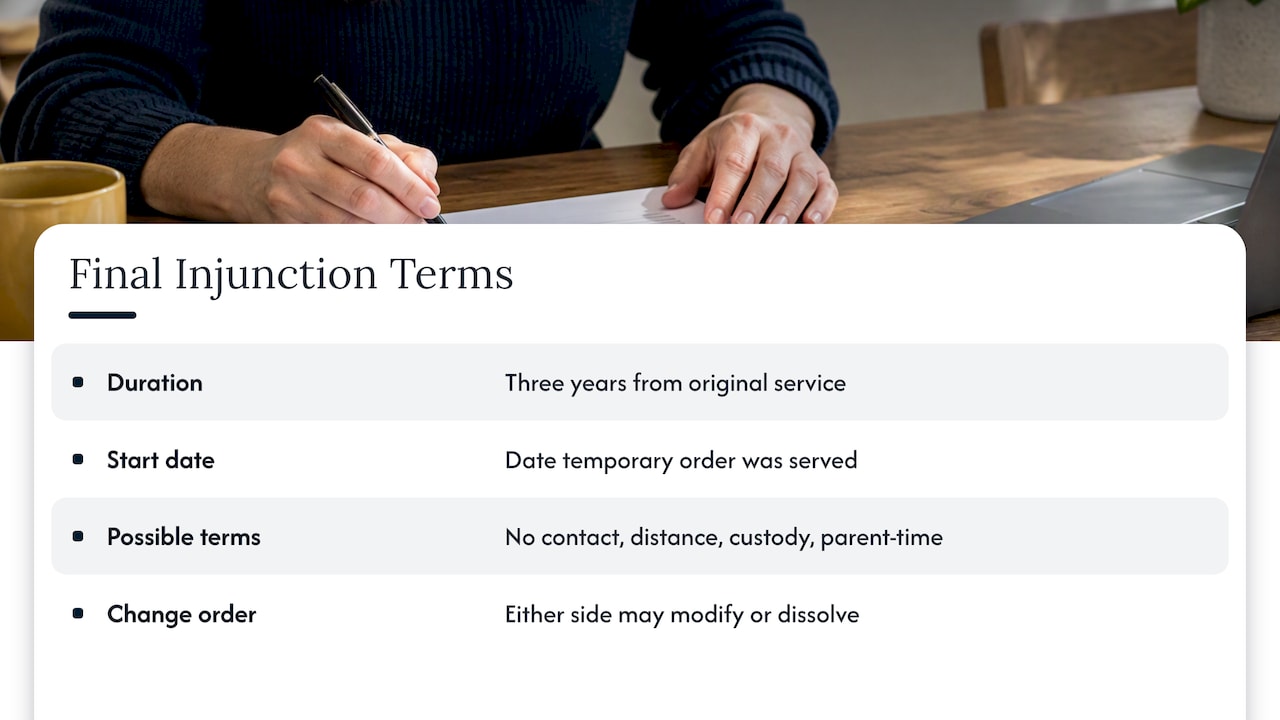
A final civil stalking injunction can prohibit the respondent from contacting the petitioner or coming near them and other designated persons. The court notes it may also address child custody and parent-time, which is where these cases often intersect with family court.
The order remains in effect for three years from the date the original temporary order was served. Mark that date, not the date of the hearing. If circumstances change before then, either side can ask the court to modify or dissolve the order, and the burden rules above apply.
Practical consequences for the respondent can reach beyond the no-contact term. If you share a workplace, a school, a church, or a child with the petitioner, the order has to be read against those facts. Ask the court, through your attorney, to spell out how exchanges and shared spaces will work, so a normal day does not become a violation.
What happens if someone violates the injunction
This is the part respondents most often underestimate. A civil order is not only civil. Under Utah’s 2022 legislation, stalking is a class A misdemeanor if the offender violates a civil stalking injunction. The Legislature framed the injunction as an added enforcement tool next to the usual criminal and civil remedies.
If you want to see how courts treat violating a protection order more generally, and which conduct such orders prohibit, that page walks through the protections in plain terms. Orders differ by state, so rely on Utah’s statute and your own paperwork for the rules that apply to you.
For the penalty side, our guide to Utah misdemeanor classes explains what class A, B, and C mean in practice.
Criminal stalking is a separate matter
A civil injunction and a criminal stalking charge can exist side by side, and one does not depend on the other. Under the same statute, stalking can rise to a third-degree felony in situations such as specified prior convictions or cohabitant status, and to a second-degree felony for use of a dangerous weapon or specified multiple prior convictions. For a plain-language breakdown of what those levels mean, see Utah felony degrees.
If police contact you about stalking, or a prosecutor files charges, the best move is to say little and call a criminal defense attorney. Anything you say about a civil case can be used in a criminal one.
Civil injunction at a glance
| Question | Answer |
|---|---|
| Where to file | District court where you or the respondent live, where you are staying, or where events occurred |
| Minimum conduct | Two or more acts that would cause a reasonable person fear or emotional distress |
| Filing and service fee | None, under Utah Code 78B-7-105(4) |
| Time to request a hearing | 10 days after service |
| Who must prove stalking | Petitioner, by a preponderance of the evidence |
| Duration of final order | Three years from service of the original temporary order |
| Violation | Class A misdemeanor |
Our perspective
We meet people on both sides of these orders, and both are frightened. The petitioner fears for their safety. The respondent fears for their record, their job, and sometimes their time with their children.
Our view is that the 10-day window is the most important deadline in the case, and people lose ground by treating it casually. A respondent who waits has to prove good cause later, and a petitioner who arrives at a hearing without organized proof may leave without the protection they came for.
Because a violation can become a criminal charge, we encourage clients to have an attorney read the order with them line by line, and to ask what it means for exchanges of children, shared workplaces, and social media. When an injunction overlaps with a custody or divorce matter, the stakes rise, and the same facts can appear in several courtrooms. Careful, early representation is how we help clients keep those cases consistent.
We approach every matter with compassion, honest advice about the evidence, and a commitment to responsiveness, because people in this situation should not have to chase answers.
Paralegal
When an attorney helps
You are not required to have a lawyer to file or to respond. Many petitioners file on their own using the court’s forms. A lawyer is worth considering when:
- The respondent has requested a hearing and you need to present evidence and examine witnesses
- You were served and face possible criminal exposure or consequences for custody, employment, or licensing
- The case overlaps with divorce, custody, or parent-time orders
- You are not a citizen and a criminal charge could affect your immigration status
- The order has been violated, or you believe it was violated by mistake
If the order touches children, see how temporary orders in a Utah divorce work and how a custody modification can be handled, since the court may address parent-time in the injunction itself.
How we can help
Loayza Law represents individuals and families in Utah across criminal defense, family law, immigration, and other practice areas. If you were served with a stalking injunction, or a stalking allegation has led to a criminal charge, our criminal defense team in Salt Lake City can review the order and the evidence with you. If the matter involves custody or parent-time, our family law practice can coordinate with it. We have served more than 1,300 clients, and we explain your options in plain language from the first call.

To see everything we handle, visit our practice areas page.
Frequently asked questions
Do I need a police report to get a stalking injunction in Utah?
No report is listed as mandatory. Utah Courts names police reports as one example of useful proof, along with witness statements, recordings, photos, and letters. A report can strengthen your request, especially if it documents specific incidents.
Can the other person find out I filed before the order is in place?
The judge can review your request and grant a temporary order based on your paperwork, without a hearing first. The respondent learns of it when they are served. The court then notifies you of any hearing date.
What if I was served and I did nothing wrong?
Request a hearing within 10 days of service, comply with the order in the meantime, and gather your own evidence. At the hearing, the petitioner must prove stalking by a preponderance of the evidence. Speak with an attorney before the hearing.
Can a stalking injunction be changed or ended early?
Yes. Either side can ask the court to modify or dissolve it. After the first 10 days, the person asking must show good cause. A judge decides based on the facts at that time.
Does the injunction affect child custody?
It can. A final order may address custody and parent-time, so tell your attorney about any custody case before the hearing.
Sources
- Civil Stalking Injunction, Utah Courts self-help
- Utah Code Title 78B, Chapter 7, Part 7 (effective May 7, 2025)
- Utah Legislature HB0175 (2022)
- How much does it cost to get a stalking injunction? WomensLaw.org