

Yes, Utah courts grant annulments, but only when you can prove specific statutory or common-law grounds under Utah Code §81-4-302, never simply because a marriage was short-lived. An annulment declares the marriage never legally existed. If your situation does not fit the recognized grounds, the smarter move is filing a combined petition for annulment or divorce, or consulting an attorney before you file anything at all.
TL;DR:
- Annulments in Utah are only granted if you can prove specific statutory or common-law grounds, such as bigamy, close kinship, or material fraud.
- Evidence for annulment cases depends heavily on the grounds, with documents like hidden prior marriages or proof of duress often necessary.
- Annulments do not automatically erase property, debts, or child support obligations, which courts allocate based on equitable principles.
- Filing must be in the county where you or your spouse reside, with deadlines of 21 days for Utah service and 30 days for outside Utah responses.
- Combining annulment and divorce petitions allows for a fallback if grounds for annulment are not met, saving time and legal effort.
Table of Contents
- Annulment vs Divorce in Utah: What Actually Changes
- What Are the Grounds for Annulment in Utah?
- Where Do You File and How Much Time Do You Have?
- How Do You File for Annulment in Utah, Step by Step?
- What Evidence Do You Need to Prove Your Grounds?
- Does Annulment Erase Property, Debt, and Child Support Obligations?
- Annulment or Divorce: How Do You Decide?
- A Paralegal’s View on Utah Annulment Cases
- How Loayza Law Supports Utah Annulment and Family Law Cases
- Sources
Annulment vs Divorce in Utah: What Actually Changes
An annulment and a divorce solve different legal problems, even though both end up in the same courtroom. Divorce dissolves a marriage the law recognizes as valid. Annulment, by contrast, is a judicial finding that the marriage was never legally valid in the first place, whether because it violated a statutory prohibition or because one party’s consent was legally defective.
That distinction has real consequences. Someone whose marriage is annulled is generally free to remarry immediately, without waiting for a divorce decree to become final. Utah does not impose a separate mandatory waiting period specific to annulment proceedings the way it structures divorce timelines, according to guidance from Utah’s self-help annulment page.
But “never existed” is a legal fiction with limits. Courts still have authority to sort out what happened while the marriage functioned:
- Property acquired during the marriage can still be divided equitably.
- Debts incurred jointly may still be allocated between the parties.
- Support obligations and parentage determinations for children born during the marriage typically remain intact.
Annulment is a statement about legal status, not a financial eraser. Utah Code §81-4-303 gives the court venue authority and judgment power specifically to resolve these questions when marriage validity itself is in dispute.
What Are the Grounds for Annulment in Utah?
Utah law splits annulment grounds into two categories, and the difference between them determines how hard your case will be to prove. Statutory grounds make a marriage automatically void. Common-law grounds make a marriage voidable, meaning a court has to actively declare it invalid based on evidence you present.
- Bigamy. A marriage entered into while either party is still legally married to someone else is void under §81-4-302, regardless of intent.
- Prohibited kinship. Marriages between close relatives fall under Utah’s incest prohibitions and are void from the outset.
- Underage marriage without required consent. Utah restricts marriage for minors and requires specific parental or judicial approval; a marriage entered without that approval can be annulled.
- Material fraud. One party lied about something central to the decision to marry, such as concealing a prior marriage, hiding a serious criminal history relevant to safety, or misrepresenting the intent to have children when that was a condition of the union.
- Duress or force. Consent obtained through threats, coercion, or physical force is not legally valid consent.
- Incapacity to consent. Mental incapacity, severe intoxication, or other conditions that prevented a party from understanding what marriage meant at the time can support annulment.
- Impotence or non-consummation. Utah recognizes this as a ground when it can actually be proven and was undisclosed before marriage.
The fraud category trips up more people than any other, mostly because they misjudge what counts. Lying about your age by a year or exaggerating your income are not material misrepresentations, according to practice guidance on Utah annulment cases. Concealing that you were already married when you took your vows is. Courts look at whether the truth would have changed the decision to marry, not whether someone was less than perfectly honest on a first date.
Where Do You File and How Much Time Do You Have?
Venue in an annulment case follows the same logic as most family law filings in Utah: you file in the district court for the county where either you or your spouse currently lives, under the framework laid out in Utah Code §81-4-303. There is no residency waiting period unique to annulment the way some states require for divorce, but you still need to establish that you or your spouse actually live in the county where you’re filing.
Proof of residency is usually straightforward: a driver’s license, a signed lease, a utility bill in your name, or a voter registration card tied to the address. Keep these documents together before you file. A clerk who cannot verify venue will send your case back, and that delay costs you weeks you don’t need to lose.
Once you serve your spouse with the petition, the clock starts on their response window.
- 21 days to respond if your spouse is served within Utah.
- 30 days to respond if your spouse is served outside Utah.
If your spouse doesn’t respond within that window, you can typically request a default judgment, meaning the court can grant the annulment based on your petition alone, without a contested hearing. That single fact catches a lot of petitioners off guard: doing nothing after being served does not protect a respondent’s interests. It usually forfeits them.
How Do You File for Annulment in Utah, Step by Step?
Utah Courts publishes the exact forms you need, and knowing the numbers ahead of time saves you a frustrating trip back to the courthouse.
- Complete form 3001FA, the Verified Petition for Annulment or in the Alternative for Divorce, available directly from Utah Courts. This form lets you plead your annulment grounds while simultaneously requesting divorce as a fallback if the annulment is denied.
- File the petition and pay the filing fee at the district court clerk’s office for your county. If you cannot afford the fee, ask the clerk for a fee waiver application; Utah Courts explains the process on its self-help annulment page.
- Serve your spouse using an appropriate summons, typically form 1015FA or 1016FA depending on whether the respondent is being served in Utah or elsewhere.
- Wait out the response window. If your spouse contests the petition, expect a hearing where you’ll need to present the evidence supporting your grounds. If they don’t respond, you can move toward default judgment.
- Attend the hearing or finalize by default, after which the court issues findings (form 3002FA) and a final decree (form 3003FA).
Pro Tip: File the combined “annulment or in the alternative for divorce” petition even if you’re confident about your grounds. If a judge rules your evidence doesn’t meet the annulment standard, you don’t have to start over with a new divorce filing; the case simply proceeds on the divorce track you already requested. Practice guidance on Utah family law cases consistently flags this as one of the more overlooked strategic moves available to petitioners, according to LegalClarity’s analysis of Utah annulment procedure.
What Evidence Do You Need to Prove Your Grounds?
Annulment cases live or die on documentation, because you’re asking a judge to override the legal presumption that a marriage is valid. What you need depends heavily on which ground you’re arguing.
- For fraud claims: gather text messages, emails, financial records, or divorce filings from a prior marriage that expose the concealed fact. Witnesses who knew about the deception before the wedding carry real weight.
- For duress or incapacity claims: police reports, restraining orders, medical records documenting incapacitation, or a treating physician’s statement can establish what happened and when.
- For non-consummation claims: this often requires more delicate documentation, sometimes including medical evaluation, and benefits significantly from attorney guidance on how to present it appropriately.
Organize everything chronologically and keep original documents separate from copies you submit to the court. Pro Tip: Don’t wait to gather evidence. Courts sometimes treat delay after discovering annulment grounds as a sign the wronged spouse accepted the marriage, a concept sometimes called ratification, and that delay can weaken an otherwise strong case, according to LegalClarity’s guidance on annulment timing.
Does Annulment Erase Property, Debt, and Child Support Obligations?
A common misconception treats annulment as a total legal reset, as if the marriage’s financial and parental consequences disappear along with its legal status. Utah courts don’t work that way. Judges retain broad equitable authority to divide property and allocate debt accumulated during the marriage, according to Utah statutory commentary on court powers in validity judgment cases, even after ruling the marriage never legally existed.
Children present a similar reality. A child born during a marriage that is later annulled generally still benefits from Utah’s parentage presumptions, meaning the legal father remains responsible for support and retains parental rights unless a separate paternity action changes that outcome, per Utah’s family law statutes on parentage.
Where annulment genuinely differs from divorce in practical terms:
- Remarriage timing: typically faster, since there’s no separate annulment waiting period.
- Records: you’ll still need to update your driver’s license and other identification if you changed your name during the marriage.
- Public and religious recognition: some religious institutions treat a civil annulment differently than a religious annulment, so check with your faith community if that recognition matters to you.
- Immigration status: if your marriage formed the basis of an immigration petition or adjustment of status, annulment can create serious complications; this situation almost always requires an attorney familiar with both family law and immigration consequences.
Annulment or Divorce: How Do You Decide?
Not every unhappy marriage qualifies for annulment, and pursuing one without solid grounds usually wastes time and money you could have spent resolving your situation through divorce instead. Run through this checklist before you commit to a strategy.
- Do you have documented evidence of a statutory ground (bigamy, prohibited kinship, underage marriage without consent) or a strong common-law claim (material fraud, duress, incapacity)?
- Are there significant assets, debts, or children involved that will require court intervention regardless of which path you choose?
- Does the other party dispute your version of events, or will this likely be contested?
- Do you need speed, particularly around remarriage eligibility, more than you need a specific “never happened” legal finding?
| Factor | Favors annulment | Favors divorce |
|---|---|---|
| Evidence quality | Strong, documented fraud/duress/incapacity | Weak or circumstantial claims |
| Marriage validity | Bigamy, prohibited kinship, underage without consent | No statutory defect present |
| Contested likelihood | Low, or default judgment likely | High, spouse will fight the grounds |
| Complexity | Few assets, no children | Significant property, debt, or custody issues |
If your case involves contested facts, significant assets, or children, hiring an attorney stops being optional and starts being the difference between a clean outcome and a drawn-out dispute. A family law attorney can also clarify related options if annulment or divorce both feel like the wrong fit for your circumstances right now.
A Paralegal’s View on Utah Annulment Cases
Working through annulment petitions day to day teaches you something the statute books don’t spell out clearly: most people who call asking about annulment don’t actually qualify for one, and the kindest thing you can tell them is that early, plainly. Utah’s grounds are narrow by design, and the temptation to stretch “he lied about everything” into legal fraud is understandable but usually unsuccessful in front of a judge.
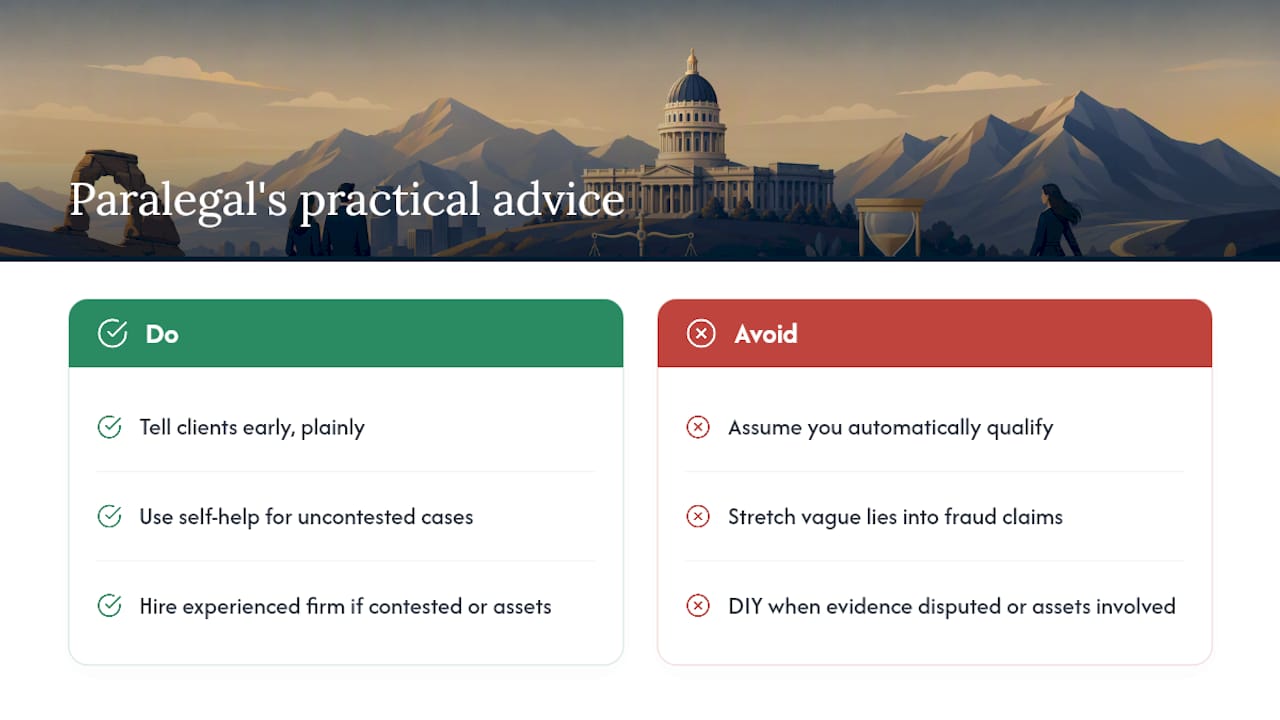
What surprises people most is how much annulment and divorce overlap procedurally once a case gets contested. You still need evidence, you still need a hearing if the other side objects, and property or child issues don’t vanish just because the marriage is declared void. The real value of annulment, in the cases where it fits, is the legal and personal clarity of saying this marriage never should have counted, plus the practical benefit of skipping divorce’s remarriage delays.
Some legal firms help clients gather the right documentation for fraud and duress claims, file the combined annulment and alternative divorce petition correctly the first time, and represent clients when a spouse contests the grounds in court. Self-help forms work fine for straightforward, uncontested cases. Once evidence is disputed or real assets are on the table, that’s when a firm with actual courtroom experience in Utah family law earns its place in your corner.
— Paralegal
How Loayza Law Supports Utah Annulment and Family Law Cases
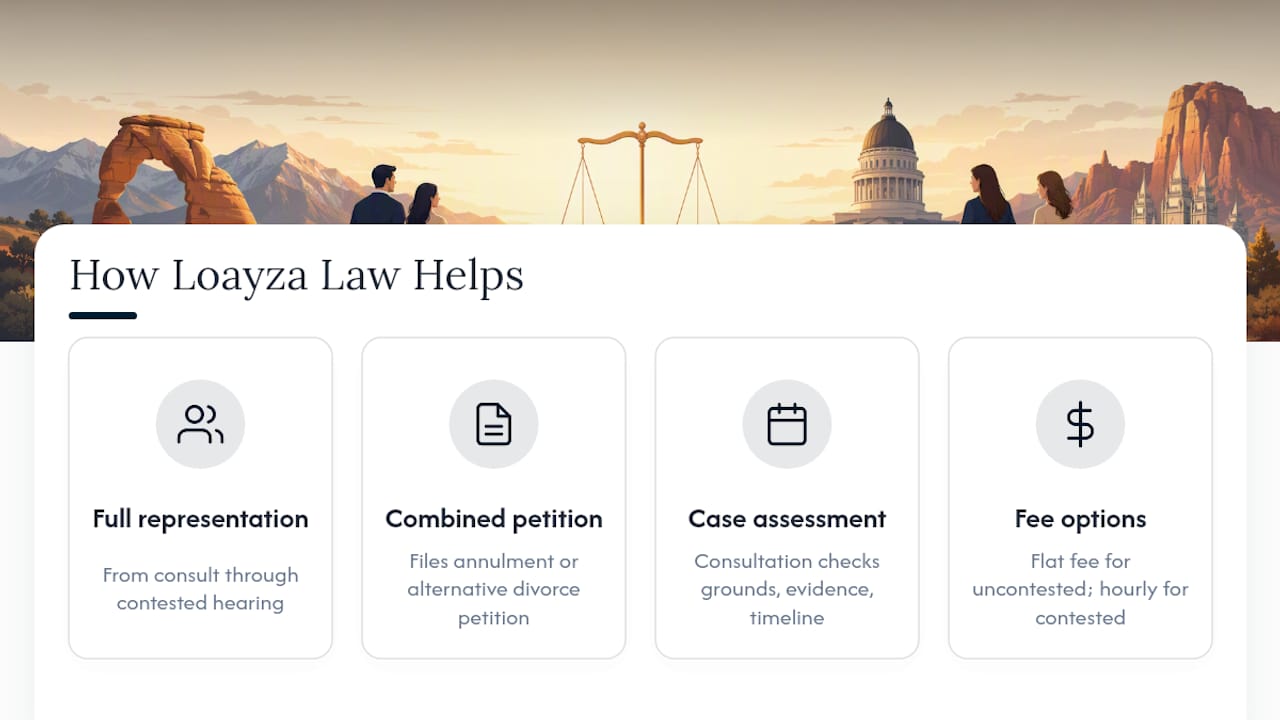
Loayza Law is the practical alternative to navigating Utah’s annulment forms and evidentiary standards alone, especially when your case involves contested fraud claims, children, or shared property that a self-help petition alone won’t resolve cleanly.

Some family law teams handle annulment petitions from the initial consult through a contested hearing if it comes to that, and routinely help clients file the combined “annulment or in the alternative for divorce” petition so a denied annulment doesn’t send you back to square one. A consultation may help determine whether your grounds are strong, what evidence you may be missing, and what a realistic timeline looks like. Some straightforward, uncontested filings can be handled for a flat fee, while contested cases with disputed evidence typically move to an hourly arrangement based on the work involved.
If you’re weighing annulment against divorce, or already know your marriage involved fraud, duress, or a statutory defect, schedule a consultation with our family law team to talk through your specific facts and next steps.
This article is general information, not a substitute for advice from a qualified lawyer. Consult a qualified legal professional about your own circumstances before acting on anything here.
Sources
- Annulment — Utah State Courts self-help
- Utah Code §81-4-302 — Annulment grounds
- Verified Petition for Annulment or in the Alternative for Divorce (form 3001FA) — Utah Courts
- Annulment in Utah: Grounds, Filing Steps, and Time Limits — LegalClarity