
Utah has a statutory dram shop law that imposes strict liability on bars, restaurants, and other commercial alcohol providers when their service leads to injury of an innocent third party. Only injured third parties, not the intoxicated person, can bring a claim, and damages are capped at $1 million per person and $2 million per incident, with punitive damages barred entirely. You generally have two years from the date of injury to file, so preserving evidence, receipts, surveillance footage, witness names, should start immediately.
TL;DR:
- The strict liability standard makes it easier to prove a dram shop claim, requiring only proof of statutory triggers like underage service or apparent intoxication.
- Evidence such as receipts, surveillance footage, police reports, and witness statements must be preserved quickly, ideally within days of the incident.
- Damages are capped at $1 million per injured person and $2 million per incident, with no punitive damages allowed against alcohol providers.
- Only third-party injured individuals or their heirs can sue, not the intoxicated person, and claims can be pursued alongside negligence claims against the driver.
- Early legal assistance is crucial to secure evidence before it is overwritten or purged, increasing chances of success in a dram shop case.
Table of Contents
- How Utah’s Dram Shop Law Works
- Who Can Sue, and Who Can Be Sued
- Proving a Dram Shop Claim: The Evidence That Actually Matters
- Damages, Caps, and Limits Under Utah’s Dram Shop Act
- The Two-Year Deadline: Why Timing Controls Everything
- Dram Shop vs. Social Host Liability in Utah
- What to Do After an Alcohol-Related Injury
- Insurance Requirements for Utah’s Licensed Establishments
- Utah’s Dram Shop Case Law and Legal Precedent
- How Utah Compares to Other States on Dram Shop Liability
- Why Early Legal Help Matters
- How Loayza Law Helps After an Alcohol-Related Injury in Utah
- Sources
How Utah’s Dram Shop Law Works
Utah’s Dramshop Act, codified at Utah Code § 32B-15-201, makes a commercial alcohol provider liable when it gives, sells, or otherwise furnishes an alcoholic product that causes intoxication resulting in injury to someone else. The Utah Supreme Court confirmed in Miller v. United States that the statute functions as a strict liability law, not a negligence standard.
That distinction changes how a case gets built. You don’t need to prove the bartender was careless or that the establishment violated some internal policy. You need to show one of four statutory triggers applied: the provider served someone under 21, served someone who was apparently intoxicated, served someone the provider knew or should have known was impaired, or served a person already on the state’s interdiction list.
Meet one of those triggers, and the strict liability framework does the rest of the analytical work. That’s a meaningfully lower bar than a typical negligence claim, though it still requires solid, timely proof, which is where most dram shop cases actually get won or lost.
Who Can Sue, and Who Can Be Sued
Only injured third parties, or their heirs in a wrongful-death situation, can bring a dram shop claim in Utah. The person who got intoxicated cannot sue the bar that served them. That’s a deliberate legislative choice: the statute exists to protect the public from other people’s drinking, not to let an intoxicated patron recover from the establishment that overserved them.
On the liability side, the Act reaches commercial providers: licensed bars, restaurants, private clubs, brewers, and distributors of alcoholic products. Utah Code carves out certain narrow exceptions, including some beer retailers selling for off-premise consumption under specific licensing categories, so not every business that touches alcohol carries the same exposure.
A dram shop claim also doesn’t replace your right to sue the intoxicated person directly. If a drunk driver hits your car after leaving a bar, you can pursue the driver for negligence and the bar under the Dramshop Act simultaneously. Many of the strongest recoveries come from pursuing both tracks at once, particularly when the driver carries minimal insurance and the establishment’s liability policy offers a more realistic path to full compensation.
Proving a Dram Shop Claim: The Evidence That Actually Matters
Utah law gives plaintiffs a built-in roadmap. Under Utah Code § 32B-15-201, certain facts create prima facie evidence of liability once established:
- The injury occurred within 30 minutes of the last alcoholic product sold or served by that provider.
- The alcohol was consumed on the provider’s premises.
- The injury happened within 10 miles of that location.
- The intoxicated person faced a DUI charge or had documented blood alcohol content evidence.
Hit those markers, and the burden shifts meaningfully in the plaintiff’s favor. Getting there requires real documentation: itemized receipts, point-of-sale timestamps, credit-card processing logs, surveillance footage, police and DUI reports, and witness statements from staff or other patrons who saw how much the person drank.
Pro Tip: Call an attorney within days, not weeks. Surveillance systems in most bars overwrite footage within 30 to 90 days, POS logs get purged on routine schedules, and servers who could identify who poured the last drink often leave the job entirely within a month.
Damages, Caps, and Limits Under Utah’s Dram Shop Act
Utah law caps dram shop recovery at $1,000,000 per injured person and $2,000,000 in aggregate for damages arising from a single incident, regardless of how many providers contributed to the intoxication. Within that ceiling, you can pursue standard compensatory damages: medical bills, lost wages, pain and suffering, and funeral or burial costs in wrongful-death cases.
Punitive damages are not available against the alcohol provider under the Act. That cap and that exclusion apply specifically to the dram shop defendant, not to a separate claim against the intoxicated individual, where punitive damages may still be on the table depending on the facts. Structuring a case to pursue both defendants correctly, and understanding where each cap applies, is exactly the kind of strategic work that determines whether a settlement covers your actual losses.
The Two-Year Deadline: Why Timing Controls Everything
Utah Code § 32B-15-301 gives you two years from the date of injury to file a dram shop claim. Miss it, and the claim is gone, regardless of how strong the underlying facts were.
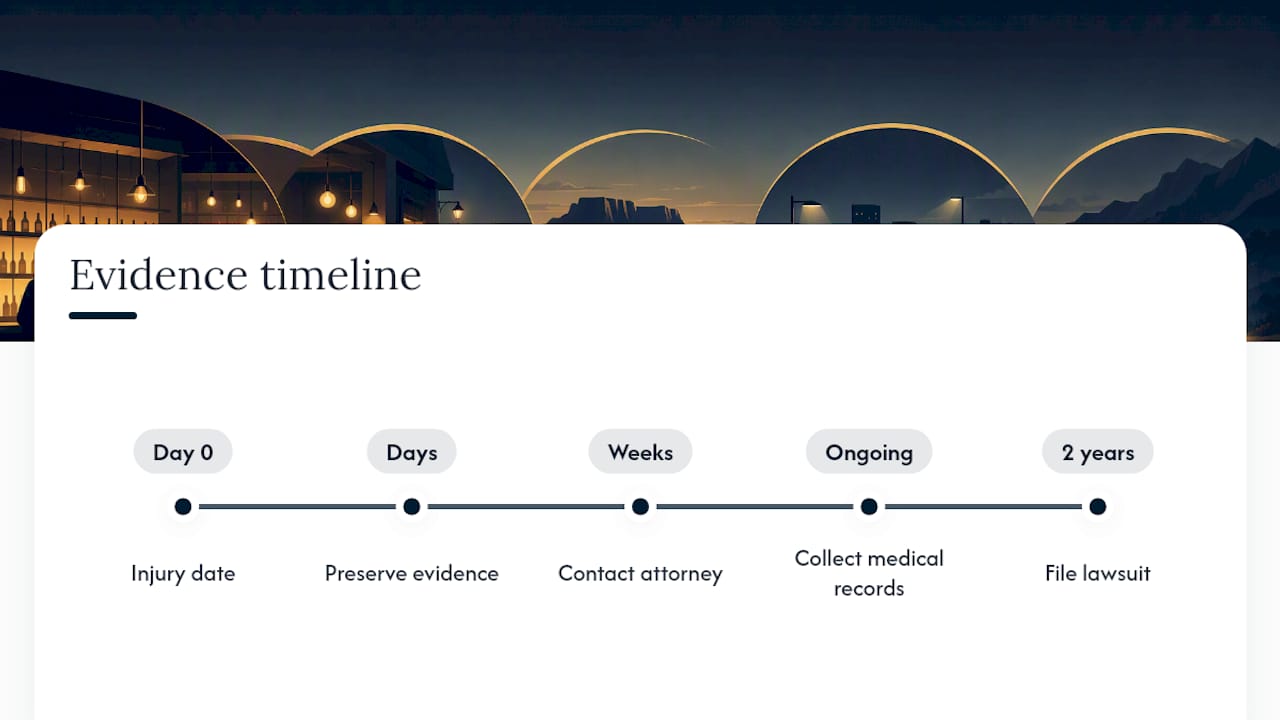
In practice, the real deadline is much shorter than two years. Evidence preservation, medical documentation, and witness statements all decay fast. A realistic timeline looks like this: preserve physical and digital evidence within days of the incident, gather medical records as treatment progresses, and contact an attorney within the first few weeks so requests for surveillance footage and POS records go out before those systems cycle the data away.
Dram Shop vs. Social Host Liability in Utah
Utah’s social host liability rule is narrower than the Dramshop Act, and the distinction trips up a lot of people evaluating their options after a party or private gathering. Social host liability applies when someone 21 or older furnishes alcohol to a person under 21, and that minor’s resulting intoxication causes injury to a third party.
Ordinary adult-to-adult social drinking at a private party doesn’t trigger liability under this rule. If two adults share a bottle of wine at someone’s house and one of them later causes a crash, the host generally isn’t liable. The underage-furnishing element is what separates a social host claim from a legal dead end.
Incidents that touch both a private party and a commercial sale, say, a minor who drank at home before also getting served at a bar, may support claims against both the host and the establishment. Sorting out which law applies to which actor is exactly the kind of analysis worth getting right before you file.
What to Do After an Alcohol-Related Injury
The steps you take in the first 48 hours often determine whether a dram shop claim succeeds. Here’s a practical sequence:
- Get medical care immediately, even if injuries seem minor. Documentation created same-day carries far more weight than a delayed exam.
- Notify police and request a copy of the incident or DUI report once available.
- Photograph the scene, including any visible injuries, vehicle damage, and the establishment itself if relevant.
- Collect witness names and phone numbers before people scatter. Bartenders, servers, and other patrons rarely stay easy to find.
- Request that the establishment preserve surveillance footage in writing, ideally through an attorney, before the recording cycles out.
- Keep every receipt tied to the incident, along with any payment confirmation texts or app notifications.
Pro Tip: When you sit down for an initial case review, bring medical records, the police report, photos, and any receipts you have. Loayza Law typically evaluates a dram shop claim by walking through the statutory elements first, then estimating likely damages and mapping out next steps for you.
Insurance Requirements for Utah’s Licensed Establishments
Utah’s dram shop exposure directly shapes how licensed alcohol sellers insure themselves. Because the Dramshop Act imposes strict liability with a potential $2 million aggregate exposure per incident, most bars, restaurants, and clubs carry liquor liability insurance as a standalone policy or endorsement, separate from general commercial liability coverage.
Standard commercial general liability policies typically exclude alcohol-related injury claims outright. That exclusion is precisely why liquor liability coverage exists as its own product: insurers price it based on the establishment’s hours of operation, whether it serves after midnight, its history of overservice incidents, and whether staff have completed responsible-service training programs.
For accident victims, this matters practically. An establishment’s insurance status often shapes settlement negotiations more than the size of the business itself. A small neighborhood bar with a solid liquor liability policy may be a more reliable source of recovery than a larger venue that let its coverage lapse or carries only minimum limits. Utah’s licensing authorities don’t universally mandate liquor liability insurance for every license type, which means coverage varies significantly from one establishment to the next. That variation is one more reason a thorough intake investigation, checking not just what happened but what insurance actually stands behind the business, matters before you value a claim.
Utah’s Dram Shop Case Law and Legal Precedent
Miller v. United States remains the anchor case for how Utah courts read the Dramshop Act. The Utah Supreme Court’s ruling rejected arguments that plaintiffs must show ordinary negligence, confirming instead that the statute creates a distinct strict liability standard tied to the specific triggers the legislature wrote into the code.
That precedent shapes nearly every dram shop case filed in Utah since. Defense attorneys can no longer argue that a bar exercised reasonable care in checking IDs or monitoring patrons as a complete defense, if one of the statutory triggers is met, care and diligence become largely irrelevant to liability, though they can still matter for apportioning fault among multiple defendants or for a comparative negligence argument regarding the plaintiff’s own conduct.
Utah courts have also consistently enforced the prima facie evidence checklist as written, giving real teeth to the 30 minute and 10 mile proximity rules rather than treating them as loose guidelines. That consistency is part of why the statutory elements deserve careful, early documentation. Courts have shown they will hold plaintiffs to the letter of the code, which means loose or incomplete evidence can sink an otherwise valid claim.
How Utah Compares to Other States on Dram Shop Liability
Most states have adopted some form of dram shop liability, either through statute or court-created common law rules, though the details vary widely from state to state, according to a state-by-state overview from the National Conference of State Legislatures. Some states impose liability only for serving minors. Others extend it broadly to any apparently intoxicated patron. A handful of states have no dram shop statute at all and instead bar these claims outright through legislation aimed at protecting the alcohol industry.
Utah sits toward the broader end of that spectrum. Its four statutory triggers, underage service, apparent intoxication, known impairment, and service to an interdicted person, cover more scenarios than many neighboring states, while its prima facie evidence checklist gives plaintiffs a clearer statutory path than states relying purely on common law negligence theories.
Where Utah differs sharply from many other jurisdictions is its damage cap structure. A $1 million per-person and $2 million aggregate ceiling, combined with an outright bar on punitive damages, is more restrictive than states that allow uncapped compensatory awards or permit punitive damages against especially reckless providers. For someone catastrophically injured by a drunk driver who left an overserving bar, that cap can matter enormously, and it’s one more reason pursuing every available defendant, the driver included, isn’t optional strategy but often a financial necessity.

Why Early Legal Help Matters
Clients often wait weeks before calling an attorney, and by then the footage is gone and the server who poured the last drink has moved on. Early contact lets an attorney send preservation letters and subpoena records before they’re purged, which changes both the strength of the evidence and the leverage in any settlement conversation. Reaching out early costs you nothing and often decides the outcome.
— Paralegal
How Loayza Law Helps After an Alcohol-Related Injury in Utah
Loayza Law is a direct legal resource for Utah residents navigating a dram shop or drunk-driving injury claim, with the personal injury experience needed to evaluate strict liability elements, damage caps, and overlapping claims against both a provider and an intoxicated driver.

A free case evaluation typically starts with a review of your medical records, police or DUI report, and any receipts or timestamps tied to where the alcohol was served, the same documentation that builds the statutory prima facie case discussed above. Most personal injury matters at the firm proceed on a contingency-fee basis, meaning you owe nothing upfront and pay only if the case results in a recovery. If you or a family member has been hurt by someone who was overserved at a Utah bar or restaurant, contact Loayza Law promptly so evidence preservation can begin before surveillance footage and payment logs disappear.
This article is general information, not a substitute for advice from a qualified lawyer. Consult a qualified legal professional about your own circumstances before acting on anything here.
Sources
- Utah Code Ann. § 32B-15-201 – Liability for injuries and damage resulting from distribution of alcoholic products – Prima facie evidence.
- MILLER v. UNITED STATES (2004)
- Utah Dram Shop and Social Host Liability: A Legal Guide
- 32B-15-201 (Effective 07/01/11) – Liability for injuries and damage resulting from distribution of alcoholic products. :: Justia