
Actual outcomes vary widely based on injury severity, treatment consistency, and insurance limits. Before anything else, get medical documentation started and keep Utah’s filing deadlines in mind.
TL;DR:
- Settlement amounts vary significantly by injury type, with traumatic brain injuries exceeding $150,000 and soft tissue injuries averaging around $18,000 to $25,000.
- Salt Lake County settlements tend to be higher due to jury composition and case volume compared to rural areas, impacting award levels.
- Insurance caps in Utah, such as minimum coverage of $30,000 per person and $65,000 per accident, often restrict actual recovery, making underinsured motorist coverage crucial.
- Building a strong claim requires detailed documentation of medical bills, evidence of lost wages, and objective medical reports before settling.
- Early settlement offers can be misleading; waiting until injuries reach maximum medical improvement ensures fairer compensation and reduces the risk of long-term costs.
Table of Contents
- Average Settlement Ranges by Injury Type and Venue
- What Affects Your Settlement Value
- How Settlements Are Paid Out in Utah
- Utah Law That Shapes Your Recovery
- Checklist to Maximize Your Settlement
- Our Experience Handling Utah Injury Claims
- A Paralegal’s View on Timing and Priorities
- How We Can Help With Your Utah Car Accident Claim
- FAQ
- Sources
Average Settlement Ranges by Injury Type and Venue
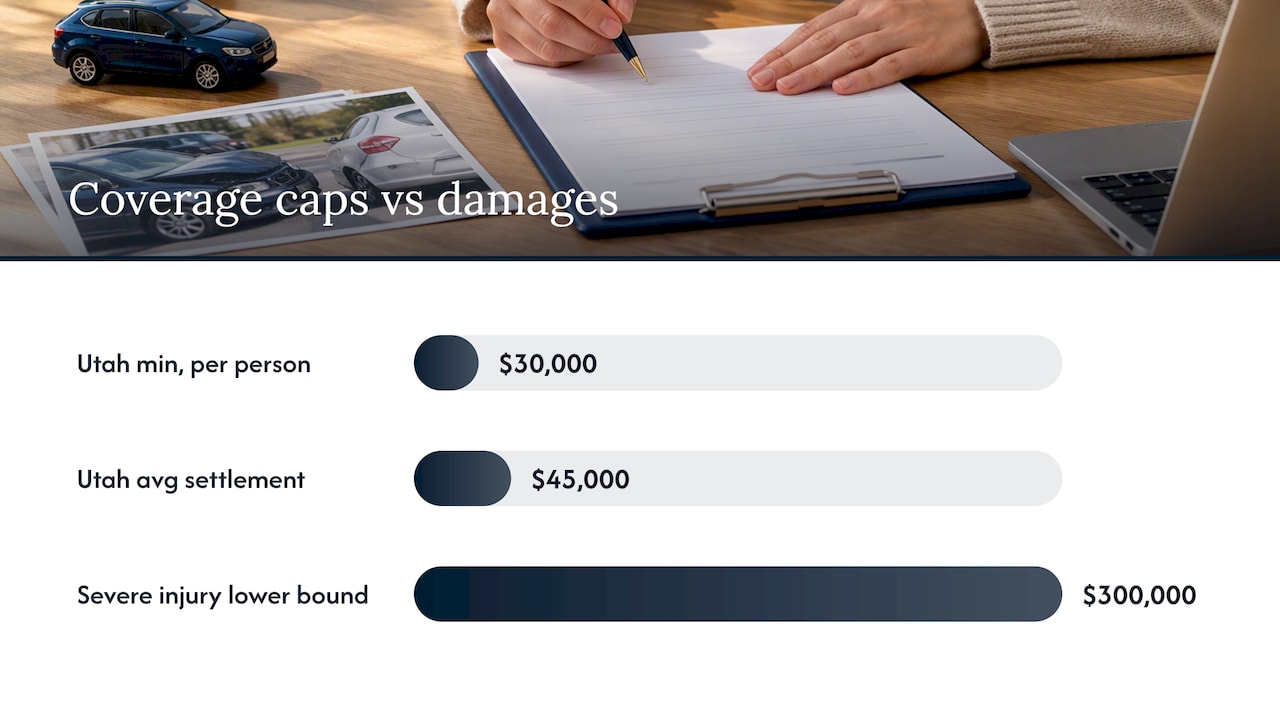
Statewide, the overall average settlement in Utah sits around $45,000, with a median closer to $18,000 to $25,000, reflecting the fact that most claims involve moderate injuries rather than catastrophic ones. The gap between average and median matters: a handful of large, severe-injury settlements pull the average upward while most people recover far less.
Injury type drives the range more than almost any other factor:
- Soft tissue injuries and whiplash typically settle between $12,000 and $30,000.
- Broken bones commonly resolve in the $45,000 to $150,000 range.
- Herniated discs often fall between $25,000 and $175,000, depending on whether surgery is needed.
- Traumatic brain injuries range from $150,000 to $900,000.
- Spinal cord injuries can exceed $300,000 to $1 million or more.
Where your case is filed matters too. Salt Lake County tends to produce higher average awards than many rural Utah counties, a pattern tied to jury composition and the sheer volume of cases moving through the system there.
Insurance limits often cap what’s actually collectible, regardless of what a jury might award on paper. Utah requires only $30,000 per person and $65,000 per accident in bodily injury liability coverage. When damages exceed what the at-fault driver carries, your own underinsured motorist (UIM) coverage becomes the realistic path to full recovery, which is why reviewing your own policy limits early in a claim is worth the time.
What Affects Your Settlement Value
Insurers and juries weigh a consistent set of factors when putting a number on a claim, and understanding them helps you build a stronger file from day one.
- Economic damages, including current medical bills, projected future treatment costs, and lost wages, form the foundation of any settlement calculation with Utah workers’ comp benefits.
- Non-economic damages, covering pain and suffering, are frequently estimated using a multiplier applied to economic damages, with more severe or permanent injuries justifying a higher multiplier.
- Liability and fault allocation directly reduce recovery under Utah law; if you share blame for the crash, your settlement shrinks proportionally.
- Insurance policy limits, across liability, UIM, and PIP coverage, set a practical ceiling on what any claim can realistically yield.
Documentation separates strong claims from weak ones. Keep every medical bill, pay stub showing missed work, and repair estimate in one place, and ask your treating providers for written records rather than relying on verbal summaries.
Pro Tip: Avoid signing a full settlement release until you’ve reached maximum medical improvement, since most releases waive your right to claim future treatment costs that only become clear months later.
Settling too early is one of the most common and costly mistakes we see. An offer that looks reasonable in week three can look thin once a specialist identifies a lasting injury in month six.

How Settlements Are Paid Out in Utah
Utah is a no-fault state for minor injuries, which means your own Personal Injury Protection (PIP) coverage pays initial medical bills and lost wages regardless of fault. You can only step outside PIP and file a third-party claim against the at-fault driver once medical bills exceed the $3,000 threshold or you’ve sustained a permanent impairment.
Once a third-party claim is underway, the process generally follows this sequence:
- You or your attorney submit a demand package with medical records and bills to the at-fault driver’s insurer.
- The insurer must provide a substantive response within 15 days and a coverage decision within 30 days, though investigations commonly extend that window.
- Negotiations proceed until both sides agree on a figure, at which point you sign a release.
- The insurer issues payment, typically within a few weeks of the signed release.
Several deductions reduce the gross settlement before you see a check:
- Attorney fees, often a contingency percentage negotiated at the start of representation.
- Medical liens and subrogation claims from health insurers or providers who covered treatment upfront.
- Any outstanding PIP or medical bills not already resolved.
If the at-fault driver carries only Utah’s minimum coverage, your own PIP benefits and UIM policy often become the real source of additional recovery.
Utah Law That Shapes Your Recovery
Three statutory rules determine how much of your claim you actually keep, and skipping past them is the fastest way to misjudge a settlement.
PIP minimum coverage is $3,000, covering medical bills and lost wages regardless of fault. You can only pursue a third-party claim once bills exceed that threshold or you’ve suffered permanent impairment or disfigurement.
Modified comparative negligence under Utah Code 78B-5-818 means you can recover damages only if you’re found less than 50% at fault, and your award is reduced by your own fault percentage.
Statute of limitations gives you four years from the accident date to file a personal injury lawsuit in Utah, though claims against government entities carry much shorter notice windows.
- Liability minimums: $30,000 per person, $65,000 per accident, $25,000 for property damage.
- PIP minimum: $3,000 before you can step outside no-fault.
- Fault bar: under 50% to recover anything at all.
Checklist to Maximize Your Settlement
A handful of concrete steps, taken in order, protect both your health and your claim’s value.
- Seek medical evaluation within 72 hours to preserve PIP eligibility and create a documented injury timeline.
- Collect the police accident report, witness contact information, and scene photos before memories fade.
- Keep every medical bill, receipt, and pay stub showing lost income in a single folder.
- File your PIP claim promptly, then wait for maximum medical improvement before considering any full release.
Pro Tip: Request copies of imaging reports and functional capacity evaluations directly from providers; insurers weigh objective medical findings far more heavily than self-reported pain.
Contact an attorney when liability is disputed, when you’re facing a permanent impairment, when the at-fault driver’s limits are clearly too low, or when an insurer’s offer doesn’t match your documented losses.
Our Experience Handling Utah Injury Claims
We bring decades of combined legal experience to personal injury matters across Utah, building tailored strategies around each client’s specific injuries and circumstances. Over 1,300 clients have trusted our team, and we have resolved more than 1,200 cases, giving us a practical, firsthand view of how Utah’s PIP rules and comparative fault standard play out in real claims.
A Paralegal’s View on Timing and Priorities
In my work on injury files, the biggest regret clients voice is settling before they knew the full extent of their injuries. Clients often want closure fast, and we understand that urge, but accepting an early offer can mean absorbing costs that surface later. Our contingency structure means you owe nothing until we recover for you, so there’s no financial pressure to rush.
— Paralegal
How We Can Help With Your Utah Car Accident Claim
If your injuries, medical bills, or an insurer’s offer have you questioning whether you’re being treated fairly, we handle Utah personal injury claims on contingency, so you pay nothing upfront and nothing unless we recover compensation for you.

A free case review with our personal injury team gives you a clear read on where your claim stands. Bring what you can:
- Police accident report and insurance information.
- Medical records and bills from every provider you’ve seen.
- Pay stubs or employer statements showing missed work.
- Photos of the scene, vehicle damage, and visible injuries.
Reach out through our practice areas page to get started, and we’ll walk you through your options for your specific situation.
This article is general information, not a substitute for advice from a qualified lawyer. Consult a qualified legal professional about your own circumstances before acting on anything here.
FAQ
What is the average car accident settlement in Utah?
The statewide average settlement in Utah is around $45,000, though the median is closer to $18,000 to $25,000 since most claims involve moderate rather than catastrophic injuries. Your actual settlement depends on injury severity, available insurance limits, and how clearly fault is established.
How much are most car accident settlements?
Most settlements involving soft tissue injuries or whiplash fall between $12,000 and $30,000, reflecting the fact that the majority of crashes cause moderate, recoverable injuries rather than permanent damage. More severe injuries, like broken bones or herniated discs, typically settle well above that range.
Is $50,000 a good settlement for a car accident?
Whether $45,000 is a fair outcome depends entirely on your injury type, medical costs, and lost income; it sits within the average range for broken bones but may undervalue a herniated disc requiring surgery or a traumatic brain injury. Comparing an offer against your documented economic damages and the statewide injury-specific ranges is the only reliable way to judge it.
How long does it take to get settlement money from a car accident?
Insurers in Utah must give a substantive response within 15 days and a coverage decision within 30 days, though investigations often extend that timeline. Once you sign a release, payment typically follows within a few weeks, but reaching that point can take months if injuries are still being treated.
Sources
For readers who want to verify the legal thresholds and procedures covered here, these sources go directly to the primary guidance.
- Filing an Auto Claim | Utah Insurance Department
- Utah Car Accident Settlement Calculator: Average Values by City & Injury (2026) | SetCalc
- Comparative negligence by state: Utah — SetCalc