

Diminished value is the drop in your vehicle’s market value that remains after it has been properly repaired, simply because it now has an accident history. In Utah, you can generally pursue that loss from the at-fault driver’s liability insurer. Recovering it from your own insurer is much less certain. This guide explains who pays, how the number is built, what evidence matters and when the clock runs out.
TL;DR
- Utah courts have long allowed an owner to recover repair costs plus any remaining loss in market value after repairs, so a claim against the at-fault driver’s insurer is the reliable path.
- Your own collision coverage usually excludes diminished value, so do not count on it unless your policy says otherwise.
- Insurers often lean on the “17c” formula. It is an insurer convention, not a Utah legal standard, and market evidence can answer it.
- Utah allows four years for a motor-vehicle property damage claim, but you should document everything well before then.
- Small claims court handles disputes up to $20,000, and larger claims go to district court.
Table of Contents
- What diminished value means after a Utah crash
- Utah has no diminished value statute, but it has case law
- Who pays: the at-fault driver’s insurer or your own
- Fault matters: the 50% rule
- How diminished value is calculated
- Evidence to gather before you ask for a dollar figure
- How to file and negotiate a claim in Utah
- If the insurer says no or lowballs you
- The deadline to file
- Our perspective
- Talk to our Utah team about your accident claim
- FAQ
- Sources
What diminished value means after a Utah crash
A repaired car is not the same asset in the market as a car that was never hit. Buyers and dealers see the accident report, and they pay less. That gap between what the car would have sold for with a clean history and what it sells for now is the diminished value.
How big can the gap be? Appraisal-industry research summarized in one diminished value appraisal guide says vehicles with documented accident history sell for roughly 10% to 33% less than comparable clean-history vehicles. A survey cited by a claims-handling publication found dealers marking down repaired vehicles by 15% to 50%. These are industry figures, not guarantees. Your own number depends on the car, the damage and your local market.
The loss is most obvious when the damage was structural, the car is recent, or mileage is low. A three-year-old SUV with frame repair will usually lose more than a ten-year-old sedan with a replaced bumper cover.
Utah has no diminished value statute, but it has case law
You will not find a Utah law that says “diminished value” and spells out a formula. Utah’s insurance commissioner told KSL in 2024 that Utah law says little about it. The right comes from court decisions instead.
In Metcalf v. Mellen (Utah 1920), the Utah Supreme Court held that an owner can recover the reasonable cost of repairs and also any depreciation in market value remaining after repairs, as described in a Utah diminished value explainer. Hill v. Varner is cited for the same measure of damages. In plain terms: the at-fault driver owes you the amount that puts you back where you were, and that includes the lost resale value.
Because the measure is the actual post-repair depreciation, the question in a claim is what your car is really worth now versus what it would be worth without the accident.
Who pays: the at-fault driver’s insurer or your own
Third-party claim against the at-fault driver
When another driver caused the crash, Utah follows a fault-based system. Their property damage liability coverage can be responsible for repair costs and diminished value. This is the dependable route, and it is where most successful claims are made.
Utah requires liability policies issued or renewed on or after January 1, 2025 to carry at least $25,000 in property damage liability (or a $90,000 combined single limit). Your repair bill, rental and any diminished value all draw from that same property damage limit, so a large repair bill can leave less room for the rest.
First-party claim under your own policy
Standard Utah auto policies commonly exclude diminution in value. Whether a driver can recover it from their own collision carrier is described as unsettled, with no controlling Utah decision either way. Read your policy’s wording before you assume anything, and treat the at-fault driver’s insurer as your main target.
If the at-fault driver has no insurance
If you carry uninsured motorist property damage coverage, that optional coverage may respond under Utah Code § 31A-22-305.5. Check your declarations page. We cover the related deadline and process in our guide to protecting a Utah uninsured motorist claim.
Fault matters: the 50% rule
Utah uses modified comparative fault. Your recovery is reduced by your percentage of fault, and you are barred if your share reaches 50% or more, as summarized in a Utah claims guide citing § 78B-5-818. The statute itself says a claimant’s fault alone does not bar recovery unless it exceeds the defendants’ combined fault.
That means an insurer arguing you were partly at fault is also arguing your diminished value should shrink. If the other side is pushing a share of blame onto you, read our explanation of how 49% versus 50% decides a Utah case.
How diminished value is calculated
There is no single required method. Three approaches come up most often.
| Method | How it works | Where it falls short |
|---|---|---|
| 17c formula | Starts from 10% of pre-accident value, then applies a structural damage multiplier and a mileage multiplier | Insurer convention, tends to produce low figures, and mileage can push it toward zero |
| Market-based appraisal | Compares your repaired car with clean-history comparable vehicles | Needs good comparables and documentation |
| Dealer or retail quotes | Written offers or trade-in estimates for the repaired car versus a clean one | Quotes vary, so get more than one |
The 17c formula is named after a Georgia court ruling involving State Farm. It caps the base loss at 10% of pre-accident value, then reduces it by a structural damage multiplier from 0.00 to 1.00 and a mileage multiplier that falls from 1.00 under 20,000 miles to 0.00 at 100,000 miles or more. It is not a Utah legal standard. Since Metcalf measures actual depreciation, you are free to challenge the formula with market evidence, as Utah-focused analysis notes.
If an insurer sends you a low offer built on 17c, this guide to countering 17c valuation offers walks through the documents that help show real market depreciation.
A worked example
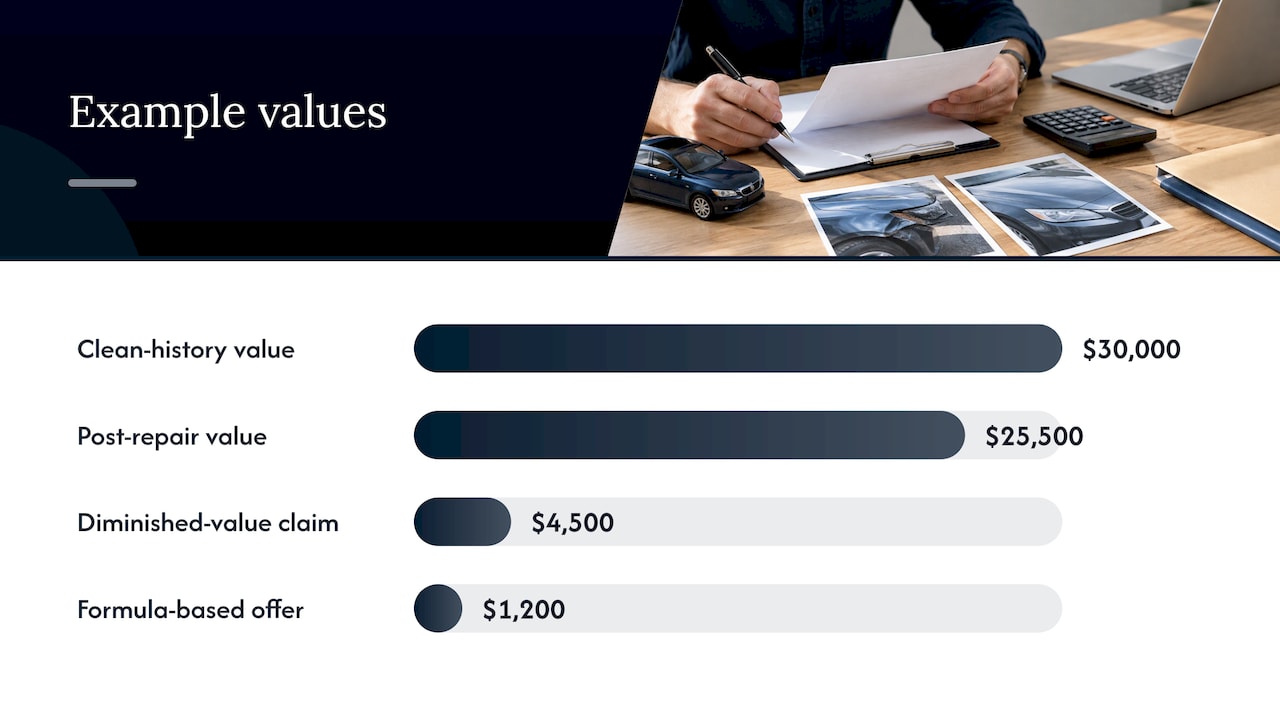
Say your car was worth $30,000 before a rear-end collision caused by another driver, and structural repairs were needed. If comparable clean-history cars sell for $30,000 and dealers will only pay around $25,500 for yours, your claim for diminished value is $4,500, in addition to the repair bill. A formula-based offer might say $1,200 because of your mileage. The difference is exactly what your evidence has to explain. This example is an illustration, not a prediction for your car.
Evidence to gather before you ask for a dollar figure
Bear River Mutual’s vice president of claims told KSL that the hardest part is proving an actual loss, since no loss is realized until the vehicle is sold, and cautioned against websites that promise a precise figure. That is why your file should be built on documents, not online calculators alone.
- The police report and the insurance claim number.
- Pre-accident value evidence: comparable Utah listings, maintenance records, and condition and mileage documentation.
- Itemized repair invoices showing parts and labor, which prove how serious the damage was.
- Photos taken after the collision and after repairs.
- Post-repair market evidence: written dealer offers or an independent appraisal of the repaired car.
- A communications log with the repair shop and the insurer, plus the VIN and accident date.
That evidence checklist follows the documentation recommended in one Utah claims guide. Keep the originals and send copies.
How to file and negotiate a claim in Utah
- Identify the at-fault driver and their insurer and open or confirm the property damage claim.
- Finish the repairs so the post-repair loss can be measured.
- Assemble your documentation using the list above.
- Establish pre-accident value with comparable Utah sales.
- Send a written demand with an appraisal, a specific dollar amount and a citation to Metcalf v. Mellen, as suggested in a Utah filing walkthrough.
- Negotiate in writing so you have a record of every offer and reason given.
Utah’s claims rules set response times. An insurer must acknowledge a claim notification within 15 days, and complete its investigation and tell first-party claimants whether it accepts or denies within 30 days of proof of loss, according to a consumer rights guide from United Policyholders. Use those timelines when an adjuster goes quiet.
If the insurer says no or lowballs you
Be realistic about the options. The commissioner told KSL that the Insurance Department cannot compel an insurer to pay diminished value, and that when a claim is denied, a lawsuit is what remains. Complaints can still document your dispute, but the lever is court.
Small claims court
Utah justice court handles disputes up to $20,000 (the limit since January 2025), and it is a faster venue where an attorney is optional. A 2013 law lets property damage to a motor vehicle go forward in small claims without limiting a separate bodily injury claim against the same defendant. Larger claims go to district court.
Suing your own insurer
Utah policyholders cannot sue for violations of the insurance code under § 31A-26-303(5), but a breach of contract action is available. That is one reason to read your policy language closely.
The deadline to file
Utah Code § 78B-2-307(3) allows four years for a claim involving personal property damage to a motor vehicle or personal property from a motor-vehicle accident. Some sources still point to the general three-year personal property limit in § 78B-2-305, but the four-year motor vehicle provision is the one written for these claims. Do not run the clock down. Evidence about comparable sales, the repair shop’s records and the other driver’s insurance details are all easier to collect early, and the earlier you demand payment, the more time you have if you need to file suit.

If the crash also injured you, keep in mind that injury and property claims have different deadlines and different value drivers. Our overview of protecting a Utah car accident settlement covers the injury side, and our Utah PIP benefits guide explains what happens when the $3,000 in no-fault benefits runs out.
Our perspective
Most people come to us after a crash thinking about medical bills, missed work and the repair estimate. The lost value in the car rarely comes up until a dealer quotes a trade-in. By then the insurer may already have closed the property damage file.
We tell clients to treat the vehicle claim as part of the whole case. Fault decides both. Evidence decides both. A concession on blame in a recorded statement can reduce what you recover on the car just as it reduces what you recover for your injuries.
Our approach is to build the claim around real market data, not around whatever formula the adjuster prefers. We explain the numbers, set realistic expectations, and answer when you call. If your claim is modest and well documented, you may be comfortable handling it directly. If the other side disputes fault, the damage is substantial, or your car claim sits alongside an injury claim, we are ready to advocate for you.
Paralegal
Talk to our Utah team about your accident claim
If another driver’s crash left you with injuries, a repaired car that is now worth less, or an insurer that will not budge, our personal injury team in Salt Lake City can review your situation. We work with clients on car accident claims, and you can see how fees work in our guide to contingency fee personal injury cases. You can also browse all of our practice areas.

Bring your police report, repair invoices and any insurer letters to the first conversation. We will help you understand where you stand and what to do next.
FAQ
Can I claim diminished value in Utah if the accident was my fault?
Generally no, because the claim runs against the at-fault driver’s liability insurer. Your own policy usually excludes diminished value, so check its wording. If fault is shared, your recovery is reduced by your percentage, and it is barred at 50% or more.
Do I have to sell my car to prove diminished value?
No. You do not need to sell, though insurers sometimes argue that no loss exists until you do. Market-based evidence such as written dealer offers and an appraisal using clean-history comparables shows the loss without a sale.
How much can I recover?
It depends on the car, the damage and mileage. Industry research cited above suggests accident history can reduce resale value by roughly 10% to 33%, but those are general ranges. Your recovery is also limited by the at-fault driver’s property damage coverage unless they have other assets.
Should I use small claims court?
Small claims can work well for documented claims up to $20,000, and an attorney is optional there. If fault is contested, the amount is higher, or you also have injuries, talk to an attorney first so one claim does not undercut the other.
How long do I have to file?
Utah Code § 78B-2-307(3) provides four years for motor vehicle property damage claims. Start earlier, since evidence and negotiations take time.
Sources
- Utah diminished value claims explained
- Utah diminished value claim and appraisal guide
- KSL: Can drivers in Utah get money if their car drops in value after a crash
- Utah Code § 78B-2-307
- Utah Insurance Department: auto accident and small claims court
- United Policyholders: insurance consumer rights in Utah
- Utah Code § 78B-5-818
- Diminished value appraisal guide
- Best practices for diminished value claim handling
- Utah diminished value claim guide, property damage limits
- Utah diminished value claim, first-party question
- How to file a diminished value claim in Utah