
Utah lets grandparents ask a court for visitation, but the bar is high. Under Utah Code § 81-9-403, in effect since September 1, 2024, a judge starts from the assumption that the parent’s decision is best for the child. To win, a grandparent must prove by clear and convincing evidence that the case fits one of two narrow situations, and then show that visitation is also in the grandchild’s best interest. A family law attorney can tell you early whether your facts fit, and our Utah family law team at Loayza Law handles custody and visitation matters like this one.
TL;DR
- Utah grandparents have standing to petition a court for visitation, but the court presumes a fit parent’s decision is in the child’s best interest.
- You must rebut that presumption with clear and convincing evidence: either you acted as a parent-like custodian or caregiver and losing the relationship would cause substantial harm, or both parents are unfit or incompetent in a way that creates potential harm.
- Even if you clear that hurdle, the judge may order visitation only if it serves the grandchild’s best interest.
- Orders can be modified or enforced later, so the paperwork you build now matters.
- The Utah court fee schedule lists a $375 filing fee for a grandparent visitation petition (cover sheet revised July 1, 2023).
Table of Contents
- What Utah law says about grandparent visitation
- Who can ask, and where
- The two ways to overcome the parent’s decision
- What the judge weighs after you clear the presumption
- Building the evidence
- How to file a petition in Utah
- Orders can change, and they can be enforced
- Common situations grandparents ask about
- Why a lawyer changes the outcome here
- Talk with a Utah family law attorney
- FAQ
- Sources
What Utah law says about grandparent visitation
Many grandparents searching for “Utah grandparent rights” expect a right to see grandchildren, the way a parent has a right to parent-time. Utah does not work that way. The statute gives grandparents the right to ask. It does not give them a right to win.
The law is built on a parent’s constitutional role. The statute states that Utah’s public policy is that a parent keeps the fundamental right and duty to exercise primary control over the care, supervision, upbringing, and education of a minor child. It then tells courts to presume that a parent’s decision about grandparent visitation is in the child’s best interest.
In practice, that means a parent who says “no visits” starts the case ahead. You are not asking the judge to compare you to the parent. You are asking the judge to set aside the parent’s decision, and Utah only allows that in specific circumstances.
What changed in 2024
The rules were renumbered, not rewritten. The earlier statute, Utah Code § 30-5-2, already contained the same two grounds for overcoming the parental presumption, the best-interest factors, protection after a stepparent adoption, and the modification and enforcement provisions. The 2024 General Session moved the content into Title 81, Chapter 9, as section 81-9-403. If an older article or form cites § 30-5-2, the substance is the same, but cite the current section in anything you file.
Who can ask, and where
A grandparent may file a petition for visitation in district court. A grandparent may also file in the juvenile court or district court where a divorce or another proceeding about custody and visitation is already pending, according to the statute.
That second option matters. If the parents are divorcing or fighting over custody right now, the court already has the family in front of it, and a grandparent’s request can be raised in that case. If the parents are together and simply cut you off, you would start a separate petition.
The statute does not require that you be the parent of a deceased or absent parent. Your standing comes from being a grandparent. Your burden comes next.
The two ways to overcome the parent’s decision
The court may find the parental presumption rebutted only if you prove, by clear and convincing evidence, one of two things. “Clear and convincing” is a higher standard than the ordinary civil rule of “more likely than not.” It means the judge must be firmly persuaded, not just leaning your way.
| Ground | What you must show | What it looks like |
|---|---|---|
| Parent-like custodian or caregiver | You acted as the child’s custodian or caregiver in a parent-like role, and losing that relationship would cause the child substantial harm | You raised the child for a period, lived with them, handled daily care, school, and medical needs |
| Unfit or incompetent parents | Both parents are unfit or incompetent, in a way that causes potential harm to the child | Documented serious problems affecting both parents, not disagreements about parenting style |
The source for both grounds is the Utah statute itself.
Why “regular babysitting” usually is not enough
The Utah Supreme Court has shown how seriously it takes the caregiver ground. In Jones v. Jones, 2015 UT 84, the court held that a grandparent visitation order is subject to strict scrutiny, meaning the grandparent must show the order is narrowly tailored to serve a compelling governmental interest. The court identified the only arguably compelling interest as harm from losing a substantial relationship where the grandparent acted as the child’s custodian or caregiver.
The grandparents in that case had cared for the child several days a week for six weeks in early 2009. The court found that did not establish a custodian or caregiver relationship, and the visitation claim failed. That case involved the earlier statute, but the two grounds carried over into the current one.
The lesson for a grandparent is practical. Frequent, loving contact, even weekly dinners and holidays, does not by itself meet the standard. Courts look for a relationship that functioned like parenting.
What the judge weighs after you clear the presumption
If you rebut the presumption, the court does not simply grant visits. It looks at the totality of the circumstances. According to the statute, those circumstances include:
- the parent’s decision about visitation
- the child’s age
- whether a parent has died or is unavailable
- the wishes of a grandchild who is 14 or older
The court may order visitation only if it also finds visitation is in the grandchild’s best interest. Two separate questions are being answered: whether the parent’s decision can be set aside, and whether visits actually help the child. A strong answer to one does not cover the other.
Building the evidence
Because the standard is clear and convincing, the quality of your proof drives the case. Start collecting it before you file.
- A timeline of caregiving. Write down when the child lived with you or was in your daily care, for how long, and who made decisions. Dates matter more than general descriptions.
- Records that show a parent-like role. School pickup authorizations, medical visit records listing you, childcare payments, photos, messages, and letters from teachers or pediatricians can show what you actually did.
- Evidence of harm from losing the relationship. The statute speaks of substantial harm. Observations from counselors, teachers, or other neutral adults about the child’s bond with you are more useful than your own opinion.
- Evidence about the parents, if you rely on the unfitness ground. This ground concerns both parents. Specific, documented facts carry weight; family conflict alone does not.
- The child’s wishes. If your grandchild is 14 or older, the court may consider their wishes. Do not coach or pressure a child. Judges notice, and it can damage your case and the relationship.
Keep communication with the parents calm and in writing where possible. A record of reasonable, polite attempts to arrange visits reads very differently from a record of angry messages.
How to file a petition in Utah
A grandparent visitation case is a civil family court case, and the paperwork has to be right. A general outline:
- Decide where to file. File a new petition in district court, or raise the request in the divorce or custody proceeding already pending.
- Prepare the petition. It should name the child and parents, state your relationship, and plead facts that fit one of the two statutory grounds. A petition that only says you miss the child gives the judge nothing to work with.
- Pay the filing fee. The Utah District Court’s Domestic Relations Cover Sheet, revised July 1, 2023, lists a $375 fee for a Grandparent Visitation petition and $170 for a counterclaim of Paternity/Grandparent Visitation, under the fee schedule in Utah Code § 78A-2-301. Fees are set by statute and can change, so confirm the amount with the court clerk when you file.
- Serve the parents. The parents must be formally notified so they can respond.
- Attend hearings and present evidence. Expect the parents to raise the presumption in their favor. Your evidence has to answer it directly.
If you are also dealing with a parent’s custody, paternity, or parent-time dispute, those issues often shape your case. Our guides on Utah parent-time schedules and parenting plans in Utah explain how the parents’ own arrangements work, which helps you understand what a court may already have in place.
Orders can change, and they can be enforced
Winning an order is not always the end. A court may modify a grandparent visitation order after a hearing, on petition of a grandparent or the child’s legal custodian, if circumstances have materially and substantially changed or the order has become unworkable or inappropriate, and modification fits the statutory factors. The statute also lets a grandparent petition the court to remedy a parent’s wrongful noncompliance with a visitation order.
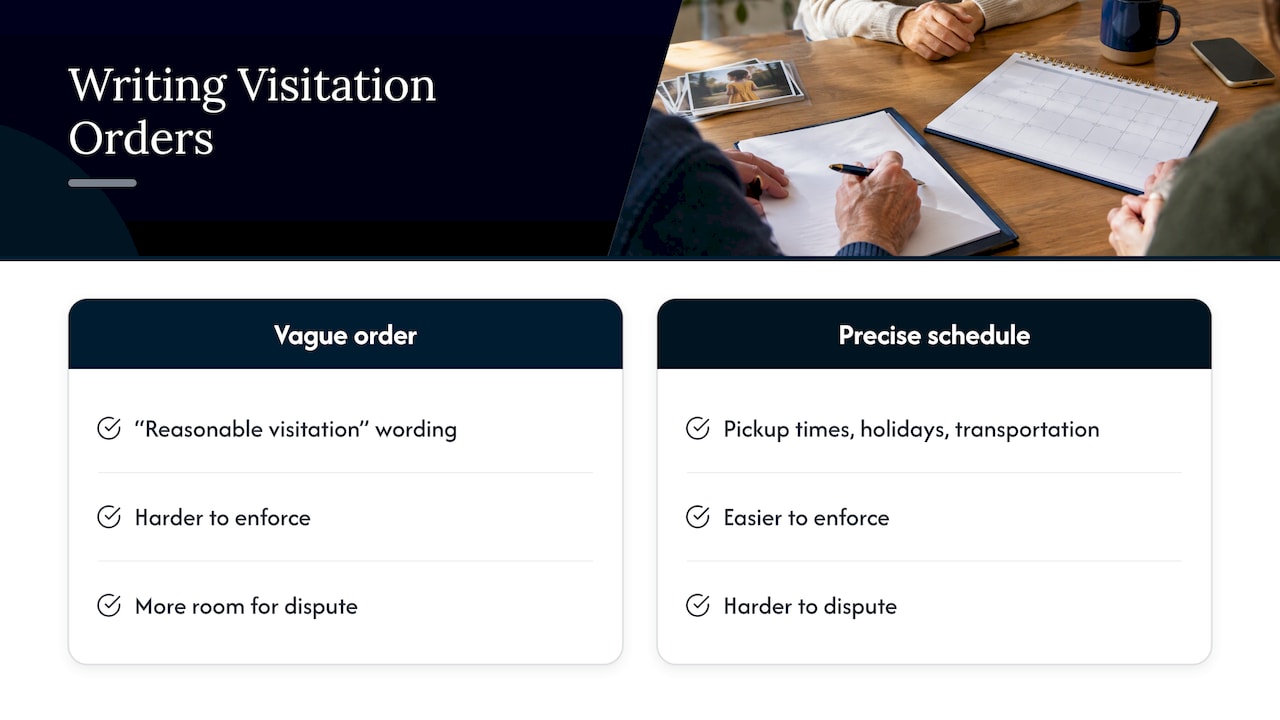
That gives the order teeth, but only if it is clearly written. Vague terms such as “reasonable visitation” make enforcement harder. A precise schedule, with pickup times, holidays, and transportation, is easier to enforce and harder to dispute. Families whose circumstances shift, such as a move, a new work schedule, or a parent’s remarriage, can look at our custody modification checklist to see how Utah modification requests are organized.
Common situations grandparents ask about

The parents divorced and the other side of the family controls access. If a divorce or custody case is pending, a petition may be filed in that case. If it is closed, you would generally file separately. You still must meet one of the two grounds.
A parent has died. A parent’s death or unavailability is one of the circumstances the court may consider once the presumption is rebutted. It does not replace the need to prove a ground.
You raised the child for years. This is the situation the caregiver ground was written for. Your documentation of that period is the center of the case.
You want custody, not visits. Visitation and custody are different claims with different standards. Talk with an attorney about which fits your facts before you file anything.
You are a father or mother’s parent and paternity is unsettled. Visitation questions can depend on who the legal parents are. Our overview of the Utah paternity process shows how legal parentage is established.
Why a lawyer changes the outcome here
Grandparent cases are not ordinary family disputes. You carry the burden of proof, the standard is the demanding clear and convincing one, and the other side begins with a legal presumption. Choosing the wrong ground, pleading too thinly, or presenting evidence that shows affection but not caregiving can end the case at the first hearing.
An attorney can look at your history with the child and tell you which ground, if any, your facts support before you pay a filing fee. Our firm has represented more than 1,300 clients and has resolved more than 1,200 cases, and family law, including custody and visitation, is one of our core practice areas.
Our perspective
Grandparents usually come to us after a painful break: a divorce, a death, or a falling out with a son or daughter. They want to know whether the law is on their side. The honest first answer in Utah is that the law starts on the parent’s side, and that is exactly why the preparation matters.
We approach these cases the way we approach every family matter: client-centered, responsive, and with a plan built around the specific outcome you want. We look first at which of the two statutory grounds your history actually supports, then at the proof that backs it up. A calm, well-documented petition tells a judge you are focused on the child.
Our family law practice covers custody, parent-time, support, and modifications, so we see how visitation fits into the rest of a family’s legal picture. Our firm brings decades of legal experience to each matter, and we want you to walk into court understanding the standard, the evidence, and the likely path.
Paralegal
Talk with a Utah family law attorney
If you are considering a petition, or a parent has already filed something that affects your access to a grandchild, our family law team can review your situation and explain your options under Utah’s statute. Learn more about our Salt Lake City family law practice, or see all of our practice areas. We do not publish a flat price for family law matters; fee arrangements depend on the case.

FAQ
Do grandparents have rights to visitation in Utah?
Grandparents have the right to petition a court, which Utah calls standing. They do not have an automatic right to visits. The court presumes the parent’s decision is in the child’s best interest, and the grandparent must overcome that with clear and convincing evidence. The rule is in Utah Code § 81-9-403.
How much does it cost to file for grandparent visitation in Utah?
The court’s Domestic Relations Cover Sheet, revised July 1, 2023, lists a $375 filing fee for a Grandparent Visitation petition. That covers the court fee only, not attorney fees, and the court’s fee schedule can change.
Can a grandchild’s wishes affect the decision?
Yes. Among the circumstances the court may consider is the wishes of a grandchild who is 14 or older. Those wishes are one factor, not a deciding vote, and the judge must still find that visitation is in the child’s best interest.
Can a visitation order be changed later?
Yes. After a hearing, a court may modify an order if circumstances have materially and substantially changed, or if the order has become unworkable or inappropriate, and modification fits the statutory factors. A grandparent can also ask the court to address a parent’s wrongful failure to follow the order.
Did the 2024 renumbering change the law?
The statute moved from § 30-5-2 to § 81-9-403 on September 1, 2024. The earlier version already had the same two rebuttal grounds, the parental presumption, and the modification and enforcement provisions.
Sources
- Utah Code § 81-9-403, Visitation rights of grandparents (effective September 1, 2024)
- Utah Code § 30-5-2 (effective September 1, 2022)
- Jones v. Jones, 2015 UT 84, Utah Supreme Court
- Utah District Court Domestic Relations Cover Sheet (revised July 1, 2023)