
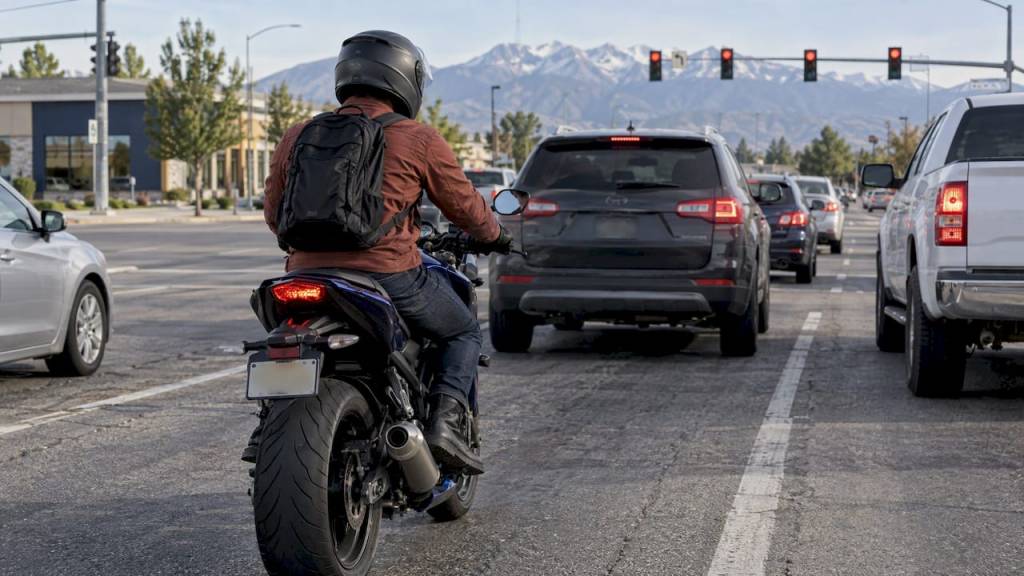
Lane filtering is legal in Utah, but only under a specific set of conditions. A motorcycle may pass a stopped vehicle in the same lane when the road has at least two lanes in your direction and a posted speed limit of 45 mph or less. You must be going 15 mph or slower, and the move must be safe. Lane splitting, which means riding between lanes of moving traffic, is illegal. Freeways and on-ramps are off limits, while certain off-ramps are allowed.
We are a Utah law firm that helps injured people and people facing traffic charges, so we see what happens when riders and drivers disagree about these rules. This guide explains the statute in plain language, walks through realistic situations, and covers what may change next.
TL;DR
- Lane filtering is legal in Utah when you pass a stopped vehicle in the same lane, at 15 mph or less, on a road with two or more lanes going your way and a limit of 45 mph or less.
- It is not legal on freeways or on-ramps. It is allowed on off-ramps that meet the lane requirement.
- Lane splitting (riding between lanes of moving traffic) is illegal, and a conviction can cost you your motorcycle endorsement for a time.
- The filtering law has a sunset date of July 1, 2027. In October 2026 a legislative committee advanced a proposal to make it permanent and widen it to roads up to 55 mph.
- If you are hurt in a crash, how fault is assigned can shape your claim, so document everything and get advice early.
Table of Contents
- What lane filtering means in Utah, and how it differs from lane splitting
- The conditions you must meet, one by one
- Where you can and cannot filter
- Four situations that come up often
- Penalties for breaking the rules
- How the law got here, and what may change
- If you are hurt in a crash while filtering
- Our perspective
- Talk to a Utah attorney about your motorcycle case
- FAQ
- Sources
What lane filtering means in Utah, and how it differs from lane splitting
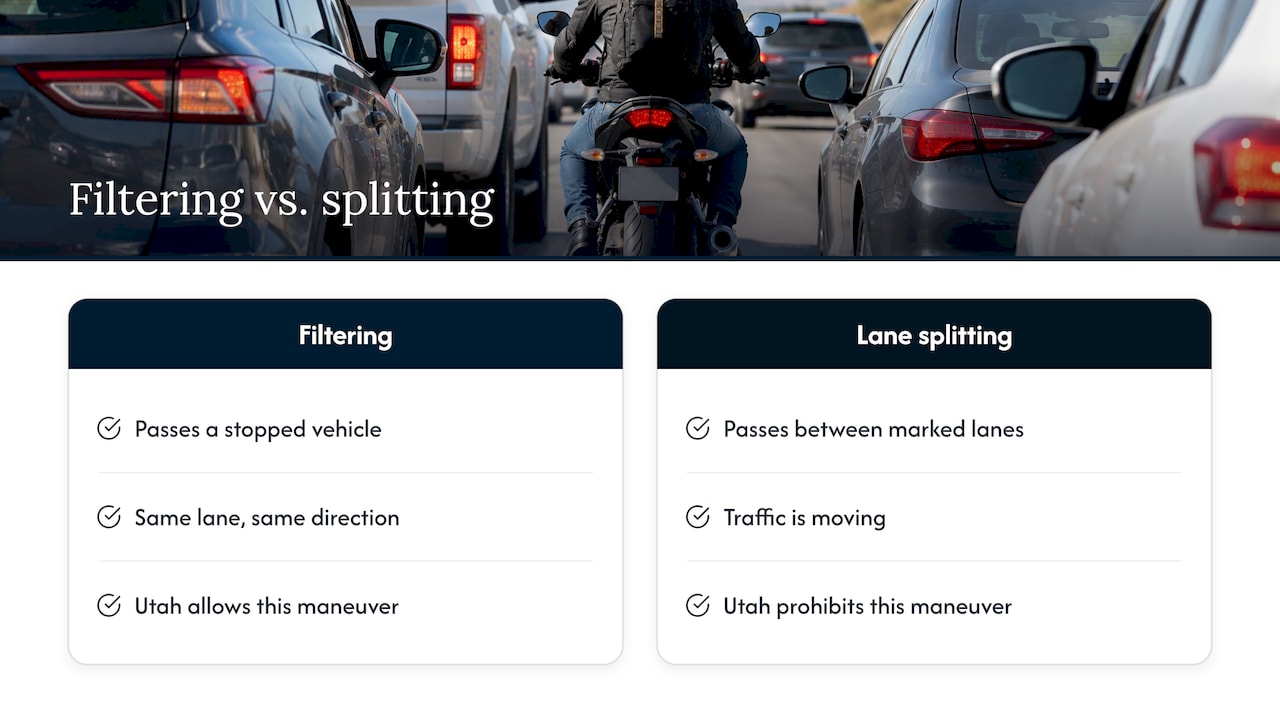
Utah law separates two maneuvers that people often lump together. Utah Code 41-6a-102 defines lane filtering as overtaking and passing another vehicle that is stopped, in the same direction of travel and in the same lane. Lane splitting is defined there as riding between clearly marked lanes of traffic moving in the same direction while that traffic is in motion.
The practical difference comes down to one word: stopped. If the cars around you are rolling, even slowly, you are not filtering. The American Motorcyclist Association describes filtering as moving to the front of stopped traffic, usually at an intersection, while splitting is passing between lanes of traffic that is moving. Utah allows the first and not the second.
The Utah Driver License Division’s 2026 Motorcycle Chart reinforces the baseline. A motorcycle is entitled to full use of a lane, and an operator may not ride between lanes of traffic or between adjacent lines or rows of vehicles. Filtering is the narrow exception to that baseline.
The conditions you must meet, one by one
The rule sits in Utah Code 41-6a-704(6). Every condition must be true at the same moment. Miss one and the maneuver is not lawful filtering.
| Condition | What it means on the road |
|---|---|
| You are on a motorcycle | The statute covers motorcycles other than autocycles. |
| Two or more adjacent lanes in your direction | A single-lane road never qualifies. An off-ramp qualifies if it is divided into two or more lanes. |
| Speed limit of 45 mph or less | Applies to the roadway. Off-ramps are treated separately. |
| Not on an on-ramp | On-ramps are excluded. |
| The vehicle you pass is stopped | It must be stopped in the same lane you are overtaking it in. |
| You travel 15 mph or less | The limit applies the entire time you are filtering. |
| The movement can be made safely | A legal setting does not make an unsafe pass lawful. |
The Department of Public Safety’s Ride to Live Utah page gives the same checklist in rider-friendly terms: 45 mph or less posted, no more than 15 mph while filtering, not on the freeway or on-ramps, but allowed on off-ramps.
The “safely” requirement matters most after a crash
The last item on the list is the one with the most room for argument. A driver, an insurer or an officer may say a pass was not safe even though every other box was checked. Think about what a reasonable rider would have seen: gaps between vehicles, mirrors, doors, pedestrians, turn signals, drivers inching forward. We come back to this in the section on crashes below.
Where you can and cannot filter
The quickest way to test a location is to ask three questions: How many lanes go my direction? What is the posted limit? Is the traffic ahead fully stopped?
Generally allowed:
- A multi-lane city street with a 35 or 40 mph limit, at a red light, with cars stopped in the lane you are passing.
- A multi-lane road with a 45 mph limit, once the traffic has actually come to a stop.
- A freeway off-ramp divided into two or more lanes. Utah added multi-lane off-ramps through H.B. 311, according to the Legislature’s review.
Not allowed:
- Any freeway lane, including when traffic is jammed solid.
- An on-ramp, even one with multiple lanes.
- A road with a posted limit above 45 mph.
- A road with one lane in your direction.
- Any situation where nearby traffic is still moving.
The Driver License Division also notes that riders should check city and county rules, since local regulations can vary.
Four situations that come up often
These examples are illustrations of how the statute reads, not rulings from any court.
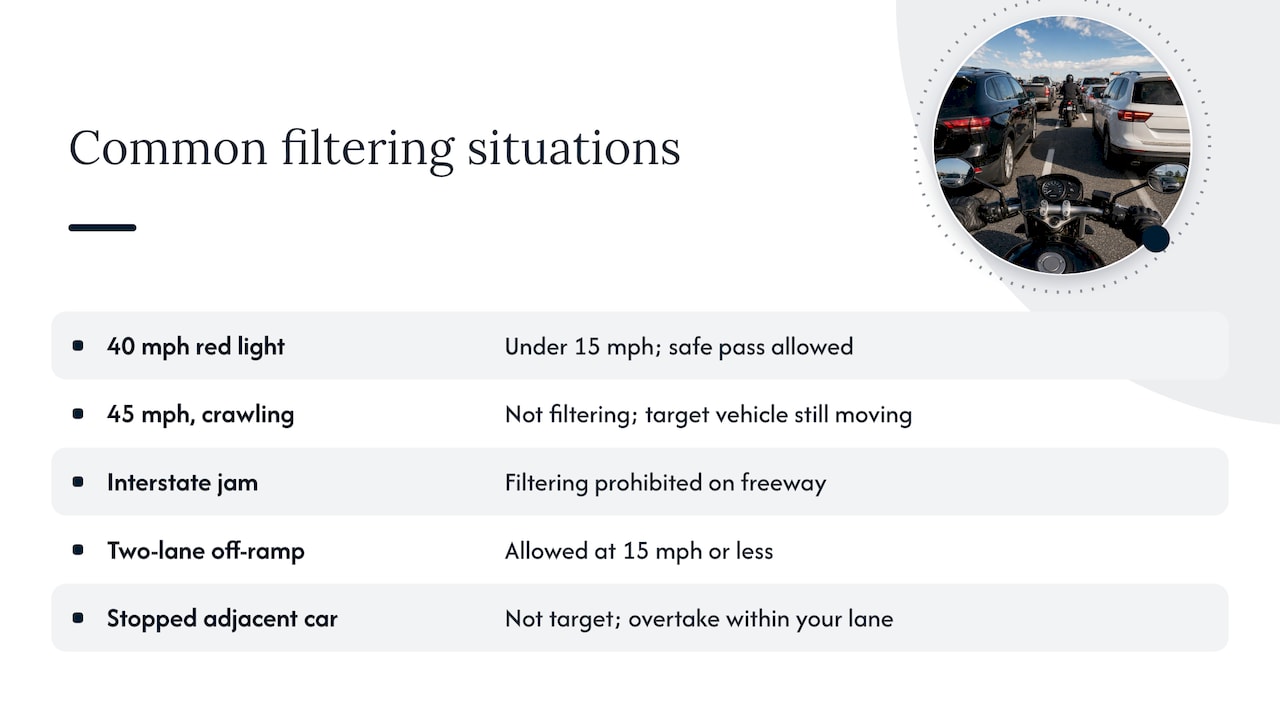
1. The 40 mph arterial at a red light. Two lanes in your direction, cars stopped at the light. You roll past the stopped car in your lane at under 15 mph and take a spot near the front. All the conditions are met, assuming the move is safe.
2. Slow traffic on a 45 mph road. Cars are crawling, not stopped. This is not filtering, because the vehicle you are passing is not stopped. Passing between moving cars is closer to lane splitting, which Utah prohibits.
3. A jam on the interstate. Traffic has stopped completely on a freeway. The setting rules it out, regardless of how slowly everyone is moving. The Utah Department of Public Safety says filtering is not legal on the freeway.
4. A two-lane off-ramp backed up from a light. Off-ramps that are divided into two or more lanes are covered. If the car ahead of you in your lane is stopped and you stay at 15 mph or less, the statute allows the pass.
A fifth situation deserves its own mention: the car that is stopped in the lane next to yours is not the vehicle you are overtaking. The statute speaks of the vehicle being overtaken in the same lane, so think of it as passing the stopped car in front of you within your own lane, not squeezing between two lanes of cars.
Penalties for breaking the rules
A violation of the filtering subsection is an infraction. Lane splitting carries steeper consequences. Under Utah Code 41-6a-704.1, as summarized in the Legislature’s interim committee report, the consequences stack up as follows:
- First conviction: 90-day suspension of your motorcycle endorsement, or of your driver license if you have no endorsement.
- Second conviction: 180-day suspension.
- Third or later conviction: revocation of the motorcycle endorsement.
The line between filtering and splitting is therefore not a technicality. If a citation says splitting and the facts show a stopped car in the same lane at 10 mph on a 35 mph road, the facts may matter a great deal. Anyone who receives a citation involving a motorcycle can talk with a criminal defense attorney before deciding how to respond. Traffic matters that look minor can affect your license and your insurance.
How the law got here, and what may change
The timeline is short and worth knowing, because the law has a built-in expiration date.
- 2019: H.B. 149 was signed on March 21, 2019, and took effect May 14, 2019. It originally had an automatic repeal date of July 1, 2022.
- 2022: H.B. 10 extended the sunset to July 1, 2027. The Department of Public Safety supported the extension to gather more data, and Rep. Walt Brooks told legislators that state data showed related accidents and deaths had decreased.
- Later bills: H.B. 311 added multi-lane off-ramps and excluded on-ramps, and H.B. 190 defined and prohibited lane splitting, according to the Legislature’s report.
- October 2026: The Transportation Interim Committee voted to advance a proposal to make filtering permanent and allow it on roads up to 55 mph. Rep. Brooks said I-15 and I-215 would stay excluded.
That last item is a proposal, not current law. Until the Legislature acts and a bill takes effect, the 45 mph limit stands. Because the rules can change with each session, confirm the current text on the Utah Legislature’s site or the Ride to Live Utah page before you ride, especially around the 2027 sunset.
If you are hurt in a crash while filtering
Motorcyclists are exposed in any collision, and a crash during a filtering maneuver adds a fault dispute. An at-fault driver’s insurer may argue that you were splitting, going too fast, or not passing safely. Those arguments aim to push a share of fault onto you, and the share assigned can change what you recover. Our page on Utah comparative negligence explains why even small differences in percentage can matter.
What helps most, starting right after the crash:
- Get medical care first and keep every record.
- Photograph the scene: lane markings, posted speed signs, the position of every vehicle, and any signal or camera nearby.
- Collect witness names and numbers. Whether traffic was truly stopped is often the central fact.
- Note your speed and the lane count while the details are fresh.
- Report the crash and your injuries but avoid recorded statements to the other driver’s insurer before you have advice.
- Check your own coverage. Our guide to Utah PIP benefits explains what to do when the first layer of coverage runs out.
If you want to understand typical case value and what drives it, read our overview of the Utah car accident settlement. And if fees are your concern, our page on contingency fee personal injury explains how that arrangement works.
Our perspective
Riders usually come to us after the law has already been argued against them. The insurer’s first move is often to say the motorcyclist was lane splitting, because it turns a simple rear-end or left-turn collision into a debate about the rider’s conduct.
We believe the best preparation is a clear understanding of the statute before anything happens. Know the conditions: stopped traffic, 15 mph or less, two lanes, 45 mph limit, no on-ramps, no freeways. When a rider can show those facts, the argument loses force.
When something does go wrong, we bring decades of legal experience and a compassionate, client-centered approach to personal injury, and to criminal defense when a citation is involved. We listen first, gather the evidence that matters, and build a strategy around your goals. We have helped over 1,300 clients, and we answer questions quickly because injured people should not wait for answers.
Paralegal
Talk to a Utah attorney about your motorcycle case
If you were hurt in a crash involving a motorcycle, or you were cited for how you passed traffic, we can review what happened and explain your options. Our attorneys handle personal injury and criminal defense matters for Utah clients, and our team is ready to listen.

Start with our Salt Lake City personal injury page, or see all of our practice areas. You can also reach us through loayzalaw.com.
FAQ
Is lane splitting legal in Utah?
No. Utah defines lane splitting as riding between clearly marked lanes of traffic that is in motion, and it is prohibited. Only lane filtering, passing a stopped vehicle in the same lane under the statute’s conditions, is allowed. A conviction for splitting can suspend your motorcycle endorsement.
Can I lane filter on the interstate if traffic is stopped?
No. Filtering is not legal on the freeway or on-ramps, no matter how slow or stopped traffic is. It is allowed on off-ramps that have two or more lanes. The 2026 proposal to widen filtering would still leave I-15 and I-215 excluded.
How fast can I go while lane filtering in Utah?
You may go 15 mph or less, and the vehicle you pass must be stopped. The road must also have a posted limit of 45 mph or less, with at least two lanes in your direction. Even within those limits, the pass must be made safely.
Is the lane filtering law going to expire?
The current law has a sunset date of July 1, 2027, after H.B. 10 extended it. In October 2026 a legislative committee advanced a proposal to make it permanent, but a proposal is not law. Check the Legislature’s site for the current status.
Sources
- Lane Filtering, Utah Legislature interim committee report
- Utah Code 41-6a-704
- Lane Filtering, Ride to Live Utah
- Motorcycle Chart 2026, Utah Driver License Division
- Did you know? Lane filtering is legal in state of Utah, ABC4
- Utah Legalizes Motorcycle Lane-Splitting, Cycle News
- Arizona, Utah laws permit lane splitting, Land Line Media
- Utah lawmakers eye permanently allowing motorcycle lane filtering, KSL