

A postnuptial agreement is a written contract between spouses, signed after the wedding, that sets out who owns what and who owes what if the marriage ends. Utah’s statute on written marital agreements is written for premarital agreements, and the rules for agreements signed after marriage are shaped largely by general contract principles and by court decisions. That makes drafting and signing steps matter more. This guide explains what the Utah statute says, what a recent Utah appellate decision clarified, and how couples can put an agreement in place that is clear, fair and well documented.
TL;DR
- A postnuptial agreement is a written contract between married spouses about property, debts and, in many cases, spousal support if they divorce or separate.
- Utah’s premarital agreement statute requires a written document signed by both parties. Applying the same discipline to a postnup is the safest approach.
- In Reese v. Reese (2026), the Utah Court of Appeals held that the child support protection in Utah Code § 81-3-203(2) applies by its terms to premarital agreements, not postnuptial agreements.
- Full financial disclosure, voluntary signatures, time to review and separate attorneys give an agreement its best chance of holding up.
- Because the terms can decide your property and support rights later, have a Utah family law attorney draft or review it before you sign.
Table of Contents
- What a postnuptial agreement is, and who uses one
- What Utah law says about marital agreements
- What a Utah court decided in 2026
- What a postnuptial agreement can cover
- When a court may not enforce the agreement
- How to put a postnuptial agreement in place
- Can you write your own?
- Our perspective
- Work with a Utah family law team
- Practical questions to settle before you sign
- FAQ
- Sources
What a postnuptial agreement is, and who uses one
A prenuptial agreement is signed before the wedding. A postnuptial agreement does the same job after it. Couples sign one for many reasons, and none of them means the marriage is in trouble:
- One spouse is starting or buying a business and wants it kept separate.
- One spouse expects an inheritance or a large gift.
- The couple never signed a prenup and now wants clarity.
- One spouse is taking on or paying down significant debt and the couple wants to define who is responsible for it.
- One spouse leaves a career to raise children and the couple wants to agree on support and property in advance.
- A couple is working through a rough patch and wants a documented plan, sometimes as an alternative to filing for divorce.
If you are still engaged, our guide to the Utah prenuptial agreement covers the premarital version in detail. The rest of this article is for couples who are already married.
What Utah law says about marital agreements
The Utah Legislature’s Uniform Premarital Agreement Act sits in Title 81, Chapter 3, Part 2 of the Utah Code. It governs agreements made in contemplation of marriage and effective upon marriage. That wording matters. A postnuptial agreement is not made “in contemplation of marriage,” so the statute does not govern it by its terms.
Still, the statute is the best map Utah gives us for what a careful marital agreement looks like. Several of its rules show up again and again in how attorneys draft postnups:
- Writing and signatures. A premarital agreement must be in writing and signed by both parties. A spoken understanding about “what’s mine and what’s yours” is not a reliable agreement.
- Voluntariness and disclosure. Under Utah Code § 81-3-205, a premarital agreement is unenforceable if it was signed involuntarily, or if it was unfair in the way the statute describes: the party lacked reasonable disclosure of the other’s property and finances, did not waive further disclosure in writing, and did not have adequate knowledge of them.
- Support and public assistance. The same section allows a court to order support to the extent needed to keep a spouse from becoming eligible for public assistance, even if the agreement modified or eliminated support.
The statute was last updated in a version effective September 1, 2024, so make sure your attorney is working from the current Title 81 text rather than older citations that still circulate online.
A couple signing after the wedding cannot assume a court will treat the agreement more leniently than the statute treats a premarital one. The sensible approach is to meet the statute’s standards from the start: a signed writing, honest disclosure, no pressure.
What a Utah court decided in 2026
The most useful recent decision is Reese v. Reese, 2026 UT App 31. The spouses had signed a postnuptial agreement in 2017 that included a child support figure if they divorced. After the divorce, one parent argued the child support term was void because Utah Code § 81-3-203(2) says a child’s right to support, medical expenses, insurance and child care coverage may not be affected by a premarital agreement.
The Utah Court of Appeals affirmed that the statute applies only to premarital agreements, not postnuptial agreements. The case turned heavily on the procedural posture, including a motion to set aside a decree that was filed too late, so it is not a license to put anything about children into a postnup. But it shows two things worth knowing:
- Postnuptial agreements are read according to their own terms and the law that actually applies to them, not automatically under the premarital statute.
- Terms in a postnup can end up incorporated into a divorce decree, where they become court orders. Wording that seemed casual at signing can follow you for years.
If children are involved, talk with a family law attorney about how child support, custody and parent-time provisions should be handled. Child-related terms are where courts look hardest.
What a postnuptial agreement can cover
Because Utah’s premarital statute is the closest written guide, it helps to see the subjects it allows spouses to address. Parties to a premarital agreement may contract about property rights, the disposition of property on separation, divorce or death, and the modification or elimination of spousal support. Postnups commonly address the same ground:
| Topic | What couples usually put in writing |
|---|---|
| Separate property | Business interests, inherited assets, property owned before marriage, gifts |
| Marital property | How assets acquired during the marriage are divided |
| Debts | Who is responsible for existing and future debt, including student loans and business debt |
| Spousal support | Whether alimony is paid, its amount and its length, or whether it is waived |
| Death and insurance | Who receives what at death, and who owns the benefit from a life insurance policy |
| Business or professional practice | Ownership, valuation method and buyout terms |
The statute also says an agreement may include other matters, including personal rights and obligations, as long as they do not violate public policy or a criminal statute. In practice, an agreement that tries to control things like daily household behavior or that punishes a spouse is likely to draw scrutiny rather than be enforced.
How an agreement interacts with divorce rules
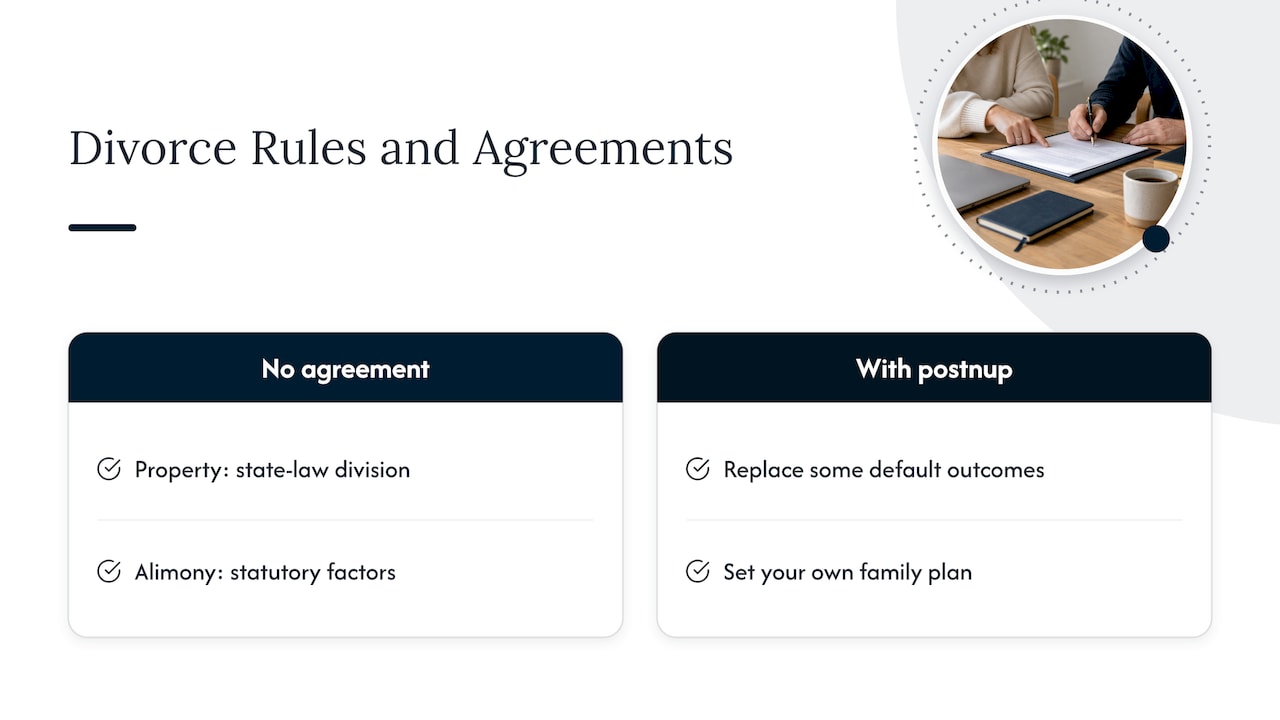
Without an agreement, a Utah court divides property under state law and decides alimony using the statutory factors. A postnup lets you replace some of those default outcomes with your own plan. To see what the defaults look like, read our Utah property division checklist and our overview of alimony under Title 81. Knowing the defaults is how you decide whether a postnup improves on them for your family.
When a court may not enforce the agreement
No article can promise that a particular agreement will hold. A judge looks at the facts. From the statute and from general contract principles, these are the areas where challenges usually arise:
- Missing signature or writing. If both spouses did not sign a written document, there is little to enforce.
- Pressure. An agreement signed under threat, or because one spouse was told the marriage would end otherwise, invites a claim that consent was not voluntary.
- Incomplete disclosure. If one spouse did not know the true size of the other’s assets and debts, the agreement may be attacked. The statute’s disclosure language shows how Utah looks at this issue.
- No time to review. An agreement handed over the night before a trip or a deadline looks rushed.
- Extreme one-sidedness. A lopsided result, especially one that would leave a spouse without support and dependent on public assistance, may draw a court’s attention.
- Unclear wording. Vague terms about what counts as “separate” or how a business is valued lead to disputes later.
Each of these is avoidable at the drafting stage, which is why the next section lays out the process step by step.
How to put a postnuptial agreement in place
These steps follow the statute’s standards and the common practices Utah attorneys use when preparing an agreement meant to last.
- Decide what you want to accomplish. Write down the assets, debts and concerns you each want to address. Be specific: a business, a rental property, a retirement account, a future inheritance.
- Gather financial information. Each spouse prepares a schedule of assets, debts, income and accounts. Attach the schedules to the agreement. Full, honest numbers are the best protection for both of you.
- Hire separate attorneys. One attorney should not represent both spouses on an agreement where your interests may differ. Independent advice helps show each spouse understood what was signed.
- Draft the agreement in writing. Include the property classification, debt allocation, support terms and what happens at death or divorce. Use clear definitions.
- Allow time to review. Give each spouse enough time to read the draft, ask questions and propose changes. A few weeks is far better than a few days.
- Sign voluntarily. Both spouses sign the document. Many attorneys also have the signatures notarized because it records the date and identity of the signers, even though the premarital statute requires only a writing signed by both parties.
- Keep records. Store signed copies, the disclosure schedules and any correspondence about negotiation with your attorney.
- Revisit it when life changes. Under the premarital statute, after marriage an agreement may be amended or revoked only by a written agreement signed by the parties. A good practice is to treat a postnup the same way: change it only in writing, signed by both.
This is also a contract, and it deserves the same care as any other significant agreement you sign as a couple. If you want a primer on reading contract terms before you sign anything, these contract questions for couples show the habit of checking who owns what and what happens if plans change.
Can you write your own?
You can write words on paper, but a do-it-yourself template is risky for something that may decide who keeps a house, a business or a retirement account. Templates are written for no particular family and no particular Utah court. They often skip the disclosure schedules, the debt allocation and the definitions that avoid fights later. They also cannot give either spouse independent legal advice, which is one of the best protections against a later claim that someone did not understand what they signed.
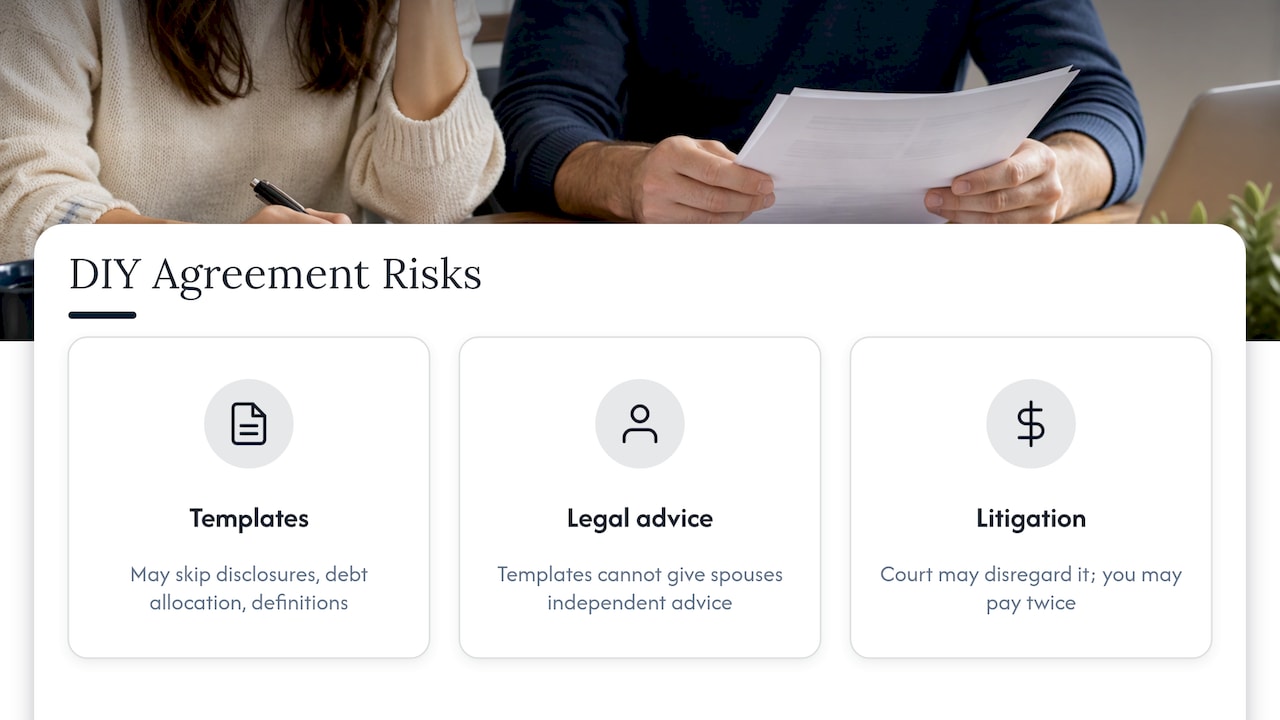
If budget is the concern, remember the cost of a poorly drafted agreement: a court may disregard it, and you will have paid twice, once for the document and again to litigate its meaning.
Our perspective
We meet couples who come in worried that asking for a postnuptial agreement will damage the marriage. In our experience, the opposite is often true. Couples who sit down, share their numbers and agree on a plan tend to leave with less uncertainty and more trust.
What we ask every client to remember is that an agreement is only as strong as its preparation. Utah’s statute for premarital agreements points to a signed writing, honest disclosure and voluntary consent. We build postnuptial agreements on those same foundations, because they are what a judge will look at if the document is ever challenged.
Our family law team works with spouses on property, support and debt terms, and we also handle the divorce and modification side. That means we think about how every clause would play out in a courtroom, not just how it reads on the day you sign. We explain each term in plain language, and we make sure the agreement fits your family’s real finances.
Paralegal
Work with a Utah family law team
At Loayza Law, our family law practice handles divorce, property division, alimony, custody and modifications for Utah families, and we bring that courtroom perspective to marital agreements. We have served more than 1,300 clients and resolved more than 1,200 cases. Fees depend on the matter, so contact us to discuss yours.

To talk through a postnuptial agreement, start with our Salt Lake City family law page or see all of our practice areas. If your situation has moved from planning to separation, our Utah divorce process guide walks through the steps and timing.
Practical questions to settle before you sign
Before a draft is finalized, work through these questions together and with your attorneys:
- Which assets are separate today, and what happens if separate money is mixed into joint accounts or into a home you both own?
- If one spouse’s business grows, does the other share in that growth, and how will the business be valued?
- Who pays existing debts, and who is responsible for debt taken on later?
- Does spousal support apply, for how long, and at what level? Our alimony guide explains how Utah handles it by default.
- What happens at death: who receives which assets, and who owns life insurance benefits?
- How and when will you review the agreement? A review every few years or after a major change, such as a new child or a business sale, keeps it current.
Writing down answers to these questions before the lawyers start drafting saves time and cost, and it produces a better document.
FAQ
Are postnuptial agreements enforceable in Utah?
Utah courts can enforce a postnuptial agreement that is a valid contract between the spouses, but enforcement depends on the facts. Utah’s premarital statute is the clearest written model: a signed writing, voluntary consent and fair disclosure. An agreement prepared to that standard, with separate attorneys, stands on solid ground.
Does a postnuptial agreement have to be notarized in Utah?
The Utah premarital statute requires a writing signed by both parties and does not mention notarization. Many attorneys still have signatures notarized because it documents who signed and when. Ask your attorney whether to do so for your agreement.
Can a postnup decide child support?
Not safely on your own. In Reese v. Reese (2026), the Utah Court of Appeals held that the statute protecting a child’s right to support applies to premarital agreements and not to postnuptial agreements. Courts still look closely at anything affecting children, so have a family law attorney draft these terms.
Can I draft my own postnuptial agreement?
You can, but we do not recommend it. Templates do not account for your finances or Utah court practice, and they cannot provide independent legal advice to each spouse. An attorney-prepared agreement with disclosure schedules is much harder to challenge.
Sources
- Utah Code Title 81, Chapter 3, Part 2: Uniform Premarital Agreement Act
- Reese v. Reese, 2026 UT App 31