
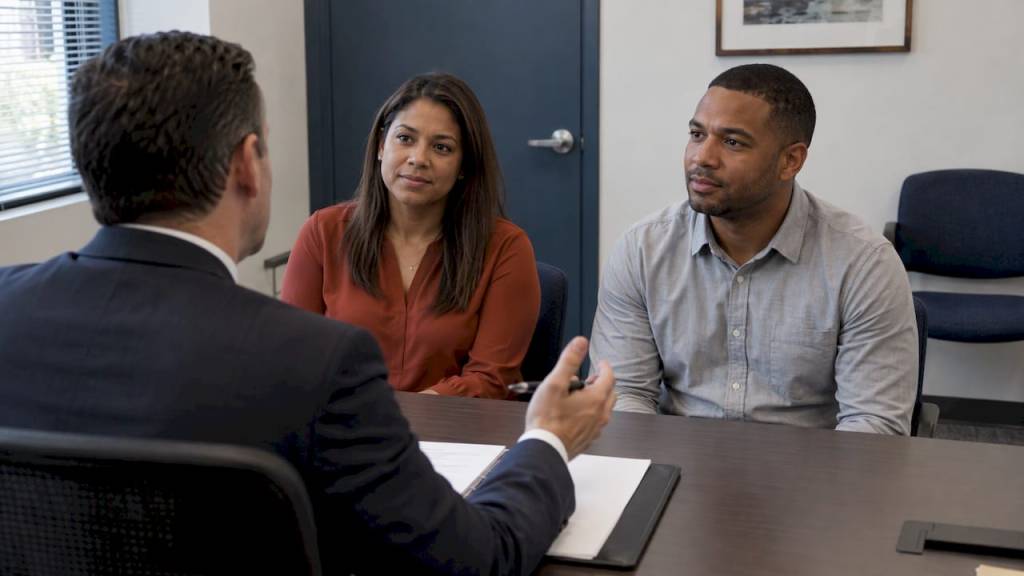
The marriage green card interview is a conversation with a USCIS officer, usually at a local field office, where you and your spouse show that your marriage is real. Most couples who are well prepared and honest find it far less frightening than they feared. It can take as little as 20 minutes, but the officer is trained to look for consistency, so how you prepare matters.
This guide explains who must attend, what the officer does, the kinds of questions couples are asked, what to bring, what a second, separate interview means, and what happens when it ends.
TL;DR
- Adjustment of status applicants must be interviewed unless USCIS waives it case by case, and in family-based cases the petitioning spouse generally attends too.
- The officer is testing whether the marriage is genuine, so expect questions about daily life, not only paperwork.
- Bring originals and copies of your identity, civil, and relationship documents, plus anything new since you filed.
- Possible outcomes are approval, a request for more evidence, a Notice of Intent to Deny, a denial, or a second interview.
- Answer truthfully. If something in your history worries you, speak with an immigration attorney before the interview, not after.
Table of Contents
- Is there always an interview?
- What happens during the interview
- The questions officers ask
- How to prepare without rehearsing a script
- What to bring
- Questions about intent, past charges, and public charge
- A separate interview: the Stokes interview
- What happens after the interview
- Perspective
- How our firm can help
- FAQ
- Sources
Is there always an interview?
Not always, but you should plan on one. USCIS policy says that adjustment of status applicants must be interviewed unless USCIS waives the interview on a case-by-case basis. For family-based applications, the same policy says USCIS generally requires the Form I-130 petitioner to appear with the principal applicant.
In a marriage case, that means the U.S. citizen or permanent resident spouse and the immigrant spouse both attend. A waiver is possible, but it is a decision USCIS makes, not something you can count on or request your way into. Your appointment notice tells you the date, time, and office. Read it carefully for the list of items to bring.
If you are filing from inside Utah and want to see how the interview fits into the whole process, our walkthrough of adjustment of status in Utah covers each filing step in order.
What happens during the interview
The officer’s job is to confirm your eligibility and to decide whether the marriage is bona fide, meaning you married to build a life together and not to obtain immigration benefits. The USCIS Policy Manual explains that the officer also verifies that you understood the questions on the application and lets you correct answers that were wrong or have changed. If anything is revised, you re-sign and date the application at the end.
A typical interview follows this order, as Nolo describes the procedure:
- The officer checks your identification.
- Both spouses, and any interpreter, take an oath to tell the truth.
- The officer reviews passports and travel documents.
- The officer goes through the written application and asks about the facts in it.
- The officer examines medical and biometrics reports.
- The officer asks about your married life and finances.
- At the end, the officer may approve the case or tell you about a denial.
Length varies. Some couples are in and out in 15 or 20 minutes. Others, especially when the file has gaps, spend longer. The same Nolo guide notes that a smooth interview can take as few as 20 minutes and end in approval. A longer interview is not automatically a bad sign, and a short one is not a guarantee.
Together or separately
Often both spouses are in the room. Sometimes the officer asks one of you to wait outside and questions each of you alone, then compares the answers. Either approach is normal. What matters is that your answers match the truth, and the truth is consistent when two people have actually lived it together.
The questions officers ask
There is no official script. Immigration officials may ask a wide range of personal questions to test whether a marriage is real, and there is no fixed list. The examples that guide mentions include how many people attended the wedding, what the couple did for a spouse’s last birthday, who pays the household bills, and what the spouse likes for breakfast.
Think of the questions in four groups.
Your story as a couple
- How and where did you meet?
- When did you start dating, and when did you decide to marry?
- Who proposed, and how?
- Who attended the wedding, and what happened that day?
Daily life at home
- What side of the bed does each of you sleep on?
- Who cooks, who shops, who takes out the trash?
- What time does your spouse leave for work and come home?
- What did you do last weekend?
Money, family, and the future
- Who pays which bills, and from which account?
- Do you share a lease or a mortgage?
- Have you met each other’s parents and siblings?
- Where do you want to live in five years?
The application itself
The officer may go through the Form I-485 line by line. Nolo reports that officers are encouraged to ask every question on the form, including questions about your intentions when you entered the United States and, in public charge matters, about your finances. Know every answer on your own application, including dates of entry, addresses, jobs, and any past arrests or immigration history.
Why small details matter
Officers look for consistency between spouses’ answers and compare them with the written record, so even casual-sounding questions about daily life can carry weight. Real couples forget things. A minor difference, such as the exact month of a trip, is normal. What raises concern is a pattern of conflicting answers on basic facts about where you live and how you share your life.
How to prepare without rehearsing a script
Preparation should help you remember, not memorize. Officers can tell the difference, and a rehearsed answer that contradicts your spouse’s is worse than an honest “I don’t remember exactly.”
- Reread your whole filing together. Sit down with the I-130, I-485, and every statement and letter you submitted. Make sure you both know what you wrote.
- Refresh your timeline. Write the key dates: first meeting, engagement, wedding, move-in, trips, and job changes. Agree on them from your shared records, such as photos, messages, and receipts.
- Talk through ordinary days. Who handles which chores, what you eat, who your friends are, what your home looks like. You do not need to quiz each other. A conversation is enough.
- Update your evidence. Add recent items to the file: new bills, a renewed lease, insurance updates, new photos with family.
- Practice listening. Answer the question asked, briefly and honestly. Do not volunteer long explanations, and do not guess.
- Plan for language. If you need an interpreter, check your notice and the USCIS rules before the day, and do not rely on your spouse to interpret for you.
On the day, dress neatly, arrive early, and expect security screening. Phones may be restricted inside the building, so check the notice.
What to bring
Start with whatever your appointment notice lists. Then add the items that show your identity, your status, and your life together.
| Category | Examples |
|---|---|
| Identity and status | Passports, the I-94 record, a state ID or driver’s license, the appointment notice |
| Petitioner’s status | U.S. passport, birth certificate, naturalization certificate, or green card |
| Civil documents | Civil marriage certificate, divorce decrees or death certificates ending any prior marriage, evidence of legal name changes |
| Photos | Passport-style photos if requested |
| Shared life | Lease or mortgage, joint bank statements, joint tax returns, insurance policies, utility bills in both names |
| Relationship | Photos across time, travel records, messages, cards, birth certificates of any children |
| Updates | Anything that changed since you filed: new address, job, child, or arrest and court records |
USCIS lists the core filing evidence for a marriage-based petition: the marriage certificate, proof that prior marriages ended, passport-style photos, name-change evidence, and proof of the petitioner’s status. USCIS also explains that evidence of a bona fide marriage is weighed as a whole, so no single document decides the case. Bring originals and a set of copies, and bring your documents in an organized folder, in the order of the categories above.
If you did not submit something that supports your case, bring it. If you had an arrest, even an old or dismissed one, bring certified court records. If you are concerned about how a record affects your immigration case, our page on immigration consequences after a DUI explains why timing and documents matter.

Questions about intent, past charges, and public charge
Some questions go beyond the marriage. The officer may ask why and how you came to the United States, whether you ever told a consular or border officer something different about your plans, and whether you have been arrested or charged with anything. These questions relate to admissibility, and honest, complete answers are essential. A misstatement can create a far bigger problem than the underlying fact.
If you have any criminal history, it helps to understand how immigration policy and criminal charges interact before you sit across from an officer. Bring the paperwork for each incident and let an attorney review it first.
Finances can come up too. Officers may look at income, your spouse’s affidavit of support, and whether you are likely to depend on public benefits. Our explanation of the public charge rule covers what the rule looks at and what documents show financial stability.
A separate interview: the Stokes interview
A second, more detailed interview is sometimes called a Stokes interview. It happens when the officer has doubts about whether the marriage is genuine. In that interview, spouses are typically separated, each is asked detailed questions, and the officer compares the answers. Research from the case-outcome sources describes it as a possible follow-up step after the first interview, and says USCIS may schedule a second interview such as a Stokes interview when additional questioning is needed.
Things that can lead to extra scrutiny include little shared documentation, inconsistent answers, a very short relationship before marriage, or earlier immigration problems. None of these means you will be denied. A couple with a real marriage and an honest record can explain and document nearly any of them.
If you receive a notice of a second interview, treat it seriously and contact an immigration attorney right away. Representation at that stage can make a real difference in how you prepare your evidence and understand your rights.
What happens after the interview
There are several possible outcomes. Based on a summary of post-interview results:
- Approval. Sometimes announced at the end, sometimes after the officer reviews the file.
- Request for Evidence (RFE). USCIS asks for specific additional documents within a deadline.
- Notice of Intent to Deny (NOID). USCIS explains its concerns and gives you a chance to respond.
- Denial. The application is refused, with a written explanation.
- Another interview. For example, a Stokes interview.
Respond to any RFE or NOID fully and by the deadline on the notice. If the case is denied, there are options, and the timing of what you do next matters. Our guide to what to do after an I-485 denial explains the choices.
Conditional residence
If you have been married less than two years when the green card is approved, you receive conditional residence for two years. USCIS explains that to remove the conditions, you must file Form I-751 within the 90-day period before your conditional green card expires. Put that window in your calendar the day the card arrives. Filing too early or too late can create problems.
Perspective
In our work with couples, the interviews that go best are not the ones with the most polished answers. They are the ones where both spouses know their own file, have gathered a few honest records of their shared life, and are calm enough to say “I don’t remember” when that is true.
We also see how much of the stress comes from unresolved questions: an old charge, a past overstay, a gap in the paperwork. Our firm brings decades of legal experience and a multicultural perspective to immigration matters, and we focus on resolving those questions before the appointment, not during it.
We believe every client deserves responsive communication and a strategy built for their own facts. Our dedication is to help your family walk into that room prepared, informed, and supported.
Paralegal
How our firm can help
If your interview notice has arrived, or you are not sure what your file shows, we can review your case with you. Our immigration team works with families on adjustment of status and related matters, from preparing documents to representing clients at interviews. You can see the full range of services on our practice areas page, or learn more about our Salt Lake City immigration team.

We have represented more than 1,300 clients, and our approach is built on integrity, clear communication, and compassion. Contact us before your interview date so there is time to organize your evidence and address any concerns.
FAQ
How long does a marriage green card interview take?
It varies. A straightforward interview can finish in as little as 20 minutes, and some take longer when the officer has more to review. The length alone does not predict the result. Your notice and the officer’s questions set the pace.
Do both spouses have to attend?
In family-based cases, USCIS generally requires the Form I-130 petitioner to appear with the principal adjustment applicant. That means the U.S. citizen or permanent resident spouse attends with the immigrant spouse. If one of you cannot attend, contact an attorney and USCIS promptly, before the date.
Can I bring a lawyer?
Yes. You may be accompanied by an attorney, who can advise you during the interview. Many couples find it especially helpful when there is a prior arrest, an earlier immigration problem, or a second interview. Tell your attorney early so there is time to prepare.
What if we give different answers to a question?
Small differences happen in real marriages. Answer honestly, say when you are unsure, and do not change your answer to match what you think your spouse said. If the officer asks about a difference, explain calmly and bring documents that support your version.
What happens if USCIS needs more information?
The officer may issue a Request for Evidence or a Notice of Intent to Deny. Each has a deadline and explains what USCIS wants to see. Respond completely and on time, and consider having an attorney review the response before you send it.
Sources
- USCIS Policy Manual, Volume 7, Part A, Chapter 5: Interview Guidelines
- USCIS Policy Manual, Volume 6, Part B, Chapter 6: Spouses
- USCIS: Bringing Spouses to Live in the United States as Permanent Residents
- USCIS: Conditional Permanent Residence
- Nolo: Marriage-Based Adjustment of Status Interview
- AllLaw: What Happens at the Green Card Marriage Interview
- Legal Clarity: How USCIS Investigates Marriages
- GC Interview: How Long After the Interview to Get a Decision
- Armstrong Bail Bonds: Immigration Policy and Criminal Charges