

You can often stop or reduce a Utah wage garnishment, but only if you move fast. File a Reply and Request for Hearing with the issuing court within 14 days of your employer’s notice. That single filing pauses the process and forces a judge to look at your case before more money leaves your paycheck. Miss that window and the withheld funds typically go straight to the creditor. Federal garnishments (IRS, student loans, Social Security) follow different timelines and rules.
TL;DR:
- Filing a Reply and Request for Hearing within 14 days of notice is essential to pause or challenge Utah wage garnishments, especially before funds are sent to creditors.
- Proper service of your filing to both the creditor and garnishee on the same day is crucial; delays or omissions can cause weeks of lost time.
- Exempt income such as Social Security, VA benefits, and certain federal or state benefits are protected and require proof and proper documentation to prevent garnishment.
- Utah caps regular wage garnishments at 25% of disposable earnings or the amount exceeding 30 times the federal minimum wage per week, whichever is less.
- Bankruptcy filings automatically halt garnishments, but timing is critical, and legal advice can determine whether a quick bankruptcy or a negotiated settlement is better.
Table of Contents
- What to Do in the First 48 to 72 Hours
- How Do You File a Reply and Request for Hearing?
- Which Income and Bank Accounts Are Protected?
- How Much Can Utah Garnish From Your Paycheck?
- Settlement, Bankruptcy, or Federal Agency Review: Which Fits Your Case?
- How Do You Prepare for the Garnishment Hearing?
- What Most People Get Wrong About Fighting Garnishment
- Why Speed Matters More Than a Perfect Legal Argument
- Get Help Stopping Your Garnishment Today
- Sources
- FAQ
What to Do in the First 48 to 72 Hours
The clock on Utah wage garnishment starts the moment your employer notifies you, not when you first notice a smaller paycheck. Treat the first three days as triage.
- Locate the Notice of Garnishment and the Reply and Request for Hearing form. Write down the exact date your employer mailed or handed you the notice. That date controls your 14-day deadline.
- File the Reply and Request for Hearing with the court listed on the writ, then serve copies on both the creditor and the garnishee (usually your employer or bank).
- Check any targeted bank account for federal benefit deposits. Social Security, VA, or other federal payments carry special protection under 31 CFR Part 212, and you can notify the bank directly that those funds are exempt.
- Pull your paperwork together now, not the week before the hearing: recent pay stubs, bank statements, benefit award letters, and your employer’s own withholding calculation. Ask payroll for that calculation in writing.
- If you need funds frozen immediately, ask the court about a Motion to Delay Enforcement or talk to an attorney about an emergency filing, including bankruptcy, the same week.
Pro Tip: Serve everyone the same day you file. A Reply that sits at the courthouse without proof of service to the creditor and garnishee can stall your hearing date by weeks.
How Do You File a Reply and Request for Hearing?
The writ of garnishment itself names the court that issued it, usually the district court where the underlying judgment was entered. That’s where your Reply gets filed. Utah State Courts publishes the current form and instructions online, and most district court clerks can point you to the self-help center if you’re filing without a lawyer.
The 14-day clock starts running from the date your employer received or mailed you the notice, not from your court hearing date or your pay period. Under Utah’s garnishment rules, missing that window generally means the garnishee releases the withheld money to the creditor with no hearing at all. There’s no automatic second chance once funds have moved.
Your Reply needs to state clearly why the garnishment should be reduced, exempted, or stopped. The strongest grounds tend to fall into a few categories:
- The income is exempt (Social Security, veterans benefits, certain retirement funds, or child support already being collected elsewhere).
- The creditor calculated the withholding percentage incorrectly under the applicable caps set by law.
- You were never properly served with the underlying lawsuit or judgment.
- The debt is already satisfied, disputed, or barred by the statute of limitations.
Attach whatever supports your claim: pay stubs, benefit letters, or proof of prior payments. Utah Rule of Civil Procedure 64D requires the garnishee to hold the property for 21 days after service while your reply works through the system, which gives you a built-in buffer once you’ve filed.
After you complete the form, serve a copy on the creditor’s attorney and on the garnishee (your employer or bank), then file a certificate of service with the court showing you did it. Courts routinely waive filing fees for people who can’t afford them. Ask the clerk about the fee waiver application when you submit your Reply. Once the court has your filing and proof of service, it typically schedules a hearing within a matter of weeks. In the vast majority of contested Utah garnishment cases, the deciding factor isn’t the strength of the legal argument. It’s whether the Reply got filed and served on time.
Which Income and Bank Accounts Are Protected?
A judge in Utah cannot waive a garnishment simply because it causes financial hardship. Relief comes from proving your income falls into a legally exempt category, not from arguing that you need the money.
Several income types carry federal or state protection regardless of the debt:
- Social Security retirement, disability, and survivor benefits
- Veterans benefits administered by the VA
- Certain other federal benefit payments, including many Supplemental Security Income deposits
- Child support you’re already receiving
- A portion of personal property and tools of the trade under Utah Code 78B-5-506
The Social Security Administration’s own guidance confirms this isn’t optional for creditors. Even when a writ technically reaches a federal benefit payor, SSA must comply with Utah’s garnishment limits rather than any higher percentage the creditor might request, and the agency can be required to return amounts withheld above what state law allows.
The catch is that a bank account rarely holds one type of deposit in isolation. If your Social Security check and a paycheck both land in the same account, the bank or garnishee may not automatically separate them. That’s your job to prove. Bring a deposit history showing which transactions came from protected sources, along with the SSA or VA award letter confirming the benefit. A simple ledger tracing each deposit to its source gives the court something concrete to act on, and you can ask the judge to order the garnishee to trace and release the protected funds specifically. If the garnishee has misclassified protected income as available for garnishment, raise that directly in your Reply and again at the hearing. Don’t assume the bank sorted it out correctly on its own.

How Much Can Utah Garnish From Your Paycheck?
Utah caps most wage garnishments at the lesser of two figures: 25% of your disposable earnings for the pay period, or the amount by which your weekly disposable earnings exceed 30 times the federal minimum hourly wage. For education loans specifically, the cap drops to 15% of disposable earnings.
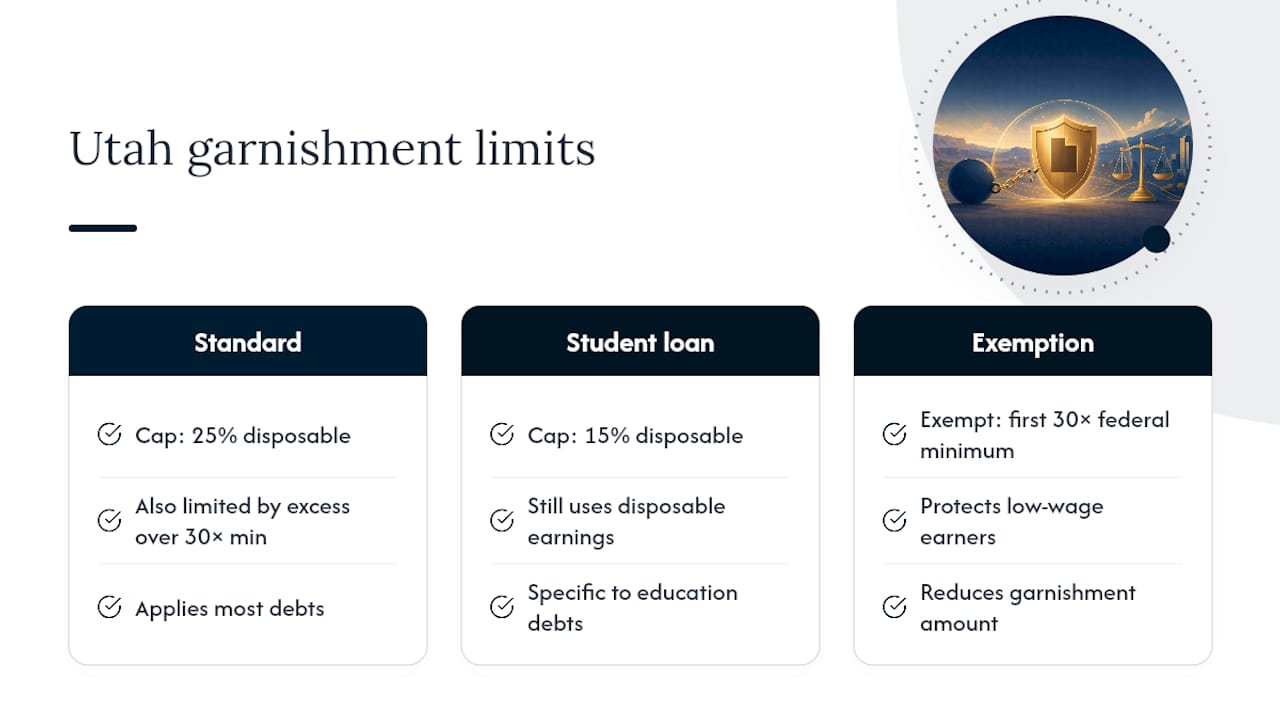
“Disposable earnings” means what’s left after your employer subtracts legally required deductions, taxes, Social Security, and mandatory retirement contributions, not your gross pay. Voluntary deductions like a 401(k) match or health savings contribution don’t count against that calculation.
A writ of continuing garnishment generally runs for 120 days; some writs issued after November 1, 2013, may remain effective for longer periods before renewal is required. If a writ expires while the debt remains unpaid, the creditor has to go back to court and start the process again rather than simply continuing to collect.
Here’s how the math plays out for a hypothetical worker earning $600 a week in disposable earnings, well above minimum wage territory:
For a lower-wage worker closer to minimum wage, the 30-times exemption often becomes the binding limit instead, protecting a much larger share of the paycheck.
Settlement, Bankruptcy, or Federal Agency Review: Which Fits Your Case?
Three separate paths can stop a garnishment, and picking the right one depends on who’s collecting and how much time you have.
Settlement works when the creditor is willing to negotiate rather than collect the full judgment through payroll. Get any agreement in writing before you stop making payments, and confirm the creditor files the paperwork to release the writ with the court. Your employer needs formal notice that withholding should stop; a verbal promise from a collections agent doesn’t protect your next paycheck.
Bankruptcy triggers an automatic stay under 11 U.S.C. § 362 the moment you file, which halts most garnishments immediately without waiting for a separate hearing. Chapter 7 can discharge many unsecured debts outright within a few months. Chapter 13 restructures debt into a repayment plan over three to five years, which sometimes fits better when you have income to protect and assets you want to keep. The difference between Chapter 7 and Chapter 13 matters a lot here, since the wrong choice can create new financial strain even after the garnishment stops.
Federal administrative garnishments don’t run through the state court process at all. The IRS, federal student loan servicers, and Social Security operate under their own notice and hearing rules, separate from a Utah district court writ. You typically request a review or an offer-in-compromise directly with the agency rather than filing a Reply with a local judge.
Pro Tip: If your garnishment involves a federal agency and a bankruptcy filing at the same time, get legal advice before you act. The automatic stay doesn’t always stop every type of federal collection, and timing mistakes here are hard to undo.
Complex agency garnishments, any bankruptcy decision, or a case tangled up with eviction or other consumer-protection issues are exactly the situations where handling it alone gets risky.
How Do You Prepare for the Garnishment Hearing?
Showing up with the right documents matters more than showing up with a good argument. Judges in Utah garnishment hearings are looking for specific proof, not general complaints about being short on money.
- Bring your paper trail. Recent pay stubs, your employer’s written withholding calculation, bank statements covering the disputed period, benefit award letters, and proof of child support obligations all belong in your folder.
- Organize your exhibits around your legal ground. If you’re claiming exempt income, lead with the SSA or VA letter and the deposit history tracing those funds. If you’re disputing the calculation, lead with your pay stubs and the math.
- Expect one of a few outcomes. The judge might grant a full exemption, reduce the withholding amount, uphold the garnishment as calculated, or continue the hearing for more evidence. Each outcome has a next step, whether that’s confirming your employer actually adjusts payroll or filing an appeal.
- Keep every receipt. Your certificate of service, proof the creditor received your Reply, and any written settlement terms all need to survive past the hearing in case a dispute resurfaces later.
Consistency between what you write in your Reply and what you say at the hearing carries real weight. Judges notice when the documents and the testimony line up.
What Most People Get Wrong About Fighting Garnishment
The pattern shows up again and again: someone gets a garnishment notice, calls the creditor hoping to work something out, and only files their Reply and Request for Hearing after the 14 days have already run out. By then, the funds are often already gone. Loayza Law’s practice across bankruptcy, family law, and general litigation in Utah means we see this timing mistake cut across every kind of underlying debt, from medical bills to old credit accounts.
The most common pitfalls aren’t legal complexity. They’re procedural: missing the deadline, filing the Reply but forgetting to serve the creditor and garnishee, trusting a verbal payment arrangement instead of getting a release in writing, or not realizing that a Social Security deposit sitting in a checking account needed to be flagged separately from other funds.
Deciding whether to file a Reply, negotiate a settlement, or move toward bankruptcy comes down to speed of relief versus permanence. A Reply can pause a single writ. Bankruptcy’s automatic stay stops nearly everything at once but carries longer-term consequences worth weighing with counsel first. There’s rarely a one-size-fits-all answer, which is exactly why the first conversation should happen before the 14 days run out, not after.
Why Speed Matters More Than a Perfect Legal Argument
The conventional wisdom on wage garnishment treats it like a negotiation problem: call the creditor, explain your hardship, work something out. That advice fails Utah residents constantly, because Utah’s process isn’t built around sympathy. A judge can’t set aside a garnishment on hardship grounds alone. Relief comes from statutory exemptions, procedural defects, or miscalculations, and none of those get raised automatically. You have to file for them within 14 days.
What gets overlooked is how much the deadline itself functions as the real battlefield. People spend their limited time trying to build the perfect argument for why they can’t afford to lose the money, when the far more urgent task is simply getting a Reply and Request for Hearing filed and served correctly before the window closes. A mediocre filing submitted on time beats a compelling case filed too late, every single time.
If there’s one priority worth acting on today, it’s this: stop trying to solve the whole problem before you’ve stopped the clock.
— Paralegal
Get Help Stopping Your Garnishment Today
Filing a Reply and Request for Hearing correctly, on time, with proper service, is where most Utah residents lose ground without realizing it until the funds are already gone. Legal firms can handle that filing directly, draft and serve the paperwork, and represent clients at the evidentiary hearing where exemptions and calculation disputes actually get decided.

At intake, bring your Notice of Garnishment, recent pay stubs, and any benefit award letters, and the firm can start evaluating whether a Reply, a negotiated release, or a Chapter 7 or Chapter 13 bankruptcy filing fits your situation best. Bankruptcy’s automatic stay can halt garnishment immediately once filed, which sometimes makes it the fastest path when a state-court Reply alone won’t cover the full picture. If your garnishment stems from a family-law judgment like unpaid support, the firm’s Utah family law practice can address that underlying case at the same time. Contact a qualified legal professional now to get your documents reviewed before your 14-day deadline runs out.
This article is general information, not a substitute for advice from a qualified lawyer. Consult a qualified legal professional about your own circumstances before acting on anything here.
Sources
- Garnishment and Debt Help — Utah State Courts
- SSA POMS: PR 04015.049 – Utah
- Utah wage garnishment law — Nolo
- Studentaid
FAQ
Can You Stop a Garnishment Once It Starts?
Yes. Filing a Reply and Request for Hearing within 14 days of your employer’s notice can pause or reduce it, and filing for bankruptcy triggers an automatic stay that halts most garnishments right away.
What States Do Not Allow Wage Garnishment?
A few states, including North Carolina, Pennsylvania, and Texas, largely bar wage garnishment for consumer debts. Utah is not one of them, though it caps how much a creditor can take.
What Is the Most a Creditor Can Garnish From Your Paycheck in Utah?
Utah limits garnishment to the lesser of 25% of your disposable earnings or the amount your weekly disposable earnings exceed 30 times the federal minimum wage, with a 15% cap for education loans.
What Kind of Bank Accounts Can’t Be Garnished?
Accounts holding exclusively Social Security, veterans benefits, or certain other federal benefit deposits are generally protected from garnishment, though you often need to document the source of those funds to the bank or the court directly.