

Yes, Utah drivers can file an uninsured motorist claim, but the process runs through specific statutory proof and timing rules rather than a simple phone call to your insurer. Utah’s Personal Injury Protection minimum of $3,000 typically pays medical bills first. Right after a crash, call 911 or file a police report, photograph the scene, and notify your own insurance carrier.
TL;DR:
- Uninsured motorist coverage applies when the at-fault driver has no liability insurance, while underinsured coverage triggers when their limits are too low to cover your damages.
- To preserve your claim, promptly gather medical records, police reports, photos, witness contacts, and track your PIP benefits, then file a written demand with your insurer before deadlines expire.
- Evidence for phantom vehicle claims must be particularly strong, including dashcam footage, multiple witness statements, physical debris, or police observations, to meet Utah’s higher proof standard.
- Utah law requires claimants to respond quickly, with insurers obligated to reply within 15 days and decide within 30 days, and legal deadlines for filing may be limited to four years for bodily injury.
- Working with an attorney is advisable if liability is disputed, injuries are severe, or an insurer denies a fair settlement, especially in complex cases involving hit-and-run or phantom vehicles.
Table of Contents
- What uninsured and underinsured motorist coverage mean under Utah law
- What UM coverage typically pays for and where it falls short
- How PIP affects your uninsured motorist claim
- Deadlines that can make or break your claim
- Step-by-step filing checklist for a Utah UM claim
- Proving hit-and-run and phantom-vehicle claims
- When to bring in a Utah personal injury attorney
- A paralegal’s view on the mistakes that cost Utah drivers their claims
- How Loayza Law can help with your uninsured motorist claim
- Where to verify the rules yourself
- Sources
- FAQ
What uninsured and underinsured motorist coverage mean under Utah law
Uninsured motorist (UM) coverage steps in when the driver who caused your crash carries no liability insurance at all. Underinsured motorist (UIM) coverage applies when the at-fault driver has insurance, but their policy limits fall short of covering your losses. Utah Code §31A-22-305 governs both coverages and sets out how claims are proven and pursued.
Insurance companies in Utah must offer UM and UIM coverage on every auto policy, but the named insured can reject it, and that rejection must be in writing. A related department bulletin confirms that UM and UIM are treated as separate coverages that cannot be combined into a single limit, and that policy language cannot narrow the definition of an uninsured vehicle to physical-contact crashes only.
A few points worth remembering:
- UM applies when the at-fault driver has zero liability insurance.
- UIM applies when the at-fault driver’s coverage is too low to pay your full damages.
- You can reject UM/UIM coverage, but only in writing, and doing so removes an important financial backstop.
What UM coverage typically pays for and where it falls short
UM coverage generally pays for bodily injury, associated sickness, and wrongful death claims caused by an uninsured driver. Property damage handling varies more by policy, so check your declarations page rather than assuming your UM coverage automatically repairs your vehicle.
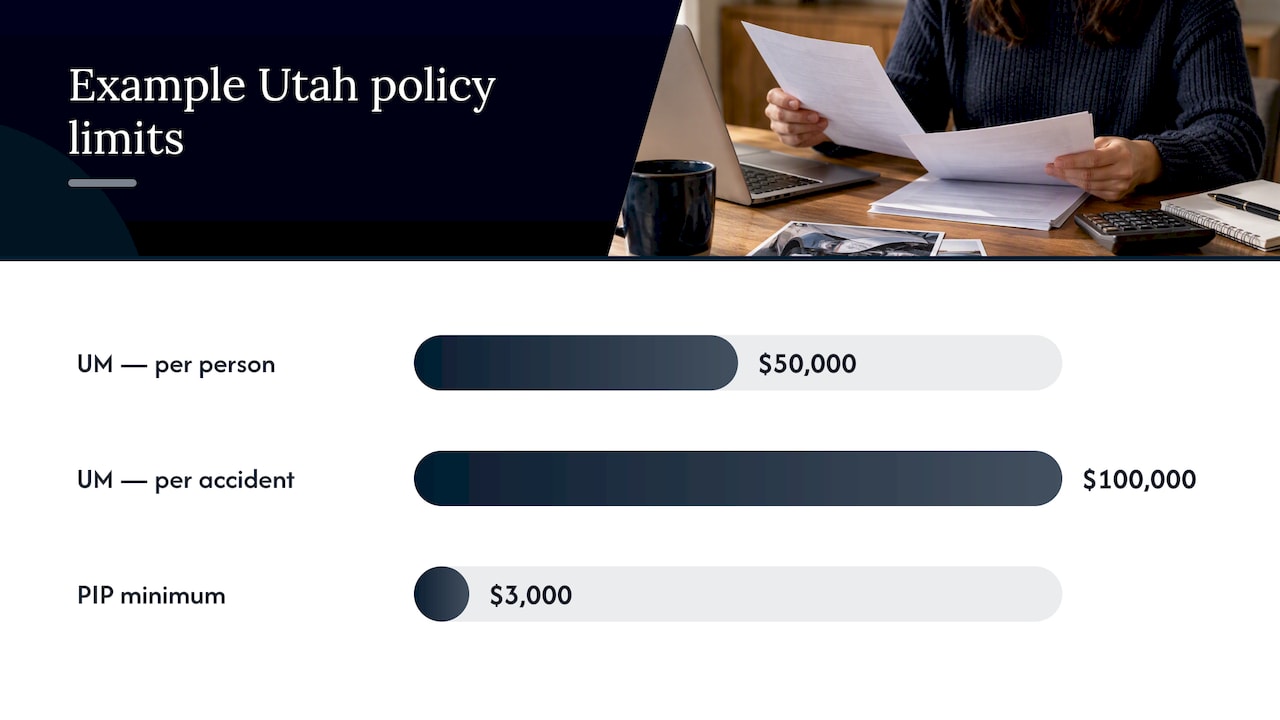
Utah Insurance Department comparison materials list illustrative example limits such as $50,000 per person and $100,000 per accident for UM bodily injury alongside the $3,000 PIP minimum. These are sample figures used for shopping comparisons, not universal amounts, so your actual limits depend on what you purchased.
Common exclusions and limits to check before assuming coverage applies:
- Intentional acts by the at-fault driver are typically excluded.
- Coverage may be capped when the uninsured vehicle is owned by the policyholder or a household member.
- Workers’ compensation benefits can overlap with or reduce a UM recovery for a work-related crash.
How PIP affects your uninsured motorist claim
Utah requires every auto policy to carry Personal Injury Protection with a minimum limit of $3,000 per person, and that PIP benefit generally has to be used up on medical expenses before you pursue certain liability or UM claims for those same bills.
PIP minimum in Utah: $3,000 per person, according to the Utah Insurance Department, which means smaller claims may resolve through PIP alone before UM ever comes into play.
PIP claims are often valued using a relative value study that assigns weight to different medical procedures, and that valuation can shape how your later UM demand gets calculated. Keep every PIP explanation of benefits and medical bill organized from the start. For a deeper look at when PIP funds run out and what happens next, see our guide on Utah PIP benefits.
Deadlines that can make or break your claim
Utah law gives UM claimants real, but limited, windows to act. Contract-based claims on your own policy, including UM claims, commonly carry a four-year statute of limitations for bodily injury under Utah Code, while property-damage timing can differ, so confirm the applicable period for your situation early.
Utah Code also lets a covered person elect binding arbitration instead of litigation, and submitting to arbitration can itself count as filing for statute-of-limitations purposes, which matters when a deadline is close. Demand and response timing under the statute often runs on 30-day and 60-day windows.
Insurers face their own clock. Utah Insurance Department rules require:
- A substantive response to a claimant within 15 days of a request.
- A decision to accept or deny the claim generally within 30 days.
- Additional time when the claim requires a more complex investigation.
Step-by-step filing checklist for a Utah UM claim
Building a UM claim in Utah is mostly about sequence: get medical care and documentation first, then assemble everything your carrier needs to evaluate the demand.
- Seek medical treatment immediately and file a police report at the scene or as soon as possible after.
- Photograph vehicle damage, injuries, and the accident scene, and collect contact information for any witnesses.
- Notify your own insurer promptly, since most policies require prompt notice regardless of who caused the crash.
- Track your PIP benefits and request the explanation of benefits statements as bills are processed.
- Send a written demand to your UM carrier once your medical picture is clear or your PIP benefits near exhaustion.
- Include the police report, medical records and bills, photos, witness statements, and proof of any wage loss with the demand.
Pro Tip: Keep a single chronological file, digital or paper, so every document you send your insurer or attorney tells the same story in the same order.
Send the police report and initial notice quickly, but wage-loss documentation and final medical summaries can follow once they’re ready.
Proving hit-and-run and phantom-vehicle claims
Utah Code sets a higher bar for uninsured vehicle claims involving no physical contact, sometimes called phantom-vehicle cases: you must show clear and convincing evidence that an unidentified vehicle caused the crash. That standard sits above the ordinary burden of proof in a typical injury claim, so evidence quality matters more here than almost anywhere else in a UM case.
Strong evidence includes:
- Dashcam or nearby traffic camera footage showing the phantom vehicle.
- Statements from multiple independent witnesses who saw the same event.
- Physical debris or paint transfer from the fleeing vehicle.
- Responding officer observations recorded in the police report.
Request footage quickly, since many systems overwrite recordings within days, and document witness statements while memories are fresh.
When to bring in a Utah personal injury attorney
Some UM claims resolve cleanly through paperwork and patience. Others get complicated fast, and that’s when legal help earns its keep.
Consider talking to an attorney when:
- Liability is disputed or the crash involved a phantom vehicle.
- Injuries are serious, permanent, or still developing.
- Your insurer denies the claim or offers a settlement that looks low.
- A statute of limitations or notice deadline is approaching.
An attorney typically investigates the crash, preserves evidence before it disappears, drafts and negotiates the written demand, and elects arbitration or files suit if the insurer won’t pay a fair amount. Loayza Law handles personal injury matters throughout Utah, drawing on decades of combined legal experience across personal injury, workers’ compensation, and related litigation to guide clients through exactly these decisions.
A paralegal’s view on the mistakes that cost Utah drivers their claims
The recurring pattern behind denied or reduced UM claims is delay: reporting late, letting photos and witness contacts slip away, or ignoring PIP documentation until it’s scattered across months of mail. Missed deadlines follow the same root cause.
One habit fixes most of it. Create a single chronological folder, digital works best, for every photo, PIP explanation of benefits, and police report, and share it with your insurer or attorney as soon as it exists.
— Paralegal
How Loayza Law can help with your uninsured motorist claim
Utah’s PIP exhaustion rules, arbitration elections, and clear-and-convincing evidence standard turn a straightforward-sounding claim into a process with real deadlines and real proof requirements. Legal practices generally investigate the crash, organize the medical and PIP documentation, draft the written demand to your UM carrier, and pursue arbitration or litigation when an insurer won’t offer a fair number.

Bring what you have to an initial consultation, even if it’s incomplete:
- The police report and any photos or witness contact information.
- PIP explanation of benefits statements and medical bills received so far.
- Correspondence from your insurer, including any settlement offer.
If a deadline is approaching or the evidence involves a hit-and-run, don’t wait for your file to be perfect before reaching out. Contact Loayza Law’s personal injury team to review your claim and discuss next steps.
Where to verify the rules yourself
For the statutory language behind UM and UIM coverage, proof standards, and deadlines, read Utah Code §31A-22-305 directly. The Utah Insurance Department’s auto claims page explains PIP requirements and insurer response timelines in consumer terms. If a claim stalls, the department’s complaints portal accepts unresolved disputes after you’ve exhausted direct communication with your insurer.
This article is general information, not a substitute for advice from a qualified lawyer. Consult a qualified legal professional about your own circumstances before acting on anything here.
Sources
- Filing an Auto Claim | Utah Insurance Department
- Utah Code § 31A-22-305 (2025) – Uninsured motorist coverage
FAQ
Does Utah require uninsured motorist coverage?
Insurers in Utah must offer UM and UIM coverage on every policy, but the named insured can reject it in writing. Unless you’ve signed that rejection, your policy likely includes this protection by default.
Do you have to pay a deductible on an uninsured motorist claim?
Whether a deductible applies depends on your specific policy, since Utah law does not set a uniform UM deductible rule. Check your declarations page or ask your insurer directly before assuming a deductible applies.
Is Utah a no-fault state for auto insurance?
Utah requires PIP coverage with a $3,000 minimum that pays medical expenses regardless of fault, which gives it a no-fault feature for smaller injury claims. Beyond that PIP threshold, injured drivers can still pursue the at-fault party or their own UM coverage for larger losses.
What does uninsured motorist coverage not cover?
UM coverage generally excludes intentional acts by the at-fault driver and may limit claims involving vehicles owned by the policyholder or household members. Property damage handling also varies by policy, so confirm what your specific UM coverage includes before filing.