

Yes, Utah law allows court-ordered alimony, governed by Utah Code § 81-4-502. Alimony generally cannot exceed the length of the marriage, and temporary support paid during the case counts toward that cap. Courts weigh standard of living, financial need, ability to pay, marriage length, custody, and (to a limited degree) fault before setting an amount, and no two awards look exactly alike.
TL;DR:
- Temporary alimony paid during the case counts toward the marriage-length cap, which influences the total support available after divorce.
- Judges consider multiple factors such as standard of living at separation, earning capacity, and contributions, leading to highly individualized awards.
- Alimony generally cannot exceed the length of the marriage, and it terminates automatically if the recipient remarries, dies, or cohabits with a new partner within one year.
- Modifications are possible for material, substantial changes, including retirement, but require proper documentation to persuade a court.
- There is no reliable alimony calculator; negotiations typically start around a 25 to 35 percent income-difference range, but actual awards depend on case-specific factors.
Table of Contents
- Types of Alimony Recognized Under Utah Alimony Laws
- How Are the Statutory Factors Weighed in Utah Alimony Laws?
- How Long Does Alimony Last, and Can It Be Changed?
- Requesting, Proving, and Enforcing Alimony in Utah
- Why There’s No Alimony Calculator That Actually Works
- When Hiring a Utah Family Law Attorney Changes the Outcome
- Get Help With Your Utah Alimony Case
- Key Statutes and Court Resources to Consult
- Sources
- FAQ
- A Practical Take on Utah’s Alimony Rules
Types of Alimony Recognized Under Utah Alimony Laws
Utah courts don’t hand out one standard alimony package. They tailor the award to what actually happened in the marriage and what the lower earning spouse needs to move forward.
- Temporary (pendente lite) alimony. This covers the gap between filing and the final decree. It matters more than most people realize because these payments count toward the marriage-length cap under § 81-4-502.
- Rehabilitative alimony. Designed for a spouse who needs time to finish a degree, earn a certification, or reenter the workforce. Courts often want a concrete plan attached, with milestones like “complete nursing certification within 18 months” rather than an open-ended timeline.
- Durational or long-term alimony. Reserved mostly for long marriages, often where one spouse stepped away from a career for years and now has diminished earning capacity relative to the other.
- Reimbursement alimony. Compensates a spouse who funded the other’s education or licensing. Courts may structure this as a lump-sum payment or spread it out periodically, depending on the payor’s finances.
Judges usually start by identifying which category fits the facts, then apply the statutory factors to set the amount and duration.
How Are the Statutory Factors Weighed in Utah Alimony Laws?
Utah Code § 81-4-502 lists the factors judges must consider, but the statute gives no formula for combining them. That discretion is exactly why two divorces with similar incomes can produce very different alimony orders.
The core factors include:
- The financial condition and needs of the recipient spouse
- The recipient’s earning capacity, including education and job skills
- The payor’s ability to provide support while meeting personal needs
- The length of the marriage
- Whether the recipient has custody responsibilities that limit employment
- Contributions the recipient made to the payor’s education or career
- The standard of living established during the marriage
Statistic Callout: Practitioners commonly note that judges benchmark the standard of living at separation, not divorce filing. For short marriages, courts may instead look back to the standard at the start of the marriage, according to Utah Courts.
Fault is on the list, but the 2024 Title 81 recodification reinforced that it’s one factor among many, not a trump card. A judge might reduce an award if one spouse’s misconduct drained marital assets, but a difficult marriage alone rarely sways the outcome. What tends to move the needle is documentation: pay stubs, tax returns, and a clear accounting of what the marital lifestyle actually cost each month.
How Long Does Alimony Last, and Can It Be Changed?
Duration and termination trip up more people than any other part of Utah’s alimony rules, mostly because the cap sounds simple until you factor in exceptions.
- The marriage-length cap. Under § 81-4-502(7), alimony generally cannot exceed the number of years the marriage lasted, and any temporary alimony paid before the decree counts against that total.
- Automatic termination events. Alimony ends when the recipient remarries or either spouse dies, per Utah Code § 81-4-505.
- Cohabitation termination. A payor can move to terminate alimony by proving the recipient is cohabiting with a new partner, but that motion must be filed within one year of discovering the cohabitation, even if the relationship has since ended.
- Modification for changed circumstances. Utah Code § 81-4-504 allows modification when either spouse shows a material and substantial change, and retirement can qualify for decrees entered after May 11, 2020.
Anyone seeking modification should gather proof of the change first: termination letters, retirement paperwork, or updated income statements, since a bare claim of hardship rarely persuades a judge on its own.
Requesting, Proving, and Enforcing Alimony in Utah
Getting alimony approved, or defending against a request, comes down to paperwork and timing more than courtroom drama.
Start with a financial declaration, which Utah courts require in nearly every divorce involving support. Pair it with recent pay stubs, two to three years of tax returns, and an itemized list of monthly expenses that reflects the marital standard of living. If you’re requesting temporary alimony, you’ll typically file a motion early in the case and may get a hearing before the final decree, especially when one spouse controls most of the household income.
- File a motion for temporary alimony if you need support before the divorce is final
- Bring a written rehabilitative plan if you’re requesting education-based support
- Use a motion to enforce, a judgment for arrears, or contempt proceedings if payments stop
- Register an out-of-state order with a Utah court before pursuing local enforcement
Pro Tip: If you’re on the paying side, don’t just argue you can’t afford the request. Bring documentation showing your actual disposable income after taxes, existing child support, and necessary living expenses. Judges respond to numbers, not general statements about financial strain.
Why There’s No Alimony Calculator That Actually Works
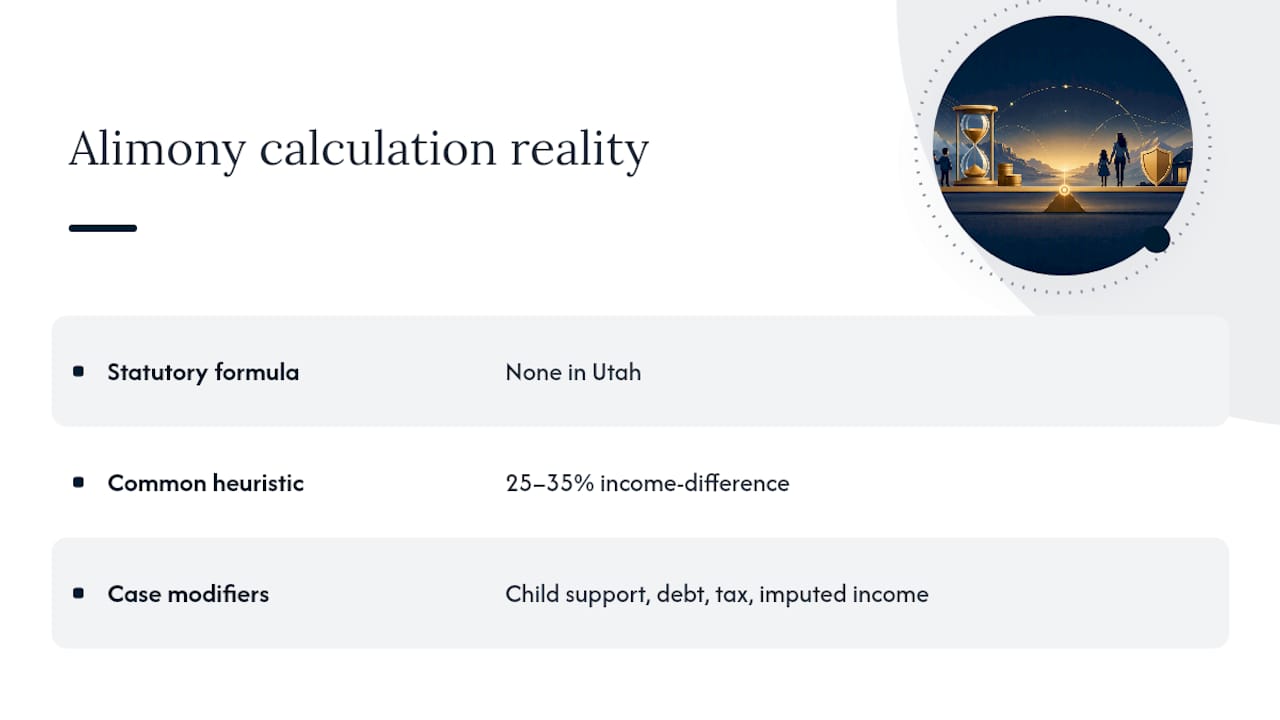
Utah has no statutory percentage formula for alimony, and any calculator promising an exact number is guessing. Judges weigh the § 81-4-502 factors case by case, which is why identical incomes can produce different results in different courtrooms.
That said, some practice guides reference informal heuristics, like starting negotiations around a 25 to 35 percent income-difference range, according to one divorce law guide. Treat that range as a conversation starter, not a guarantee. Child support obligations, shared marital debt, tax treatment, and imputed income (what a court thinks you could earn) all shift the real number up or down. A Utah alimony calculator found online can help you sanity check a settlement offer, but it can’t replace a factor-by-factor analysis of your actual case.
When Hiring a Utah Family Law Attorney Changes the Outcome
Alimony cases get complicated fast when finances aren’t simple, marriages ran long, or one spouse disputes what the other could realistically earn. Those are the moments where representation tends to matter most.
An attorney typically handles evidence gathering, drafts a rehabilitative plan with realistic milestones, negotiates with opposing counsel before a hearing ever happens, and advocates directly in front of the judge when negotiation stalls. Experienced legal professionals have represented Utah families in numerous client relationships, with an understanding of how local judges tend to apply the statutory factors. That local familiarity can shape how a case gets prepared from day one.

Get Help With Your Utah Alimony Case
Utah alimony laws leave real room for negotiation, and that discretion cuts both ways. It can work in your favor with the right evidence, or against you without it.

Loayza Law’s family law team handles the full range of alimony matters, from petitioning for temporary support during an active divorce to filing modification requests when circumstances change years later. If payments have stopped or a former spouse is dodging enforcement, the firm also pursues judgments and contempt actions on behalf of Utah clients. Related family matters, like reviewing a prenuptial agreement that may waive or limit support, often come up in the same conversation. If you’re heading into a divorce or already dealing with a disputed alimony order, contact Loayza Law’s family law practice for a case review before your next court date.
Key Statutes and Court Resources to Consult
- Utah Code Section 81-4-502 — statutory factors and the marriage-length cap
- Utah Code Section 81-4-504 — modification standards
- Utah Code Section 81-4-505 — termination rules
- Utah Courts — Alimony — plain-language guidance and forms
- WomensLaw — Divorce: Can I get alimony? — consumer-facing overview
This article is general information, not a substitute for advice from a qualified lawyer. Consult a qualified legal professional about your own circumstances before acting on anything here.
Sources
- Utah Code Section 81-4-502
- Utah Code Section 81-4-505
- Utah Courts — Alimony
- WomensLaw — Divorce: Can I get alimony?
- Utah Code Section 81-4-504
FAQ
How Much Alimony Will I Have to Pay in Utah?
There’s no fixed formula. The amount depends on the recipient’s need, your ability to pay, marriage length, and the other factors under Utah Code § 81-4-502, so two cases with similar incomes can end up with different orders.
How Can I Avoid Paying Alimony in Utah?
You generally can’t avoid it outright if the statutory factors support an award, but you can limit exposure by documenting a genuinely limited ability to pay, showing the marriage was short, or negotiating a rehabilitative plan with a defined end date instead of open-ended support.
If My Husband Dies, What Am I Entitled to in Utah?
Alimony itself ends at the payor’s death under Utah Code § 81-4-505, but a surviving spouse may still have claims through life insurance, retirement benefits, or the estate, depending on what the divorce decree and any beneficiary designations specify.
How Long Does a Man Have to Pay His Ex-Wife Alimony?
Utah generally caps alimony at the length of the marriage, and temporary alimony paid before the decree counts toward that limit. Alimony can end earlier if the recipient remarries or is proven to be cohabiting, per the same statute.
What’s the Difference Between Alimony and Child Support in Utah?
Alimony supports the lower earning spouse based on need and the marital standard of living, while child support is calculated separately using state guidelines tied to each parent’s income and the custody arrangement for the children.
A Practical Take on Utah’s Alimony Rules
Most people going through a Utah divorce assume alimony works like child support, plug in two incomes and get a number. It doesn’t. That surprises people, and honestly, it should give both sides pause before they walk into court assuming they know what a judge will do.
The bigger issue I see is how often temporary alimony gets treated as a formality rather than a strategic decision. Because those payments count toward the marriage-length cap under § 81-4-502, agreeing to an extended temporary support period without thinking it through can quietly shrink what’s available later. Fault gets overestimated too. Readers often assume proving a spouse’s misconduct will drive up an award, but Utah’s recodified statute treats fault as one factor among several, not a lever that overrides earning capacity or need.
If there’s one thing worth taking seriously, it’s the one-year cohabitation filing window. Payors who suspect cohabitation but wait too long to act can lose the right to terminate alimony on that ground entirely, even with solid proof in hand.
— Paralegal