

Breach of contract and fraud are not the same claim, and confusing them can cost you a case. A broken promise is a breach; a lie that got you to sign in the first place, or a promise made with no intention of keeping it, can be fraud. The two claims sometimes overlap, but they carry different burdens of proof, different pleading rules, and very different remedies.
TL;DR:
- Fraud claims require proof of pre-contract deception made with fraudulent intent, unlike breach claims that focus solely on performance failures.
- Demonstrating fraud often depends on contemporaneous written evidence showing the other side knew facts were false at the time of signing.
- Remedies for fraud include rescission, tort damages, and punitive damages, which are broader than the expectation and specific performance damages available for breach.
- Fraud claims must be pleaded with particularity, detailing who, what, when, where, and how the deception occurred, making them harder to prove than breach cases.
- Only pursue fraud if you have clear evidence of a separate misrepresentation made before signing, not just a deal that later fell through or was broken.
Table of Contents
- Contract Breach vs. Fraud: The Core Legal Tests
- Fraud in the Inducement, Promissory Fraud, and Concealment
- Pleading and Proof: Why Fraud Claims Face a Higher Bar
- Contract Damages vs. Fraud Remedies: What You Can Actually Recover
- What to Do Right Now if You Suspect Fraud
- How Experienced Contract Litigators Screen These Cases
- When Adding a Fraud Claim Actually Makes Sense
- Talk to Loayzalaw About Your Contract Dispute
- Sources
- FAQ
Contract Breach vs. Fraud: The Core Legal Tests
Breach of contract is about performance. You had an agreement, one side had an obligation, that obligation was not met, and the failure caused measurable damages. Courts do not ask why the other side broke the deal, only whether they had a duty and whether they missed it. A contractor who walks off a job three weeks late has breached, regardless of motive.
Fraud is about deception, and that difference in focus is what separates the two doctrines. To win a fraud claim, you generally need to show:
- A false representation or a material omission
- Knowledge that the statement was false, or reckless disregard for its truth
- Intent that you would rely on it
- Actual reliance on your part
- Damages that resulted from that reliance
Notice what is missing from breach but central to fraud: intent. Courts distinguish “you didn’t do what you promised” from “you never meant to do it, or you lied about facts to get me to sign.” That second category is what Cornell’s Wex legal dictionary describes as fraud in the inducement, where deception at the front end of a deal, not failure at the back end, drives the claim. A seller who claims a building has no foundation issues, knowing it does, and who gets a buyer to sign based on that lie, has committed fraud in the inducement even before any contract term gets breached.
Fraud in the Inducement, Promissory Fraud, and Concealment
Three doctrines let a fraud claim survive alongside, or instead of, a straightforward breach claim, and each turns on timing rather than outcome.
Fraud in the inducement covers false statements made to get someone to sign an agreement they otherwise would not have entered. Under Cornell’s Wex definition, this doctrine can make the entire contract voidable, letting the injured party seek rescission or damages rather than being stuck enforcing a deal built on a lie.
Promissory fraud is narrower and harder to prove. It applies when someone makes a promise they never intended to keep at the moment they made it. Signing a supply contract while already planning to sell to a competitor instead is promissory fraud, not just a later breach.

Concealment involves hiding material facts that, if disclosed, would have changed the other party’s decision to sign. Silence about a known defect, told falsely as “we have no problems,” fits here.
The common thread across all three:
The Second Circuit has held that a contractual promise supports a fraud claim only when the promisor had fraudulent intent at the time of signing — a later, willful breach alone will not sustain it.
That timing rule is the single most useful filter for deciding which claim you actually have.
Pleading and Proof: Why Fraud Claims Face a Higher Bar
Federal courts require fraud to be pleaded with particularity, not just alleged in general terms. You cannot simply write “the defendant misrepresented the deal.” Courts want specifics.
Here is what a properly pleaded fraud claim needs to identify:
- Who made the false statement, by name and role
- What exactly was said or concealed, in near-verbatim terms if possible
- When the statement was made, ideally tied to a specific date or meeting
- Where it happened, whether in writing, by phone, or in person
- Why or how the statement was false, and what the person knew at the time
Intent, the hardest element, gets proved indirectly. Contemporaneous emails, internal memos, prior drafts of the agreement, and communications with third parties often carry more weight than anything said after the dispute erupted. As practitioner guidance on fraud and breach of contract notes, plaintiffs frequently add fraud claims to strengthen leverage, but courts dismiss a large share of them for lacking exactly this kind of detail.
Pro Tip: Save anything written before the contract was signed. A single email that contradicts a later denial is often worth more than pages of argument after the fact.
Statutes of limitations differ too. Fraud claims often benefit from a “discovery rule,” which starts the clock when the deception was found rather than when it happened, while breach claims typically run from the date of the breach itself.
Contract Damages vs. Fraud Remedies: What You Can Actually Recover
The remedies available shift substantially depending on which claim you can prove, and that gap explains why so many plaintiffs try to plead both.
Breach of contract typically allows:
- Expectation damages, putting you in the position you would have been in had the contract been performed
- Specific performance, ordering the other side to actually complete the deal, in limited circumstances
- Restitution, returning any benefit unjustly retained
Fraud opens a wider door:
- Rescission, unwinding the contract entirely as though it never existed
- Tort damages, which can reach beyond the contract’s own terms
- Punitive damages, available in some fraud cases where contract law caps recovery at compensatory amounts
- Criminal exposure, in cases involving outright deceit like forged documents or falsified financials
That gap in available damages is exactly why fraud claims get added even when a straightforward breach case would be easier to prove. A Practical Law practice note warns that doctrines like the economic loss rule can block a fraud claim that merely restates a broken promise, so the extra remedy only helps if the underlying deception is real and provable.
What to Do Right Now if You Suspect Fraud
If you think you have been lied to, not just let down, the steps you take in the next few weeks matter more than almost anything that happens later in litigation.
- Gather everything written before you signed. Emails, texts, drafts, marketing materials, and any statement made during negotiation.
- Preserve electronic records intact. Do not delete, edit, or “clean up” files, even accidentally. Courts penalize altered evidence harshly.
- Write down your own timeline while it is fresh. Note who said what, when, and what you relied on when you decided to sign.
- Collect financial records showing harm. Bank statements, invoices, and receipts that tie your losses directly to the misrepresentation.
- Decide with counsel whether fraud adds real value. If the only evidence is a promise that was later broken, a straightforward breach claim may be the stronger path.
Pro Tip: Before you decide to plead fraud, ask whether you have a document dated before signing that shows the other side knew something they did not tell you. Without that, a fraud claim is much harder to win.
How Experienced Contract Litigators Screen These Cases
Attorneys who handle contract disputes regularly run a quick filter before deciding whether fraud belongs in a complaint. Is there a distinct misrepresentation, separate from the broken promise itself? Is there contemporaneous proof, something written before the ink dried? And does the contract contain an integration or no-reliance clause that could block a fraud claim outright?
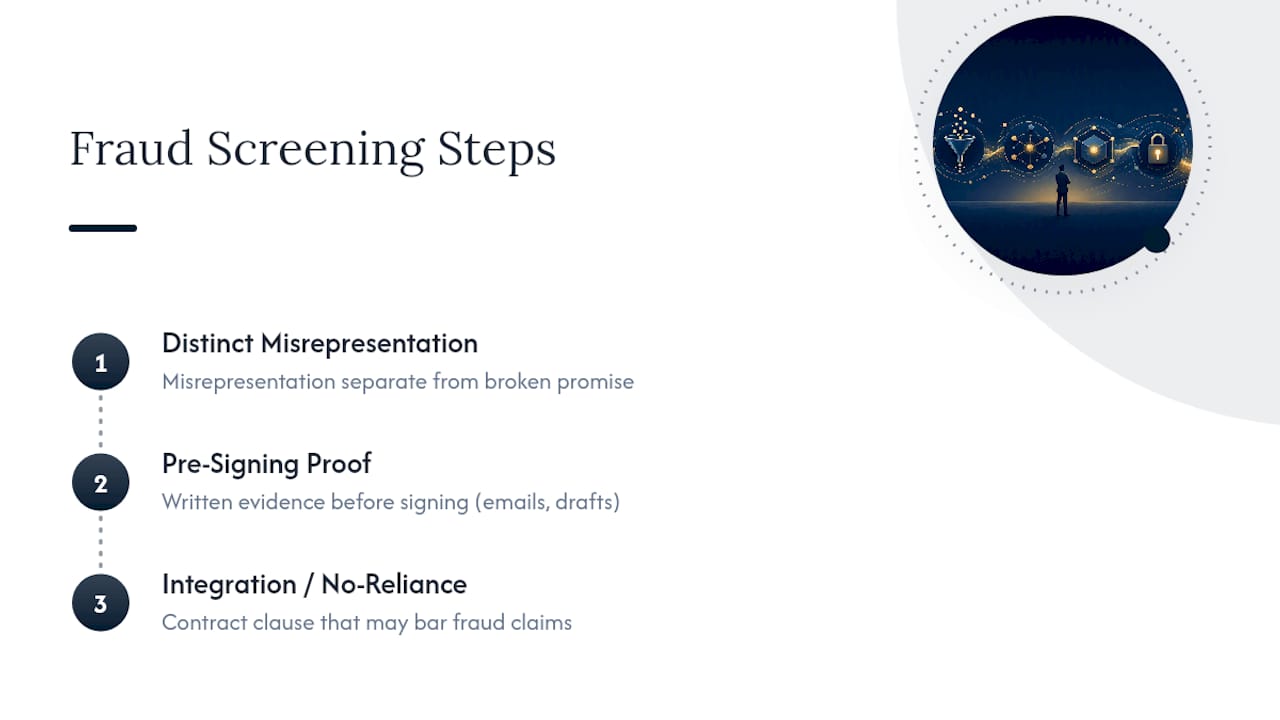
Evidence that meaningfully helps a fraud claim looks different from standard breach proof. A signed contract and a missed deadline prove breach. A pre-signing email contradicting later denials, or a draft term sheet showing the other side never intended the final terms, proves something closer to fraud. An experienced contract-dispute team’s approach starts with exactly this kind of evidence triage, sorting what supports a stronger claim from what merely restates a disappointment, before deciding how to frame the complaint.
When Adding a Fraud Claim Actually Makes Sense
Fraud claims buy you rescission, tort damages, and sometimes punitive relief that contract law simply does not offer. But that upside comes with a steeper pleading burden, a real risk of early dismissal, and higher litigation costs if the proof is thin. The practical rule: only push for fraud when you have a distinct, provable misrepresentation made before you signed, not just a deal that fell apart afterward.
— Paralegal
Talk to Loayzalaw About Your Contract Dispute
If you are staring at a broken agreement and wondering whether you have a breach claim, a fraud claim, or both, that is the kind of screening question handled by experienced contract-dispute attorneys for Utah clients and businesses.

A contract-dispute team reviews documents, communications, and timelines to identify whether a distinct misrepresentation exists before signing, then builds a strategy around whichever claim fits the facts. Services often include case evaluation, evidence preservation guidance, negotiation, and litigation representation when settlement talks stall. Instead of guessing which theory to plead, or risking a fraud claim dismissal for lack of particularity, clients can get an honest read from experienced attorneys. Visit the contract disputes page to request a case review and learn more about your dispute.
This article is general information, not a substitute for advice from a qualified lawyer. Consult a qualified legal professional about your own circumstances before acting on anything here.
Sources
- fraud in the inducement | Wex – Cornell Law School
- Asserting fraud claims in a breach of contract case (Practical Law practice note)
- Fraud and breach of contract — UpCounsel
- Second Circuit: Breach of contract can only serve as the basis for a fraud claim if there is proof of fraudulent intent at the time of contract execution
FAQ
Is breach of contract considered fraud?
No. Breach is a failure to perform an obligation, while fraud requires a false statement or concealment made with intent to deceive. A breach only becomes fraud when there was deception at or before signing.
What are the four types of contract breaches?
Courts generally recognize minor breach, material breach, anticipatory breach, and actual breach, each defined by how significant the failure is and when it occurs relative to the contract’s timeline.
What are the three types of fraud most relevant to contracts?
The three doctrines that most often apply are fraud in the inducement, promissory fraud, and fraudulent concealment, each turning on deception that happened before or at the time of signing.
What is the most famous breach of contract case?
Contract law courses commonly cite Hadley v. Baxendale for establishing how foreseeable damages are calculated, though it addresses breach remedies rather than fraud.
How do I know if I should pursue a fraud claim instead of just breach?
Ask whether you have a specific, provable misrepresentation made before you signed, supported by contemporaneous documents. Without that, a straightforward breach claim is usually the stronger and faster path, and a consultation with a contract-dispute attorney can help confirm which theory fits your facts.