

Yes, Utah courts can modify final family orders when they have jurisdiction and the legal standard is met. Child support follows numeric thresholds, custody and parent-time require a material and substantial change tied to the child’s best interests, and you file in the court that issued your original order using the correct petition or motion form. Some cases settle by stipulation, which skips the contested-proof fight entirely.
TL;DR:
- Utah courts can only modify support orders older than three years with at least a 15% change unless supporting evidence demonstrates a more significant discrepancy.
- Custody and parent-time modifications require both a material change in circumstances and that the change benefits the child’s best interests, with proof of lasting alterations.
- Out-of-state orders are only modifiable in Utah if the original order is registered and Utah has established continuing jurisdiction, which can depend on residency and time since moving.
- Filing requires a petition, supporting documents like income proof and supporting evidence, and payment of a fee, with options for stipulations or mediation to expedite resolution.
- Success depends on thorough documentation and jurisdiction checks; legal professionals can help avoid errors that may lead to case denial or delay.
Table of Contents
- What Family Orders Can Utah Modify?
- How Do You Modify Child Support in Utah?
- What’s the Standard for Modifying Custody?
- Can Utah Modify an Out-of-State Order?
- What Forms and Fees Are Required to File?
- What Evidence Should You Collect Before Filing?
- What Are Stipulated Modifications and Mediation?
- What Happens If the Court Denies Your Modification?
- What Outcomes Should You Expect From a Modification Petition?
- How We Approach Modification Cases
- Let Loayza Law Handle Your Modification Petition
- Sources
- FAQ
What Family Orders Can Utah Modify?
Utah courts can modify custody, parent-time, child support, alimony, and several other provisions written into a divorce decree, as long as the standard is met and Utah retains authority over the case. Some decree provisions only remain modifiable if a Utah court actually entered the original decree.
The legal standard for most modifications is the same starting point: a material and substantial change in circumstances since the order was entered. This must be a real, lasting shift, not a temporary blip. Utah Courts generally treats a change as non-temporary only when it’s expected to last at least 12 months.
Modifiable orders typically include:
- Child custody and parent-time schedules
- Child support amounts
- Alimony (spousal support)
- Property or debt provisions in narrow circumstances
- Health insurance and childcare cost allocations
When both parents agree on the new terms, a stipulated modification lets you skip the evidentiary hearing and move straight to a signed order.
How Do You Modify Child Support in Utah?
Child support modification runs on numbers, not just narrative. The Office of Recovery Services and Utah’s court rules set specific percentage thresholds that determine which legal pathway applies.
If your order is less than three years old, the bar is higher: a 15% difference plus proof of a genuine material change in circumstances, such as a job loss or a substantial raise.
Pro Tip: Run your own guideline calculation before filing. If the gap between your current order and the guideline number doesn’t clear the threshold, save yourself the filing fee and revisit later.
To support either pathway, gather:
- Two years of tax returns for both parents
- Recent pay stubs or proof of current income
- A completed child support worksheet
- Documentation of health insurance premiums and childcare costs
- Proof of any income change (layoff notice, new offer letter, disability determination)
ORS can also review and adjust support administratively without a court hearing, which is often faster when custody isn’t in dispute and only the dollar amount needs updating.
What’s the Standard for Modifying Custody?
Custody and parent-time modifications face a tougher test than support changes. You must prove both a material and substantial change in circumstances and that the requested change actually serves the child’s best interests. Proving one without the other typically fails.
Utah Courts treats this as a two-part showing, and courts are cautious about disrupting a child’s routine without solid evidence behind the request.
Common qualifying changes include:
- A parent’s relocation, especially beyond commuting distance
- Documented abuse, neglect, or substance use
- A significant, lasting shift in a parent’s work schedule or living situation
- A child expressing a well-reasoned preference as they get older
- One parent consistently violating the existing parent-time order
Temporary relief is available under Rule 106 while a modification case is pending, but the bar for temporary custody or parent-time changes is narrow. Courts generally require proof of immediate and irreparable harm, or a relocation scenario, such as a move of more than 149 miles, that demands an interim schedule. Your existing order stays fully enforceable until a judge signs something new, so don’t assume a pending petition changes anything on its own.
Can Utah Modify an Out-of-State Order?
Jurisdiction is the first question, not an afterthought. Utah courts generally hold exclusive, continuing jurisdiction over orders they issued, but that authority can shift if a parent and child have moved away and established residency elsewhere.
Common jurisdiction snags include:
- The original order came from another state and was never registered in Utah
- One parent still lives in the state that issued the order
- The child has lived outside Utah long enough to shift the controlling state
If your order originated elsewhere, you typically must register the foreign order in Utah before asking a Utah court to change it, and the issuing state usually needs formal notice once Utah’s modification is final. Anyone whose case crosses state lines should check the Support Modification Jurisdiction Chart and talk to counsel before filing, since a jurisdictional misstep can void months of work.
What Forms and Fees Are Required to File?
Filing a modification case in Utah follows a fairly consistent procedural sequence, whether you’re changing support, custody, or alimony.
- File the right document. Use a Petition to Modify for contested cases, or a Petition and Stipulation to Modify when both parties agree. Support cases also require a current child support worksheet.
- Pay the filing fee or request a waiver. Utah’s court fee schedule lists a filing fee around $100 for a petition to modify a divorce decree, though exact amounts vary by filing type. A fee waiver is available for those who can’t afford it.
- Serve the other party. You generally must complete service within 120 days of filing, then file proof of service with the court.
- Wait for a response. The other party has 21 days to answer if served inside Utah, or 30 days if served outside the state.
- Move toward resolution. Expect mediation, sworn declarations, or a case management conference before a judge issues Findings of Fact and a final order.
What Evidence Should You Collect Before Filing?
Strong documentation is what separates a granted modification from a denied one. Judges look for concrete proof, not just an account of what changed.
For financial claims, gather two years of tax returns, recent pay stubs, proof of any benefits, and documentation of childcare or medical costs. For custody claims, collect school records, shared calendars showing actual parent-time exercised, any CPS reports, witness statements, and dated texts or emails showing a pattern of behavior.
| Evidence Type | Best For | Where to Get It |
|---|---|---|
| Tax returns and pay stubs | Child support | Employer or IRS transcript |
| Child support worksheet | Support motions and petitions | Utah Courts forms page |
| School and medical records | Custody, relocation | School office, provider |
| Dated communications | Pattern of violations | Phone or email export |
Write a short, factual declaration for each major point you plan to raise, and organize exhibits in the order you’ll reference them at hearing. Judges notice when a petition is well organized.
What Are Stipulated Modifications and Mediation?
A stipulated modification happens when both parents agree on the new terms and sign a joint petition, often waiving formal service since neither side is contesting anything. This route moves fast, usually resolving in weeks rather than months, because there’s no hearing to schedule.
- Joint petitions with a signed stipulation can go straight to a judge for signature
- Many parenting-plan cases require mediation before a contested hearing is even scheduled
- ORS can adjust support amounts administratively but cannot touch custody or parent-time
If your dispute is purely financial, routing it through ORS review often resolves the issue without a court date at all.
What Happens If the Court Denies Your Modification?
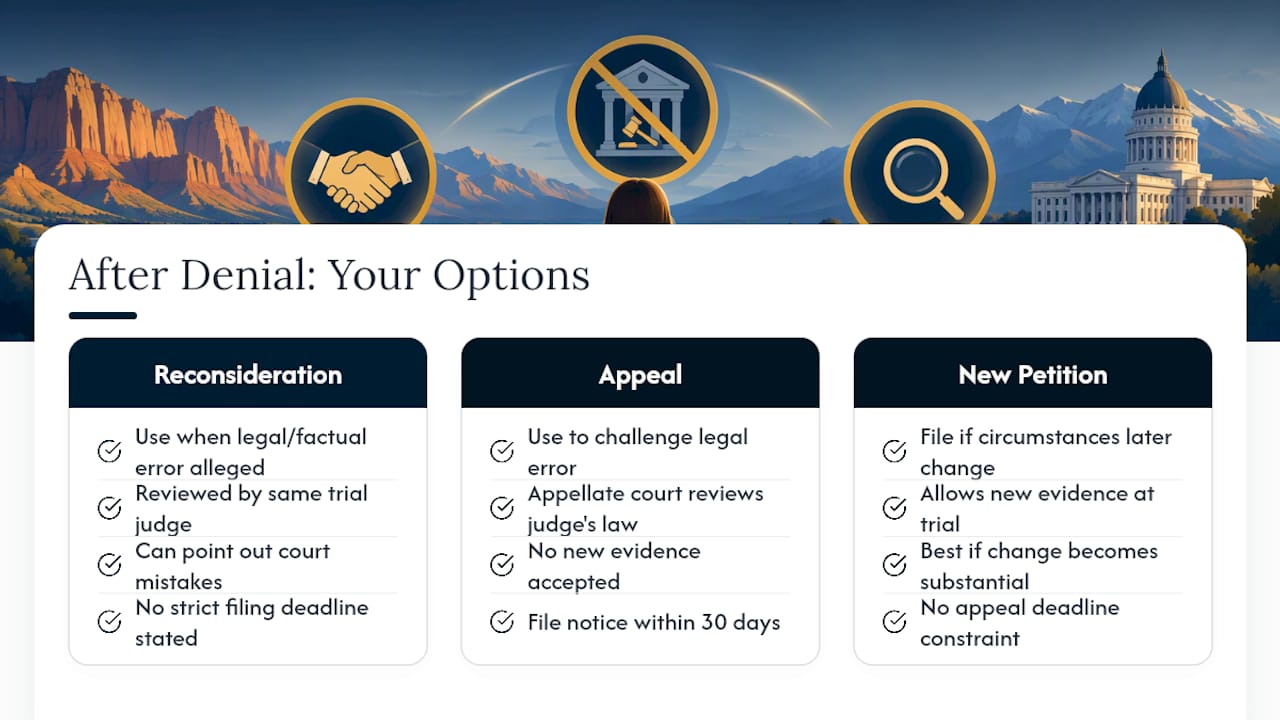
A denial isn’t necessarily the end of your case, but it does require a specific next step. If a judge rules against your petition to modify, you generally have two options: request reconsideration if you believe the court made a legal or factual error, or file a formal appeal with the Utah Court of Appeals.
Appeals in family law modification cases are narrow. The appellate court doesn’t re-hear your case or take new evidence. It reviews whether the trial judge correctly applied the material and substantial change standard, and whether the factual findings were reasonably supported by the record you presented below. That’s why the evidence you submit at the trial court level matters so much. If the record is thin, there’s nothing for an appellate court to fall back on.
Filing an appeal starts a clock, typically within 30 days of the final order, and missing that window generally forfeits your right to challenge the ruling. The process involves filing a notice of appeal, ordering transcripts of the hearing, and submitting written briefs arguing the legal error. It’s a slower, more expensive path than the original petition, often taking many months to resolve.
Before appealing, many parents consider whether circumstances have changed enough to simply file a new petition to modify instead. If your first attempt failed because the change wasn’t substantial enough yet, waiting and refiling with stronger evidence later can be more effective than fighting the denial on appeal. An attorney can help you weigh which path actually fits your situation, since the two roads lead to very different timelines and costs.
What Outcomes Should You Expect From a Modification Petition?
Modification petitions resolve in one of several ways, and understanding the range helps set realistic expectations before you file.
Full denial happens when the petitioner fails to prove a material and substantial change, or when the requested change wouldn’t actually serve the child’s best interests. The existing order stays exactly as written, and the petitioner may owe the other side’s attorney fees in some cases.
Partial modification is common in custody disputes. A judge might deny a full custody change but adjust the parent-time schedule, or grant a support increase smaller than requested based on the actual guideline calculation rather than the number either parent proposed.
Full modification grants the petition as filed, resulting in a new order that replaces the prior one entirely. This is most likely when the evidence clearly meets the threshold and the other party doesn’t contest it, or when both sides stipulate to the change from the start.
Dismissal without prejudice can occur for procedural defects, like improper service or missing forms, which usually just means refiling correctly rather than losing on the merits.
Each outcome carries real consequences for both parents and, most importantly, for the child’s daily routine. A partial win on parent-time can still meaningfully improve a family’s situation even without a full custody change, which is why many attorneys encourage clients to think in terms of realistic, evidence-backed requests rather than all-or-nothing petitions.
How We Approach Modification Cases
We push clients to organize their evidence before anything else. A modification case is won or lost on the paper trail: pay stubs, calendars, communication records. Second, we always check jurisdiction first, since a case built on the wrong court’s authority collapses no matter how strong the underlying facts are. Third, we look for stipulation opportunities early, because a signed agreement protects a child’s stability faster than any hearing can.
— Paralegal
Let Loayza Law Handle Your Modification Petition
Loayza Law is the alternative to piecing together forms and deadlines on your own. Where a self-filed petition risks a jurisdiction mistake or a missed service deadline, our family law team drafts the petition, assembles the financial and custody evidence, and represents you at hearings so a technical error doesn’t cost you the case.

Our attorneys check jurisdiction before filing, prepare the child support worksheet correctly the first time, and push for stipulated resolutions whenever both parents can agree. Legal teams with Utah-specific procedural knowledge and client-centered advocacy have helped numerous clients navigate family law and other legal matters successfully. If a divorce decree needs updating alongside a custody change, our Utah alimony guide explains how spousal support factors into the same modification. Visit our practice areas page or contact our Salt Lake City family law team directly to schedule a consultation and get your modification petition moving.
Sources
Utah’s self-help pages cover custody modification and child support modification forms directly. ORS explains support adjustment thresholds, while URCP Rule 106 governs temporary orders and procedure. Filing fees appear on the Utah Courts fee schedule, and a temporary custody guide offers additional background on interim relief.
This article is general information, not a substitute for advice from a qualified lawyer. Consult a qualified legal professional about your own circumstances before acting on anything here.
- Modifying custody — Utah Courts
- Change a Child Support Order — ORS Utah
- Modifying child support — Utah Courts (forms & process)
FAQ
What Is the Standard to Modify a Custody Order in Utah?
You must prove a material and substantial change in circumstances since the original order, and show that the requested change serves the child’s best interests. Both elements are required. Proving only one typically results in denial.
How Much Does Child Support Have to Change to File a Motion?
Orders under three years old typically need a 15% difference plus proof of a material change.
How Long Do I Have to Respond After Being Served?
The response window is 21 days if you were served within Utah, or 30 days if served outside the state. Missing that deadline can result in the petition being granted without your input.
Can I Modify an Order From Another State in Utah?
Only if Utah has jurisdiction, which usually requires registering the out-of-state order first and confirming Utah, not the original state, now has authority over the case. Crossing state lines often complicates this, so checking jurisdiction before filing saves time and money.
Does Loayza Law Handle Modification Cases?
Yes. Loayza Law’s family law team handles custody, child support, and alimony modification petitions across Utah, including jurisdiction review, evidence preparation, and courtroom representation. Pricing depends on the complexity of your case and is available directly through the firm.