

Utah calculates child support under an Income Shares model that combines both parents’ gross monthly incomes with the child’s overnight schedule to set a base obligation. The Office of Recovery Services (ORS) calculator or the printable worksheets from Utah Courts can produce a reliable estimate in minutes. Medical and childcare costs get added on top, split proportionally by income, and either parent can request a modification once specific statutory thresholds are met.
TL;DR:
- Extending parent-time with at least 25 consecutive overnights in a 30-day period results in a 50% reduction in the noncustodial parent’s child support obligation.
- Accurate income verification and precise overnight counts are critical, as errors can significantly impact support orders and often go uncorrected for years.
- Medical and childcare costs are added on top of the base support, split proportionally by each parent’s income share, and must be documented carefully for consistency.
- A support modification can be requested if there is a 10% difference from the guideline calculation or a material change such as a 30% income shift or custody change.
- The Income Shares model assumes support should reflect the household expenses if parents had stayed together, but factors like unconventional income or cases with extensive overnights can alter the calculation.
Table of Contents
- How the guideline model works: income shares and its three components
- How to calculate your Utah child support estimate step by step
- How overnights and the 2024 extended parent-time rule change your amount
- What counts as income and when a court imputes it
- When you can request a Utah child support modification
- What your payments cover and how ORS enforces the order
- Why this guide comes from a Utah family law practice
- What the guideline gets right, and what it still misses
- If you need help reviewing or filing your support calculation
- Sources
- FAQ
How the guideline model works: income shares and its three components
Utah’s child support statutes are built on the Income Shares model, which assumes a child should receive the same proportion of parental income they would have received if the household had stayed together.
Three components make up the full guideline amount:
- Base support: the core monthly figure drawn from the statutory combined-income table.
- Medical and insurance costs: the reasonable cost of health coverage and uninsured medical expenses, divided pro rata.
- Child care expenses: work-related or education-related child care, also divided by income share.
Rounding rules apply once the math is done, and Utah maintains a separate low-income table for parents whose combined gross income falls below a statutory floor, which keeps the obligation from swallowing a parent’s ability to meet basic needs. A judge can deviate from the guideline number, but only with written findings explaining why the standard calculation would be unjust in that particular case.
How to calculate your Utah child support estimate step by step
Working through the math by hand takes patience, but it mirrors exactly what the ORS calculator does behind the scenes.
- Gather proof of income for both parents: recent pay stubs, the last one or two tax returns, and documentation of any bonuses or self-employment earnings.
- Confirm the number of children involved and count overnights with each parent over a typical year.
- Choose the correct worksheet, sole, joint, or split custody, based on that overnight count.
- Calculate each parent’s adjusted gross monthly income under Utah Code 81-6-203 and 81-6-204, which govern what counts as income and how certain deductions apply.
- Locate the base combined obligation in the statutory tables at 81-6-302 or 81-6-304, then apportion it according to each parent’s percentage of the combined income.
- Add each parent’s pro rata share of medical insurance and child care costs.
- Round the final monthly figure to the nearest dollar.
The Utah Courts self-help pages walk through each worksheet line by line and list exactly what documentation a filing requires. Running the same numbers through the ORS calculator is the fastest way to double-check your manual math before you file.
Pro Tip: Print and save both the ORS calculator output and your completed worksheet. Courts and ORS caseworkers often ask for both when reviewing a support order.
How overnights and the 2024 extended parent-time rule change your amount
The number of overnights each parent has with the child shifts the base obligation because the parent with more overnights is presumed to already be covering a larger share of day-to-day costs directly.
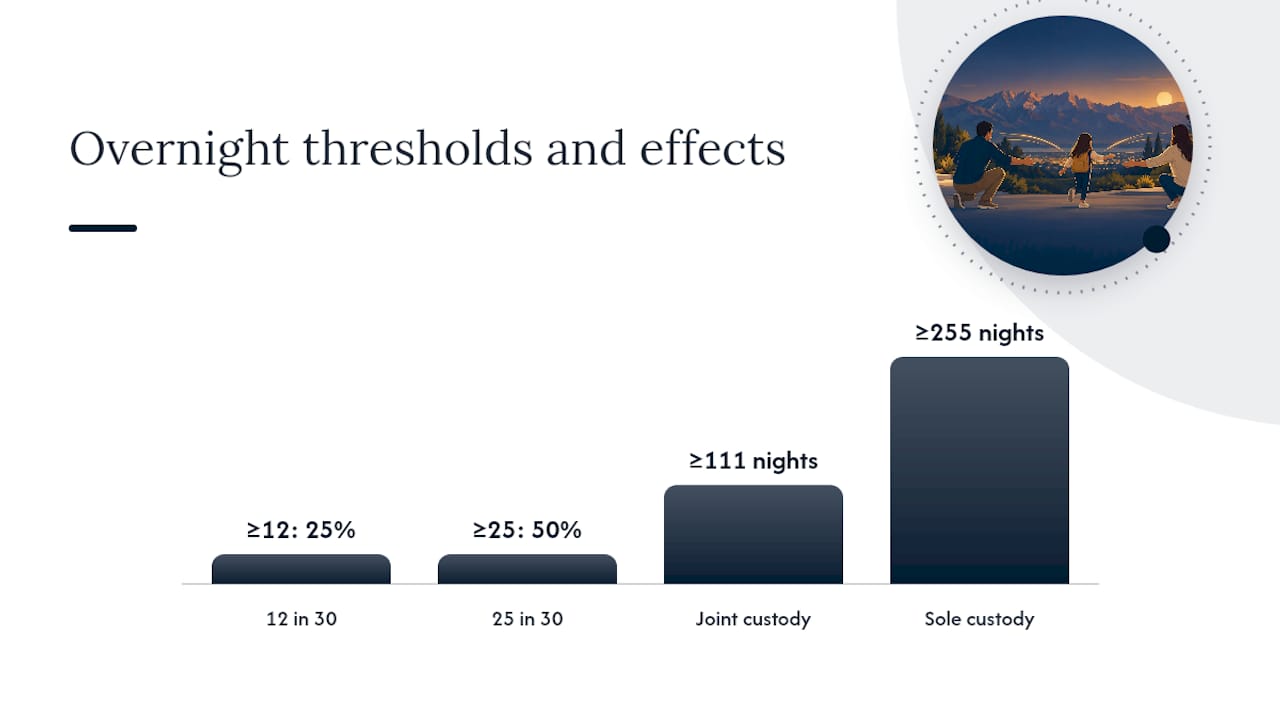
- Joint physical custody applies when a parent has 111 or more overnights a year, which typically lowers the paying parent’s obligation.
- Sole physical custody applies when one parent has 255 or more overnights, shifting most of the base obligation to the other parent.
- Split custody, where each parent has primary custody of at least one child, requires separate worksheet calculations that are then offset against each other.
Effective September 1, 2024, Utah Code 81-6-211 added specific reductions for extended parent-time: a noncustodial parent with at least 25 of 30 consecutive overnights receives a 50% reduction in base support, and one with at least 12 of 30 consecutive overnights receives a 25% reduction. ORS has its own procedures for applying these reductions and processing any resulting refund.
A parent exercising a sufficient number of consecutive overnights of parent-time over a 30-day period now qualifies for a 50% reduction in base child support under Utah Code 81-6-211. That single change can move a support order by hundreds of dollars a month once documented and applied correctly.
What counts as income and when a court imputes it
Utah casts a wide net when defining income for support purposes. Statute directs courts to include:
- Wages, salaries, commissions, and bonuses.
- Investment income, retirement and pension distributions, and Social Security benefits.
- Alimony received from a previous marriage, which factors into gross income even as separate alimony obligations are calculated in a divorce.
Earned income is generally limited to one full-time equivalent position, so a parent working two jobs is not automatically penalized for the second one in every case. Self-employed parents average their monthly gross income over a representative period to smooth out seasonal swings.
When a parent is voluntarily unemployed or underemployed without a valid reason, courts can impute income based on employment history, education, and local job availability, and Utah Code 81-6-203 allows federal minimum wage as a fallback figure when no better evidence exists.
When you can request a Utah child support modification
Utah does not require proof of hardship to revisit a support order, just evidence that meets one of a few statutory tests.
- Compare your current order to a fresh guideline calculation: a difference of 10% or more generally supports a modification request on its own.
- Document a material change such as a 30% shift in either parent’s income, a custody schedule change, or a child aging out of support.
- Use the ORS calculator output as evidence of the guideline difference, and attach pay stubs, tax returns, childcare invoices, and parenting-time records.
- File either through ORS for an administrative review or through a court petition when the case involves other contested issues.
Reviewing your case roughly every three years, even without an obvious trigger, catches wage growth or cost changes before they compound.
What your payments cover and how ORS enforces the order
Base child support is meant to cover a child’s everyday needs, housing, food, and clothing, while medical and childcare costs are billed and reimbursed separately according to each parent’s income share. Courts rarely credit in-kind contributions, like buying clothes directly, against a cash support obligation, so payments through the proper channel matter.
- ORS handles income withholding directly from a paying parent’s employer in most cases.
- ORS applies federal and state tax offsets against significant arrears.
- ORS processes refunds and applications tied to the extended parent-time reduction under 81-6-211.
The ORS noncustodial parents FAQ confirms that ORS remains the correct point of contact for payment processing questions rather than the other parent directly.
Why this guide comes from a Utah family law practice
This guide was prepared by a paralegal at a Utah law firm experienced in family law matters, with a background in interpreting Utah’s child support statutes and ORS procedures for real families.
What the guideline gets right, and what it still misses
The Income Shares model is fairer than flat percentage formulas because it ties support to what a household would have spent together, and the 2024 extended parent-time reduction finally recognizes that a parent with substantial overnights already carries real costs. That is a meaningful fix to a formula that used to treat every noncustodial parent the same regardless of actual involvement.
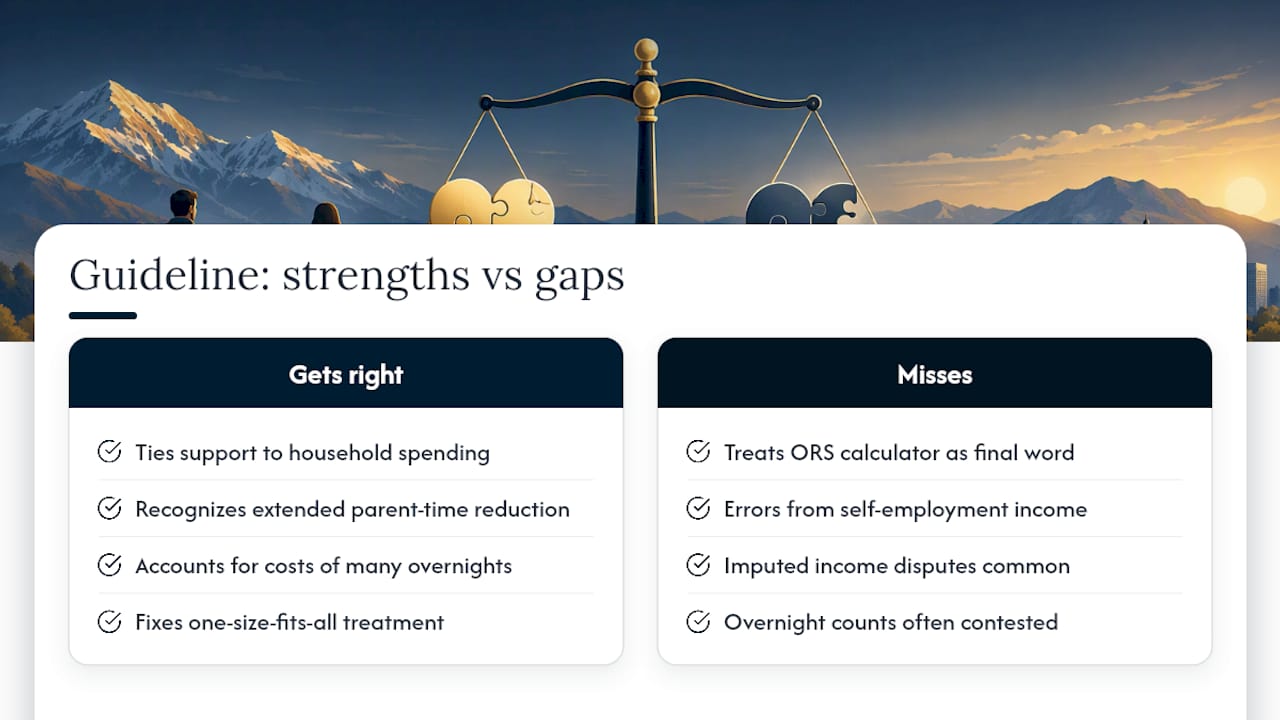
Where the conventional advice falls short is in treating the ORS calculator as the final word; understanding what judges look for in custody cases can help clarify how custody and parent-time evidence influence support orders. It is an estimate built on the numbers you feed it, and self-employment income, imputed income disputes, and overnight counts are exactly where errors creep in and cases get contested. Readers underestimate how often a support order gets set based on incomplete income documentation, then stays wrong for years because nobody revisits it.
Prioritize accurate income verification and an honest overnight count before you trust any output number, then treat that number as a starting point for negotiation or filing rather than a guaranteed result.
— Paralegal
If you need help reviewing or filing your support calculation
Running the numbers is one thing. Making sure the worksheet, income documentation, and any extended parent-time reduction are filed correctly is another. Loayza Law’s family law team reviews support calculations, prepares modification petitions, and represents clients through ORS and court proceedings across Utah.

| What we help with | Why it matters |
|---|---|
| Reviewing ORS calculator results | Confirms income and overnight inputs are accurate before filing |
| Preparing modification petitions | Meets the 10% and material-change filing standards |
| Court and ORS representation | Handles disputed income, imputation, and custody questions |
Contact our family law practice for a consultation on your specific support order.
This article is general information, not a substitute for advice from a qualified lawyer. Consult a qualified legal professional about your own circumstances before acting on anything here.
Sources
- 403P – Recovery Services (Child Support) – Utah DHHS
- Utah Courts — Child support (self-help)
- ORS — Calculate child support
- Utah Code 81-6-211 (Reduction for extended parent-time)
FAQ
How is child support calculated in the state of Utah?
Utah adds both parents’ gross monthly incomes, finds the base obligation in a statutory combined-income table, and splits it by each parent’s income share. Medical and childcare costs are added separately using the same proportional split, and the ORS calculator can generate this figure automatically once you enter both incomes and the overnight schedule.
How much child support will I pay if I make $2,000 a week?
There is no single answer, because the amount depends on the other parent’s income, the number of children, overnights, and medical and childcare costs, not on one parent’s earnings alone. Running both parents’ actual gross monthly incomes through the ORS calculator or the Utah Courts worksheets is the only way to get a figure specific to your case.
Is Utah a 50/50 child custody state?
Utah does not presume equal 50/50 custody by default; custody and parent-time are decided based on the child’s best interest, with joint physical custody defined as 111 or more overnights per year with a parent. The ORS worksheet you use, sole, joint, or split, depends on the actual overnight schedule ordered by the court.
What is typical alimony in Utah?
Utah alimony is set case by case based on need and ability to pay rather than a fixed statutory formula, and it is calculated separately from child support even though alimony received counts toward gross income for support purposes. Readers researching how alimony interacts with a divorce settlement can review Utah’s alimony framework for more detail on how payments and caps are determined.
When can I request a Utah child support modification?
Filing can go through ORS for an administrative review or through a court petition when other issues are contested.