

Utah small businesses facing debt they cannot repay typically choose one of two paths: liquidation under Chapter 7 or reorganization under Chapter 11, often through Subchapter V. Subchapter V was built for businesses like yours, cutting costs and complexity so a struggling company can keep operating while it pays creditors on a workable schedule. Because deadlines start running the moment you file, talk to a Utah bankruptcy attorney before you commit to either route.
TL;DR:
- Entity type determines personal liability; corporations and LLCs generally protect personal assets unless a personal guarantee is signed.
- Filing deadlines, including the 60-day status conference and 90-day plan submission, require careful planning to avoid case dismissal or conversion.
- Costs include fixed court fees, attorney fees, and potential professional expenses, with Subchapter V often reducing ongoing trustee fees.
- Consulting a local Utah bankruptcy attorney early helps navigate deadlines, meet eligibility requirements, and better manage costs and outcomes.
Table of Contents
- Is your business a separate legal entity? How entity type affects bankruptcy
- Chapter 7 vs Chapter 11 / Subchapter V: goals, trade-offs, and likely outcomes
- Subchapter V eligibility and key rules you must meet
- Process and timeline for filing in Utah: step-by-step from prep to plan
- Costs and fees in the District of Utah: filing fees and realistic cost expectations
- How to decide and next steps: questions to ask a bankruptcy attorney and red flags
- Why hire a local Utah bankruptcy lawyer: Loayza Law proof points
- Alternatives to bankruptcy for small businesses in Utah
- Post-bankruptcy obligations and rebuilding credit for small business owners in Utah
- What Utah business owners get wrong about bankruptcy
- How Loayza Law can help with your bankruptcy filing
- Sources
- FAQ
Is your business a separate legal entity? How entity type affects bankruptcy
The single biggest factor in how your bankruptcy plays out is whether your business is legally separate from you. A corporation or LLC generally shields your personal assets from business debt, so filing on behalf of the entity keeps the case focused on business property and business creditors. A sole proprietorship offers no such wall: the business and the owner are the same legal person in the eyes of the court, so a bankruptcy filing pulls in personal assets alongside business ones.
Partnerships sit somewhere in between, since partners can carry personal liability for business obligations depending on how the partnership is structured. Personal guarantees complicate matters further. Even owners of a corporation or LLC who signed a personal guarantee on a loan or lease can find that debt following them into their own finances regardless of how the business is organized.
- Corporations and LLCs generally separate business debt from personal assets, unless a personal guarantee exists.
- Sole proprietors and some partners can face personal exposure for business debts by default.
- A dissolved Utah entity may need to resolve outstanding tax obligations before reinstatement, which matters if you plan to keep the business alive under a different structure.
Knowing where your business falls on this spectrum shapes everything that follows, from which chapter fits your goals to how much personal risk you are carrying into the process.
Chapter 7 vs Chapter 11 / Subchapter V: goals, trade-offs, and likely outcomes
Chapter 7 and Chapter 11 answer two different questions. Chapter 7 asks how to wind the business down and pay creditors from whatever assets exist. Chapter 11, including its Subchapter V version, asks how to keep the business running while restructuring what it owes.
- Chapter 7 puts a trustee in charge of selling nonexempt business assets and distributing proceeds to creditors, then the business closes. It suits owners who no longer see a path to profitability and want a clean exit rather than a drawn-out repayment plan.
- Chapter 11 lets the business continue operating as a debtor in possession while it negotiates a repayment plan with creditors, which suits businesses with a viable core but too much debt weighing them down. Standard Chapter 11 was historically expensive and slow for small operations, which is exactly the gap Subchapter V was designed to close.
Subchapter V trims the traditional Chapter 11 process by appointing a trustee whose job is to help the debtor and creditors reach a consensual plan, rather than running the business themselves. Many small debtors under Subchapter V also avoid the quarterly fees the U.S. Trustee Program otherwise charges, which lowers the cost of staying in Chapter 11 long enough to reorganize.
The trade-offs are straightforward: Chapter 7 is faster and gives up the business, while Chapter 11 or Subchapter V takes longer and demands active management but preserves the company and, often, the owner’s ongoing income from it.
Pro Tip: If your business still generates revenue and you want to keep it running, ask your attorney about Subchapter V eligibility before assuming a standard Chapter 11 filing is your only reorganization option.
Subchapter V eligibility and key rules you must meet
Subchapter V is not open to every business. Eligibility turns on a debt ceiling and how that debt was incurred, and missing either requirement pushes you back into standard Chapter 11 or another chapter entirely.
- Your total noncontingent, liquidated secured and unsecured debt must fall under $3,424,000 for cases filed on or after June 21, 2024.
- Your business must be engaged in commercial or business activity, and at least 50% of your qualifying debt must come from that activity.
- A trustee is appointed automatically in every Subchapter V case to help move the plan toward agreement with creditors.
- The court schedules a mandatory status conference within roughly 60 days of filing, and you must submit a status report beforehand outlining your plan for reorganization.
- You then have 90 days from filing to submit your reorganization plan, though the court can extend that deadline for circumstances outside your control.
Skipping the status conference or missing the plan deadline without a court-approved extension can lead to dismissal or conversion to Chapter 7, so these dates need to be on your calendar from day one.
Process and timeline for filing in Utah: step-by-step from prep to plan
Filing bankruptcy is not a single event but a sequence of deadlines that starts the day you file and does not let up for months. Knowing the sequence in advance keeps you from missing something that could sink an otherwise sound reorganization.
- Gather your financial picture before you file: a full creditor list, recent bank statements, tax filings, and a clear accounting of business assets and liabilities. Individual debtors must also complete credit counseling within 180 days before filing unless an exception applies.
- File the petition, which immediately triggers the automatic stay, stopping most collection calls, lawsuits, and garnishments against the business. If you need faster relief from an active garnishment before your case is even filed, a wage garnishment response may buy you time.
- Attend the 341 meeting of creditors, a standard step across chapters where creditors can ask about your finances under oath.
- Prepare for the status conference, which Region 19 guidance requires within about 60 days of filing for Subchapter V cases, along with an initial financial report.
- File your reorganization plan within 90 days, then keep filing monthly operating reports as a debtor in possession for as long as the case remains open.
A trustee is appointed in every Subchapter V case at the outset, under U.S. Trustee Program rules, and that appointment shapes how quickly your plan moves toward creditor agreement.
Costs and fees in the District of Utah: filing fees and realistic cost expectations
The court fees themselves are fixed and public. As of Q3 2026, the Chapter 7 filing fee in the District of Utah is $338, while a Chapter 11 petition runs $1,738. Those numbers are only the starting point.
- Attorney fees vary by case complexity and typically make up the largest share of total cost, whether billed flat or hourly.
- Chapter 11 cases outside Subchapter V often carry quarterly U.S. Trustee fees, while many Subchapter V debtors avoid that recurring cost.
- Additional professional fees, such as an accountant preparing financial reports, can add up over a multi-month reorganization.
Ask your attorney for a fee structure up front, and ask specifically whether Subchapter V’s reduced procedural burden translates into a lower total bill for your case.
How to decide and next steps: questions to ask a bankruptcy attorney and red flags
The right chapter depends on facts specific to your business: whether it can realistically turn a profit once the debt load is restructured, how much of your debt is secured against equipment or property, whether tax debts are in the mix, and whether you personally guaranteed any of the obligations you are trying to discharge.
- Ask how long your specific case is likely to take given your debt load and creditor mix.
- Ask which chapter they recommend for your situation and why, not just what you asked for.
- Ask for a clear fee structure in writing before you sign anything.
- Ask how often you will hear from them and who handles day-to-day questions.
- Ask about outcomes in cases similar to yours, without expecting guarantees.
Watch for red flags: an attorney who promises a specific outcome, who cannot give you a fee estimate after reviewing your finances, or who has no history working District of Utah bankruptcy cases. If your creditor list leans heavily on subcontractors, understanding how that dependency shapes restructuring risk is worth raising with your attorney directly.
Pro Tip: Bring your full creditor list to the first consultation rather than a summary, since secured versus unsecured status often determines which chapter makes sense.
Why hire a local Utah bankruptcy lawyer: Loayza Law proof points
Bankruptcy law is federal, but how a case moves through court depends heavily on local practice, from Region 19’s Subchapter V reporting expectations to how the District of Utah’s clerk’s office handles filings. The law firm brings decades of legal experience and has served many clients across numerous resolved cases, gaining familiarity with how Utah courts operate beyond textbook procedure.
That local grounding matters most in the details: knowing what a status conference filing needs to include, anticipating how a trustee typically approaches a consensual plan, and catching a missed deadline before it becomes a dismissal. The bankruptcy practice is part of a broader litigation practice covering family law, contract disputes, and more, focusing on client-centered advocacy and responsive communication throughout the process.
Alternatives to bankruptcy for small businesses in Utah
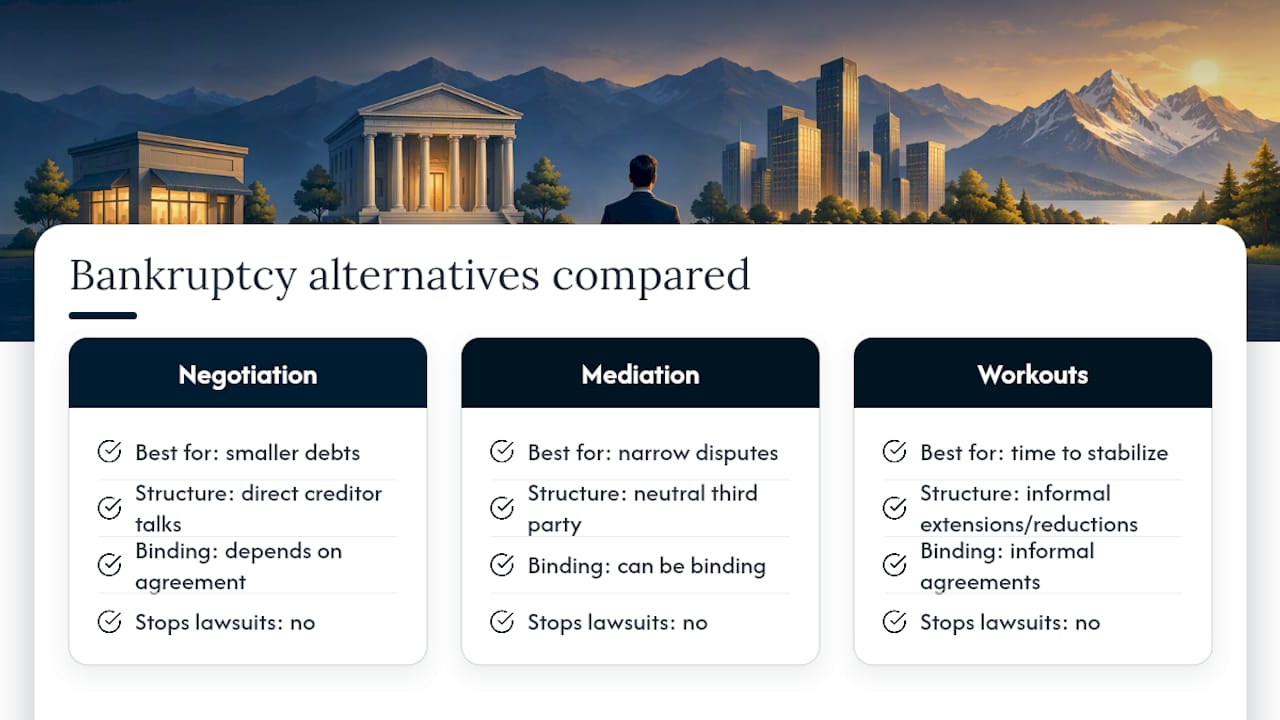
Bankruptcy is not the only way to handle unmanageable business debt, and for some owners it is not even the best first move. Debt negotiation, where you or your attorney contact creditors directly to settle for less than the full balance or restructure payment terms, can resolve smaller debt loads without a court filing. Creditors sometimes prefer this route because it recovers more than a Chapter 7 liquidation typically returns them.
Mediation offers a more structured alternative, bringing a neutral third party into negotiations with one or more creditors to reach a binding agreement outside of court. This works best when the dispute is narrow, such as a disagreement with a single major creditor over payment terms, rather than a broad debt load spread across dozens of vendors.
Out-of-court workouts, informal agreements to extend payment timelines or reduce interest, can also buy a business time to stabilize without the reporting obligations and court oversight that come with any bankruptcy chapter. Some businesses combine several of these approaches, negotiating with their largest creditors while paying smaller ones on schedule.
None of these alternatives stop collection lawsuits or garnishments the way an automatic stay does, so they tend to work best before creditors have escalated to legal action. Once lawsuits or garnishments are already underway, bankruptcy’s automatic stay often becomes the more reliable tool, since it applies to all creditors at once rather than requiring separate agreements with each one.
Post-bankruptcy obligations and rebuilding credit for small business owners in Utah
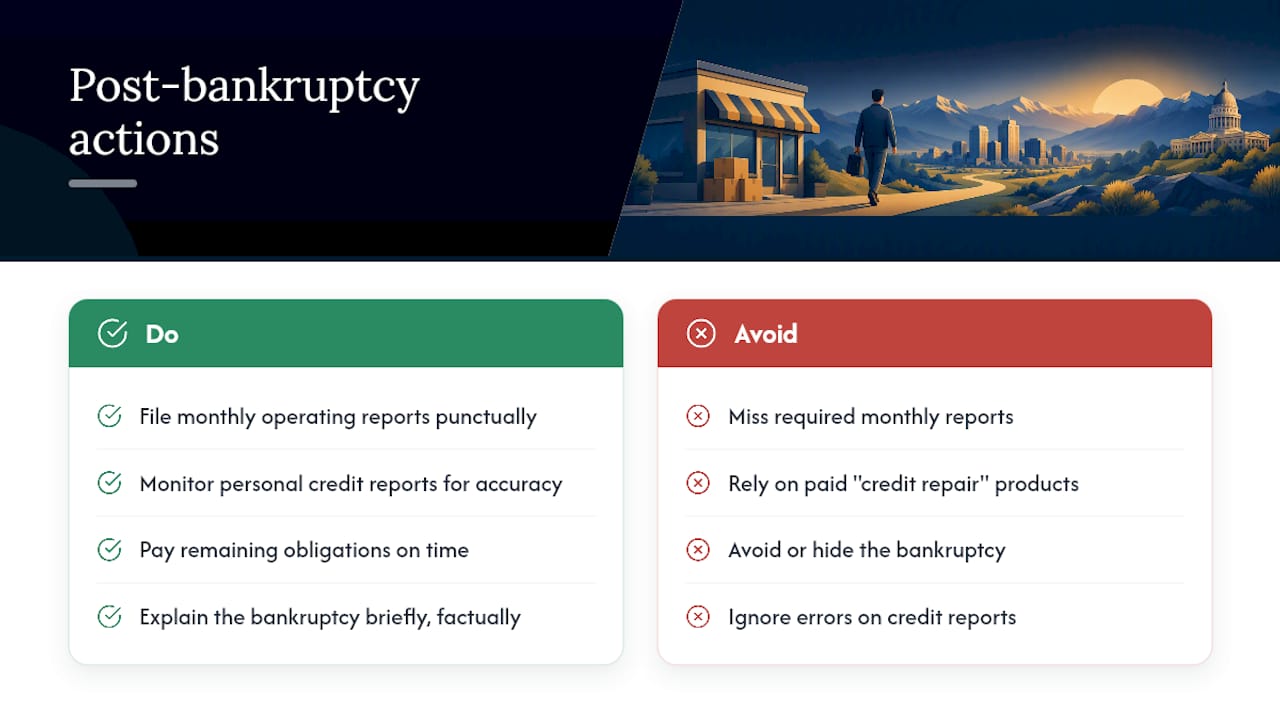
Filing does not end your obligations the moment the court approves a plan or grants a discharge. Chapter 11 and Subchapter V debtors must keep filing monthly operating reports until the plan is confirmed and, in many cases, for a period afterward while payments continue under the plan’s terms. Missing these reports can jeopardize a plan that otherwise took months to negotiate.
For sole proprietors whose personal and business finances were intertwined in the case, rebuilding credit afterward means monitoring personal credit reports for accuracy, since bankruptcy filings can remain on a credit report for years and errors in how the discharge or dismissal was reported can drag down a score longer than necessary. Paying remaining obligations on time, whether a reaffirmed debt or a new line of credit, does more to rebuild credit standing than any specific product marketed as a credit repair tool.
Business owners who reorganized and kept operating also carry a practical obligation: demonstrating to future lenders, landlords, and vendors that the restructuring worked. That often means being ready to explain the bankruptcy briefly and factually rather than avoiding the topic, since many commercial lenders will ask directly during underwriting. A business that emerges from Subchapter V with a confirmed plan and a history of on-time payments under that plan has a concrete story to tell, which tends to carry more weight with lenders than time alone.
What Utah business owners get wrong about bankruptcy
The biggest misconception in this area is that bankruptcy means the end of the business. In practice, Subchapter V exists specifically because Congress recognized that standard Chapter 11 was too slow and costly for the businesses that most needed reorganization, and a well-prepared Subchapter V filing is often the difference between closing the doors and continuing to operate under a manageable plan.
The conventional advice to “wait and see” before consulting an attorney is the part that deserves more pushback. The 60-day status conference and 90-day plan deadline in Subchapter V leave almost no room for delay once you file, and owners who spend weeks deciding whether to act often lose options they would have had earlier, like negotiating with a key creditor before a lawsuit is filed.
What matters most is treating the entity question and the debt limit as the first two filters, not an afterthought. Knowing whether your business structure exposes your personal assets, and whether your debt load fits Subchapter V’s ceiling, should shape the very first conversation you have with an attorney rather than a detail sorted out later.
— Paralegal
How Loayza Law can help with your bankruptcy filing
Loayza Law handles Chapter 7, Chapter 13, and Chapter 11 bankruptcy matters for Utah clients, including small business owners weighing Subchapter V. Bring your creditor list, recent bank statements, and a summary of business debts to your first consultation. Fees depend on the specifics of your case, and every outcome depends on the facts you bring to the table, but the Bankruptcy practice team in Salt Lake City can walk you through what applies to your situation.

Reach out through the practice areas page to schedule a consultation before your next deadline passes.
This article is general information, not a substitute for advice from a qualified lawyer. Consult a qualified legal professional about your own circumstances before acting on anything here.
Sources
- District of Utah | Filing fees
- U.S. Trustee Program | Subchapter V
- Bankruptcy basics | U.S. Courts (Chapter 7 basics)
- Region 19 Chapter 11, Subchapter V Guidelines for Debtors in Possession
FAQ
How long before a debt is uncollectible in Utah?
This depends on the type of debt and the applicable statute of limitations, which varies by debt category rather than a single fixed period. An attorney can review your specific creditor claims to determine which are still legally collectible in your case.
What disqualifies you from a Chapter 7 bankruptcy?
There is no single disqualifying rule, but a prior bankruptcy case dismissed for willful failure to appear or comply can trigger a 180-day bar on refiling. Individuals also generally need to complete credit counseling before filing unless an exception applies.
How much money can you have in the bank when you file Chapter 7?
Utah’s bankruptcy exemptions determine how much cash and other property you can keep, and the exact amount depends on which exemption category applies to your assets. Because Chapter 7 pulls in personal assets for sole proprietors, reviewing your specific exemption eligibility with an attorney before filing is worth the time.
What is the 90 day rule for Chapter 7?
There is no single universal “90 day rule.” Common references include the 90-day period bankruptcy law examines for recoverable preference payments to creditors, and separately, Subchapter V’s 90-day plan filing deadline for businesses reorganizing rather than liquidating.