

A Utah prenuptial agreement is fully enforceable when it meets five core requirements under Utah Code § 81-3-202: the agreement must be in writing, signed by both parties, entered voluntarily, supported by full financial disclosure, and not unconscionable at the time of signing. Miss any one of those, and a court can void the entire document.
Here is the minimum checklist every couple should confirm before signing:
- In writing. Oral prenups have no legal standing in Utah.
- Signed by both parties. Both signatures must appear on the executed document.
- Voluntary execution. No coercion, threats, or undue pressure from either side.
- Full financial disclosure. Each party must honestly disclose assets, debts, and income.
- Not unconscionable. Terms cannot be so one-sided that a court finds them fundamentally unfair.
Start conversations well before your wedding to allow ample time for review, retain independent counsel for each party, and store notarized originals in a secure location. If you want a review of a draft or need representation, contact a Utah family law attorney before you sign anything.
Table of Contents
- Why Utah couples commonly use prenuptial agreements
- What Utah law requires for a valid prenuptial agreement
- What your Utah prenup can and cannot include
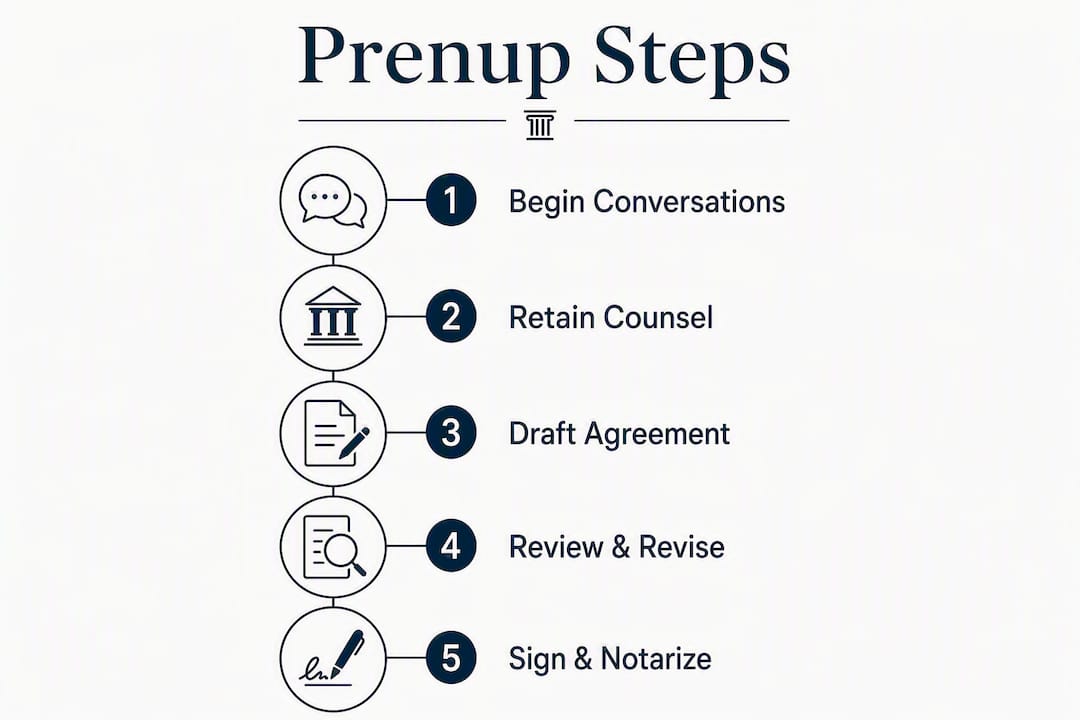
- How to create an enforceable prenup in Utah: a step-by-step checklist
- Common reasons Utah prenups fail in court and how to avoid each one
- How prenuptial and postnuptial agreements differ in Utah
- Key questions to ask a Utah prenup attorney before you sign
- Key Takeaways
- A practical perspective on prenups in Utah
- Loayzalaw helps Utah couples protect what matters most
- Authoritative sources and further reading
Why Utah couples commonly use prenuptial agreements
A prenuptial contract in Utah is not just for the wealthy. Under Utah’s equitable distribution framework, a court divides marital property in a way it deems fair, which is not automatically a 50/50 split and may not reflect what either spouse intended. A valid prenup overrides those default rules for the subjects it covers.
Common reasons couples sign one:
- Protecting premarital assets. A party who owns a home, investment accounts, or a retirement fund before marriage can keep those assets separate if the marriage ends.
- Shielding a business. A business owner entering a second marriage may want to protect equity, goodwill, and future growth from being classified as marital property.
- Preserving an inheritance. If you expect a significant inheritance or have already received one, a prenup can keep it outside the marital estate.
- Setting spousal support expectations. Couples can agree in advance on whether alimony will be paid, for how long, and under what conditions, removing uncertainty from a future divorce.
- Coordinating with an estate plan. A prenup can align with a will or trust, particularly in blended families where children from a prior relationship have inheritance interests.
- Managing debt. A party carrying significant student loans or business debt can use a prenup to prevent that liability from attaching to the other spouse.
Consider a business owner in Salt Lake City who built a software company before marriage. Without a prenup, a divorce court could treat appreciation in that business as marital property subject to division. A well-drafted agreement, with a current valuation attached as a schedule, keeps the premarital equity clearly separate.
Pro Tip: If either of you owns a business, attach a current valuation or appraisal as a schedule to the agreement. A court is far more likely to honor a specific, documented figure than a vague ownership clause with no supporting numbers.

What Utah law requires for a valid prenuptial agreement
Utah adopted the Uniform Premarital Agreement Act, codified at Utah Code § 81-3-201 et seq., which sets the statutory floor for enforceability. Meeting these requirements is not optional; it is the difference between a document that holds up in court and one that gets thrown out.
- Written form. The agreement must be a signed, written document. No exceptions.
- Both parties sign. Both spouses-to-be must execute the agreement before the wedding.
- Voluntary execution. Courts examine whether each party signed freely. Timing, access to counsel, language comprehension, and evidence of pressure all factor into this analysis. Agreements presented 24–48 hours before the wedding, or accompanied by ultimatums, face a high risk of being challenged successfully for duress.
- Full financial disclosure. Each party must provide a fair and reasonable disclosure of property, debts, and financial obligations. Hiding assets or understating liabilities is the most common ground for invalidation.
- Not unconscionable. A court will refuse to enforce terms that are so one-sided they shock the conscience, particularly when combined with inadequate disclosure at the time of signing.
Utah courts presume a valid prenup is enforceable. The burden of proof falls on the party seeking to invalidate it; that party must demonstrate involuntariness, unconscionability, or inadequate disclosure. That presumption is a meaningful protection, but only if the procedural steps above were followed carefully.
Statute note: Notarization and court filing are not legally required under Utah’s Uniform Premarital Agreement Act. Practitioners strongly recommend notarizing signatures anyway, because a notarized document creates contemporaneous evidence of voluntary execution and makes it significantly harder for a party to later claim they did not sign or were coerced.
Independent counsel for each party is not legally mandated either, but it is one of the strongest procedural protections available. A court evaluating voluntariness will look at whether each party had a meaningful opportunity to consult an attorney and understand what they were agreeing to.
What your Utah prenup can and cannot include
Knowing the boundaries before drafting saves time and prevents clauses that a court will simply ignore or strike.
Commonly allowed subjects:
- Characterization of property as separate or marital
- Division of specific assets and debts at divorce or death
- Spousal support terms, including amount, duration, and triggering conditions
- Business ownership protections and treatment of future business appreciation
- Retirement account treatment and beneficiary designations
- Choice-of-law provisions (subject to public policy limits)
- Rights and obligations regarding specific real property
Prohibited or unenforceable items:
- Any clause that purports to set, waive, or limit child support
- Terms that attempt to predetermine child custody or visitation
- Provisions that violate Utah public policy or encourage divorce
- Clauses that waive rights the law does not permit parties to waive by contract
A practical example of an allowed clause: “All premarital retirement account balances held by either party as of the date of marriage, and any passive growth on those balances, shall remain the separate property of the account holder.” That kind of specific, documented clause is far more durable than a general statement that “retirement accounts are separate.”
How to create an enforceable prenup in Utah: a step-by-step checklist
| Step | Recommended Lead Time | Responsible Party |
|---|---|---|
| Begin conversations and agree to pursue a prenup | — | Both parties (joint) |
| Each party retains independent legal counsel | — | Party A and Party B separately |
| Exchange full financial disclosures (tax returns, account statements, deeds, loan statements, business docs) | — | Both parties |
| Attorney drafts agreement; other party’s attorney reviews | — | Drafting attorney / reviewing attorney |
| Negotiate terms; revise draft | — | Both parties and their attorneys |
| Both parties sign before a notary | At least 7 days before wedding | Both parties |
| Store notarized originals securely (each party retains one; law firm retains one) | Day of signing | Both parties and attorneys |
Attorney-drafted agreements typically vary in cost depending on complexity, the number of assets involved, and whether negotiation is required. Online services may offer lower starting prices, but usually lack personalized legal counsel or a review of your specific financial picture. For a meaningful agreement, attorney drafting is the standard that courts expect to see.
The ContractsCounsel marketplace shows real variance in attorney bids for Utah prenup work, reflecting differences in complexity and market. A straightforward agreement for two people with modest assets costs far less than one involving a business, multiple properties, or a blended family.
Pro Tip: Notarize signatures and keep at least three originals: one for each party and one with the drafting attorney. A prenup is a private contract that takes effect on marriage and does not require court filing. If you cannot produce the original signed document in a later divorce or probate proceeding, enforcing its terms becomes significantly harder.
Common reasons Utah prenups fail in court and how to avoid each one
Procedural unfairness, not poor legal wording, is the most frequent cause of invalidation. Courts look at how the agreement was made, not just what it says.
- Inadequate financial disclosure. Prevention: Attach detailed schedules listing all assets, debts, account balances, and income sources. Update them if circumstances change materially before the wedding.
- Signing too close to the wedding. Prevention: Aim for a fully executed agreement at least two weeks before the ceremony. Agreements signed 24–48 hours before the wedding face heightened judicial scrutiny for duress.
- No independent counsel for one party. Prevention: Each party should retain their own attorney. Keep the engagement letters and any written communications as evidence that both parties had access to counsel.
- Ambiguous or unconscionable terms. Prevention: Use specific, defined language. Avoid vague phrases like “reasonable support” without defining the amount or duration. Have counsel review every clause for enforceability.
- Missing schedules or supporting documents. Prevention: Attach tax returns, account statements, property deeds, and business valuations as exhibits. A bare agreement with no supporting documents is an invitation to a disclosure challenge.
- No record of the negotiation process. Prevention: Keep dated emails, attorney correspondence, and draft versions. This paper trail rebuts a later claim that one party was pressured or had no opportunity to negotiate.
Documentary evidence that helps rebut a duress or disclosure challenge: dated email threads between attorneys, signed acknowledgment of financial schedules, attorney engagement letters for both parties, and the notarized agreement itself with a date clearly preceding the wedding by a meaningful margin.
How prenuptial and postnuptial agreements differ in Utah
Timing is the most obvious difference, but the legal treatment diverges in ways that matter practically.
| Feature | Prenuptial Agreement | Postnuptial Agreement |
|---|---|---|
| Timing | Before marriage | After marriage |
| Governing law | Utah Uniform Premarital Agreement Act (§ 81-3-201 et seq.) | General contract principles |
| Judicial scrutiny | Presumed enforceable; challenger bears burden of proof | Higher scrutiny; courts examine fairness more closely |
| Child support/custody | Cannot be determined by either agreement | Cannot be determined by either agreement |
| Independent counsel | Strongly recommended | Often required in practice to withstand scrutiny |
| Typical cost | — | Often higher due to added complexity and scrutiny |
Postnuptial agreements in Utah are enforced under general contract law, not the specific statutory framework that governs prenups. Because spouses owe each other duties of good faith during marriage, courts apply closer scrutiny to postnups and look carefully at whether both parties had independent counsel and made full disclosures. For comparison, postnuptial agreements in other states face similar heightened review, as outlined in resources like this postnuptial agreement guide for Texas.
A postnuptial agreement makes sense when circumstances change after marriage: a spouse starts a new business, receives a large inheritance, or the couple’s financial picture shifts significantly. The extra documentation burden is real, but a well-executed postnup can still provide meaningful protection.
Key questions to ask a Utah prenup attorney before you sign
Walking into a first consultation prepared makes the meeting more productive and helps you evaluate whether the attorney is the right fit.
- How many prenuptial agreements have you drafted under Utah law, and have any been challenged in court? Experience with Utah premarital agreements specifically matters more than general family law experience.
- Will you represent only one of us? An attorney cannot ethically represent both parties to a prenup. Confirm this upfront.
- How do you handle financial disclosure? Ask whether the attorney will prepare or review financial schedules and what format they use.
- What is your fee structure? Flat fee or hourly? What triggers additional charges? Get this in writing.
- What is your timeline from first meeting to signing? Confirm the attorney can complete the work well before your wedding date.
- Will you recommend notarization and secure storage? An attorney who does not raise these points may not be thinking about long-term enforceability.
- What happens if my fiancé’s attorney proposes changes? Understand the negotiation process and how revisions are handled.
Red flags to watch for: an attorney who suggests representing both parties, vague or verbal-only billing estimates, pressure to sign quickly without adequate review time, or a draft that arrives with no attached financial schedules. After the meeting, request a written engagement letter before any work begins, exchange disclosure documents promptly, and set clear windows for negotiation and revision.
Key Takeaways
A Utah prenuptial agreement is enforceable when it satisfies five statutory requirements, is signed well before the wedding, and is supported by full financial disclosure and independent counsel for each party.
| Point | Details |
|---|---|
| Five statutory requirements | Writing, both signatures, voluntary execution, full financial disclosure, and not unconscionable under Utah Code § 81-3-202. |
| Timing matters | Sign well before the wedding; begin the process early to allow ample time for disclosure and negotiation. |
| Cost range | Attorney-drafted prenups in Utah typically cost $1,000–$10,000; online services start around $599 but lack personalized counsel. |
| What prenups cannot decide | Child support and custody are always decided by a court at the time of divorce, not by a prenup or postnup. |
| Loayzalaw’s role | Loayzalaw represents individual clients in Utah prenup matters, handling drafting, disclosure review, and estate-plan coordination. |
A practical perspective on prenups in Utah
The conventional wisdom treats a prenuptial agreement as a sign of distrust. That framing misses what these agreements actually do in practice. A prenup is a financial planning document. It forces both parties to disclose their full financial picture before the wedding, which is a conversation most couples benefit from having regardless of whether they ever divorce.
What practitioners see most often is not couples who drafted bad agreements. It is couples who waited too long, signed under pressure, or skipped the disclosure schedules because they felt awkward listing every account. Those are the agreements that fail. The legal wording is rarely the problem. The process is.
The other thing worth saying plainly: the burden of proof in Utah sits with the party challenging the prenup. A well-documented agreement, signed with adequate lead time, with independent counsel on both sides and notarized originals in secure storage, is genuinely difficult to invalidate. The procedural steps are not bureaucratic formalities. They are the enforceability of the agreement.
If you are already married and wondering whether a postnuptial agreement could accomplish similar goals, the answer is yes, with more effort. Courts apply greater scrutiny, independent counsel becomes even more important, and the documentation burden is higher. The protection is still available; it just requires more care.
Loayzalaw helps Utah couples protect what matters most

Loayzalaw’s Salt Lake City family law practice handles prenuptial agreement drafting and independent-review consultations for individuals across Utah. The firm represents one party per agreement, which means your interests are the only ones being served. Services include full financial disclosure preparation, business valuation referrals, estate-plan coordination, and secure document retention guidance.
Flat-fee and hourly arrangements are available depending on the complexity of your situation. To get started, bring a summary of your assets, debts, and income to the initial consultation, along with any existing estate planning documents. The firm serves clients in Salt Lake City and surrounding Utah counties.
Contact Loayzalaw to schedule an initial consultation and get a clear picture of what your prenuptial agreement needs to include, how long the process will take, and what it will cost.
This article provides general legal information about Utah prenuptial agreements and is not a substitute for advice from a licensed Utah attorney about your specific situation. Confirm current statutory requirements with the Utah Legislature’s official code or a qualified family law attorney.
Authoritative sources and further reading
The sources below are the primary authorities for Utah prenuptial agreement law. Verify any statutory requirement directly with the official Utah Legislature site, as statutes are amended periodically.
- Utah Code § 81-3-202 — Uniform Premarital Agreement Act: The controlling statute for prenup enforceability in Utah. Start here for the five core requirements.
- Utah Courts — Property Division: Official court guidance on how Utah divides marital property at divorce, which explains the default rules a prenup can override.
- ContractsCounsel — Utah Prenup Pricing: Market-level cost data and attorney bids for prenup work in Utah, useful for budgeting.