

Divorce does not automatically end a two-year conditional green card, but it changes how you remove the conditions. You can no longer file jointly with your spouse. You file Form I-751 on your own and request a waiver based on a good-faith marriage that ended in divorce, then prove the marriage was real. We handle immigration matters at Loayza Law, and a divorce-based waiver is a case where the order of events, the evidence and the timing decide the outcome.
TL;DR
- A conditional green card is held by people who were married less than 2 years when they got permanent residence. It stays valid until USCIS decides your Form I-751, according to USCIS.
- The divorce waiver is available only after the marriage has legally ended. A separation, formal or informal, does not qualify.
- You can file the waiver at any time before you are removed, so you do not have to wait for the 90-day window that applies to joint filers.
- You carry the burden of proving the marriage was entered in good faith, even when it ended quickly.
- Stepparent adoption in Utah is a separate family court matter and does not change an adult’s I-751 case.
Table of Contents
- What divorce does to a conditional green card
- Your three paths when the marriage is ending
- Deadlines: the 90-day window and the waiver
- The waiver grounds
- Proving the marriage was real
- Common mistakes that cost people their status
- What the divorce means for citizenship
- Can you get divorced while on a green card?
- Stepparent adoption in Utah is a different track
- Getting help with your waiver
- FAQ
- Sources
What divorce does to a conditional green card
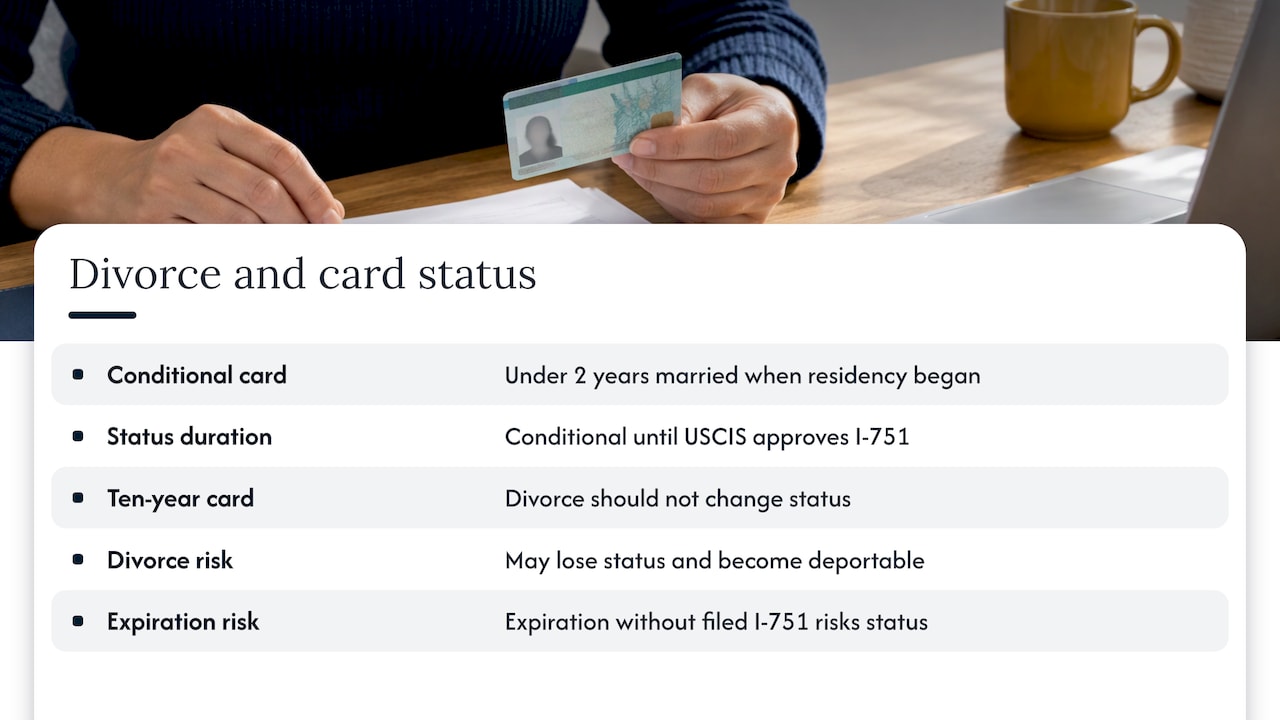
Your status is conditional if it is based on marriage and you had been married less than 2 years on the day you became a permanent resident. It remains conditional until USCIS approves your I-751, as USCIS explains. A ten-year green card is different. If you already hold a ten-year card, divorce should not change your status, according to the Maryland People’s Law Library.
With a conditional card, the risk is real. The same source notes that if the marriage ends, you may lose conditional resident status and become deportable unless you take the right steps. That is why the divorce itself is not the danger. The danger is letting the card’s expiration date pass without a properly filed I-751.
Divorce versus separation
The law treats these very differently. A divorce is a court order that legally ends the marriage. Separation usually leaves you legally married while you live apart. The USCIS Policy Manual states that a conditional resident qualifies for the good-faith divorce waiver only if the marriage has already been terminated, and that no waiver of the joint filing requirement rests on a legal or informal separation.
If you are weighing the two, our guide to legal separation versus divorce explains how each works in family court. For a conditional resident, the immigration consequence should be part of that decision from the start.
Your three paths when the marriage is ending
Path 1: Divorce is final before you file
This is the cleanest route. Once the decree is entered, you file Form I-751 alone and request the waiver for a good-faith marriage terminated other than by death. You attach the final decree and your evidence of the marriage.
Path 2: You already filed jointly and the divorce finalizes while it is pending
USCIS may not deny a joint petition solely because you are separated or have started divorce or annulment proceedings. But if the divorce is finalized while the joint petition is pending, you are no longer eligible to use the joint petition. Per the Policy Manual, you may ask USCIS to amend the joint petition to a waiver based on divorce. In practice, USCIS typically issues a request for evidence asking for the final decree and a written request to amend, so you do not start over.
Path 3: The divorce is still pending when the card is about to expire
This is the tightest situation. If the divorce is not final when USCIS asks for the decree, and it is not final within the response period, the petition may be denied. This is where coordinating the divorce timeline with your immigration deadline matters most. Quick, orderly divorce proceedings can protect your filing, and a card that is close to expiring should be treated as urgent.
Deadlines: the 90-day window and the waiver
Joint filers must file during the 90-day period immediately before the conditional residence expires. Filing earlier can lead to rejection, according to the USCIS Form I-751 page. Missing that window can terminate conditional status and lead to removal proceedings, though USCIS can accept a late filing when you show good cause.
Waiver filers have more room. Per the Policy Manual, Chapter 5, a conditional resident seeking a waiver may file at any time after receiving conditional status and before being removed. Do not read that as permission to wait. Treat the card’s expiration date as your working deadline, and file as soon as the decree is in hand.
The waiver grounds
The same chapter lists four grounds for waiving the joint filing requirement:
- Extreme hardship if you were removed from the United States.
- A good-faith marriage that was terminated other than by death (the divorce waiver).
- Battery or extreme cruelty by your spouse against you or your child.
- Battery or extreme cruelty by a petitioning stepparent or a conditional-resident parent against a conditional-resident child.
Most people reading this are on the second ground. If abuse is part of your story, the third ground may apply as well, and it can be filed with the divorce ground. A hardship waiver on its own can also rest on facts that a divorce waiver does not require, so the grounds should be chosen deliberately, not by default.
Proving the marriage was real
The waiver is not granted because the divorce happened. USCIS recognizes that genuine marriages can end in under two years, and the Policy Manual says the 1986 marriage fraud law was not meant as a tool against bona fide but brief marriages. It also makes clear that you remain responsible for submitting evidence that the marriage was entered in good faith and not to evade immigration laws.
The Maryland People’s Law Library gives examples of documents that show good faith, such as a joint lease, a joint bank account, joint credit cards, or coverage under the same auto or health insurance policy. Build the file around the whole relationship, not only the paperwork from the green card process:
- Shared living: leases, mortgage papers, utility bills and mail at a common address.
- Shared finances: joint tax returns, joint accounts, shared loans and insurance beneficiary designations.
- Shared life: photos across time, travel records, messages, and statements from friends and family who knew you as a couple.
- Timeline: a short, honest account of how the relationship began and why it ended.
The intent when you married is the central question. Evidence from after the breakdown matters less than records from the months when you were together. You can see how officers question couples in our guide to the marriage green card interview, and the same themes appear in a waiver file.
Common mistakes that cost people their status
- Treating separation as enough. Without a final decree, the divorce waiver is not available.
- Ignoring the expiration date while the divorce drags on.
- Filing a thin evidence package. A decree alone proves the marriage ended, not that it was real.
- Inconsistent statements. Dates, addresses and the story of the marriage should match across your original application, your divorce papers and your I-751.
- Not updating your address with USCIS, which can cause you to miss a request for evidence.
What the divorce means for citizenship
Divorce also affects your naturalization timeline. The People’s Law Library notes that a conditional resident who divorces before completing three years of good-faith marriage to a U.S. citizen must wait five years to apply for citizenship, instead of using the three-year rule. Plan the dates with that in mind.
Can you get divorced while on a green card?
Yes. Nothing prohibits a green card holder from divorcing, and family courts handle these cases like any other. The immigration question is only what your card type requires afterward. Property division, support and any children’s issues still go through the court. Our checklist on Utah property division shows how we organize that side of the case.
Stepparent adoption in Utah is a different track
Some readers searching this topic have a second question: a stepparent adopting a spouse’s child. This is a family court process, separate from an adult’s I-751.
Per the Utah State Courts, a married person who adopts a minor stepchild becomes the child’s legal parent, and the other birth or legal parent’s rights end. Consent is required from:
- the adopting person’s spouse,
- the child, if 12 or older,
- the child’s non-custodial parent, and
- a court-appointed guardian, if the guardianship order gives that right.
The court can terminate a parent’s rights on specific grounds, such as a voluntary consent or abandonment, under Utah Code 81-13-205 and 80-4-301. A LegalClarity summary of Utah law lists a one-year marriage, a shared address for a year, an age gap of at least ten years and 180 days of the child living in the home, with a judge able to waive the 180 days for good cause. Verify the current requirements with the court before filing.
If the child is foreign-born, adoption alone does not confer immigration status. USCIS says a separate process is required. A stepparent who is a U.S. citizen or permanent resident can also petition for a stepchild with Form I-130 if the marriage occurred before the child’s 18th birthday, and adoption is not required for that petition. None of this affects your own I-751.
What we tell clients
At Loayza Law, we handle both immigration and family law, and we see divorce-based waivers as cases where those two worlds have to be coordinated. The divorce decree is a family law document, but it is also the key exhibit in your immigration filing. When one team keeps both timelines in view, the decree date, the card expiration date and the evidence file work together instead of against each other.
Our approach is to begin with the calendar. We confirm when the card expires, where the divorce stands and what proof of the marriage exists, then decide which filing path fits. We also prepare the person, not only the forms, because a waiver case is about telling a consistent, honest story of the marriage.
This is the kind of work our client-centered advocacy is built for: clear communication, a plan tailored to your facts, and no surprises about what USCIS will ask.
Paralegal
Getting help with your waiver
We represent clients in immigration and family law matters, which is useful when a conditional green card and a divorce overlap. Our Salt Lake City immigration page describes how we approach these cases, and our practice areas cover the family law side of the divorce. Our firm has served more than 1,300 clients and resolved more than 1,200 cases.

If your card is approaching its expiration date or your divorce is moving, bring your card, your divorce papers and whatever records you have of the marriage. If you are still at the start of the green card process, our guide to getting a green card through marriage explains the steps and timeline.
FAQ
Does divorce cancel my conditional green card?
No. Divorce does not end your status automatically. Your status continues until USCIS decides your I-751, but you can no longer use the joint petition once the divorce is final. You must request a waiver and prove the marriage was in good faith.
Can I file the I-751 waiver before my divorce is final?
The divorce waiver requires a terminated marriage, and separation does not qualify. If you file jointly while still married, USCIS may request the final decree and your written request to amend the petition. If the divorce is not final within the response period, USCIS may deny the petition.
What if I miss the 90-day window?
For joint filers, missing the window can terminate conditional status and lead to removal proceedings. USCIS may accept a late filing if you show good cause. Waiver filers may file at any time before removal, but should not wait.
Does a divorce affect a ten-year green card?
Generally not. A permanent resident with a ten-year card keeps that status after divorce. The conditions and the I-751 apply only to two-year conditional cards.
Does stepparent adoption in Utah change my own green card case?
No. Stepparent adoption is a Utah court proceeding about parental rights. Your I-751 depends on whether your marriage was entered in good faith and has ended. A foreign-born child needs a separate immigration process.
Sources
- USCIS: Removing Conditions on Permanent Residence Based on Marriage
- USCIS Policy Manual, Volume 6, Part I, Chapter 5: Waiver of Joint Filing Requirement
- USCIS Policy Manual, Volume 6, Part I, Chapter 4: Joint Petitions
- USCIS: Petition to Remove Conditions on Residence (Form I-751)
- Maryland People’s Law Library: How Will Divorce or Separation Affect My Immigration Status
- Utah State Courts: Adopting a Minor Stepchild
- USCIS: Adoptions policy manual update
- USCIS: Immigration, Adoption, and Citizenship for Stepchildren of U.S. Citizens and LPRs
- LegalClarity: Utah stepparent adoption requirements