

A green card through marriage lets the spouse of a U.S. citizen or lawful permanent resident live and work in the United States permanently. The core steps are the same for everyone: the sponsoring spouse proves status, the couple proves the marriage is real, the sponsor shows enough income, and the foreign spouse completes either adjustment of status inside the U.S. or consular processing abroad. Most cases take a year or more, and the details of your situation decide the route.
We handle immigration matters for families every day, so this guide sticks to what couples actually ask: who qualifies, which forms to file, what evidence works, what it costs, how long it takes, and what happens after approval.
TL;DR
- A U.S. citizen or a green card holder can petition for a spouse with Form I-130. Citizens’ spouses are treated as immediate relatives, with no wait for a visa number.
- Inside the U.S. you generally file Form I-130 and Form I-485 together. From abroad, you file Form I-130 and then move to consular processing.
- Expect roughly 10 to 17 months for an in-country case, plus a few more months if the spouse is overseas.
- If you have been married less than two years when residence is granted, the card is conditional and you must file Form I-751 together within the 90 days before it expires.
- Government fees alone run from the low thousands of dollars, and they change, so confirm each figure on the USCIS fee schedule before you file.
Table of Contents
- Who can apply for a marriage-based green card
- Inside the U.S. or abroad: two routes
- Forms and documents you need
- How to prove your marriage is real
- How long a marriage green card takes
- What it costs in government fees
- Conditional residence and removing conditions
- The 90-day rule and other pitfalls
- Perspective: why a marriage case deserves a careful review
- Work with a Utah immigration team
- FAQ
- Sources
Who can apply for a marriage-based green card
Both U.S. citizens and green card holders can sponsor a spouse. USCIS explains that a citizen or permanent resident may petition to bring a spouse to the United States as a permanent resident, and that a green card holder files Form I-130 first. So the answer to a common question is yes: a green card holder can file for a spouse.
The difference between the two sponsors matters for timing:
- Spouse of a U.S. citizen: classified as an immediate relative. A visa is immediately available, so there is no queue for a visa number.
- Spouse of a green card holder: the petition is approved first, then the couple waits until a visa number becomes available before the spouse can adjust status or complete consular processing.
The marriage itself must also qualify. According to the USCIS Policy Manual, a spousal relationship must be legally valid where the marriage took place, consistent with U.S. public policy, bona fide, and entered into by two people who were legally free to marry. If either of you was married before, you will need proof that the earlier marriage ended.
What “bona fide” means in practice
The Policy Manual says the marriage must have been entered into in good faith: the spouses intended to build a life together when they married, and did not marry primarily to get around immigration law. USCIS does not judge whether the marriage will last, only whether it was genuine at the start.
That is why couples with a short courtship, a large age gap, different languages or different religions should not panic. Those facts alone do not defeat a case. What helps is a clear, consistent record of a shared life.
Inside the U.S. or abroad: two routes
The first decision is where the foreign spouse will complete the process.
Adjustment of status (inside the U.S.)
For the spouse of a citizen who is already in the country, USCIS says to file Form I-130 and Form I-485 together when the spouse entered through lawful admission or parole. To adjust status, USCIS requires that the applicant:
- properly files Form I-485,
- was inspected and admitted or paroled into the U.S.,
- is physically present in the U.S. when filing,
- is eligible for an immigrant visa and has one immediately available, and
- is admissible, or eligible for a waiver of inadmissibility (USCIS).
The fourth and fifth points are where most complicated cases are decided. An unlawful entry, a past overstay, an old arrest or an earlier immigration violation can all change the analysis, and the wrong filing can put the foreign spouse at risk. If anything in your history worries you, speak with an immigration attorney before filing anything. Our guide to adjustment of status in Utah walks through the filing steps in more detail.
Consular processing (abroad)
If the spouse lives overseas, the citizen files Form I-130. After approval, the case goes to the National Visa Center (NVC), which collects visa fees and supporting documents and notifies you when a visa number is about to become available. The spouse then interviews at a U.S. consulate. After the visa is granted, the beneficiary pays the USCIS Immigrant Fee before the card is produced.
Which route fits you
| Question | Adjustment of status | Consular processing |
|---|---|---|
| Where is the foreign spouse? | In the U.S., lawfully admitted or paroled | Outside the U.S. |
| Main forms | I-130, I-485, I-864 | I-130, DS-260, I-864 |
| Where is the interview? | A local USCIS field office | A U.S. embassy or consulate |
| Work and travel permits | Optional I-765 and I-131 while pending | Not applicable; the visa is the entry document |
| Typical added step | Wait for a decision on the I-485 | NVC document review, then consular scheduling |
Forms and documents you need
USCIS lists the core forms for a marriage case as Form I-130, Form I-485 and Form I-864, with Form I-765 and Form I-131 available for work authorization and travel (USCIS). Documents commonly include:
- your marriage certificate,
- proof that any prior marriages ended (divorce decrees, death certificates),
- passport-style photos,
- proof of the petitioner’s citizenship or permanent residence,
- the foreign spouse’s birth certificate and a government-issued photo ID, and
- evidence of inspection and admission or parole into the U.S.
The Form I-485 instructions specify two identical color passport-style photographs, a photocopy of a government-issued photo ID, a photocopy of a birth certificate issued by the proper civil authority, and evidence of inspection and admission or parole. Always use the current edition of every form, because USCIS rejects outdated editions.
The financial sponsor and Form I-864
Most family-based immigrants need an Affidavit of Support. USCIS describes it as a legally binding commitment by the sponsor to maintain the immigrant. The income threshold depends on household size and is tied to the federal poverty guidelines published on Form I-864P, which USCIS updates annually. If the petitioner’s income falls short, a joint sponsor can help; USCIS says a joint sponsor must meet the same requirements as the petitioner but does not need to be a relative (USCIS).
Public charge rules also changed in 2026. We summarize them in our public charge rule explainer, which is worth reading before you assemble your financial documents.
How to prove your marriage is real
The form itself is the easy part. The evidence is where couples need to be organized. Think of it as a timeline of your relationship, with documents from different sources that agree with each other.
Strong evidence usually includes:
- Shared finances: joint bank statements, joint credit cards, shared loans, tax returns filed jointly.
- Shared home: a lease or mortgage with both names, utility bills, and mail addressed to both of you at the same address.
- Shared life: insurance policies naming each other, medical records or emergency contacts, travel itineraries, and photos from different times and places.
- Family and friends: short sworn statements from people who know you as a couple.
- Children: birth certificates of children you share.
If you have not combined finances yet, do not invent paper to fill a gap. Provide what is true and explain it in a short, honest cover letter. Officers are trained to look for consistency, and genuine couples are usually consistent about the story of how they met, where they live, and daily routines.
How long a marriage green card takes
USCIS says to expect a marriage case in 2026 to take a year or more: about 10 to 17 months when applying from inside the U.S. with Form I-485, and an additional 2 to 4 months for consular processing when the spouse is overseas. Individual cases vary with the field office, the quality of the evidence and whether USCIS asks for more information.
| Stage | What happens | Typical impact on timing |
|---|---|---|
| Filing | Forms, fees, evidence submitted | Receipt notices arrive within weeks |
| Biometrics | Fingerprints and photo | Often early in the case |
| Work permit | Optional Form I-765 while I-485 is pending | Separate processing |
| Interview | Both spouses answer questions together | Often in the second half of the process |
| Decision | Approval, request for evidence, or denial | Card arrives after approval |
Published estimates from private guides range widely, and several report that interview practices became stricter in 2026, with in-person interviews expected in more cases and requests for evidence adding months. Treat any single number as an estimate and check the current processing times on the USCIS website for your field office before planning around a date.
Practical ways to avoid delays
- Use the current form editions and the correct fee.
- Sign every form where required and answer every question; write “N/A” rather than leaving blanks.
- Translate every foreign-language document with a certification of accuracy.
- Keep copies of everything you file and every notice you receive.
- Update USCIS promptly if you move.
- Respond to any request for evidence by its deadline, and treat it like a new filing.
What it costs in government fees
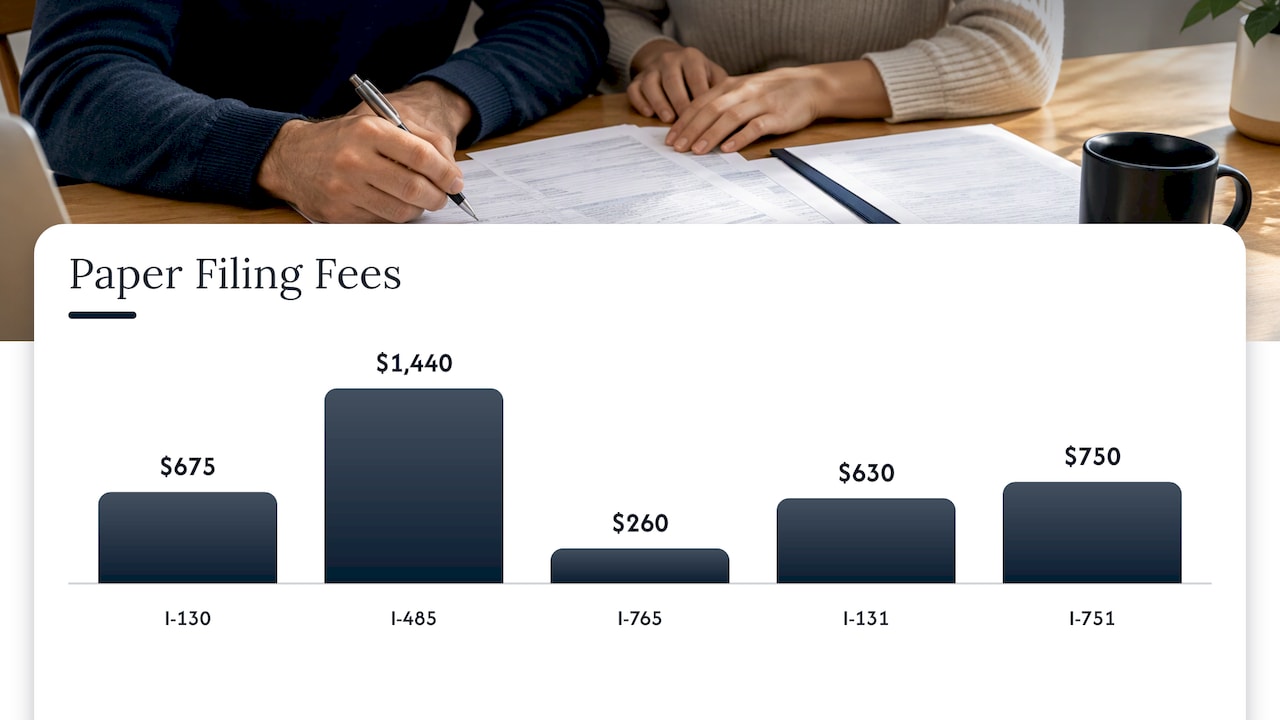
Fees change, so use the official USCIS fee schedule, Form G-1055 as your final reference. Based on the edition dated 10/26/26, the main amounts for a marriage case are:
| Form | Purpose | Paper | Online |
|---|---|---|---|
| I-130 | Petition for Alien Relative | $675 | $625 |
| I-485 | Adjustment of status (applicant 14 or older) | $1,440 | $1,390 |
| I-765 | Work permit with a pending I-485 | $260 | n/a in this summary |
| I-131 | Advance parole (travel) | $630 | $580 |
| I-751 | Remove conditions on residence | $750 | $700 |
For a paper-filed adjustment case, the required I-130 and I-485 fees add up to $2,115. The optional work and travel permits add more. Consular processing has its own State Department and USCIS fees in addition to the I-130, which is why the total differs between the two routes. These government fees do not include medical exam costs, translations, document copies, or attorney fees.
We do not publish a flat price for immigration cases on our site, because the work depends on your history and the complexity of your file. We are happy to explain how fees work for your situation during a consultation.
Conditional residence and removing conditions
If you have been married less than two years on the day your spouse becomes a permanent resident, the green card is conditional. USCIS states that the card expires two years after the date conditional residence begins, and that missing the deadline to remove conditions could cost the person their status and lead to removal.
Here is what to do:
- Mark the date 90 days before the card expires.
- File Form I-751 together, as a couple, within that 90-day window (USCIS Policy Manual).
- Include fresh evidence of the marriage covering the two years since approval.
- Keep the receipt notice. USCIS says a properly filed I-751 extends status and work authorization for 48 months.
If your I-751 is still pending after that extension and you need proof of status, USCIS directs you to call its Contact Center at 800-375-5283. If the marriage has ended in divorce before filing, a waiver may be available, and that is a situation where you should speak with an attorney before you file.
The 90-day rule and other pitfalls
You will often see the “90-day rule” in marriage cases. It is a guideline used to evaluate whether a person who entered on a temporary visa, such as a tourist visa, misrepresented their intentions if they married or took other actions inconsistent with that status soon after arrival. The State Department changed its older 30/60-day approach to a 90-day period, and USCIS later referenced it in its Policy Manual. It is an evaluation guide, not an automatic bar, and the facts of your entry and your marriage still matter.

If you married within a few months of arriving on a visitor visa, do not assume you are disqualified, and do not assume you are safe either. Talk through the timeline with an attorney before filing.
Other common problems include:
- Filing with an old form edition or the wrong fee. USCIS may reject the package, costing you weeks.
- Inconsistent answers at the interview. Review your own forms together beforehand.
- Unreported history. Arrests, prior visa applications and prior removal orders must be disclosed. If you are unsure what government records contain, an immigration FOIA request can show your file before you apply.
- Applying without lawful admission. This is the situation where a provisional waiver, discussed in our guide on the I-601A hardship waiver, may come into play.
- A denied I-485. A denial is not always the end. See what to do in our article on an I-485 denial.
Perspective: why a marriage case deserves a careful review
Couples often come to us believing their case is simple because their love is real. We understand that, and we respect it. A genuine marriage is the foundation of the case, but the filing still has to be right.
In our experience in immigration matters, the cases that go most smoothly begin with a full review of the foreign spouse’s entry history, the sponsor’s income, and the couple’s evidence before any form is signed. We read the whole story first so that nothing in the file surprises you at the interview.
Our multicultural perspective helps us explain the process in a way families can follow, and we stay responsive so you are not left guessing about deadlines. With more than 1,300 clients served and more than 1,200 cases solved, we bring decades of legal experience and a client-centered approach to every immigration file.
Paralegal
Work with a Utah immigration team
If you want a second set of eyes on your eligibility, your evidence or your forms, our immigration team can review your situation and explain your options in plain language. We represent families through adjustment of status, consular processing, conditional residence and the complications that can arise along the way. Learn more on our Salt Lake City immigration page, or see all of our practice areas.

Bring your marriage certificate, your spouse’s passport and any immigration papers you already have, and we can start from there.
FAQ
Can a green card holder file for a spouse?
Yes. A permanent resident can file Form I-130 for a spouse, according to USCIS. The difference is that the spouse of a green card holder must wait until a visa number becomes available before adjusting status or completing consular processing, while the spouse of a citizen does not.
Can I work while my marriage green card is pending?
If you are applying from inside the U.S., you can file Form I-765 for a work permit together with or after your I-485. USCIS lists the work permit and the travel document (Form I-131) as options for adjustment applicants (USCIS). Do not travel abroad while the I-485 is pending without first confirming with an attorney that you will be protected.
Do we both have to attend the interview?
In most marriage cases the couple is expected to attend together, so plan to bring originals of the documents you submitted, plus updated evidence of your shared life. The notice you receive from USCIS will state exactly who must come and what to bring.
What if our marriage is less than two years old?
The green card will be conditional and valid for two years. You will then file Form I-751 together in the 90 days before it expires, and a timely filing extends your status while USCIS decides (USCIS).
Does the marriage green card process cost the same abroad?
Not exactly. The I-130 fee is the same, but consular cases add State Department fees and the USCIS Immigrant Fee, while adjustment cases add the I-485 fee. Review the current USCIS fee schedule and the State Department fee page before you budget.
Sources
- Bringing Spouses to Live in the United States as Permanent Residents, USCIS
- Chapter 6, Spouses, USCIS Policy Manual
- Green Card for Immediate Relatives of U.S. Citizen, USCIS
- Consular Processing, USCIS
- Form I-485 Instructions, USCIS
- Chapter 6, Affidavit of Support, USCIS Policy Manual
- Form I-864 Instructions, USCIS
- Affidavit of Support, USCIS
- Form G-1055 Fee Schedule, USCIS
- Removing Conditions on Permanent Residence Based on Marriage, USCIS
- Chapter 5, Conditional Permanent Resident Spouses, USCIS Policy Manual
- USCIS incorporates State Department’s 90-Day Rule, CLINIC