

If your Utah workers’ compensation claim was denied, you can contest it by filing an Application for Hearing with the Utah Labor Commission. Before you file, preserve your denial notice, Form 089, and every medical record tied to your injury. Many workers also benefit from legal advice at this stage, since the deadlines and evidence rules are unforgiving.
TL;DR:
- Form 089 must explain the denial, and if an independent medical exam influenced the decision, the carrier must provide that physician’s report too.
- Insurers must decide compensability within 21 days of claim notice; a single extension of 24 days can push the decision to about 45 days.
- Common attachments include Form 113a or 113b, Form 307, and Form 308; applicants must also document service on the employer and insurer.
- An unfavorable decision generally must be appealed within 30 days, and missed filing or discovery deadlines can jeopardize the claim regardless of its merits.
- Seek legal review early, especially when the denial disputes medical causation, relies on an independent medical exam, or attributes the injury to a preexisting condition.
Table of Contents
- Common reasons insurers deny workers’ compensation claims in Utah
- How to file an Application for Hearing and which forms to attach
- Critical deadlines and timeline expectations after a denial
- Gathering evidence and organizing your appeal file
- What happens at the hearing: discovery, IMEs, and medical panels
- Deciding whether to hire a workers’ comp attorney in Utah
- Preparing witnesses and avoiding technical dismissal
- How Loayza Law helps with a denied workers’ comp claim
- FAQ
- Sources
Common reasons insurers deny workers’ compensation claims in Utah
Understanding why your claim was denied tells you exactly what evidence you need to fight back. Insurance carriers in Utah typically cite one of a handful of recurring reasons, and each calls for a different response.
- Late reporting: your employer or the carrier may argue you missed the reporting window, which can trigger scrutiny under Utah’s 180 day reporting rules for workplace injuries.
- No causal connection: the carrier claims your injury did not happen in the course of your job duties, often disputing the medical link between the incident and your condition.
- Pre-existing condition: insurers frequently argue your injury stems from a prior condition rather than a workplace event.
- Insufficient medical documentation: gaps in treatment or missing records can leave a claim looking unsupported.
- Intoxication or substance use: some denials cite a statutory exclusion tied to drug or alcohol use at the time of injury.
- Coverage disputes: occasionally the denial rests on a finding that no compensable injury or employment relationship existed.
Whatever the stated reason, the carrier must give you a written explanation. The official Form 089 sets out the required content of that denial notice, and carriers are instructed to mail it to you the same day they deny your claim. If an independent medical exam (IME) played a role in the decision, the carrier must also give you a copy of that physician’s report alongside the denial letter.
How to file an Application for Hearing and which forms to attach
Filing a complete, properly supported Application for Hearing is what moves your case into formal adjudication. The Employees’ Guide to Appealing a Workers’ Compensation Claim Denial walks through the process in detail, and following it closely saves time later.
- Choose the correct Application for Hearing form. The Labor Commission publishes separate versions for industrial accidents, occupational disease claims, and death benefit claims, all downloadable from the Adjudication Division.
- Attach supporting forms. Common attachments include Form 113a or 113b (summary of medical records), Form 307 (list of medical treatment providers), and Form 308 (authorization to release medical records).
- Complete proof of service. You must show the employer and insurer were properly served with your Application.
- Submit your filing. The Commission accepts filings by mail, fax, in person, or email to casefiling@utah.gov.
- Wait for the Order. Once filed, the Commission issues an Order to the employer and insurer, who are then required to file a formal Answer.
Pro Tip: Keep a dated copy of everything you submit, including your proof of service, since missing paperwork is one of the most common reasons claims stall in adjudication.
A paralegal team has built a Utah workers’ comp paralegal checklist that lists these forms with direct links, which many claimants find useful when assembling their filing packet for the first time.
Critical deadlines and timeline expectations after a denial
Utah’s workers’ compensation timeline runs on strict windows, and missing one can cost you your claim. Insurance carriers must make an initial compensability determination within 21 days of receiving notice of your claim, and they may request a one-time 24-day extension using Form 441, which means a final determination generally lands within about 45 days total of notification.
- Once you file your Application for Hearing, the Commission issues an Order requiring the employer and insurer to respond.
- Hearings are commonly scheduled several months after the Answer is filed to allow both sides adequate time for discovery.
- A Motion for Review of an unfavorable decision, and further escalation to the Appeals Board or the courts, generally must be filed within 30 days, as outlined in Utah Code 34A-2-801.
Missing any of these windows can close off your right to appeal, so mark each date the moment you receive a denial or a decision.
Gathering evidence and organizing your appeal file
A well-organized file makes the difference between a claim that stalls and one that moves forward. Start by requesting your complete medical record, including emergency room notes, follow-up visits, imaging, and prescriptions, using Form 308 to authorize release from each provider.
- Medical records: build a chronological treatment timeline from the date of injury forward.
- Workplace evidence: gather incident reports, witness names and statements, timecards, supervisor reports, photos of the injury or hazardous conditions, and any written communication with your employer.
- Administrative exhibits: keep your denial letter (Form 089), any IME report, prior light-duty or functional capacity offers, and copies of any settlement or release documents.
Pro Tip: Label every exhibit with a date and source before the hearing, since judges and opposing counsel will expect a clean, chronological record.
Readers rebuilding their claim history often find it helpful to review our guide on avoiding procedural dismissal, which covers the paperwork pitfalls that delay cases the most.
What happens at the hearing: discovery, IMEs, and medical panels
Once your Application is filed and answered, your case enters discovery, the stage where most cases are genuinely won or lost. Both sides exchange written discovery requests, may take depositions, and must produce exhibits ahead of the hearing date; failing to comply with a discovery request or subpoena can weaken your position or lead to sanctions.
- If the carrier relied on an IME to support the denial, it must provide you with that report, and you can challenge the findings with your own treating physician’s opinion.
- When medical issues remain genuinely disputed, an administrative law judge may refer the case to a Commission medical panel to resolve causation or treatment questions.
- At the hearing itself, both sides present evidence and testimony, after which the judge issues a written decision.
- From that decision, the clock starts again on any further appeal window.
Judges and Commission staff cannot give legal advice during this process, which leaves self-represented claimants navigating formal procedure largely on their own.
Deciding whether to hire a workers’ comp attorney in Utah
You are allowed to represent yourself throughout this process, but the employer and insurer will almost certainly have legal counsel on their side. Many Utah workers’ compensation attorneys work on a contingency basis, and the Commission has an Appointment of Counsel process that governs how attorney fees are set and, in some situations, how employer or insurer fees are handled.
- Complex or disputed medical causation often calls for an attorney who can manage expert testimony.
- Depositions and subpoenas require procedural knowledge most claimants do not have.
- A single missed deadline or incomplete form can lead to dismissal regardless of how strong your underlying case is.
Pro Tip: If your denial involves a disputed IME or a pre-existing condition argument, get a case review before your hearing date approaches, not after.
Preparing witnesses and avoiding technical dismissal
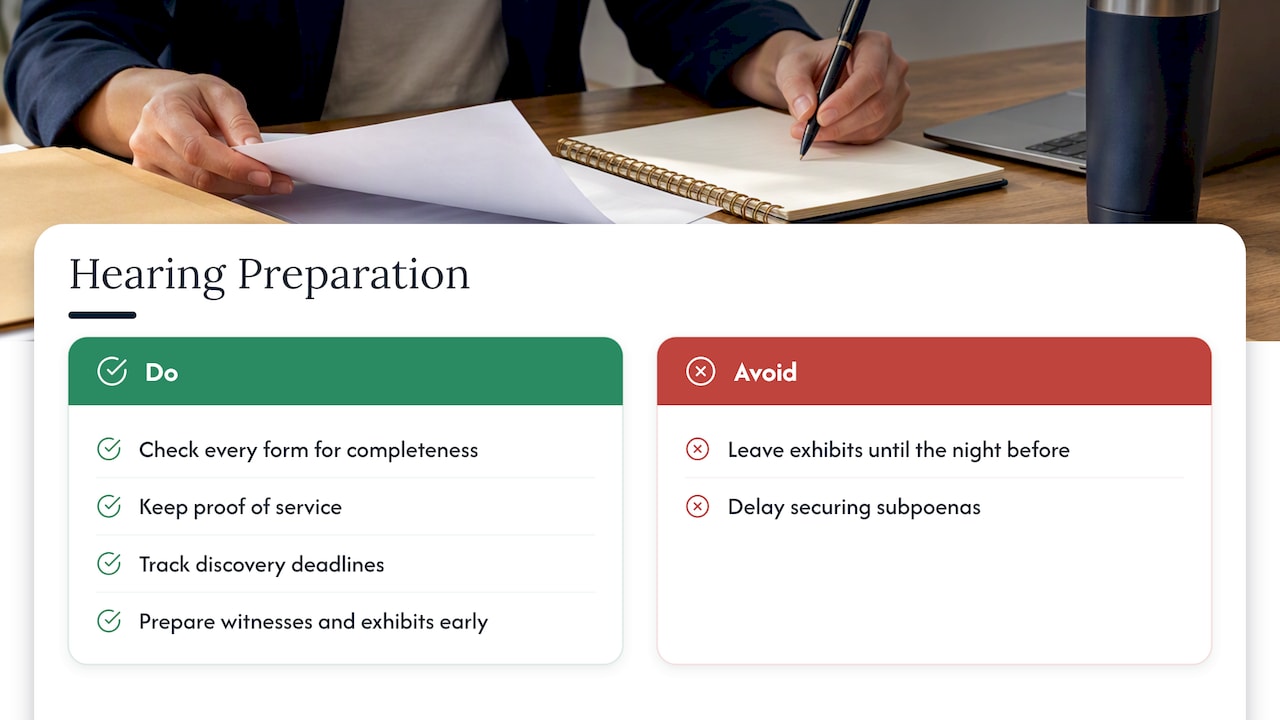
Most denied claims fail on paperwork, not on the facts of the injury. Double-check every form for completeness, keep your proof of service, and track discovery deadlines closely.
If your case involves witnesses, prepare them for what a deposition or hearing actually involves, and secure subpoenas early so testimony is not lost to scheduling conflicts. Organizing exhibits chronologically before the hearing date, rather than the night before, consistently produces a cleaner record for the judge.
— Paralegal
How Loayza Law helps with a denied workers’ comp claim
We help Utah workers move from a denial letter to a filed, fully supported Application for Hearing, and we stay with you through discovery and the hearing itself.

- We review your denial notice and medical records during intake to identify the strongest grounds for appeal.
- We prepare and file your Application for Hearing along with the required supporting forms.
- We handle discovery, including subpoenas and witness preparation, ahead of your hearing date.
- We represent you at the hearing and advise you on settlement offers if the carrier presents one.
We generally work on a contingency basis consistent with the Commission’s Appointment of Counsel framework, so you can speak with us about your case before committing to anything. Reach out through our Utah workers’ compensation page to request a case review.
This article is general information, not a substitute for advice from a qualified lawyer. Consult a qualified legal professional about your own circumstances before acting on anything here.
FAQ
How often are workers’ comp claims denied?
Denial rates vary by insurer and claim type, and no single Utah-specific figure is published by the Labor Commission. What matters more for your case is the specific denial reason stated on your Form 089, since that determines what evidence will move your appeal forward.
Is workers’ compensation required in Utah?
Utah employers are generally required to carry workers’ compensation coverage for their employees under Utah Code Title 34A. Coverage requirements and exceptions depend on business structure and employee classification, so a denial based on a coverage dispute should be reviewed closely against your specific employment situation.
Why would workers’ compensation be denied?
Common reasons include late reporting, disputes over whether the injury happened in the course of employment, pre-existing condition arguments, insufficient medical documentation, and intoxication exclusions. The carrier is required to state its reason in writing on Form 089 when it denies a claim.
Who pays if workers’ comp is denied?
If your claim is denied and you do not successfully appeal, medical bills and lost wages related to the injury are not covered through workers’ compensation, and you may need to pursue other coverage such as health insurance. Workers exploring whether a separate personal injury claim might apply to their situation can review this comparison of workers’ comp and personal injury claims.
What should I do immediately after receiving a denial?
Preserve your Form 089 denial notice and any IME report, then begin gathering your full medical record and workplace documentation. Filing your Application for Hearing promptly protects your right to contest the decision before deadlines close in.
Sources
- Official Form 089 Employee Notification of Denial of Claim (Revised 12/2025)
- Utah Code — 34A-2-801 Initiating adjudicative proceedings