
Yes: Utah hospitals can file liens against your settlement under Utah Code Chapter 7, and federal programs like Medicare can pursue repayment of conditional payments through the Benefits Coordination and Recovery Center. Before you sign any release, verify filed liens, report your case to Medicare if you are a beneficiary, and talk with an attorney.
TL;DR:
- A Utah hospital must file verified notice in county district court and send certified notice before payment, or it risks losing rights and facing penalties.
- Report Medicare claims to the BCRC early; its initial payment compilation takes about 65 days, while final demands accrue interest if unpaid after 60 days.
- For Utah car crashes, PIP generally covers the first $3,000 of necessary treatment; hospitals may assert liens once coverage is exhausted or denied.
- Utah law generally permits lien reductions only for attorney fees, court costs, and incidental recovery expenses; broader reductions require the hospital’s written agreement.
Table of Contents
- Utah Hospital Lien Law: Statutory Basics You Need to Know
- Filing, Notice, and Enforcement: How Utah Hospitals Perfect and Enforce a Lien
- Medicare Conditional Payments and the BCRC: What to Report and When
- Other Payers and Coordination of Benefits: Medicaid, Private Insurance, PIP, and Workers’ Comp
- How Liens Affect Your Settlement Proceeds: Order of Claims and Example Scenarios
- Practical Checklist: What to Do From Intake Through Settlement to Handle Medical Liens
- Local Practice Note From the Loayza Law Paralegal Author
- How an Attorney Can Help You Clear Medical Liens Before You Settle
- FAQ
- Sources
Utah Hospital Lien Law: Statutory Basics You Need to Know
Under Utah Code Chapter 7, a Utah hospital that provides emergency or medical services to an accident victim can assert a lien against any settlement or judgment the patient later receives. The lien covers reasonable, usual, and necessary charges incurred up to the date your damages are paid, so the amount isn’t frozen at your first bill.
The statute also limits how much that lien can shrink. Reductions are generally allowed only for:
- Attorney fees tied to obtaining the settlement or judgment
- Court costs incurred in the case
- Other expenses incidental to securing the recovery
Beyond those categories, the hospital does not have to accept a lower payoff unless it agrees in writing. In practice, this means a routine emergency room visit can turn into a lien claim that eats a meaningful share of your settlement unless someone negotiates it down or documents a legal basis for reduction.
Filing, Notice, and Enforcement: How Utah Hospitals Perfect and Enforce a Lien
A hospital lien in Utah doesn’t attach automatically. The hospital has to follow specific procedural steps, and missing them can cost the hospital its right to collect.
- The hospital files a verified written notice of lien in the district court of the county where it is located, describing the patient, the treatment dates, and the amount claimed.
- Before any settlement payment goes out, the hospital must send notice by certified mail to the liable party and, where known, to that party’s insurance carrier.
- If the hospital skips these steps, Utah Code Chapter 7 allows penalties against the noncompliant lienholder, including loss of the right to recover attorneys’ fees and exposure to treble damages or a statutory penalty.
For injured Utahns, this matters because a defectively noticed lien may not be enforceable at all. An attorney reviewing your file will check the county docket and the certified-mail record before assuming a hospital’s claimed lien amount is valid.
Medicare Conditional Payments and the BCRC: What to Report and When
If you are a Medicare beneficiary, a separate recovery process runs alongside any hospital lien. Medicare pays conditionally so your care isn’t delayed while liability gets sorted out, then seeks reimbursement once a settlement, judgment, or award resolves the case, according to CMS guidance on the recovery process.
- The Benefits Coordination and Recovery Center (BCRC) compiles the conditional payments Medicare made and issues a Conditional Payment Letter (CPL) or Notice (CPN).
- After you report a settlement, Medicare issues a final demand that must be paid within 60 days or interest begins accruing.
The BCRC’s initial compilation process takes roughly 65 days to produce a CPL. That timeline matters because waiting until the week of settlement to request one can stall your distribution.
Some claimants qualify to self-calculate their conditional payment amount, typically for smaller liability settlements, subject to physical trauma criteria, waiting periods, and physician or beneficiary certification. The BCRC reviews the self-calculated figure before accepting it as final.
Other Payers and Coordination of Benefits: Medicaid, Private Insurance, PIP, and Workers’ Comp
Hospital liens and Medicare recovery aren’t the only claims against your settlement. Several other payers may have a stake, depending on how your treatment was covered.
- Medicaid requires states to seek reimbursement from liable third parties, and recipients generally assign their recovery rights to the state before benefits are paid, per federal coordination-of-benefits guidance.
- Utah hospitals may assert a lien when a private insurer denies coverage or fails to pay a claim within 180 days.
- Utah runs on a no-fault auto system, so Personal Injury Protection (PIP) typically pays the first $3,000 in medically necessary treatment after a car accident, which shapes how liens and subrogation interact in vehicle cases. Our guide to Utah PIP benefits walks through what happens once that threshold is exhausted.
- Workers’ compensation generally takes priority for treatment tied to a job injury, though the interaction with hospital liens and health-plan claims can vary by case.
Knowing which of these payers is active in your case determines which notices to track and which claims to verify before you settle.
How Liens Affect Your Settlement Proceeds: Order of Claims and Example Scenarios
Once a settlement check arrives, it doesn’t go straight into your pocket. Several claims typically get resolved first, and the order matters.
- Prior recorded liens and properly noticed hospital liens are addressed before funds are released to you.
- Medicare or Medicaid recovery claims are satisfied based on the final demand amount, since Utah law generally gives payors a one-year window to pursue liable parties who pay without resolving a known lien.
- Attorney fees and case costs are deducted under the terms of your fee agreement, which our contingency fee breakdown explains in more detail.
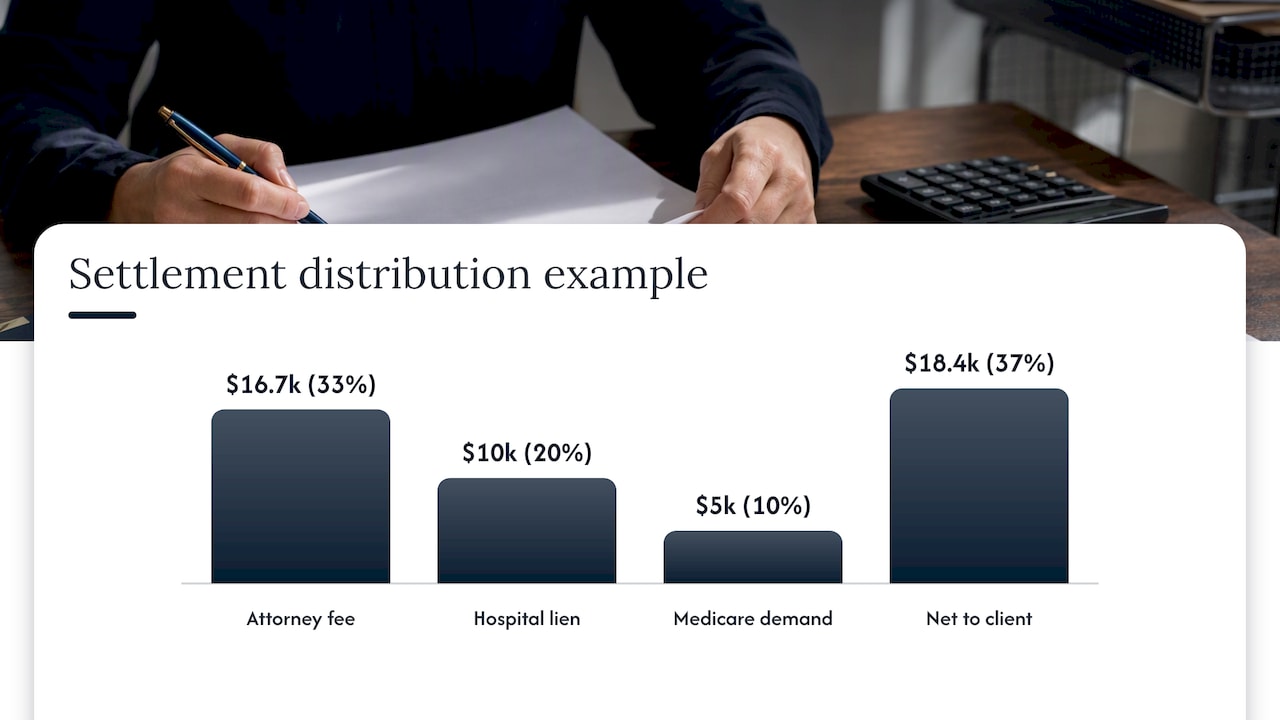
Say a settlement totals $50,000, with a $10,000 hospital lien and a $5,000 Medicare conditional payment demand. After a one-third contingency fee ($16,650) and both claims, the net check is roughly $18,350. A second example: a $20,000 settlement with a $3,000 PIP-related hospital lien and no Medicare involvement nets closer to $11,000 after a similar fee structure.
Pro Tip: Request your Medicare final demand before scheduling settlement distribution, since an unresolved conditional-payment demand can delay your check and accrue interest.
Practical Checklist: What to Do From Intake Through Settlement to Handle Medical Liens
Handling liens well starts at intake, not at the settlement table.
- Collect itemized bills, provider names, and treatment dates for every facility involved, and keep copies of all medical records.
- If you’re a Medicare beneficiary, report the case to the BCRC early and request a CPL as settlement approaches; consider self-calculation only if you meet the eligibility criteria.
- Confirm whether a hospital actually filed a verified lien notice in district court, request an itemized statement, and verify that certified-mail notice went to the liable party and insurer.
- Negotiate lien reductions where the law allows it, and get written confirmation that the lienholder will release its claim once paid.
- Before any funds are distributed, obtain Medicare’s final demand, secure the hospital’s written lien release, and get clear, written settlement-disbursement instructions.
Pro Tip: Ask every provider for an itemized statement rather than a lump-sum balance; itemization makes it far easier to spot charges that fall outside “reasonable, usual, and necessary.”
Readers starting a claim from an incident like a dog bite often face the same intake sequence; our Utah dog bite checklist walks through the early documentation steps in more detail. For broader context on how fault allocation affects your final number, see our breakdown of Utah’s comparative negligence rule. If lien amounts feel disputable, a Grace Legal Group overview of settlement fee limits offers useful background on how fees and liens interact nationally.
Local Practice Note From the Loayza Law Paralegal Author
Working through Utah lien files day to day, the same three problems show up repeatedly: a hospital that never sent proper certified-mail notice, an itemized statement that arrives incomplete, or a client who signs a release before Medicare’s final demand is in hand. Each one is preventable with early documentation and a timely call to the BCRC.
We handle personal injury matters and draw on local procedural familiarity with county district court filings and lien notice requirements to efficiently manage claims for distribution.
— Paralegal
How an Attorney Can Help You Clear Medical Liens Before You Settle
We verify whether a hospital lien was properly filed and noticed, negotiate reductions where the statute allows them, request Medicare’s final demand on your behalf, and draft release language that protects you once liens are paid. That kind of verification work is exactly where a lien claim can quietly cost you money if no one checks it.

If you’re heading into a consult, bring:
- Itemized medical bills from every provider involved
- Any lien notices you’ve received by mail
- Correspondence from your health insurer, Medicaid, or Medicare
Our Utah personal injury page has more on how we handle these cases from intake through settlement, and you can reach out directly to get a clear read on what your liens and conditional-payment exposure actually look like before you sign anything.
This article is general information, not a substitute for advice from a qualified lawyer. Consult a qualified legal professional about your own circumstances before acting on anything here.
FAQ
Can a hospital take my entire settlement for unpaid bills?
A Utah hospital lien is limited to reasonable, usual, and necessary charges and generally can’t be reduced except for attorney fees, court costs, and incidental expenses unless the hospital agrees otherwise in writing. It can still claim a significant share of a settlement, which is why verifying the lien amount matters.
What happens if Medicare isn’t notified before I settle?
If you don’t report your settlement, Medicare can still issue a final demand once it learns of the payment, and that demand must be paid within 60 days or interest starts accruing. Reporting early through the BCRC typically produces a more accurate number than waiting for Medicare to calculate it after the fact.
Does Utah PIP coverage affect whether a hospital can file a lien?
PIP generally pays the first $3,000 of medically necessary treatment after a car accident, so a hospital lien is less likely while PIP funds are still being applied. Once PIP is exhausted or coverage is denied, a Utah hospital can assert a lien against the eventual settlement.
Can I negotiate a hospital lien down on my own?
You can ask, but Utah law only requires acceptance of reductions tied to attorney fees, court costs, and incidental litigation expenses unless the hospital agrees to more in writing. Attorneys who regularly review itemized statements and lien notices are often better positioned to identify errors or notice defects that support a larger reduction.
Sources
- Chapter 7 Hospital Lien Law (Utah Code)
- Medicare Secondary Payer Recovery Process: Your rights & responsibilities (CMS)
- Provo