
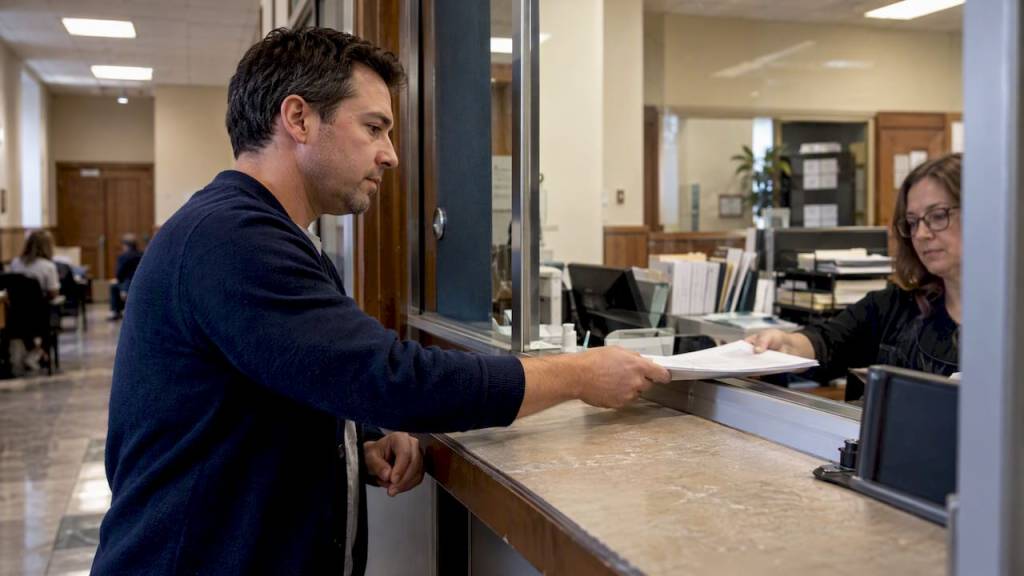
Yes, you can ask a Utah court for a temporary order to set custody, support, or who stays in the house while your divorce is pending. You need a filed case, completed parenting and divorce classes when children are involved, and a Financial Declaration before a judge will hear the motion. If safety or finances are at immediate risk, we recommend asking about emergency relief under Rule 65A right away.
TL;DR:
- Before requesting a hearing, file the divorce petition, required course certificates when children are involved, and a Financial Declaration for any request involving money.
- Use Rule 65A emergency relief for an immediate safety risk; ordinary temporary order motions follow the standard process and may wait for a hearing slot.
- Temporary custody arrangements can shape the final decree, while judges generally find support changes easier to grant because they rely more heavily on financial calculations.
- After a response, contested issues require one good faith mediation session, but temporary relief can proceed meanwhile; agreements need a signed stipulation or court order.
- Changed income, relocation, or new safety evidence may support modification, while violations of an existing order usually call for enforcement or contempt, not modification.
Table of Contents
- What a Motion for Temporary Order does in a Utah divorce
- When do you actually need a temporary order hearing?
- Forms, evidence, and classes you need before the hearing
- Step-by-step: preparing and filing a Motion for Temporary Order
- Modifying a temporary order or fighting one you disagree with
- How mediation fits around your temporary order
- What happens at the temporary order hearing
- Paperwork checklist and where to find the official forms
- How long it takes and what it costs
- Common mistakes we see before temporary-order hearings
- Get help preparing your temporary order motion
- FAQ
- Sources
What a Motion for Temporary Order does in a Utah divorce
A Motion for Temporary Order asks the court to set short-term rules while a divorce case moves toward a final decree. These rules commonly cover child custody and parenting time, child support, temporary alimony, and who stays in the family home. The Utah Courts self-help pages explain that this relief is meant to hold the household together financially and logistically until the court resolves the full case, not to decide the final outcome.
That said, temporary arrangements carry weight. Judges often look at how custody and support worked under a temporary order when they write the final decree, so a careless or rushed filing can echo for months. Temporary orders are different from emergency protective relief: a true emergency, such as a risk of harm to a child or spouse, calls for a Rule 65A temporary restraining order rather than the standard motion process, since Rule 65A moves faster and does not wait for the usual briefing schedule.
When do you actually need a temporary order hearing?
Not every disagreement needs a judge. Couples who agree on the basics can file a stipulation, which a judge typically signs without a hearing and which saves both time and money. A contested motion makes sense when the disagreement touches something neither spouse can safely leave unresolved for months.
- Custody or parenting time is seriously disputed and the children need a schedule now.
- One spouse is withholding income, hiding assets, or refusing to pay shared bills.
- There is a credible safety concern involving a spouse or child.
- Both parties are fighting over who stays in the marital home.
- A spouse cannot cover rent, utilities, or basic living expenses without a support order.
Urgency matters for scheduling. A case still waiting on mediation can usually get a temporary order hearing anyway, since mediation and temporary relief run on separate tracks, but courts in busier counties may take longer to find hearing slots than smaller jurisdictions.
Forms, evidence, and classes you need before the hearing
Utah courts will not simply take your word for your income, your parenting plan, or your need for support. Specific paperwork has to be on file first, and skipping a piece is the single most common reason hearings get delayed.
- File a Financial Declaration whenever you are asking for money, including child support or alimony.
- Attach a child support worksheet any time child support is part of the request.
- File a Parenting Plan when you are asking for joint legal or physical custody or a specific parent-time schedule.
- Complete the Divorce Orientation Course and the Mandatory Parenting Course if minor children are involved in the case.
Utah Code §81-4-402 requires these courses for divorce cases with minor children, and courts generally will not hear a motion for temporary orders until certificates of completion are filed, with only limited exceptions. The Utah Courts temporary order page also notes that judges tend to grant temporary child support changes more readily than custody changes, since support is mostly a math problem while custody requires a harder look at the child’s circumstances.
Step-by-step: preparing and filing a Motion for Temporary Order
Getting a hearing date quickly depends less on luck than on sequencing. Courts move faster when the paperwork arrives complete and in order the first time.
- Confirm your divorce petition is already filed; a motion for temporary orders cannot stand on its own.
- Decide whether a stipulation will work or whether you need a contested motion, based on how much you and your spouse actually agree on.
- Complete and file your class certificates (Divorce Orientation and Mandatory Parenting Course) if the case involves minor children.
- Assemble your Financial Declaration, child support worksheet if applicable, and Parenting Plan if you are requesting custody or parent-time terms.
- Draft the Motion for Temporary Order itself along with a proposed order; where children are involved, Utah’s standard form is the Order on Motion for Temporary Order – With Children (1104FA), which already includes sections for custody, parent-time selection, the child support worksheet, temporary alimony, and attorney fees.
- File the motion and all supporting documents with the court clerk, then serve the other party according to the court’s service rules, keeping a signed proof of service for your file.
- If the situation is urgent, ask the court clerk about expedited hearing options or, for true emergencies, Rule 65A relief instead of the standard motion timeline.
- Gather your hearing exhibits: recent paystubs, bank statements, childcare and medical expense records, and any written witness statements relevant to the request.
- Bring a clean, specific proposed order to the hearing. A judge who has to guess at your intended schedule or dollar figures is a judge who delays signing anything.
Pro Tip: Write your proposed order as if the judge will sign it exactly as submitted, because often they will.
For readers who want the bigger picture before diving into motion practice, our guide to the Utah divorce process walks through how temporary orders fit into the full case timeline.
Modifying a temporary order or fighting one you disagree with
Temporary orders are not frozen in place. If circumstances shift, either spouse can ask the court to change the terms before the final decree is entered.
- A significant change in income, whether a job loss or a raise, can justify adjusting support.
- A parent relocating, or a documented safety concern arising after the order, can justify revisiting custody terms.
- Vague or unworkable language in the original order is itself grounds to ask for a clearer version.
To modify an order, start by rereading the existing language closely, since vague wording often causes more disputes than the underlying disagreement. Gather proof of what changed, file a motion to modify with specific proposed language, and request a hearing that explains why the change is needed now rather than later. Courts tend to treat support modifications as straightforward financial calculations, while custody modifications require stronger evidence because judges are more cautious about disrupting a child’s routine. If the other party is simply ignoring an existing order rather than asking to change it, the remedy is usually a motion for contempt or another enforcement request, not a modification.
How mediation fits around your temporary order
Utah requires good-faith participation in mediation for contested divorce issues once a response has been filed, but this requirement does not stop temporary orders from moving forward. Under Utah Code §81-4-403, parties must attend at least one mediation session if issues remain contested, yet the statute specifically allows pretrial, temporary relief to be entered in the meantime.
If mediation produces an agreement, that memorandum of understanding is not automatically enforceable. It needs to be converted into a signed stipulation or incorporated into a court order before it carries the force of a temporary order. A party can sometimes be excused from mediation for good cause, such as a documented safety concern, and that exemption does not change the timing of a temporary order request one way or the other.
What happens at the temporary order hearing
Temporary order hearings run short and focused. Judges are not trying to resolve the entire divorce in that one session, so they want clear, current facts showing why relief is needed now rather than a full relitigation of the marriage.
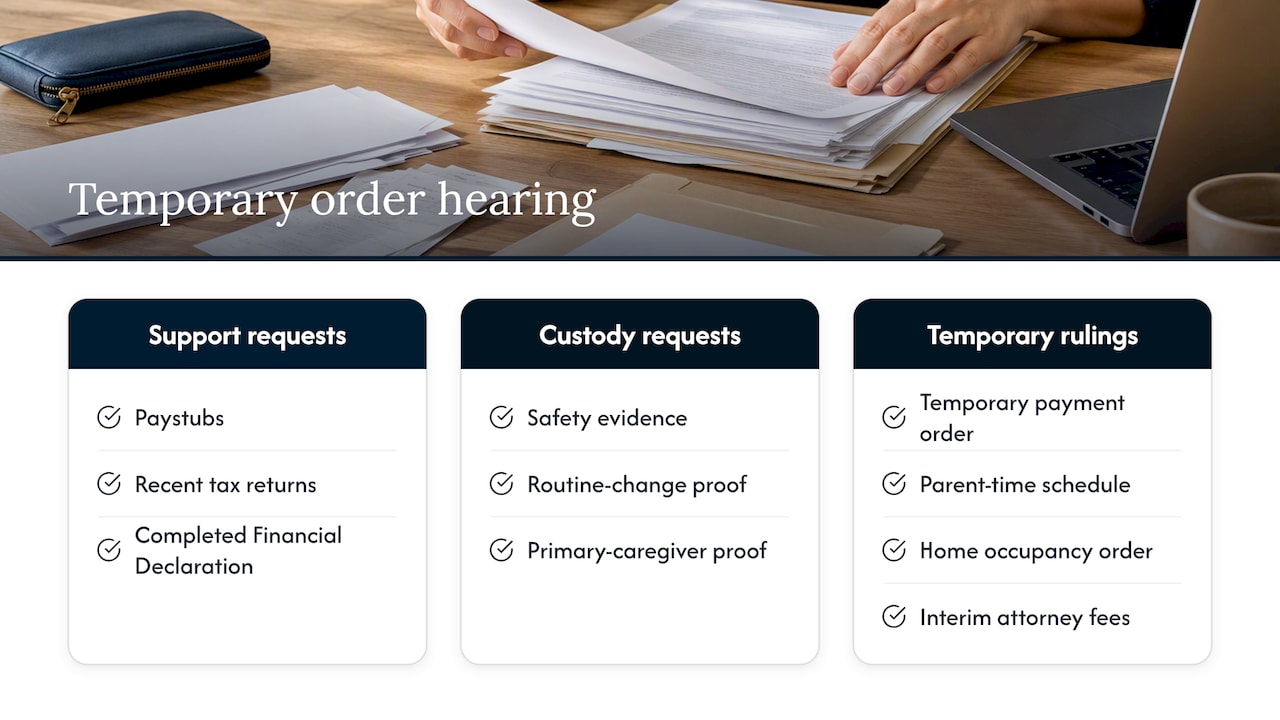
For support requests, bring income documentation: paystubs, recent tax returns, and a completed Financial Declaration. For custody requests, bring evidence tied to the child’s current situation, whether that is a safety concern, a change in the existing routine, or proof of who has been the primary caregiver. Judges can issue temporary payment orders, set a parent-time schedule, address who stays in the home, and in some cases award interim attorney fees. Whatever the outcome, the signed order stays in effect until the final decree or a later modification replaces it.
Paperwork checklist and where to find the official forms
Before you head to the courthouse, run through what the clerk will expect to see filed.
- Divorce petition already on file.
- Motion for Temporary Order, with a proposed order attached.
- Financial Declaration (forms 1102FA/1111FA depending on your situation) if money is requested.
- Child support worksheet if child support is part of the request.
- Parenting Plan if custody or parent-time terms are requested.
- Certificates for the Divorce Orientation Course and Mandatory Parenting Course, when minor children are involved.
- The Order on Motion for Temporary Order – With Children (1104FA) as your proposed order template if children are part of the case.
Label every exhibit clearly and attach the child support worksheet directly to any request involving support, since a detached worksheet is an easy thing for a clerk to miss. The Utah Courts self-help site also explains fee waiver options for filers who cannot afford the standard filing fees.
How long it takes and what it costs
A full Utah divorce can take a year or more to reach a final decree, which is exactly why temporary orders exist: they fill the gap so support and parenting do not sit unresolved for months. Temporary order hearings themselves can often be scheduled well before the final decree, though timing varies by county caseload.
Expect filing fees at the courthouse, mediator fees if your issues remain contested, and possibly attorney fees depending on how your case is handled. Courts can order one spouse to pay a share of the other’s attorney fees as part of a temporary order, which matters when there is a real income gap between spouses. If you are weighing how a temporary alimony order might compare to what you would receive at final judgment, our breakdown of Utah alimony laws covers how the two interact. For readers who need short-term cash flow before a support order is in place, the Divorce Financial Impact Calculator from Mali can help model what a proposed support figure would mean for a monthly budget.
Common mistakes we see before temporary-order hearings

The hearings that go smoothly almost always share the same foundation: complete paperwork filed well ahead of time. The ones that get delayed usually share the same three problems.
Filers forget to submit class certificates before asking for a hearing date, which stalls the case by weeks. Financial Declarations arrive missing bank statements or recent paystubs, which gives the other side room to argue the numbers are unreliable. Proposed orders show up vague, asking for “reasonable” support or a parenting schedule with no actual dates attached, leaving a judge unable to sign anything specific. We prepare evidence and proposed orders written in language a judge can adopt on the spot, because a hearing that ends with the judge asking for revisions is a hearing that costs you another court date. Whether you handle a motion yourself or bring in counsel often comes down to how contested the case is and how much is financially at stake; our checklist for choosing a divorce lawyer walks through that decision in more detail.
— Paralegal
Get help preparing your temporary order motion
Filing a complete, hearing-ready motion on the first try saves weeks of back-and-forth with the court, and that is where we can take the pressure off. We help clients assemble Financial Declarations, Parenting Plans, and proposed orders built to the standard Utah judges expect, and we represent clients directly at temporary order hearings when the case is contested.

If you are heading into a consultation, bring your filed petition, recent pay documentation, and any existing agreements or disputes with your spouse so we can assess your situation quickly. Visit our family law practice page to see how we can help with your temporary order request, or reach out to schedule a consultation and get a clear next step for your case.
This article is general information, not a substitute for advice from a qualified lawyer. Consult a qualified legal professional about your own circumstances before acting on anything here.
FAQ
What is a temporary order hearing in a divorce case?
A temporary order hearing is a short court session where a judge decides interim rules for custody, support, or property use while a divorce case is still pending. The Utah Courts explain that these hearings focus on immediate needs rather than resolving the full divorce, and the resulting order stays in effect until the final decree or a later modification.
What is the simplest, cheapest way to divorce in Utah?
Couples who agree on custody, support, and property division can often finalize a divorce through a stipulated agreement, avoiding most hearings and the added cost of contested litigation. Filing a stipulation also tends to shorten the time a temporary order needs to stay in place, since fewer issues remain for a judge to decide at trial.
What’s the hardest state to get a divorce in?
Divorce difficulty depends heavily on each state’s residency rules, waiting periods, and property division laws, which vary too much to rank reliably. In Utah specifically, a divorce can still take a year or more to finalize, which is part of why temporary orders exist to manage custody and support in the meantime.
What assets cannot be touched in a divorce?
This depends on each state’s property laws and the specific facts of a marriage, such as whether an asset was kept separate from marital funds. Readers with questions about protecting or dividing specific property during a Utah divorce should raise the issue directly with a family law attorney, since the answer depends on documentation and timing unique to each case.
Sources
- Utah Courts – Temporary orders
- Utah Code Section 81-4-402
- Utah Code §81-4-403 (mediation requirement)
- Order on Motion for Temporary Order – With Children (1104FA)