

When parents live in different states, or one parent moves a child across state lines, the first question is not who should have custody. It is which state’s court gets to decide. In Utah that answer comes from the Uniform Child Custody Jurisdiction and Enforcement Act (UCCJEA), and getting it wrong can mean months of work in a court that has no power over your case. Our family law attorneys in Utah help parents sort this out before they file, because the filing state often shapes everything that follows.
TL;DR
- Utah can make the first custody order only if it is the child’s “home state” (where the child lived with a parent for six consecutive months before the case began), or a narrow exception applies.
- A Utah court that already issued a custody order usually keeps exclusive, continuing control as long as the child or a parent still lives in Utah.
- You cannot simply file in the state you prefer. Utah will not modify another state’s order unless it has jurisdiction under the UCCJEA.
- Utah courts can enforce another state’s custody order once it is registered, and can act in an emergency to protect a child who is physically in Utah.
- Because the rules are technical, confirm the right state before you spend time and filing fees.
Table of Contents
- What the UCCJEA does
- Who can make the first custody order
- When Utah keeps control after an order
- If you want to move out of state after an order
- Changing a custody order across state lines
- Enforcing another state’s custody order in Utah
- Emergencies and two states at once
- Serving a parent who lives in another state
- Mistakes that cost parents the most
- How we help families with interstate custody
- Our perspective
- FAQ
- Sources
What the UCCJEA does
The UCCJEA is a uniform law adopted by every U.S. state except Massachusetts, as of June 2024. Its purpose is to stop parents from shopping for a friendlier court, to keep decisions in the state closest to the child, and to make one state’s order enforceable in another.
In practice, only one state at a time should be handling a child’s custody. If a Utah judge and a Texas judge both think they are in charge, the UCCJEA tells them how to decide who is right, and it requires them to talk to each other. Utah’s version of the act now sits in Utah’s Domestic Relations Code. The enforcement provisions are in Title 81, Chapter 11, effective September 1, 2025, and the jurisdiction sections in Title 78B, Chapter 13 were renumbered on the same date. Older articles and court forms may cite the old numbers, so check the section you are reading against the current code.
Who can make the first custody order
The starting point is the child’s home state. Under Utah Code §78B-13-201, a Utah court can make an initial custody decision only in these situations:
- Utah is the child’s home state on the day the case is filed.
- Utah was the home state within the six months before filing, and a parent or person acting as a parent still lives in Utah.
- No other state has home-state jurisdiction (or the home state has declined), the child and at least one parent have a significant connection with Utah beyond simply being present, and substantial evidence about the child is available in Utah.
- Every court that could have jurisdiction has declined in favor of Utah.
- No other state would have jurisdiction.
The statute says these are the only grounds. A child’s physical presence in Utah is neither necessary nor enough by itself.
What “home state” means in plain terms
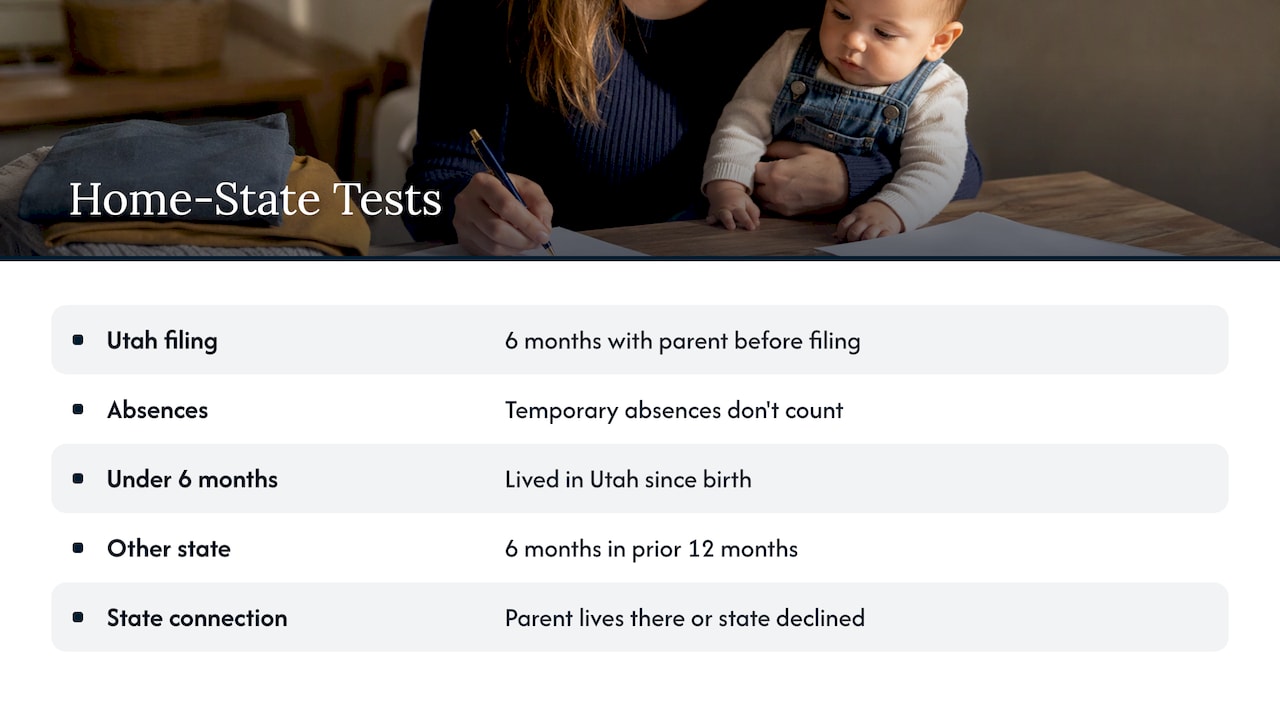
The Utah Courts’ jurisdiction flowchart turns the statute into questions. The first one is whether the child lived in Utah with a parent for six consecutive months immediately before the petition was filed, not counting temporary absences. For a child under six months old, the question is whether the child has lived in Utah since birth.
If the answer is no, the chart asks whether the child lived in another state for six consecutive months within the twelve months before filing, and whether a parent still lives in that state or that state has declined in favor of Utah.
A worked example
Say a mother and her 8-year-old have lived in Boise, Idaho for three years. The father lives in Salt Lake City. The mother takes the child to Utah for a summer visit that lasts eight weeks, and the father files for custody in Utah the day after she heads home.
Utah is not the home state. The child’s time in Utah was a temporary absence from Idaho, and Idaho was the home state. Idaho would be the proper place for the first order. Presence in Utah for a visit does not create Utah jurisdiction, which is why a quick filing in Utah would likely be dismissed or sent to Idaho.
Now change one fact: the mother and child moved to Utah in January and the father, still in Idaho, files in Idaho in March. Idaho was the home state within six months and the father still lives there, so Idaho may keep jurisdiction for a case filed within that window. The date of filing matters, and so does the date of the move.

The four bases in order
A court guide from the National Judicial Institute on Domestic Violence describes a hierarchy, with home state first. That same guide notes that the “extended home state” rule often matters when a parent leaves with the children to escape abuse: the previous state can keep jurisdiction for cases filed within six months of the move.
| Basis | What it asks | Priority |
|---|---|---|
| Home state | Did the child live with a parent in the state for six consecutive months before filing? | First |
| Significant connection | Do the child and a parent have real ties and is evidence in the state, and no home state exists or it declined? | Second |
| More appropriate forum | Did the home state decide another state is a better place to hear the case? | Third |
| No other state | Does no other state have jurisdiction? | Last |
When Utah keeps control after an order
Once a Utah court has entered a custody order that followed these rules, it generally holds exclusive, continuing jurisdiction. Under Utah Code §78B-13-202, that control ends only when a court finds one of two things:
- The child, and at least one parent or person acting as a parent, no longer have a significant connection with Utah, and substantial evidence about the child’s care and relationships is no longer in Utah.
- The child, both parents and any person acting as a parent no longer live in Utah.
The practical result is simple. If you obtained a custody order in Utah and the other parent moved to Florida, Utah usually still controls as long as you and the child remain here. The other parent cannot file in Florida to change the order just because they moved. A Utah court may still decline if it decides Utah is an inconvenient forum and another state is more appropriate, a decision that looks at factors like how long the child has lived elsewhere and where the evidence is. An Iowa appellate decision involving a Utah child shows that analysis in action.
If you want to move out of state after an order
Parents with a Utah order who plan to relocate often ask whether the move changes which court is in charge. Generally it does not, until the connection to Utah really ends. A move by one parent leaves Utah in charge if the child and the other parent remain here. That is also why moving with a child without following the order or getting the other parent’s agreement or court approval is risky: it can lead to enforcement actions in Utah. If you are the parent staying behind, Utah’s courts remain the place to ask for a remedy. If you are the parent leaving, a revised parenting plan agreed in writing and filed with the court is usually cleaner than relying on an informal understanding. Our guide to a Utah parenting plan covers what to include.
Changing a custody order across state lines
The Utah Courts’ Modifying Custody page states that Utah can modify an out-of-state custody order only if it has jurisdiction. The order must first be registered and confirmed as a Utah judgment, and after any change the filer must notify the issuing court and every court where the order was registered. The same page warns that jurisdiction can be very complex when the controlling order came from another state or the family is spread across states, and it urges filers to confirm Utah is the right court before spending money on a modification.
The Utah Courts’ modification jurisdiction chart sets out the logic:
- Was the controlling order entered or last changed by a Utah court? If so, and no court has found that everyone has left Utah, the exclusive continuing jurisdiction rule applies.
- If the order is from another state, Utah may modify only if it would have jurisdiction to make an initial order, including where the foreign order has been registered in Utah.
If you are preparing to ask for a change, our child custody modification checklist lists the paperwork and facts judges expect, and our page on modifying Utah orders explains when a stipulation can avoid a hearing.
Enforcing another state’s custody order in Utah
A parent holding an order from another state does not have to start over in Utah. Under Utah Code §81-11-306, a Utah court may grant the relief Utah law ordinarily allows to enforce a registered out-of-state custody determination. It must recognize and enforce that order, and it may not modify it except as the UCCJEA’s jurisdiction rules allow.
Utah’s enforcement chapter is built for speed. A verified petition must state the issuing court’s basis for jurisdiction, whether the order was vacated, stayed or modified, related proceedings such as protective orders or adoptions, the child’s and respondent’s addresses, and any request for law-enforcement help. The hearing is held on the next judicial day after service unless that is impossible.
In some cases, a prosecutor or the attorney general may take lawful action to locate a child, obtain the child’s return or enforce a custody order, including where there is a reasonable belief of wrongful removal under the Hague Convention. The prosecutor acts on behalf of the court and does not represent either parent, so you still need your own attorney for your side.
Emergencies and two states at once
A child who is physically in Utah can be protected here even when Utah is not the home state. According to Utah’s family law materials compiled by NIWAP, a Utah court has temporary emergency jurisdiction if the child is present in Utah and has been abandoned, or if an emergency requires protecting the child, a sibling or a parent from mistreatment or abuse.
The emergency order is temporary by design:
- If another state already has an enforceable order or a pending case, the Utah order must set a period for getting an order from that state and lasts until then.
- If no other case exists, it lasts until a state with proper jurisdiction acts, and it can become final if it says so and Utah later becomes the home state.
- Both courts must communicate immediately once they learn of each other’s case, to resolve the emergency, protect safety and set the duration.
If you or your child are in immediate danger, call 911 first. Then speak to a family law attorney the same day, because the facts you document in the first days drive what the court does. For a general look at why speed matters in these situations, urgent legal help for parents explains the benefits of acting quickly. If a protective order has been violated, see our page on protective order violations in Utah.
Serving a parent who lives in another state
Utah courts can give notice to a parent outside the state. Notice may follow Utah law or the law of the state where service happens, in a way reasonably calculated to give actual notice, and publication is allowed when other means fail. A parent who submits to the court’s jurisdiction does not need to be served, per the same NIWAP compilation. Proper notice matters: an order entered without it is open to challenge later.
Mistakes that cost parents the most
- Filing in the wrong state because it is closer or friendlier. Jurisdiction is not a preference, and a dismissal wastes the filing fee and weeks of time.
- Counting the six months wrong. Temporary trips do not reset the clock, and neither does a short stay somewhere new.
- Ignoring a case already pending elsewhere. If another state started first with valid jurisdiction, Utah generally must defer.
- Modifying an out-of-state order without registering it first. The order must be registered and confirmed in Utah, and every court involved must be notified of any change.
- Self-help moves. Taking or keeping a child in another state without an order or agreement can lead to enforcement and, in some cases, criminal exposure.
How we help families with interstate custody
Loayza Law’s family law practice in Utah covers divorce, child custody, support, alimony, property division and modifications. We have served more than 1,300 clients and solved more than 1,200 cases, and we bring a client-centered approach to each. If your child’s other parent lives in another state, or you are weighing a move, we can look at where the child has lived, which orders exist and which court should hear your case. Our Salt Lake City family law page describes the practice, and you can read how a family law attorney’s role in custody cases works from the first consultation.

To discuss your situation, start at our practice areas page and reach out to the family law team.
Our perspective
Interstate custody cases are decided early, often before a parent realizes it. The date a child moved, the place a petition was filed and the order that already exists can settle the question of which court decides, and those facts are fixed long before anyone argues about parenting time.
We start every custody matter by building a timeline: where the child has lived, with whom, and for how long, and what any court has already ordered. That timeline tells us whether Utah is the right place to file, whether an existing order needs to be registered, or whether a different state should lead. It also helps us prepare a parent for the conversation with the judge.
Families come to us frightened and tired. We think the most useful thing we can do is give them a clear path early, communicate quickly and keep the focus on what is best for the child. Our family law attorneys work with parents across Utah on custody, parent-time, support and modifications, and we take the same careful approach when more than one state is involved.
Paralegal
FAQ
Can I file for custody in Utah if my child just moved here?
Only if Utah qualifies under the UCCJEA. Usually that means the child has lived in Utah with a parent for six consecutive months before filing. If your child recently moved from another state where a parent still lives, that state may keep jurisdiction for a time. An attorney can look at the dates and tell you where to file.
Can I move out of state with joint custody?
You generally need the other parent’s agreement or the court’s approval before relocating with a child under a custody order. The safest path is a written, revised parenting plan filed with the court. Moving first and sorting it out later can bring enforcement action in Utah, which usually keeps authority over its own order while the other parent or the child remains here.
How long does Utah keep jurisdiction over my custody order?
Utah keeps exclusive, continuing jurisdiction until a court finds that the child and at least one parent no longer have a significant connection with Utah and the evidence is no longer here, or that the child and both parents no longer live in Utah. As long as you or the child still live in Utah, Utah usually remains in charge.
Will Utah enforce a custody order from another state?
Yes. Once the order is registered, a Utah court must recognize and enforce it, and it can use the remedies Utah law normally provides. Utah can change the order only if the UCCJEA’s jurisdiction rules allow it. Enforcement hearings move quickly, often on the next judicial day after service.
Sources
- Uniform Child Custody Jurisdiction and Enforcement Act (UCCJEA), Cornell Legal Information Institute
- Utah Code Title 81, Chapter 11, Uniform Child Custody Jurisdiction and Enforcement Act (effective 9/1/2025)
- Utah Code §81-11-306, Enforcement of registered determination
- Utah Code §78B-13-201, Initial child custody jurisdiction
- Utah Code §78B-13-202, Exclusive, continuing jurisdiction
- Utah Courts, Jurisdiction to Enter an Initial Custody or Parent-time Order
- Utah Courts, Jurisdiction to Modify a Custody or Parent-time Order
- Utah Courts, Modifying Custody
- NJIDV, UCCJEA Guide for Court Personnel and Judges
- NIWAP, Utah Family Law: Jurisdiction and Service of Process
- Iowa Court of Appeals opinion, April 18, 2018