

A Utah impairment rating is a percentage, assigned by a physician after you reach maximum medical improvement (MMI), that measures the permanent loss caused by a work injury. It is the medical starting point for permanent partial disability (PPD) compensation under Utah workers’ compensation. The rating alone does not pay you. A weekly benefit rate, a number of weeks and, often, a formal hearing application all sit between the rating and a check.
We wrote this guide for injured workers and families who just heard the words “impairment rating” from a doctor or an adjuster and want to know what comes next.
TL;DR
- An impairment rating is a percentage set by an authorized physician after MMI, using the AMA Guides plus Utah’s 2006 supplemental guides.
- The rating is a medical opinion. Your PPD award is a legal and financial result that also depends on your wages, the statutory schedule and dependents.
- For July 1, 2026 through June 30, 2027, the maximum weekly PPD benefit is $870.00.
- You must get a rating within six years of the injury, or file an application for hearing within that window, to keep the claim alive for up to 12 years.
- A rating does not automatically trigger payment. Do not wait for the insurer to volunteer it.
Table of Contents
- What an impairment rating actually measures
- Which rules govern the rating
- When and by whom the rating is done
- From percentage to paycheck
- The deadlines that protect your claim
- A rating does not pay itself
- What to check in your own rating
- Our perspective: the rating is medical, the award is legal
- Related issues that come up with ratings
- How we can help
- FAQ
- Sources
What an impairment rating actually measures
An impairment rating converts a physical loss into a number. A permanent loss of motion in a shoulder, reduced grip strength or a lasting spine injury is described by a doctor and then expressed as a percentage of the body part or of the whole person.
It measures the medical loss, not your job, your age or your paycheck. Two workers with the same rating can have very different lives afterward: a surgeon and a roofer with the same knee impairment face different consequences. Utah’s PPD system does not try to capture that in the rating itself. Wages and the statutory schedule enter later, when the award is calculated.
The Utah Labor Commission’s own materials are candid about the limits. Its Impairment Rating Committee describes impairment calculation as not an objective science but one built largely on consensus. That is why two qualified doctors can reach different numbers, and why a rating deserves a careful look rather than automatic acceptance.
Which rules govern the rating
Utah doctors do not rate in a vacuum. Three layers apply:
- The AMA Guides. The American Medical Association’s Guides to the Evaluation of Permanent Impairment (Fifth Edition) is the base reference.
- Utah’s 2006 supplemental guides. The Commission developed these to reduce variability and to give more consistent results in Utah claims. The supplement states that it is used for all impairment ratings done in the state.
- Utah statute and rule. If the Utah guides and the AMA Fifth Edition conflict, the workers’ compensation statute, §34A-2-412, takes precedence. The Commission’s rule on permanent impairment ratings, R612-300-9, incorporates the 2006 guides by reference for impairments not expressly listed elsewhere in the rule.
If your rating looks off, the useful question is not “Is the number fair?” but “Did the physician apply the right guide, the right table and the right measurements?”
When and by whom the rating is done
Maximum medical improvement comes first
The rating cannot be completed until you reach MMI. The Labor Commission describes MMI as the point when your condition has stabilized and further functional improvement is unlikely, even with more treatment or rehab. Only a treating physician can declare that you have reached it.
That timing matters. A doctor who rates you too early may understate a permanent loss that would have become clear a few months later. A worker who keeps treating without ever getting a rating can run into the deadline described below.
Who determines the rating
In Utah, the rating must be completed by an authorized physician after MMI. In practice that is usually your treating doctor or a specialist in the same claim. The insurance carrier may also send you to its own examiner. Those opinions can differ, and when they do the disagreement is typically resolved through the Commission’s adjudication process.
The Labor Commission’s Adjudication division handles hearings and appeals in these disputes.
From percentage to paycheck
A rating becomes money through the PPD benefit. Three inputs matter.
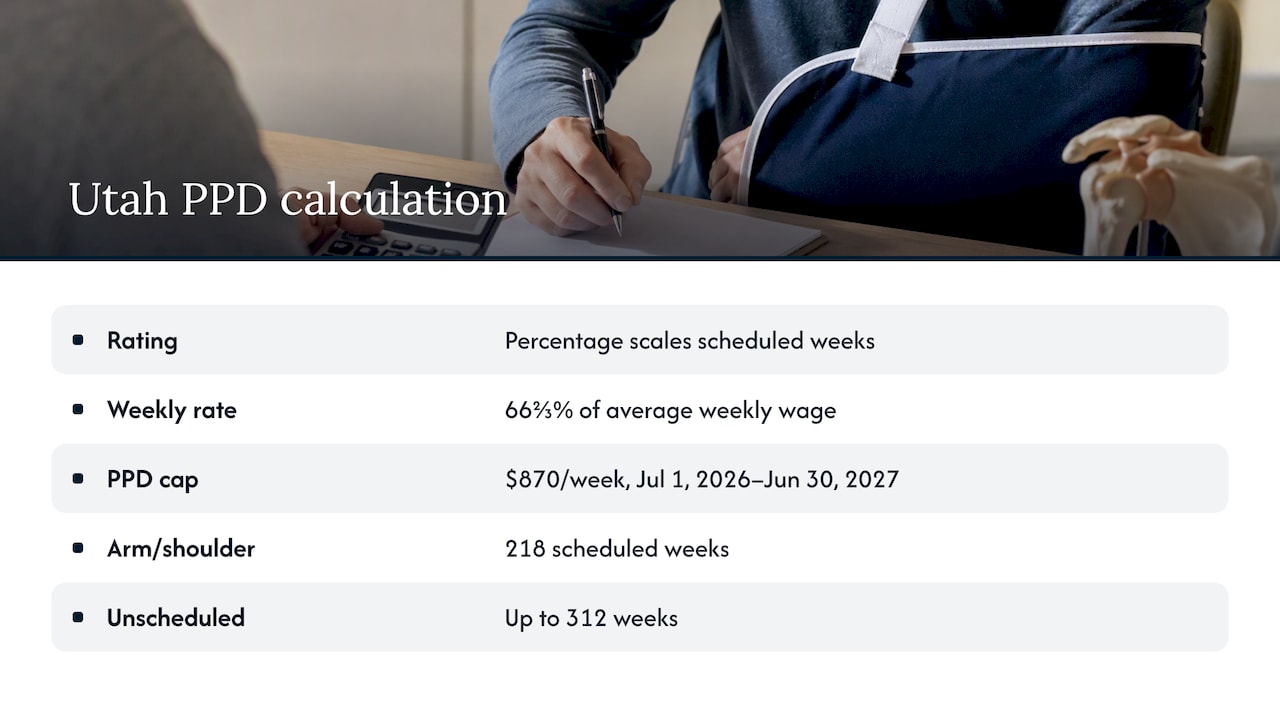
1. Your weekly rate. PPD is paid at 66-2/3% of your average weekly wage at the time of the injury, capped at a statutory maximum. For the period July 1, 2026 through June 30, 2027, that maximum is $870.00 per week. Temporary total and partial disability benefits, which cover the healing period, have a higher maximum of $1,376.00 for the same period.
2. The number of weeks. Utah’s schedule assigns a fixed number of weeks to specific losses, for example 218 weeks for an arm and shoulder amputation. When an injury is not on the schedule, the weeks are based on medical evidence and proportion to scheduled losses, and cannot exceed 312 weeks.
3. The rating itself. The percentage scales the weeks. A higher rating means more weeks of payments.
PPD is paid in addition to temporary total and temporary partial disability, not instead of them.
A simple illustration
This is arithmetic to show the structure, not a prediction of any award. Suppose a worker with an unscheduled injury is rated at 10% and the weeks are measured against the 312-week ceiling: 10% of 312 is 31.2 weeks. If that worker’s rate were the $870.00 maximum, the total would be roughly $27,144. A worker with a lower wage would have a lower weekly rate, and a different schedule or a different method of converting the rating would change the weeks. Your actual figure depends on your claim, which is why a case review matters.
| Input | Where it comes from | Who controls it |
|---|---|---|
| Impairment percentage | Physician applying the AMA Guides and Utah’s 2006 supplement | Doctor, sometimes disputed |
| Weekly rate | 66-2/3% of your average weekly wage, up to the cap | Wage records, insurer calculation |
| Number of weeks | Statutory schedule or medical evidence, up to 312 weeks | Statute, then the Commission |
| Timing of payment | Claim process and hearing, if needed | You, your attorney, the Commission |
The deadlines that protect your claim
The most expensive mistake we see is not a bad rating. It is a missing one.
Injured workers must obtain an impairment rating within six years of the date of injury. If they do not, they must file a formal application for a hearing within that same six-year window to keep the claim open for up to 12 years from the date of injury. The Commission’s Employee’s Guide lays this out. Miss it, and permanent partial disability benefits can be permanently barred.
Two earlier deadlines also shape the story, and they come before any rating:
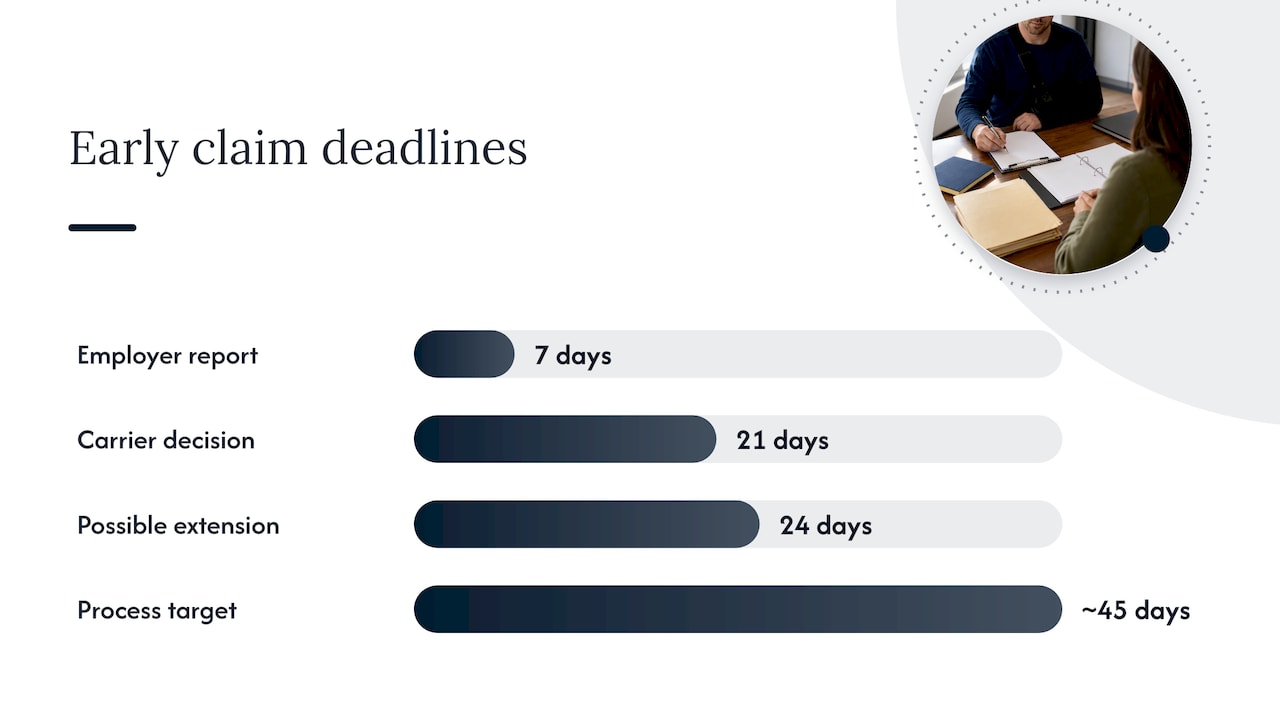
- Your employer has seven days to file a First Report of Injury with its carrier. The carrier has 21 days to decide compensability, with a possible 24-day extension, and the process is meant to finish within about 45 days.
- You have your own reporting duties as a worker. We cover them in our guide to workplace injury reporting in Utah.
A rating does not pay itself
Many workers assume that once a rating exists, the insurer sends the money. That is not how it reliably works. Under §34A-2-412, a worker who files an application for hearing under §34A-2-417 may receive a permanent partial disability award. In practice a formal application is often needed, especially when the rating is disputed or the time limits are approaching.
So the sequence usually looks like this:
- Treat until your doctor finds MMI.
- Obtain the impairment rating from an authorized physician.
- Review it against the guides, your medical records and your restrictions.
- Confirm the weekly rate and number of weeks the insurer is using.
- File for a hearing if the carrier is not paying, the rating is disputed, or a deadline is near.
What to check in your own rating
Bring the report to someone who reads these every week. Before that, you can look for the basics yourself:
- Is the date after MMI? A rating written before your condition stabilized is a red flag.
- Did the doctor examine the right body parts? Compensable conditions sometimes get left out of the report, such as a secondary spine or nerve problem.
- Are the measurements documented? Range of motion, strength and imaging should be described, not only summarized as a final percentage.
- Does the report name the guide and edition used? Utah’s 2006 supplement and the AMA Fifth Edition should appear.
- Does it match your work restrictions? If a doctor assigns permanent restrictions but a very low rating, ask why. Our piece on documenting light duty restrictions from day one explains how restrictions build the record.
- Is the wage figure right? The rating does not set it, but an error in your average weekly wage lowers every benefit that follows.
Our perspective: the rating is medical, the award is legal
We handle workers’ compensation claims in Utah, and our view is consistent: an impairment rating is a medical determination, but the final disability award is a legal outcome. The rating is one part of a calculation that also includes your pre-injury wages, the statutory schedule for the injured body part and any dependents.
Because the rating comes from a consensus-based process, small differences in how a physician measures or applies a guide can change the number. Getting the rating right, and challenging it when it is wrong, can be the difference between receiving the full compensation the law provides and a much lower amount.
What we tell clients most often:
- Do not treat the first rating as final just because it is on letterhead.
- Do not let months pass after MMI while you wait for the insurer to bring up PPD.
- Keep every medical record, restriction note and wage document. The hearing record is built from paper.
- Ask questions early. Many of the problems we see were fixable a year before they were found.
We approach each case with the same priorities: clear communication, a strategy built around your facts, and persistence when an insurer pushes back.
— Paralegal
Related issues that come up with ratings
Denied claims. If the carrier denies compensability, there may be no PPD discussion at all until the denial is resolved. See our walkthrough on Utah workers’ comp denials and appeals, and on avoiding a 60-day dismissal if you appeal.
Settlements. Some PPD disputes end in a settlement rather than a hearing decision. Settlements need approval, and we explain the paperwork in what an ALJ needs to approve a Utah workers’ comp settlement.
Filing basics. If you are earlier in the process, our checklist for filing Utah workers’ comp claims covers the forms.
Other injury claims. An impairment rating is a workers’ compensation concept. If your injury came from a car crash, different rules and deadlines apply. Our pages on Utah PIP benefits and comparative negligence address those.
How we can help
If you have been told you are at MMI, received a rating, or are approaching the six-year mark, we can review the report, the wage calculation and the status of your claim, and tell you plainly what we see. Our Salt Lake City workers’ compensation team represents injured workers in Utah, and you can see all of our practice areas if your situation touches more than one legal issue, for example an immigration question alongside a workplace injury.
FAQ
Who determines my impairment rating in Utah?
An authorized physician completes it after you reach maximum medical improvement. Only a treating physician can find that you have reached MMI. If you and the insurer disagree about the rating, the dispute can be taken to the Labor Commission’s adjudication process.
Is a higher impairment rating always better for me?
A higher rating generally means more weeks of PPD, but it must be supported by the medical findings. An inflated number without exam data will not survive a challenge. What you want is an accurate rating that reflects every permanent condition from the injury.
How long do I have to get an impairment rating in Utah?
You must obtain a rating within six years of the injury date. If you do not have one by then, you must file an application for hearing within the same six years to keep the claim open for up to 12 years from the injury. Check your own date of injury now rather than later.
Does the insurer pay PPD automatically once I have a rating?
Not reliably. A formal application for hearing under §34A-2-417 is often needed to obtain a PPD award, especially when there is a dispute or a time limit is close. Do not assume the carrier will raise it.
What is the maximum weekly PPD benefit in Utah right now?
For July 1, 2026 through June 30, 2027, the maximum permanent partial disability benefit is $870.00 per week. Your own rate is 66-2/3% of your average weekly wage, subject to the statutory minimum and maximum.
Sources
- Utah Labor Commission: Quick Reference Guide, effective July 1, 2026
- Utah Labor Commission: Quick Reference Guide, effective July 1, 2025
- Utah Labor Commission: Supplemental 2006 Utah Impairment Guides
- Utah Admin. Code R612-300-9, Permanent Impairment Ratings (Legal Information Institute)
- Utah Code §34A-2-412, Utah State Legislature
- Utah Code §34A-2-412 (2018 version, PDF)
- Utah Labor Commission: Injured Workers
- Utah Labor Commission: Workers’ Compensation Claims Process
- Utah Labor Commission: Employee’s Guide to Industrial Accidents
- Utah Labor Commission: Adjudication