
In Utah, a wrongful death claim lets the heirs of someone killed by another person’s wrongful act or neglect seek money damages from the person or business responsible. Only certain relatives can bring it, a short filing deadline applies, and a death at work usually follows a different path. If you have lost someone, the most useful step you can take is to speak with a Utah attorney early, while evidence is fresh and the deadline is far off. Our firm handles personal injury and workers’ compensation matters in Utah, and we can help you understand where your family’s situation fits.
TL;DR
- Under Utah Code § 78B-3-106, the decedent’s heirs, or a personal representative acting for them, may sue the person or employer whose wrongful act or neglect caused the death.
- “Heirs” has a specific legal meaning: spouse, children, parents, and in some cases stepchildren or other blood relatives.
- The filing deadline for a wrongful death action is short, generally two years under Utah Code § 78B-2-304, so waiting costs you options.
- Deaths covered by workers’ compensation follow a separate set of rules, and a third party may still be responsible.
- Damages are set by what the circumstances make just, and juries are guided by Utah’s model instructions.
Table of Contents
- What a wrongful death claim is in Utah
- Who can file a Utah wrongful death claim
- The deadline: why waiting is the costliest mistake
- What you must prove
- Damages: what a Utah wrongful death claim can recover
- When the death happened at work
- Common situations behind these claims
- First steps for a family
- Our perspective
- How we can help
- FAQ
- Sources
What a wrongful death claim is in Utah
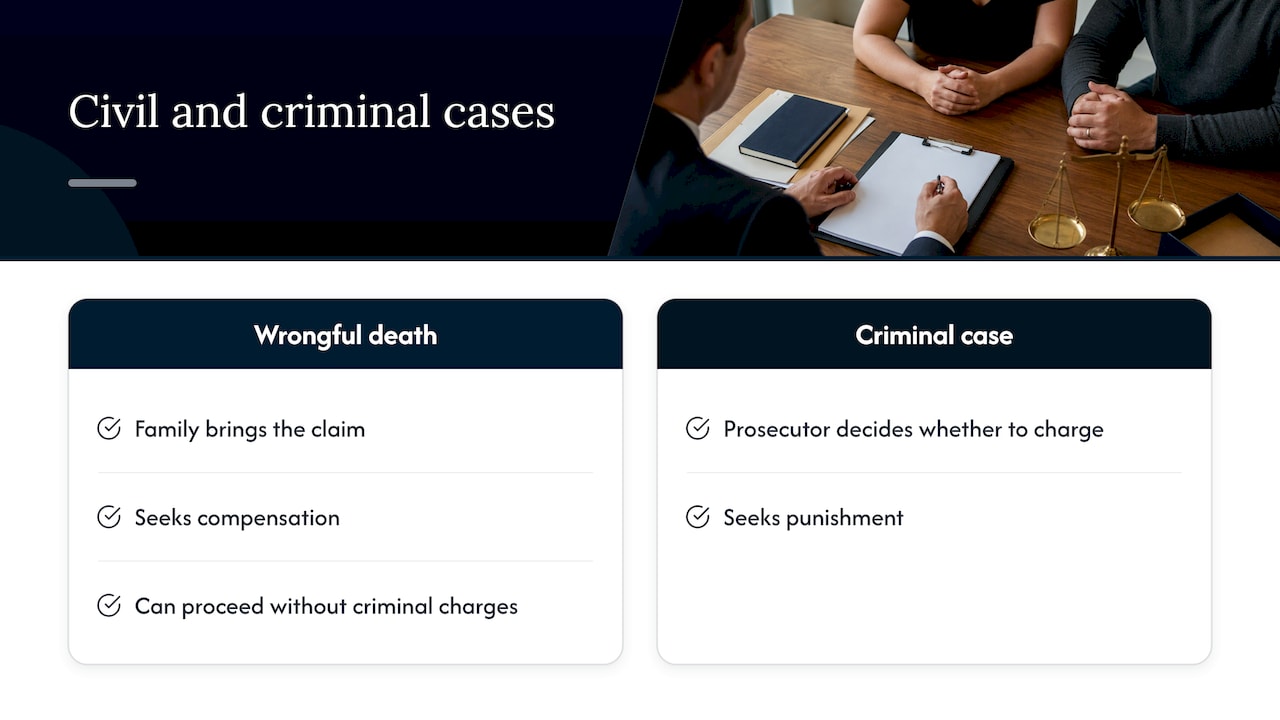
A wrongful death claim is a civil lawsuit, not a criminal case. A prosecutor decides whether to charge someone with a crime. A wrongful death claim is brought by the family, it asks for compensation rather than punishment, and it can go forward whether or not criminal charges were filed.
The law behind it is short. When a person’s death is caused by the wrongful act or neglect of another, the heirs, or the personal representative for the benefit of the heirs, may maintain an action for damages against the person who caused the death, or against an employer responsible for that person’s conduct. That is the text of Utah Code § 78B-3-106. The same section carves out the Workers’ Compensation Act, which we cover below.
“Wrongful act or neglect” covers more than intentional harm. Most Utah wrongful death cases begin with ordinary negligence: a driver who ran a red light, a property owner who ignored a known hazard, a contractor who skipped a safety step, a business that served a visibly intoxicated customer. Negligence means failing to use reasonable care, and it is the same idea that drives injury cases that do not end in death.
Who can file a Utah wrongful death claim
Not everyone who loved the person can file. The claim belongs to the decedent’s “heirs,” and Utah defines that term by statute. It may be brought by the heirs, by the personal representative (the person appointed to manage the estate) for their benefit, or, if the deceased adult had a guardian, by the guardian for the benefit of the heirs. Only one action may be maintained in that guardian situation.
Under Utah Code § 78B-3-105, heirs are:
- The surviving spouse
- The decedent’s children
- The decedent’s natural parents, or adoptive parents if the decedent was adopted
- Stepchildren under 18 at the time of death who received financial support from the decedent or lived with the decedent at least part of the time
- Blood relatives under the rules of intestate succession (the order of inheritance when there is no will), but only if no spouse, child, or parent survives
The stepchild language comes from a 2022 amendment, S.B. 207, which is worth knowing if your family is blended. A stepchild who depended on the decedent may now qualify, and either financial support or part-time residence is enough.
A common question: what is a wife entitled to?
There is no fixed amount a spouse receives. A surviving spouse is an heir and can take part in the claim, but the recovery depends on the facts: what the family lost, who the other heirs are, and how responsibility is proved. Questions about the estate itself, such as who serves as personal representative, are separate from the wrongful death claim, and an attorney can sort out which is which.
The deadline: why waiting is the costliest mistake
Utah gives wrongful death claims a shorter window than many injury claims. The general limit is two years, set in Utah Code § 78B-2-304. Missing it can end the case no matter how strong the evidence is.
There is also a related rule for people who die while holding a claim of their own. Under Utah Code § 78B-2-105, if someone entitled to bring an action dies before the limitation period runs out and the claim survives, the representatives may bring it within the later of the original period or one year after the death. That rule has been in its current form since May 14, 2019.
Two practical points follow:
- Claims against government bodies can carry earlier notice requirements. If a city, county, school, or state employee may be involved, raise it with an attorney right away so no notice deadline is missed.
- Evidence does not wait for the deadline. Surveillance video gets overwritten, vehicles get repaired or sold, and witnesses move. The earlier a claim is investigated, the more there is to work with.
We do not suggest guessing at deadlines for your specific case. The date that matters depends on the date of death, who the defendant is, and how the death happened, and an attorney should confirm it.
What you must prove
Utah wrongful death cases are built on the same four elements as other negligence claims:
- Duty: the defendant owed the decedent a duty of care, such as a driver’s duty to follow traffic law or a property owner’s duty to keep premises reasonably safe.
- Breach: the defendant failed to meet that duty.
- Causation: the breach caused the death. Medical records, accident reconstruction, and expert opinions often matter here.
- Damages: the death produced real losses for the heirs.
Two Utah-specific points are worth knowing. First, fault is shared in Utah, and a defendant will often argue the decedent was partly to blame. How that percentage is measured can decide a case, which is why our page on Utah comparative negligence walks through the 49% versus 50% line.
Second, the evidence rules treat these cases in a particular way. Utah Rule of Evidence 601(b) says that in an action for the declarant’s wrongful death, a statement of the decedent is admissible against the plaintiff notwithstanding the hearsay rule. In plain terms, something your loved one said before death can be offered by the defense. Your attorney needs to know about any statements, messages, or recorded accounts early.
Damages: what a Utah wrongful death claim can recover
The statute is flexible. Section 78B-3-106(4) says damages may be given as, under all the circumstances of the case, may be just. Rather than a fixed schedule, juries apply guidance from the Utah Courts. The Model Utah Jury Instructions include separate wrongful death instructions for the death of an adult (CV2013) and of a minor (CV2014), along with instructions on survival claims (CV2015 and CV2016) and on economic and noneconomic damages generally.
In practice, families and their attorneys look at categories like these:
| Category | What it usually looks at |
|---|---|
| Economic losses | Funeral and burial costs, medical bills before death, lost income and financial support the decedent would have provided |
| Noneconomic losses | Loss of companionship, guidance, and care for the surviving spouse, children, or parents |
| Survival claim | Losses the decedent suffered between injury and death, which belong to the estate |
| Prejudgment interest | Interest on certain past, out-of-pocket losses when statutory conditions are met |
The categories are a way to organize a case, not a promise of any result. Every outcome depends on the facts and the proof.
Prejudgment interest
Utah Code § 78B-5-824 allows a plaintiff in a personal injury or wrongful death case to seek prejudgment interest on special damages actually incurred, in tier 1 cases, if the plaintiff first makes a written settlement demand that does not exceed 1-1/3 of the eventual judgment. The interest is simple, set at two percentage points above the prime rate with a floor of 5% and a ceiling of 10%, and it does not apply to future medical expenses, lost future wages, or lost future earning capacity. The demand’s amount matters, so this is a strategy point to settle with your attorney before any demand goes out.
No double recovery
In Riggs v. Georgia-Pacific LLC (2015), the Utah Supreme Court held that the wrongful death claim is independent and was not barred by the decedent’s earlier injury settlement. That matters for families whose loved one began a claim before dying. The court also warned that heirs cannot recover the same loss twice, for example lost wages the decedent already recovered. Careful accounting of what was paid and when is part of preparing the case.
When the death happened at work
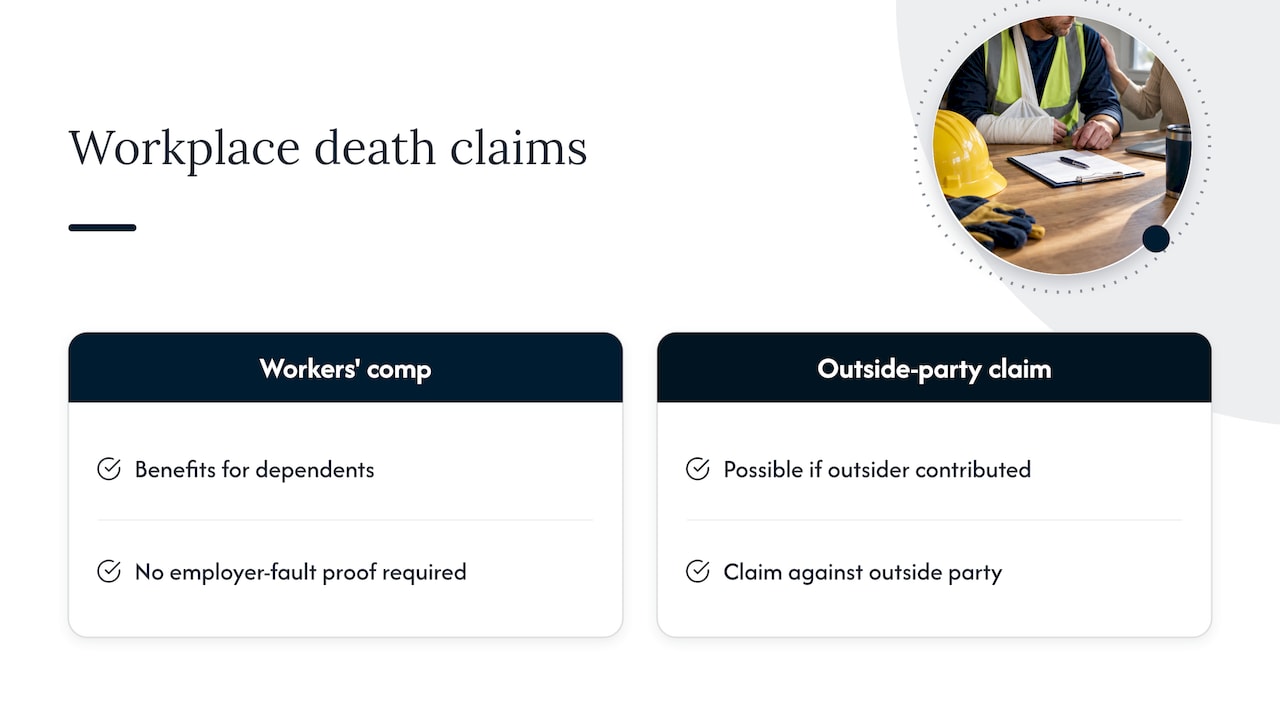
The wrongful death statute begins by excluding matters covered by the Workers’ Compensation Act. If a loved one died from a workplace accident or illness, the first route is generally a workers’ compensation claim, which provides benefits to dependents without proving the employer was at fault.
That does not always end the question. If someone other than the employer contributed to the death, such as the maker of a defective machine, a negligent driver, or a separate contractor on the site, a separate claim against that outside party may be possible. Our page on third-party work injury claims in Utah explains how those claims sit beside workers’ compensation, and our overview of filing workers’ comp claims correctly covers the paperwork side. Reporting steps and deadlines for workplace injuries are covered in our guide to workplace injury reporting in Utah.
Common situations behind these claims
Wrongful death claims are tied to the same kinds of events that drive injury cases in general:
- Vehicle crashes. Including crashes with uninsured drivers, where the family’s own coverage may come into play. Our guide to uninsured motorist claims in Utah explains why that coverage has its own timing rules.
- Dangerous property conditions. Falls and other premises hazards, which we cover in Utah slip and fall law.
- Alcohol-related deaths. Utah’s dram shop law can reach a business that overserved a patron, and the evidence needed is specific. See our Utah dram shop law checklist.
- Workplace incidents. Discussed above.
Medical negligence cases are a different category. Malpractice claims are governed by their own procedures and requirements, so a death after medical care calls for an attorney who confirms those rules from the start.
First steps for a family
Grief makes paperwork hard. These steps keep options open without asking you to do everything at once:
- Get the official records. Request the death certificate and any police, medical examiner, or incident reports.
- Preserve evidence. Keep photos, messages, receipts, and the decedent’s devices and vehicle as they are, if you can.
- Be careful with insurers. Adjusters may call quickly and ask for recorded statements. You are not required to give a recorded statement before you have legal advice.
- Keep a list of losses. Funeral bills, medical bills, pay stubs, tax returns, and records of what the decedent contributed to the household.
- Identify the heirs. Knowing who qualifies under § 78B-3-105 avoids surprises later.
- Talk to an attorney early. The deadline, the possible defendants, and the workers’ compensation question all depend on specifics.
When you look for a personal injury lawyer near you, ask how the attorney handles communication and how fees work. We explain how contingency arrangements work in personal injury cases on our contingency fee page.
Our perspective
A family dealing with a death is asked to make legal decisions in the worst week of their lives. We think the best help starts with clarity: who can file, what the deadline looks like, and what the case will need.
Our firm has served more than 1,300 clients and resolved more than 1,200 cases, and we approach each matter with client-centered advocacy and responsive communication. We build a strategy around the family’s own priorities, not a template.
Utah wrongful death law rewards early work. Heirs must be identified correctly, the workers’ compensation question has to be answered, and responsibility has to be proved with real evidence. We take those steps seriously and keep you informed as the case moves.
Paralegal
How we can help
Our Salt Lake City team represents Utah families in personal injury and workers’ compensation matters, and we bring decades of legal experience and a commitment to integrity and responsiveness to every case. If your family has lost someone and you want to understand your options, start with our Salt Lake City personal injury page or see all of our practice areas.

For a death on the job, our workers’ compensation page explains how we help families through that process.
FAQ
Who is allowed to file a wrongful death lawsuit in Utah?
The decedent’s heirs, or a personal representative acting for the heirs, may file. Heirs include the spouse, children, parents, and certain stepchildren. Other blood relatives qualify only when no spouse, child, or parent survives.
How long do I have to file a wrongful death claim in Utah?
The general deadline is two years under Utah Code § 78B-2-304. Government defendants and special circumstances can change the timeline, so confirm your date with an attorney as soon as you can.
Is there a cap on wrongful death damages in Utah?
The wrongful death statute does not set a fixed dollar schedule. It allows damages that are just under all the circumstances, and juries are guided by Utah’s model instructions. A specific cap may apply in certain case types, such as claims against government entities or medical providers, so ask an attorney about your defendant.
Can I file a wrongful death claim if my loved one died at work?
The statute excludes matters covered by workers’ compensation, so the first route is usually a workers’ compensation claim for dependents. A separate claim against a third party, such as an equipment maker or an outside driver, may still be possible.
Is a wrongful death claim the same as a criminal case?
No. A wrongful death claim is a civil action brought by the family for compensation. A criminal case is brought by the state, and the two can proceed separately.
Sources
- Utah Code § 78B-3-106, Death of a person: suit by heir or personal representative
- Utah Code, Title 78B, Chapter 3, Part 1 (§ 78B-3-105, definition of heirs)
- Utah S.B. 207, Wrongful Death Action Amendments (2022)
- Utah Code § 78B-2-105, effective 2019
- Utah Code § 78B-5-824, prejudgment interest
- Model Utah Jury Instructions, Second Edition
- Utah Rules of Evidence, Rule 601
- Riggs v. Georgia-Pacific LLC, Utah Supreme Court (2015)