

To sign a Form I-864 as a sponsor, your household income generally has to be at least 125% of the federal poverty guidelines for your household size. The number depends on who counts in that household, and a shortfall can be covered with household members’ income, assets or a joint sponsor. Getting this wrong is one of the quieter reasons a green card case stalls. Our immigration attorneys at Loayza Law handle family-based green card cases from our Salt Lake City immigration office, and the I-864 is where we see families most often need to stop and count carefully before they file.
TL;DR
- The sponsor’s household income must generally reach 125% of the HHS poverty guidelines for the household size. Active-duty military sponsors petitioning for a spouse or child need 100%.
- Household size counts the sponsor, dependents, the immigrants being sponsored and certain relatives who live with the sponsor, so it is usually larger than people expect.
- A shortfall can be covered by household members’ income (Form I-864A), the immigrant’s continuing income, qualifying assets, or a joint sponsor who meets the requirement on their own.
- A petitioner with no income still files their own I-864. A joint sponsor adds to that filing and does not replace it.
Table of Contents
- What the I-864 is and who has to meet the income test
- The 2026 income thresholds
- Who counts in your household size
- What counts as income
- Covering a shortfall
- Sponsoring a spouse when you have no income
- Joint sponsor requirements
- Public charge rules and your filing
- Why the details are worth getting right
- Perspective: what we tell families before they sign
- Talk to an immigration attorney in Utah
- FAQ
- Sources
What the I-864 is and who has to meet the income test
The Affidavit of Support is a contract between the sponsor and the U.S. government. The sponsor promises to support the immigrant at a minimum income level, which is how the government confirms the new permanent resident is unlikely to need certain public benefits. It is required in most family-based green card cases, and in some employment-based cases where a relative owns the sponsoring business.
USCIS states the test plainly: household income must be equal to or higher than 125% of the U.S. poverty level for the sponsor’s household size, with a 100% threshold for sponsors on active duty in the Armed Forces who are petitioning for a spouse or child. The USCIS Policy Manual says the same thing from the officer’s side: the sponsor must show the ability to maintain the immigrant at that income level, and officers check that every person claimed on the sponsor’s latest tax return was counted in the household size.
That last point matters. Leaving a dependent off the household count to land on a lower threshold is an error officers are told to look for, and it can trigger a request for evidence or a denial.
The 2026 income thresholds
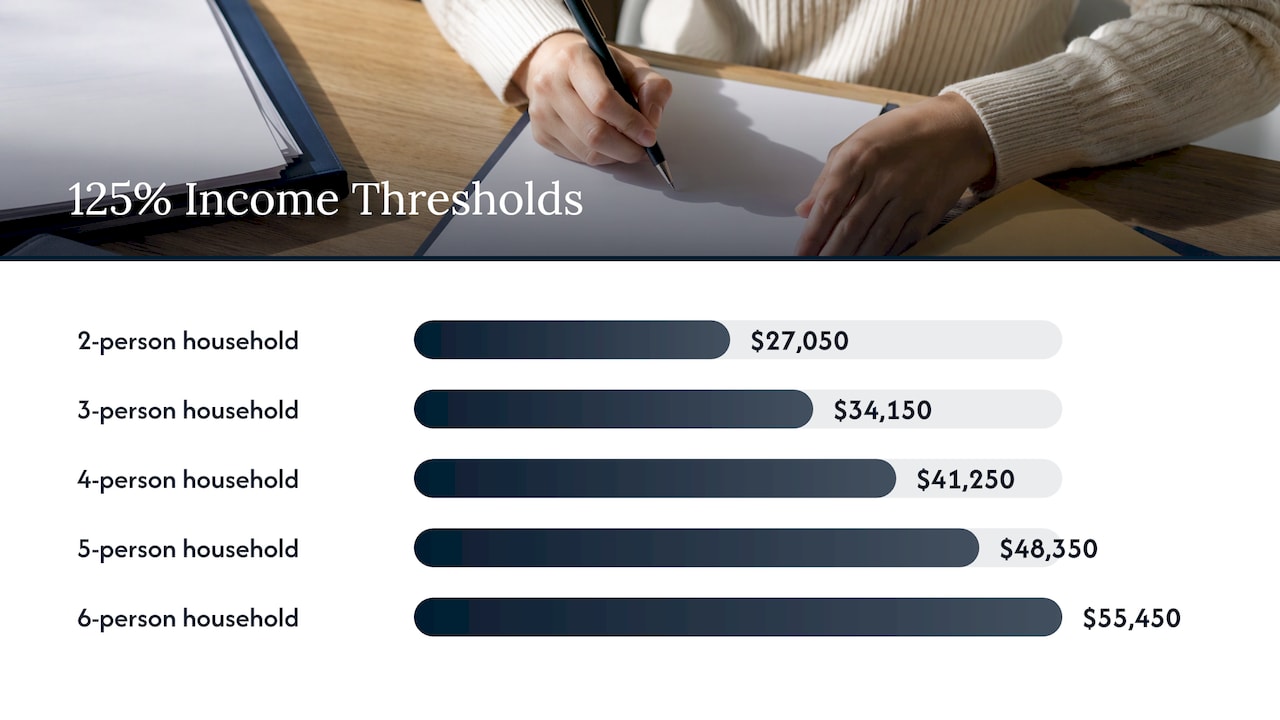
The 125% figures come from the poverty guidelines the Department of Health and Human Services publishes each January. They move once a year with inflation, and USCIS republishes them in the Form I-864P table. The Federal Register notice of January 15, 2026 set the 2026 guidelines by raising the Census Bureau thresholds by the 2.63 percent consumer price change between 2024 and 2025. USCIS then applied the 125% multiplier, effective March 1, 2026.
For the 48 contiguous states, D.C., Puerto Rico, the U.S. Virgin Islands, Guam and the Northern Mariana Islands, the I-864P table lists:
| Household size | 125% minimum income | 100% (active-duty military) |
|---|---|---|
| 2 | $27,050 | $21,640 |
| 3 | $34,150 | |
| 4 | $41,250 | |
| 5 | $48,350 | |
| 6 | $55,450 | |
| 7 | $62,550 | |
| 8 | $69,650 |
Each additional person adds $7,100 at the 125% level and $5,680 at the 100% level. Alaska and Hawaii have their own, higher tables on the same USCIS page. The table above is the one published for filings after March 1, 2026. Because the guidelines are reissued each year, check the I-864P page for the table in force on the day you sign, and use the version that matches your filing date.
A worked example: a U.S. citizen husband, his wife who is applying for a green card, and one child of his under 21 form a household of three. The minimum is $34,150 in the table above. If he earned $30,000, he is $4,150 short and has to cover the gap another way.
The form itself was also updated. USCIS published a new edition of Form I-864 (edition date 08/24/26), accepted alongside the previous edition for a 30-day grace period. Beginning October 1, 2026, only the 08/24/26 edition is processed. An outdated edition is a simple, avoidable reason for a rejected filing.
Who counts in your household size
This is where most sponsors miscount. According to the Form I-864 instructions, the household includes:
- the sponsor;
- the sponsor’s spouse and dependent children under 21;
- everyone the sponsor claimed as a dependent on the most recent federal tax return;
- every person being sponsored in this case;
- any immigrant the sponsor previously sponsored who is still owed support.
Other relatives, such as adult children, parents or siblings, can be added only if they share the sponsor’s principal residence and sign Form I-864A. Adding someone raises the threshold, so it only makes sense when that person’s income or assets more than offset the added cost.
What counts as income
The State Department’s guidance in 9 FAM 601.14 defines income as the total unadjusted income shown on the tax return, before deductions. That includes salary and monetary gains from rent, interest, dividends and other sources. For a self-employed sponsor, the number to look at is the income on the return, and USCIS’s I-864 checklist asks for the relevant Schedule C, D, E or F from the most recent return.
The key evidence rule is in 8 CFR 213a.2: the sponsor’s household income for the year the immigrant filed the application carries the greatest weight. Earlier returns and financial history are evidence of whether that income will continue. So there is no rule that income must clear the guideline in each of the last three years. Still, the same regulation allows an officer to find an affidavit insufficient where specific facts, such as a recent job change or a sharp drop in income, suggest the income will not hold.
USCIS asks for:
- the sponsor’s most recent federal income tax return with W-2s, every 1099 and any schedules, or a statement explaining why the sponsor was not required to file;
- optionally, three years of tax information, six months of pay stubs and an employer letter, if the sponsor believes they help the case.
If you need a transcript, 9 FAM notes the sponsor can get the return transcript free through IRS Form 4506-T.
Be consistent. If you earned income in a year, report it on the form. Blank sections where you had income are a common cause of delay, and a mismatch between the form and the tax return invites a request for more evidence.
Covering a shortfall
If the sponsor’s own income falls below the line, the immigrant is inadmissible on public charge grounds unless the gap is closed. The I-864 instructions list the ways, which can be combined:
- Household members’ income. Relatives who live with the sponsor, or who are claimed as tax dependents, can add their income by signing Form I-864A. USCIS says those who count are related by birth, marriage or adoption and either are tax dependents or have lived with the sponsor for the last 6 months.
- The immigrant’s own income. Income counts if it continues from the same source after the green card. A spouse’s income counts regardless of where the spouse lives.
- Assets. Savings, stocks, bonds, CDs, real estate and similar holdings can fill the gap if their combined net value (value minus liabilities) exceeds a multiple of the shortfall.
- A joint sponsor. Covered in the next section.
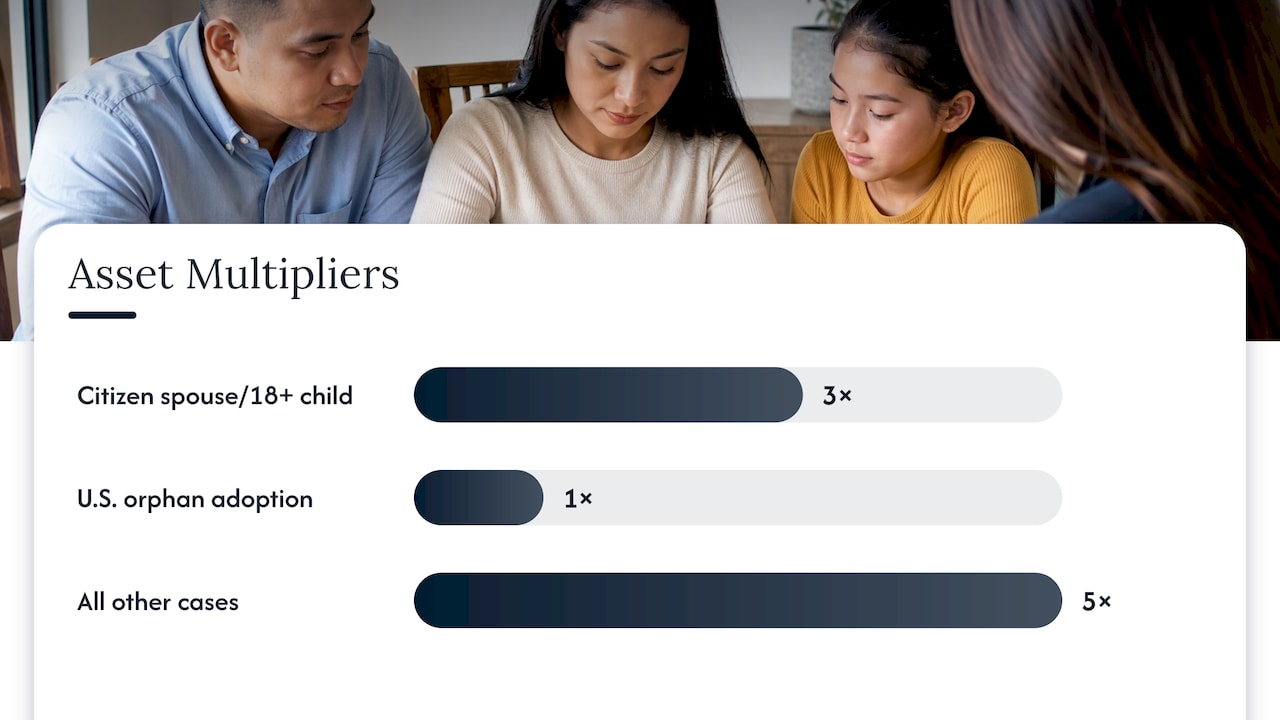
The asset multipliers are set in 8 CFR 213a.2: three times the shortfall when the immigrant is the spouse, or a child 18 or older, of a U.S. citizen; one times the shortfall for an orphan who will be adopted in the U.S.; and five times in all other cases.
Back to the earlier example: the husband is $4,150 short, and his wife is the spouse of a citizen, so the multiplier is three. He would need roughly $12,450 in qualifying net assets. If the same case were a different family category, the multiplier of five would mean $20,750.
Assets have practical limits. Under 9 FAM 601.14, they must be located in the United States and be readily convertible to cash within one year, with documents showing location, ownership, value and any liens. The State Department’s I-864 FAQs add that the value of your home can count, while a car generally does not unless you own more than one and the primary one is excluded.
Sponsoring a spouse when you have no income
Yes, you can petition for your spouse with no income, but you still file your own Form I-864. 9 FAM 601.14 is explicit that even when a joint sponsor is used, the petitioner submits their own affidavit, whether they had no income or were not required to file a tax return. If you had no tax filing, you include a statement explaining why.
From there, the questions are whether your spouse’s expected continuing income, any household member’s income or your assets close the gap, and if not, who can be a joint sponsor. Spouses of U.S. citizens benefit from the lower three-times asset multiplier, which can make assets a realistic route.
Joint sponsor requirements
A joint sponsor steps in when the main affidavit is not enough. Per USCIS, a joint sponsor must meet the same requirements as the petitioner, except that they do not need to be related to the immigrant. In practice that means:
- Status. The joint sponsor meets the general sponsor requirements, which include being a U.S. citizen or permanent resident with a U.S. domicile, and being at least 18. Read the form instructions for the full list before choosing someone.
- Income on their own. The joint sponsor, alone or with their own household, must reach 125% of the poverty guideline for their household size. That size includes the immigrants being sponsored. A friend with a household of five needs $48,350 at the 125% level plus the added persons being sponsored.
- No pooling. The petitioner’s income cannot be added to the joint sponsor’s. 9 FAM adds that combining the primary sponsor’s, the immigrant’s and the joint sponsor’s incomes is not sufficient. The joint sponsor has to clear the bar independently, by income, assets or both.
- Their own form. The joint sponsor files a separate Form I-864 with their own tax documents, and a separate I-864A if they use a household member’s income.
What a joint sponsor takes on
The joint sponsor is jointly or severally liable with the petitioner for reimbursement obligations. In plain terms, a government agency can seek repayment from either of them if the immigrant receives certain means-tested public benefits. This is a legal commitment, and anyone you ask should read the form and understand it before signing. We explain it to joint sponsors as part of the case, so they decide with full information.
Documents a joint sponsor prepares
- A completed, signed Form I-864 using the current edition
- The most recent federal tax return with W-2s and 1099s, or a statement on why no return was required
- Proof of status (citizenship or permanent residence) and domicile
- Form I-864A and supporting records for any household member whose income is used
- Asset records showing location, ownership, date of acquisition, value and liens, when assets are used
Public charge rules and your filing
The I-864 sits inside the broader public charge review. Rules in this area have been changing, and the Affidavit of Support requirements stay a core part of every family-based case. We keep an overview of the public charge rule on our site, and it is worth reading alongside your I-864 planning.
The affidavit is also one of several steps in the process. If you are working out the full filing sequence, our guide to adjustment of status in Utah walks through where it fits. If a green card application is ever denied, see what to do after an I-485 denial.
Why the details are worth getting right
The affidavit is typically filed alongside the application, and mistakes surface when an officer reviews it, often weeks or months later. A wrong household count, a missing 1099, an old form edition or a joint sponsor who cannot meet the number alone each mean a request for evidence or a denial, and a restart of the clock on a case the family has already waited a long time for.
The fixes are all knowable in advance: count the household against the instructions, run the numbers against the I-864P table for your filing date, decide whether income, assets or a joint sponsor is the right way to close any gap, and make sure each signer’s tax records match what the form says.
Perspective: what we tell families before they sign
Most I-864 problems we see are decisions made before the form is filled in. A family picks the household size that looks easiest, or asks a relative to be the joint sponsor without checking whether that person clears the number alone. Then the paperwork is built around the choice.
We start with the arithmetic. We count the household the way the instructions require, compare it with the published table, and then look at every route to close a gap: household members’ income, the immigrant’s continuing income, assets with the right multiplier, or a joint sponsor. Each route has its own documents and its own obligations, and the family should choose it knowingly.
Our immigration practice works with a multicultural perspective, and we know that many sponsors are signing a legal obligation for the first time. We take the time to explain what the obligation means, including for a joint sponsor who is a friend or relative doing the family a favor. Our team has served more than 1,300 clients, and we bring that experience to each affidavit so the filing is complete and consistent with the tax records behind it.
Paralegal
Talk to an immigration attorney in Utah
If you are planning a family-based green card filing and you are not sure your household income, assets or joint sponsor will hold up, our team can review the numbers with you before anything is submitted. Immigration is one of the core practice areas at Loayza Law, and we can walk you through the full case, not just the affidavit.

See our immigration law page for Salt Lake City or our full list of practice areas to get started.
FAQ
Do I need to show three years of income above the poverty line?
No. The regulation gives the greatest weight to your household income for the year the immigrant filed the application. Earlier years are used as evidence of whether that income will continue. Sponsors may still submit three years of tax information if it helps their case.
Can I sponsor my spouse if I have no income?
Yes, but you still file your own Form I-864 with a statement explaining why you did not file taxes, if that applies. Your spouse’s continuing income, household members’ income, qualifying assets or a joint sponsor can then cover the gap. A joint sponsor adds a second affidavit and does not replace yours.
Who can be a joint sponsor?
A joint sponsor does not have to be related to the immigrant, but they must meet the sponsor requirements, including a U.S. domicile, and reach 125% of the poverty guideline for their own household size. Their income cannot be combined with the petitioner’s to get there.
What is the minimum income to sponsor one immigrant spouse?
For a sponsor with no other dependents, the household is two people, and the 125% threshold published by USCIS effective March 1, 2026, is $27,050 for the 48 contiguous states. Each dependent or additional sponsored person adds $7,100. Alaska and Hawaii have separate tables, and the guidelines are reissued every year.
Sources
- Affidavit of Support, USCIS
- HHS Poverty Guidelines for Affidavit of Support (I-864P), USCIS
- Affidavit of Support Under Section 213A of the INA (Form I-864), USCIS
- Form I-864 Instructions, USCIS
- USCIS Policy Manual, Volume 8, Part G, Chapter 6
- 8 CFR 213a.2, eCFR
- 9 FAM 601.14 Affidavit of Support, U.S. Department of State
- I-864 Affidavit of Support FAQs, U.S. Department of State
- Federal Register, Vol. 91, Issue 10, January 15, 2026