

In Utah, supervised visitation is called supervised parent-time. A judge orders it only when a child needs protection from harm and no lesser restriction would do the job. If you are a parent facing a request for supervision, or a parent asking for it, the outcome depends on the evidence you bring and on how the order is written: who supervises, what goals the parent must meet, and when the court will look at the order again. Our family law team at Loayza Law helps Utah parents build or answer that case, and this guide explains the rules first.
TL;DR
- Utah law defines supervised parent-time as time with the child during which the noncustodial parent must be accompanied by a person the court approves.
- A court may order it only if it finds evidence of likely harm to the child, that supervision is necessary, and that no less restrictive means is reasonably available.
- The court prefers trained professionals in abuse and safety cases, but relatives or other willing, capable people can supervise in other situations.
- Orders are meant to be reviewed: the court sets follow-up hearings, and the parent can ask to modify the order once the court’s goals are met.
- Utah amended the governing statute in 2026, so older online guides may describe outdated wording.
Table of Contents
- What supervised parent-time means in Utah
- When a Utah court may order it
- Who can supervise
- What happens at the visit
- How supervision is reviewed, changed, and ended
- If you are the parent asking for supervision
- If supervision is being requested against you
- The parts of the case that surround supervision
- Perspective
- Getting help with a supervised parent-time case
- FAQ
- Sources
What supervised parent-time means in Utah
Parent-time is the time the noncustodial parent spends with a child, and the Utah Courts self-help page on custody and parent-time explains that a court can order any schedule that fits the children’s best interests. Most parents get a standard schedule, which we cover in our guide to the Utah parent-time schedule.
Supervised parent-time is a restricted version of that. Utah Code § 81-9-101 defines it as parent-time that requires the noncustodial parent to be accompanied by an individual the court has approved. The parent keeps the relationship with the child. The difference is that another adult is present during the visit.
Supervision is not a finding that a parent is unfit, and it is not necessarily permanent. It is a protective condition a judge attaches to parent-time when the facts call for it, and the same judge can loosen it later.
When a Utah court may order it
The key provision is Utah Code § 81-9-207, as amended effective May 6, 2026. A court may order supervised parent-time only if it finds all three of these:
- There is evidence that the child is likely to be subject to physical harm, emotional harm, or abuse from the noncustodial parent if left unsupervised.
- Supervision is necessary to protect the child.
- No less restrictive means is reasonably available.
The third point matters most in practice. Before ordering supervision, a judge is expected to ask whether something lighter would protect the child, such as a third-party exchange of the child, conditions on the parent-time, or a graduated schedule. A request that skips this analysis is vulnerable, and so is an objection that ignores it.
What counts as abuse
The statute defines abuse by reference to specific offenses. They include child abuse, aggravated child abuse, child abandonment, child torture, domestic violence in the presence of a child, and child abuse homicide. Emotional harm is a separate ground, so supervision does not require a criminal conviction, but it does require evidence.
Other safety factors the court weighs
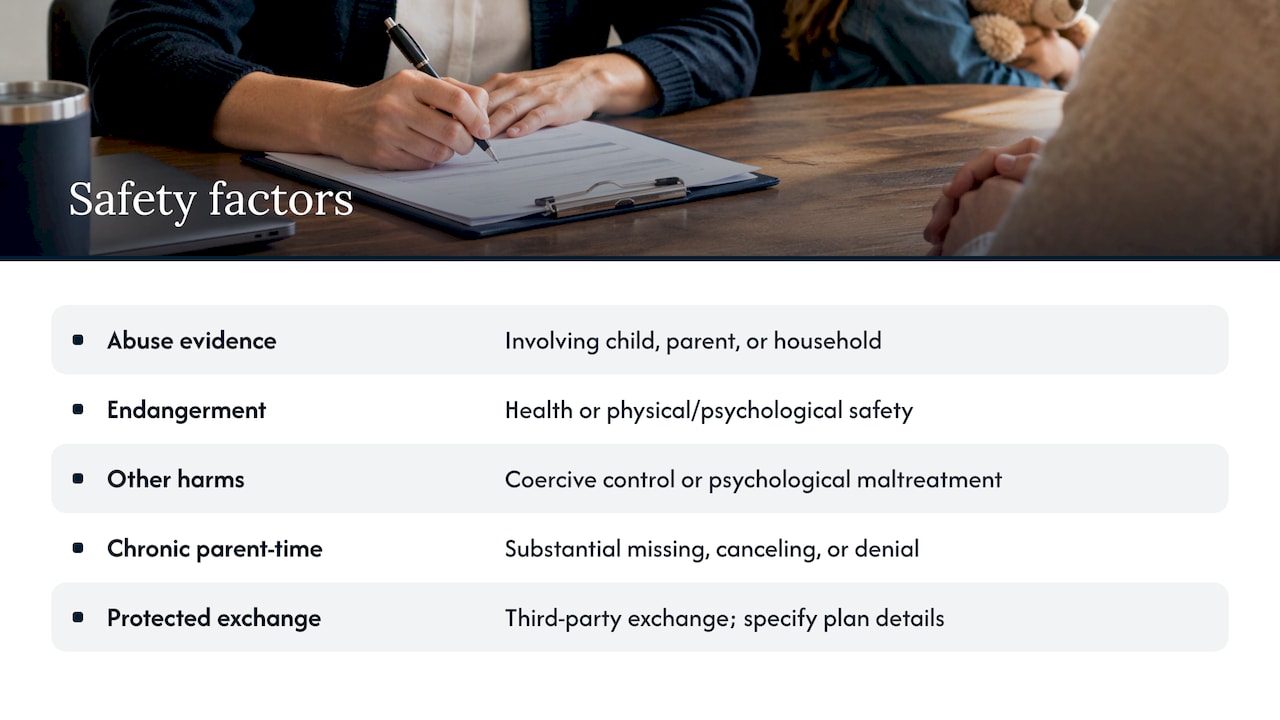
When a judge sets any parent-time schedule, § 81-9-206 requires consideration of evidence of domestic violence, physical abuse, or sexual abuse involving the child, a parent, or a household member, and of whether parent-time is likely to endanger the child’s health or physical or psychological safety. The court may also consider coercive control, psychological maltreatment, and a substantial and chronic pattern of missing, canceling, or denying regularly scheduled parent-time.
If a protective order or stalking injunction is still in place, the court must consider whether the child’s pick-up and transfer should go through a third party. The parenting plan then has to specify the time, day, place, manner, and third party for the exchange. Where there is a protective order, stalking injunction, or finding of domestic violence, the court must consider the impact of that violence and make specific findings about the award.
The older rule and the 2026 amendment
Before the 2022 to 2025 recodification, supervised parent-time lived in the divorce code at § 30-3-34.5. That version also required necessity and the absence of a less restrictive option, and it gave preference to people the parties suggested, including relatives. Utah moved the rules into Title 81. In 2026 the Legislature passed S.B. 257, Domestic Relations Amendments, which among other things clarifies the offenses tied to supervised parent-time and addresses parent-time schedules. The Legislature’s passed-bills list shows it effective May 6, 2026, and the Governor’s office confirms he signed it on March 18, 2026.
If you are reading an older article that cites the 2018 or 2023 statute, check it against the current text before relying on it.
Who can supervise
The supervisor is not chosen casually. Under § 81-9-207, the court looks at the reason for supervision:
| Situation | Who the court prefers |
|---|---|
| Domestic violence, child abuse, or ongoing risk is found | A professional individual or private agency trained in child abuse reporting laws, child developmental needs, and the dynamics of domestic violence, child abuse, sexual abuse, and substance abuse |
| A professional is not available, affordable, or practicable | A trained individual capable of providing physical and psychological safety |
| Other cases | Any willing, capable individual, with preference to people suggested by the parties, including relatives |
Three practical points follow from this.
Proposing a relative is allowed, but the court must be satisfied. A grandparent or aunt can supervise in many cases, provided the judge finds the person willing and capable of protecting the child from physical or emotional harm. If the case involves abuse or domestic violence, expect the court to look first at a trained professional.
Cost is part of the analysis. The statute’s preference for professionals applies when one is available, affordable, and practicable. At the time supervision is imposed, the court is also directed to consider whether professional or agency costs would prevent the parent from exercising parent-time at all, and whether the requirement should expire after a set period. Raise the budget at the hearing, not afterward.
The supervisor must be someone the child can be safe with. A relative who sides with the parent against the other household, or who will not enforce the rules, can undermine the whole order and give the other side grounds to ask for more restrictions.
What happens at the visit
The order itself controls the details, so read yours closely. A typical order, or the agency or supervisor’s own rules, will address the schedule, the location, who attends, and whether the visit can be ended. Because those terms vary from case to case, ask your attorney to make sure the order states them clearly rather than leaving them to later argument.
Terms worth settling in the order before it is signed:
- Frequency and length. How many hours each week, and on which days.
- Location. A professional site, the supervisor’s home, or a public place.
- Exchanges. Who brings the child, and whether the parents have any contact. With a protective order in place, the statute points toward a third-party exchange.
- Cancellations. What happens when a visit is missed, since a chronic pattern of missing or canceling parent-time is something the court may consider under § 81-9-206.
- Communication. What the supervisor may report to the court and to the parties.
For the child, predictability helps. Keep the schedule, arrive on time, and keep conversations about the case away from the visit. A parent who treats the visits as the main opportunity to show the court a safe, steady relationship is in the strongest position at review.
How supervision is reviewed, changed, and ended
Utah does not treat supervision as a permanent label by default. Under § 81-9-207, the court must schedule one or more follow-up hearings to revisit supervised parent-time. The noncustodial parent may petition at any time to modify the order upon showing that the goals and expectations the court set have been accomplished. The earlier 2025 version also required specific goals and follow-up hearings, except where indefinite supervision was found necessary because of abuse or incapacity.
That structure tells a parent what to do:
- Get the goals in writing. If the order says only “supervised,” there is nothing to show you have completed. Goals might include completing a program, stable housing, or a period of consistent visits. They must come from the court order, not from your own list.
- Document progress. Keep a record of attended visits, completed requirements, and anything the supervisor or agency has reported.
- File a petition when the goals are met. The statute lets you ask at any time once you can demonstrate they are accomplished.
- Prepare for the hearing as you would for the original one. The judge still has to weigh safety, and the other parent can present evidence.
The wider modification rules differ depending on whether you are changing custody or parent-time, and the standard is stricter for custody. Our child custody modification checklist walks through the paperwork, and the guide to modifying Utah orders explains when a stipulation can avoid a hearing.
If you are the parent asking for supervision
The statute puts the burden on the evidence, so a request built on fear alone is weak. A strong request usually has:
- Specific incidents with dates, and any police reports, protective orders, or child protective records.
- Messages, photos, or witness accounts that show the risk to the child, not just conflict between the adults.
- A reasoned explanation of why lesser measures would not protect the child, because the court must find that no less restrictive means is reasonably available.
- A proposed supervisor who meets the statute’s preferences, along with the cost and availability.
If there is a protective order or stalking injunction, say so early. The court must consider third-party exchanges and make specific findings when domestic violence is involved.
If supervision is being requested against you
A request for supervision is serious, but it is not the end of your relationship with your child. The same three findings are required, so your response should address each one. Show where the evidence is thin, where the allegations do not meet the statute’s definitions, and what lesser arrangement would keep the child safe. The court’s preference for the least restrictive option works in your favor when you offer a workable alternative.
If the order is made anyway, do not treat it as a punishment to endure. Ask the court to set clear goals and a review hearing, propose a supervisor you can afford, and then use the visits to build the record. Fathers in particular often face these cases without knowing their options, and our overview of father’s rights in Utah covers custody, parent-time, and paternity. If you are not yet the legal father, start with the Utah paternity process.
The parts of the case that surround supervision
Supervised parent-time rarely stands alone. It sits inside a custody or divorce case, which means a parenting plan, child support, and often a decision about the family home. Money pressure makes supervision harder, since professional supervision has a cost. If the house is part of the dispute, a resource on selling a house during a divorce explains the sale options that families weigh. Child support is calculated separately from parent-time, and you can estimate it with our Utah child support guide.
When the other parent lives in another state, jurisdiction becomes its own question. Our page on interstate custody in Utah explains which court decides.
Perspective
Parents often come to us afraid of one word: supervised. Some fear it will define them in front of their child. Others fear that without it, their child is exposed to real danger. Both fears are reasonable, and both are answered the same way, with a clear record and a precise order.
The statute is specific about what a judge must find, and that gives a parent something to work with. We build our family law cases around the facts the court has to weigh, and we explain each step in plain terms so you know what is coming before the hearing. Our firm has served more than 1,300 clients, and in family cases we keep our attention on the details that decide the order: the goals, the supervisor, the exchanges, and the date the court will look at it again.
An order that is vague is hard to follow and hard to modify. An order with clear goals and a review hearing gives a parent a path forward and gives a child stability. That is the order we work toward, whichever side of the request you are on.
Paralegal
Getting help with a supervised parent-time case
Our family law practice handles custody, parent-time, support, and modifications for Utah families, and we can help you present or answer a request for supervision, set the goals in the order, and prepare for the review hearing. Start with our family law page for Salt Lake City, or read how an attorney’s role works in custody cases.

If your situation also involves criminal charges, an immigration issue, or a work injury, our practice areas cover those too, so one firm can coordinate the pieces that touch your family case.
FAQ
Can a Utah judge order supervised visitation without proof of abuse?
The statute requires evidence that the child is likely to suffer physical harm, emotional harm, or abuse if left unsupervised. A criminal conviction is not the only kind of evidence. The court must also find that supervision is necessary and that no less restrictive means is reasonably available.
Can a family member supervise parent-time?
Often, yes. Outside cases involving domestic violence, child abuse, or ongoing risk, the court can approve any willing, capable individual, with preference to people the parties suggest, including relatives. In abuse cases the court first looks to a trained professional or agency, then to a trained individual.
How long does supervised parent-time last?
There is no fixed period in the statute. The court must schedule follow-up hearings, and the noncustodial parent may petition at any time to modify the order after showing the court’s goals have been accomplished. Where abuse or incapacity makes indefinite supervision necessary, the court can find so.
Does a protective order change how exchanges work?
It can. If a protective order or stalking injunction is in place, the court must consider whether pick-up and transfer of the child should happen through a third party. The parenting plan must then name the time, day, place, manner, and third party for the exchange.
Sources
- Utah Courts: Child Custody and Parent-Time
- Utah Code, Title 81, Chapter 9 (definitions, effective September 1, 2024)
- Utah Code § 81-9-207 (effective May 6, 2026)
- Utah Code § 81-9-206 (effective May 6, 2026)
- Utah Code § 30-3-34.5 (2023)
- Enrolled Copy S.B. 257, 2026 General Session
- Utah Legislature: Bills Passed
- Governor Spencer J. Cox: Bills