
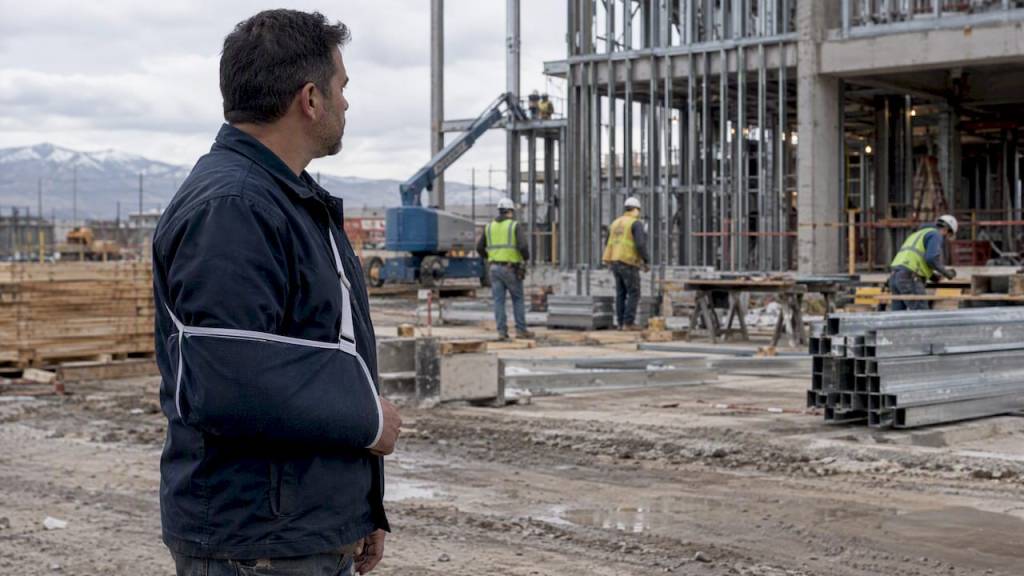
If someone other than your employer or a coworker caused your injury on the job, Utah law lets you collect workers’ compensation and also bring a separate civil claim against that outside party. Utah Code §34A-2-106 preserves both paths. The workers’ comp claim pays medical care and wage benefits regardless of fault. The third-party claim seeks damages from the at-fault party, and it brings its own rules about notice, liens and settlement.
This guide explains who counts as a third party, what to do in the first weeks, how the carrier’s reimbursement claim can shrink your recovery, and the mistakes that cost injured workers the most.
TL;DR
- A third party is anyone other than your employer, its officers, agents or employees whose wrongful act or neglect caused your injury, such as a negligent driver, a property owner, another contractor or a product manufacturer.
- Filing a workers’ comp claim does not block a third-party claim. The two run side by side.
- Report the injury to your employer right away. Missing the 180-day window can cost you workers’ comp benefits.
- The workers’ comp carrier can claim reimbursement and a credit against future benefits from your third-party recovery, so the net number matters more than the headline number.
- Do not sign a release or settlement until a lawyer has reviewed both claims together.
Table of Contents
- What a third-party work injury claim is
- Who can be a third party in Utah
- How the two claims work together
- The first weeks: what protects both claims
- Notice and the carrier’s interest in your case
- Liens, reimbursement and your real net recovery
- Settling the workers’ comp side
- Fault, and why a small percentage matters
- Our perspective
- When to talk to a lawyer
- FAQ
- Sources
What a third-party work injury claim is
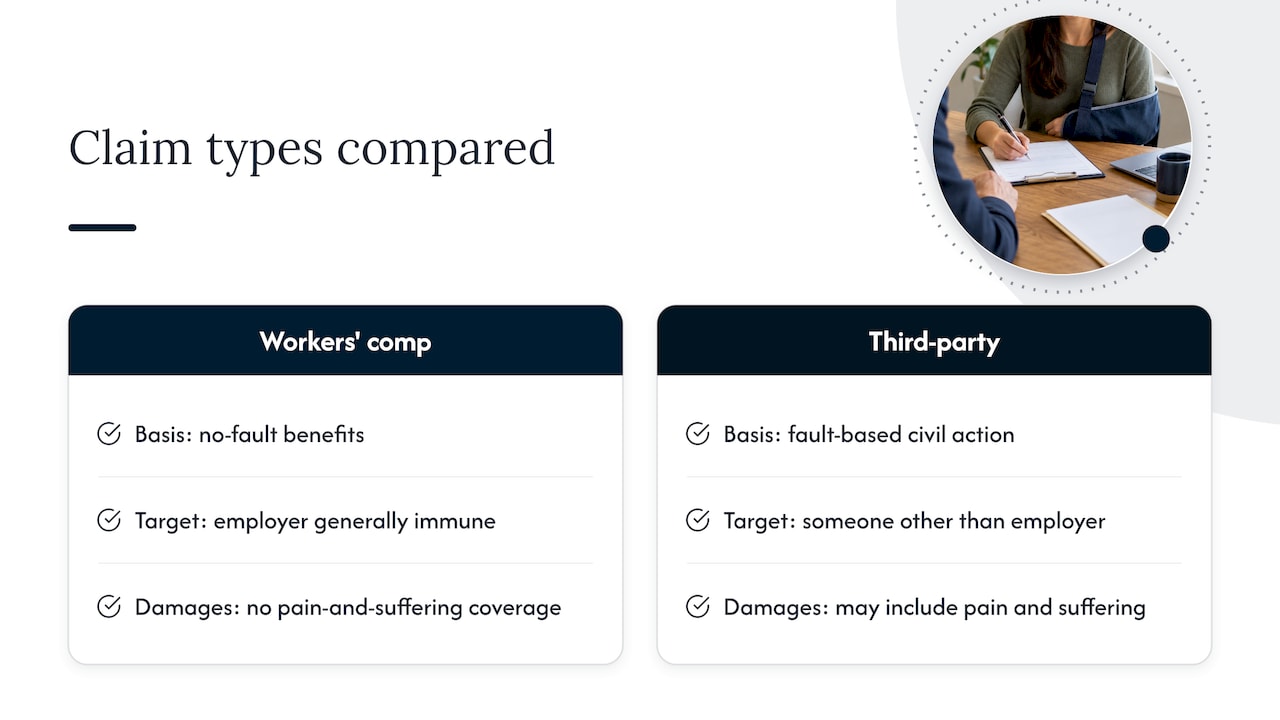
Workers’ compensation is a no-fault insurance system. You get benefits for a compensable injury without proving anyone did anything wrong, and in exchange you generally cannot sue your employer. A third-party claim is different. It is an ordinary fault-based civil action against someone who is not your employer, and you must show that their wrongful act or neglect contributed to your injury.
That difference has practical consequences. A third-party case can recover categories of damages that workers’ comp does not cover, such as pain and suffering. Utah’s statute allows the action when a person other than the employer, its officers, agents or employees caused the compensable injury. It also names several kinds of outside actors who can qualify, including subcontractors, general contractors, independent contractors, property owners, and lessees or assignees who do not stand in an employer-employee relationship with you.
The statute does not make every person around a job site a target. A coworker generally cannot be a third party, and the employer keeps its workers’ compensation immunity. Whether someone is a true third party depends on the legal relationship, which is why the facts need review case by case.
Who can be a third party in Utah
The most common situations we see in work injury cases include:
- Negligent drivers and trucking companies. A delivery driver, a crew member driving between sites or a worker struck while on the road can have both a workers’ comp claim and a claim against the other driver. Our guides on Utah PIP benefits and uninsured motorist claims cover the auto insurance side.
- Other contractors on a shared site. Construction and industrial sites often have several companies working at once. If a subcontractor’s unsafe work hurt a worker employed by a different company, that subcontractor may be a third party.
- Property owners. If you were hurt while working at a location the owner controlled, for example a slip on an unmaintained walkway during a delivery, a premises claim may exist. See our steps for preserving a slip and fall claim in Utah.
- Product manufacturers. A defective machine, tool, ladder or safety device can lead to a claim against the company that made or sold it.
- Willful acts of an outsider. Utah’s definition of a work injury includes an injury caused by a third person’s willful act directed at an employee because of the employment, which can also open a separate claim against that person.
If you are unsure whether the person who hurt you counts, do not assume the answer is no. Staffing arrangements, leased employees and multi-company job sites make the employer relationship harder to read than it looks.
How the two claims work together
Think of two tracks that affect each other.
| Workers’ compensation | Third-party claim | |
|---|---|---|
| Against whom | Your employer’s insurance carrier | A non-employer who caused the injury |
| Fault required | No | Yes, wrongful act or neglect |
| What it pays | Medical care, wage replacement, disability benefits | Damages under civil law, which can include pain and suffering |
| Where it is decided | Utah Labor Commission process | Civil court or settlement |
| Reimbursement | None | Carrier may claim repayment and a future credit |
A third-party lawsuit does not make the workers’ comp claim unnecessary. You still need to report the injury, treat with an appropriate provider and meet the Labor Commission’s deadlines. Our overview of filing a Utah workers’ comp claim correctly walks through the forms and records.
The first weeks: what protects both claims
Early records tend to shape both cases. The Labor Commission’s timeline creates several documents: the employer’s report, the physician’s report and the carrier’s decision on compensability. If they describe how, when and where the accident happened in different ways, the inconsistency can surface later in the benefits claim and in the civil case.
Report and document
The Utah Labor Commission tells workers to report the injury to the employer immediately and to make sure the report is documented. Failure to report within 180 days may disqualify you from benefits. Waiting is a risk even if you think the injury is minor, because many back, shoulder and head injuries get worse. Our page on 180-day reporting and workplace injury forms covers the details.
After you report, the Commission’s guidance says the employer generally has 7 days to report to its carrier, the carrier has 14 days to file the First Report of Injury with the Industrial Accidents Division, and the carrier generally must decide compensability within 21 days, with an additional 24-day investigation extension available through Form 441.

Tell your doctor the full story
Tell the treating physician exactly how, when and where the injury happened. The physician’s initial report is generally due within 7 days of the first visit, and it becomes part of your record. Keep the account consistent every time you tell it.
Preserve evidence of the outside party
The Labor Commission lists the kinds of records worth keeping, and they fit a third-party case well:
- Incident reports and written statements.
- Photographs of the scene, the equipment and your injuries.
- Names and contact details of witnesses.
- Medical records and wage information.
- Texts, emails and safety communications.
- Vehicle or equipment information, including model numbers and who owned or maintained it.
- Every letter from an insurer.
If a machine or vehicle is involved, tell a lawyer quickly so the item can be preserved before it is repaired, sold or discarded.
Document your restrictions
Work restrictions affect wage benefits, light-duty offers and the value of the civil claim. We explain how to record them in Utah light duty work: document restrictions from day one.
Notice and the carrier’s interest in your case
This is the part many workers do not expect. When the employer or carrier is paying compensation, Utah law makes it a trustee of the third-party cause of action. The statute requires written notice to the compensation carrier and other obligated payers before you proceed against the third party. It also requires notice of known attempts to attribute fault to the employer or its protected personnel. And the carrier or employer cannot settle and release the claim without Labor Commission consent.
The reason is coordination. Your civil case can affect what the carrier gets back and what it owes later, even though the employer keeps its immunity from suit.
The practical rule: do not sign a third-party settlement or release before the carrier’s statutory interest has been analyzed. A release signed too early can create disputes with the carrier or jeopardize future benefits.
Liens, reimbursement and your real net recovery
A third-party settlement is not simply your money. Under Utah law, reasonable litigation expenses, including attorney fees, are charged proportionately among the parties with an interest in the recovery. The carrier is reimbursed for qualifying benefits it paid, and the balance is applied to reduce or satisfy future compensation obligations.
The Utah Supreme Court addressed this on February 26, 2026, in HB Construction v. Labor Commission. The injured employee had settled a tort action against third parties for $5 million after a workplace accident that left him severely disabled. The question was how the carrier’s past payments and its anticipated future liability affect who bears the cost of obtaining that recovery. Under the decision, when a carrier claims both reimbursement and an offset for future benefits, its anticipated future benefits count in calculating its proportionate share of legal expenses, and it must bear that share before taking the offset.
What this means for you:
- Do not accept the carrier’s lien figure at face value. Ask what it has paid and also what future obligation it is trying to offset.
- Compare settlement offers on a net basis: gross amount, minus fees and costs, minus the carrier’s share after proportionate expenses, minus other liens.
- Health insurers, hospitals and Medicare may also assert claims. Our page on Utah medical liens explains the filing steps and Medicare recovery.
A worked structure, with placeholder numbers only to show the logic: a gross recovery is reduced by the expenses of getting it, then the carrier’s reimbursement is calculated after it has paid its proportionate share of those expenses. Only then is the remainder applied against future compensation. Each step changes what lands in your pocket, which is why the spreadsheet matters as much as the settlement number.
Settling the workers’ comp side
A workers’ comp settlement is not final just because you and the carrier agree. The Labor Commission must approve it. The Commission distinguishes two types:
- Compromise settlements resolve a genuine dispute over whether benefits are payable.
- Commutation settlements convert established benefits into a lump sum, which generally requires special circumstances and information about future medical costs, injury severity, age, restrictions, work ability, modified duty and post-injury work history.
A quick lump sum can mislead. It has to account for future treatment, permanent restrictions and your ability to work, not just current bills. When a third-party case exists, both settlements should be evaluated together. Our guide to documents needed for approval of a Utah workers’ comp settlement lists what the judge will expect. If the carrier denies your claim, see what to do after a Utah workers’ comp denial.
Fault, and why a small percentage matters
Because the third-party case is a fault-based civil claim, the other side will look for ways to assign some blame to you. Utah applies comparative negligence, and a few percentage points can decide whether a claim survives. We break it down in 49% vs 50% in Utah comparative negligence. Workers’ comp is no-fault, so your own mistakes generally do not defeat that claim, but they can hurt the civil one.
Our perspective
We handle workers’ compensation, personal injury and the places where the two meet. The pattern we see most is a worker who has done everything right on the comp claim and has never been told a second claim exists. The injury happened on a road, on another company’s site or with a defective tool, and nobody at the employer or carrier had a reason to mention it.
Our advice is practical. Report the injury in writing. Keep your medical story consistent. Do not talk recorded statements with the other party’s insurer without advice. And before any money changes hands, ask for the full picture: who has a lien, how fees and costs are shared, and what happens to future benefits. A settlement that looks large can leave a worker with little if the offset and liens were never analyzed.
We work with injured workers and families across Utah, including many who speak limited English, and we explain each step plainly. Fee arrangements depend on the practice area. For injury cases, our page on how contingency fees work in personal injury explains the model, and we go over the terms of your particular case before you sign anything.
— Paralegal
When to talk to a lawyer
Talk to an attorney promptly if any of these apply:
- A driver, contractor, property owner or equipment maker other than your employer may be at fault.
- The carrier has sent a notice about reimbursement, a lien or a credit.
- You have been offered a settlement or asked to sign a release.
- Your injury has permanent restrictions or you cannot return to your old job.
- The carrier has denied or delayed your claim.
If you were hurt at work in Utah, our team can review both the workers’ comp claim and any outside-party claim together. See our workers’ compensation practice in Salt Lake City and our personal injury practice, or browse all practice areas. Our firm has served more than 1,300 clients and resolved more than 1,200 cases, and we would be glad to look at yours.
FAQ
Can I get workers’ comp and sue a third party for the same injury?
Yes. Utah Code §34A-2-106 allows an injured employee to pursue workers’ compensation and also seek damages from a non-employer whose wrongful act or neglect caused the injury. The carrier may then have a reimbursement and offset interest in your third-party recovery.
Can I sue my employer or a coworker?
Generally no. Workers’ compensation is the exclusive remedy against your employer, and the statute’s third-party action is aimed at people other than the employer, its officers, agents or employees. Outside companies and individuals on the job site are a different matter and need to be analyzed.
Do I have to tell the workers’ comp carrier before I file a third-party case?
Yes. Utah’s statute requires notice to the compensation carrier and other obligated payers before you proceed against the third party. It also requires notice of known attempts to attribute fault to the employer or its protected personnel. A lawyer should handle this notice so it is accurate and timely.
Will the carrier take part of my third-party settlement?
Possibly. The carrier can be reimbursed for qualifying benefits it has paid, and the rest of the recovery may be applied against future compensation. Under HB Construction, the carrier must bear a proportionate share of legal expenses that reflects its future credit as well. Reviewing these numbers before you settle can change your net result.
How long do I have to report a work injury in Utah?
The Labor Commission says that failing to report within 180 days may disqualify you from workers’ compensation benefits. Report right away and make sure the report is documented. Deadlines for a civil lawsuit against a third party are separate, so ask an attorney about them early.
Sources
- Utah Code §34A-2-106, third-party liability
- Utah Code Title 34A, Chapter 1, Labor Commission Act
- Utah Labor Commission: injured workers
- Utah Labor Commission: workers’ compensation settlement agreements
- HB Construction v. Labor Commission (Utah 2026), FindLaw